It’s always nice to kick off a week with notification that a paper you have co-authored has been published.
In this case, and due to a magnificent effort by lead author Gavin Schmidt (who heaven knows must have many other things on his plate at NASA GISS right now), the” Datasets and protocols for including anomalous freshwater from melting ice sheets in climate simulations ” is now out in Geoscientific Model Development.
If that sounds a bit clunky, well it is. The idea is that the paper is a technical guidance, to help climate models (specifically for CMIP7), to include the effects of ice sheets into the earth system, without having to actually include a full ice sheet model, which turns out to be quite hard, particularly in Antarctica.
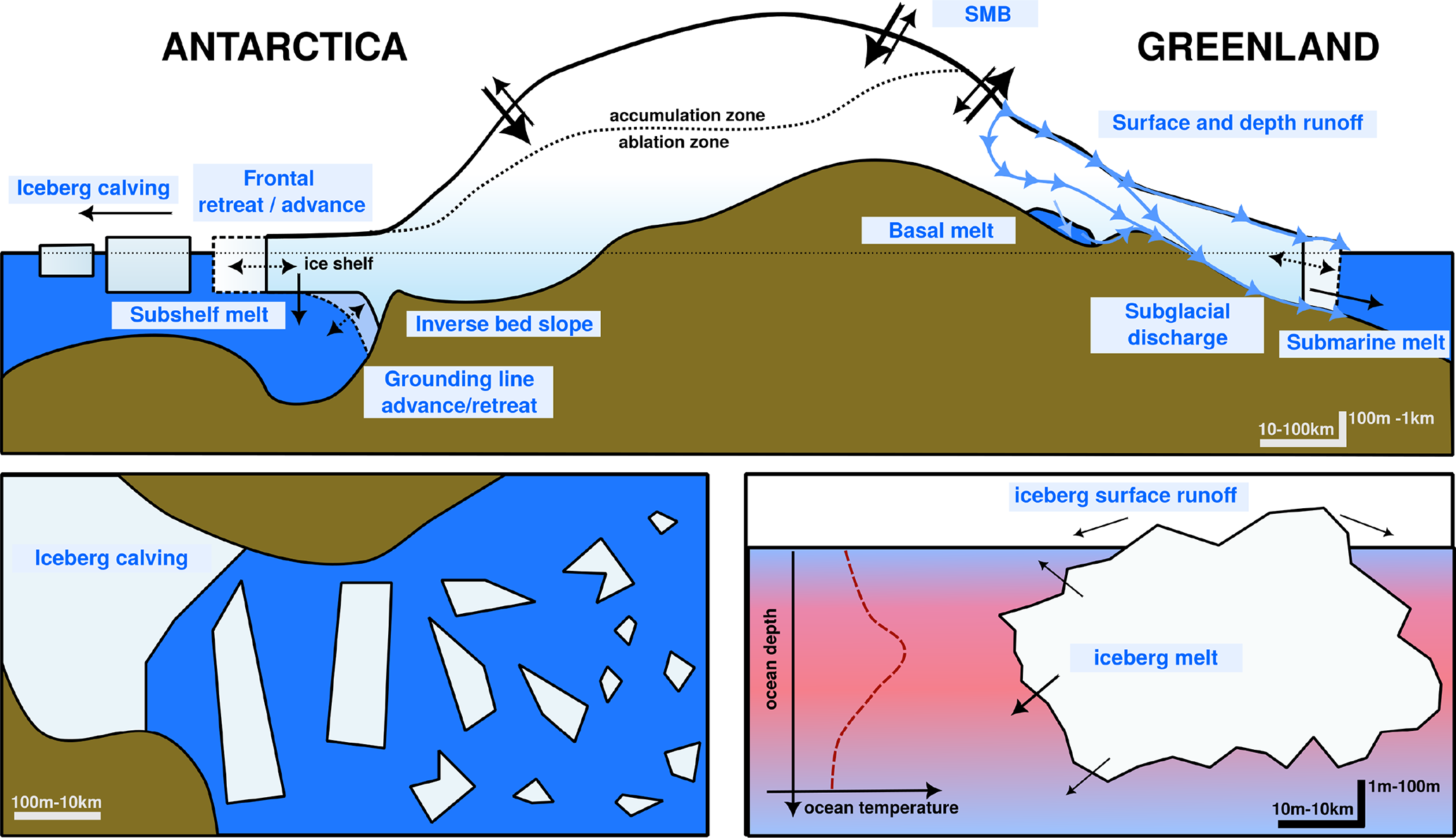
Even so there’s a lot of general interest in the paper, including how this is usually done now (there are a range of different approaches, each with their quirks). And then a particularly nice and clear section is given on all the many different ways that ice sheets lose ice. The figure below from the paper shows some of these and as they all have different downstream effects on ocean circulation, sea ice and of course sea level rise, it’s important to work out how to include them efficiently. The paper as it stands is a really nice introduction to the subject.
Figure 1 from Schmidt et al., 2025 showing a schematic of how ice sheets lose ice.
Icebergs are particularly interesting as a source, as the meltwater from these can take years to be added to the ocean, in which time, they will have drifted hundreds or thousands of kilometres. We have some suggestions on those too.
In any case, we hope this paper, which grew out of a technical online workshop on the subject, partly organised by our Ocean Ice project, will turn out to be a useful source for the groups that actually run the global climate models for CMIP and the IPCC. Many of these models are still in development or being initialised now, so time is already short for those of us involved in the technical parts of the exercise. The publishing process is slow, but this is also why preprints are so valuable. This paper in its submitted form has been up for months, it’s only now the final version is ready, but it hasn’t changed much. While it feels hard enough keeping up with published papers that preprints feel like a distraction, science is moving so fast, it’s probably essential. Maybe I’ll write more about that later. Of course preprints (and indeed published papers) can lead you astray, especially in fields you don’t know much about (as COVID was a helpful reminder), so perhaps sensibly the IPCC insists on acceptance of manuscripts before including them in their reports. Nonetheless, keeping up with preprints is now probably almost as important for scientists as keeping up with the published literature.
On the subject of the IPCC, I was reminded this weekend that it’s now less than 500 days until the submission deadline for the working group 1 part of the next IPCC report (AR7), so it’s time to start thinking about what are the priorities to get into the scientific literature to inform this effort. IPCC can only report published work, and doesn’t do its own, so now is the moment to pull out that unfinished but crucial piece of evidence of something or other relevant and get it submitted.
Not coincidentally, it’s time to talk about Academic Writing Month (AcWriMo). I actually try to write all through the year but November is time for a final push to try and meet my (usually far too ambitious) annual goals.
I had intended to start AcWriMo again this year, I’ve a huge backlog of papers to get done and it seemed a good way to start. However, a big proposal writing effort (more on here if the funding comes through) and a Hackathon (of which more also anon), both extremely rewarding and in fact also involving a lot of writing, somewhat derailed the first 10 days of my effort…
Now however it is time to focus on the remaining almost 3 weeks of November. The plan is one hour per day, except weekends, just focused on papers. I’ve put it in my calendar already. Let’s see if I can stretch more than that. Also non- negotiable is daily exercise. The fresh air and time away from the computer is almost as important as sitting down to do the work.
I’ve got an almost done experimental protocol to write for the PolarRES project (which finishes his month, so there’d be a nice symmetry to getting that done). And then there’s the much delayed reply to reviewers on our ice mélange study in NW Greenland as my main foci, but I also want to help my Hackathon group get their project knocked into shape, so some time will be spent there.
I’ve also got various diverse co-authored papers I need to contribute to, read,edit and give my options on. I hate to become a roadblock for colleagues so that also needs some attention but I’m for sure already out of time.
So if you want to see all stages of the sausage being made, follow along with the hashtag (#AcWriMo25) on socials, but hopefully you won’t see me there much because I #amwriting.
Over on Blue sky I found a link to this piece by Daniel Nettle – a reflection on life as a researcher, the race for the glittering prizes of high profile publications and how to “succeed” in academia, where succeed has the simple metric of ‘in ten years.. to have remained alive, and ideally continued doing some research.’
Ten years ago in Greenland, I did not imagine I’d still be doing this job-
I found myself very much nodding along with the sentiments of the piece, the conceit that
“Our seduction was by the primary research process: the idea that you could find a question; hit on your own approach; perform and manufacture the work; and finally, see it there in print, with your name attached, a thread woven in to the tapestry of human knowledge. A thread of memory.”
that also motivates me and apparently others in the research world. I still think that idea of building something bigger, no matter how tiny the contribution, the sum total of knowledge is a motivating factor. As Daniel writes, it’s a seduction, but it is also one that resonates and lasts, even through those years when the grind gets you down…
This part also made me laugh in recognition about what makes people persevere in research:
“If she [a student interviewing professors about success in academia] knew how narrowly I have hung on, I thought, she might have chosen someone else for her assignment.”
It’s not always easy keeping going, much of our work requires intrinsic motivation and it too often dissolves into something self-destructive. Famously, science and research in general is prone to mental health problems and I rather liked the characterisation here:
“Periodic demoralization and depression are not rare amongst researchers. It’s not not caring any more, or not being able to be bothered, as depression is often and erroneously characterized. It is caring so much, being so bothered, that one cannot advance on any front. One drowns in one’s own disorganized and gradually souring passion. This feeling is probably near-ubiquitous too.”
But persevere we do and persevere we must and where I thought this piece gets really interesting is where he points to the techniques and lessons that lead us to surviving the academic environment. As the essay is rather long, and a pdf, I thought I would summarise his main lessons here. The first one is I think the most important and while he calls it every day has to count for something (where every day means every *working* day, time off is still essential). I prefer to summarise it as just one thing.
Lesson 1. Every day has to count for something
“I try to start each working day with a period of uninterrupted work. Work, for me, is: collecting data, analysing data, writing code, drafting a paper, writing ideas in a notebook, or just thinking. Things that do not qualify as work are: background reading, literature searches, answering correspondence, marking students’ assignments, peer-reviewing a paper, sorting out my website, correcting proofs, filling in forms, tidying datasheets, having meetings, and so on.”
This goes back to paying yourself first. I’m not always very good at doing it, but I also try to do something meaningful and deep work like each day. Part of the reason I have found the last few months quite hard at work is a surfeit of meetings, workshops and travels, which have been in general quite destructive and distracting from the main work of the day, which could probably be summed up as, learn how the icy bits of the world work. My #AcWriMo efforts as well as #30dayMapChallenge in November were in effect just the kick start I needed to get back into the real scientific work of research, because as Daniel Nettle so eloquently put it:
Daily deep work keeps the black dog away, for there is nothing worse for mood than the sense that one is not progressing. And it can spiral in a bad way: the more you feel you are not progressing, the worse you feel; the worse you feel the more your hours become non-deep junk; and the more exhausted you are by non-deep junk hours, the less you progress.
Not all black dogs are bad.
Lesson 2. Cultivate modest expectations
This was a curiously freeing part to read and I absolutely agree with it. Too often what John Kennedy calls Natureorscience papers are seen as the gold standard. And yet as Daniel Nettle eloquently points out:
the glittering prizes we academics strive for are positional goods kept deliberately scarce by bureaucratic or commercial interests, and allocated in ways whose relationship to long-term value is probably quite weak. For example, Nature is a for-profit enterprise that rejects nearly everything in order to defend its exclusive market position. If we all send everything there, the rejection rate goes up. If we all increase the quality of our science, it still nearly all gets rejected, by the very design of the institution. The idea that all good papers can be in Nature or Science is as ludicrous as the idea that all Olympic athletes can get gold medals, but without the strong link between actual ability and finishing position that obtains in the Olympics.
It’s absolutely true that a natureorscience paper on the CV is seen as a big thing, the ultimate to strive far. And it is. Getting through the review process is in itself an achievement. But it’s also worth bearing in mind that many natureorscience landmark studies don’t stand the test of time. They rarely shift paradigms, though they can focus attention on new subjects, and sometimes that’s a new and important field. And sometimes it’s a distraction. I can think of several notable examples published since I started working in glaciology (but no, I’m not going to call them out here). The text in these journals is often far too compressed to get important details in, I recall an old mentor suggesting that the natureorscience paper is the advert, the starter that reels you in. The good stuff, the actual filler that makes you look at the world anew with its insights, new methodologies and the rest, is very often in a very different journal. So go for natureorscience if you get the opportunity, and if you have the results, but aiming for there from the start is not necessarily the right way to position your research career. Though as this post is now veering dangerously towards giving advice rather than simply expressing my usual slightly scrambled thoughts, take this one with a dollop of Atlantic brine..
For what it’s worth though, I do believe this:
Great art often begins on the fringe. Similarly, valuable future paradigms and innovative ideas start life in obscure places. Journal editors cannot yet see their potential, and the authors themselves are tentatively feeling their way into something new. So by focussing on capturing the established indicators of prestige, you distort the process away from answering the question that interests you in an authentic way, and into a kind of grubby strategizing. Or so I tell myself, admittedly through clenched teeth at times.
Lesson 3. Publish steadily
Is back to just one thing in a way.
the mistake a lot of people make is focussing too much on getting the big shot, the single career-establishing paper in a top journal, and therefore not quietly building up a solid, progressive portfolio of sound work.
Doing the work is the best advice I can give and the advice I would give myself back in the early days of what has become (almost by accident) a research career. Now, I would hesitate to say publish something every year. I know scientists who insist on one first author paper a year, and some who strive for 3. Both seem arbitrary and potentially dangerous in terms of motivation, particularly for a young ECR just making their first steps and unsure of how to do it. Nevertheless it’s certainly true that, regardless of publish or perish, just the feeling of making forward progress, however incremental, is so important. Keep the momentum going. It’s part of what makes the traditional british PhD ending with a big book so hard, there’s no feedback on the way. Just an hour a day (or even an hour a week in busy times) is enough to keep me moving forward, and it’s often enough to produce a decent paper, eventually. And don’t worry, science is highly collaborative, I wouldn’t be able to do it without all my colleagues to remind me on, nudge me to get on with something and keep the wheels turning. I love you all for it too…
So if you are worrying about staying the game, rather than planning your next Science publication, I would ask yourself where your 1-2 solid papers each year are going to come from. Just as you should not go a single day without proper work, you should not go a single year without publishing anything, as one year rapidly becomes three.
Lesson 4: Get your hands dirty
This is why I do field work. But it’s also why I’ve embraced the opportunity to learn more about deep learning and AI/ML methods. Learning new stuff is exciting, it keeps you fresh and helps make new connections. It’s when disciplines cross-connect that the exciting stuff happens and the sparks fly in the brain.
“Keeping your hands dirty also means learning how to do new things. And this is a good thing: the skills I picked up in graduate school could not possibly have sustained me this long. Learning new skills has always paid dividends of one kind or another; and stepping back from doing primary research myself has always been the point at which things have started to go less well.”
I have written one too many white paper style articles recently, it’s time to go back to the field, and back to the code to see if we can make things better by integrating the data and the models.
Learning to fly a drone and to process the data is something I’ve been working on the last few years. I have a really exciting dataset now but little time to work on it. Ifyou’re looking for an interesting MSC thesis project get in touch!
A note of caution though, it’s always easier to start something new than finish an old project. The best colleagues will help you stay on track and make sure you finish what you started!
I’m going to add one more point, which isn’t expressly mentioned in the original piece that started this ramble:
Lesson 5: Cultivate outside interests.
Far too many of us put families, friends, sports, hobbies and anything else that doesn’t taste of work to one side, in pursuit of the all-consuming. It’s not only not healthy, it’s also limiting. The brain needs time off to churn away by itself. You can’t force that unconscious process. Better to take a long walk to admire the flowers than try to twist your brain in knots when you hit a wall. A good night’s sleep is an amazingly effective part of the research process too.
So there we have it, some thoughts on being a (mid-career) scientist and how I have managed to stay in the game. YMMV as the Americans say.
Finally, all that I have said relies on having a supportive employer and good colleagues. The sometimes horrifying stories (take for example this one) of people being pushed out by bullying colleagues, or structural discrimination is a whole other story. And not one I’m going to take on here, but I would point out that without organisation, labour inevitably gets crushed by capital, so organise, join a union, find out what your rights are and make sure that you have a supportive hinterland to help you get through the bad times.
And everyday, do just one thing to help you advance.


 Sterna Paradisaea