A Climate Atlas is discovered..

This post is in response to a thread posted on blue sky* by Jeremy Bassis and a discussion between Felicity mcCormack and Gavin Schmidt. All these people are well-respected climate scientists and the original thread was posted as a result of a Nature piece about operationalising climate models (and sea level rise), like we forecast the weather. This is something I’ve been thinking about for a while too, as sea level rise is an undeniable existential threat to my home country…

Anyway, I replied with a link to the Danish Climate Atlas – which to my mind is very much a model for how climate information should be done. I can’t give a full overview of the Climate Atlas, largely because it’s not my story to tell, but as Jeremy asked me to talk more in depth about it, and given the 300 character limit, I thought I’d formulate a few thoughts here first before sharing…
The climate atlas is not a book but a web frontpage that allows anyone with an internet connection to get high quality climate information at a local scale in Denmark. The map interface makes it easy and intuitive to use, and for detail a whole bunch of reports and datasets in different formats can be downloaded (everything from ASCII to GIS to netcdf). You can explore it here. All the data is given on a kommune (local authority) level except for sea level rise data which is divided up by coastal stretches.
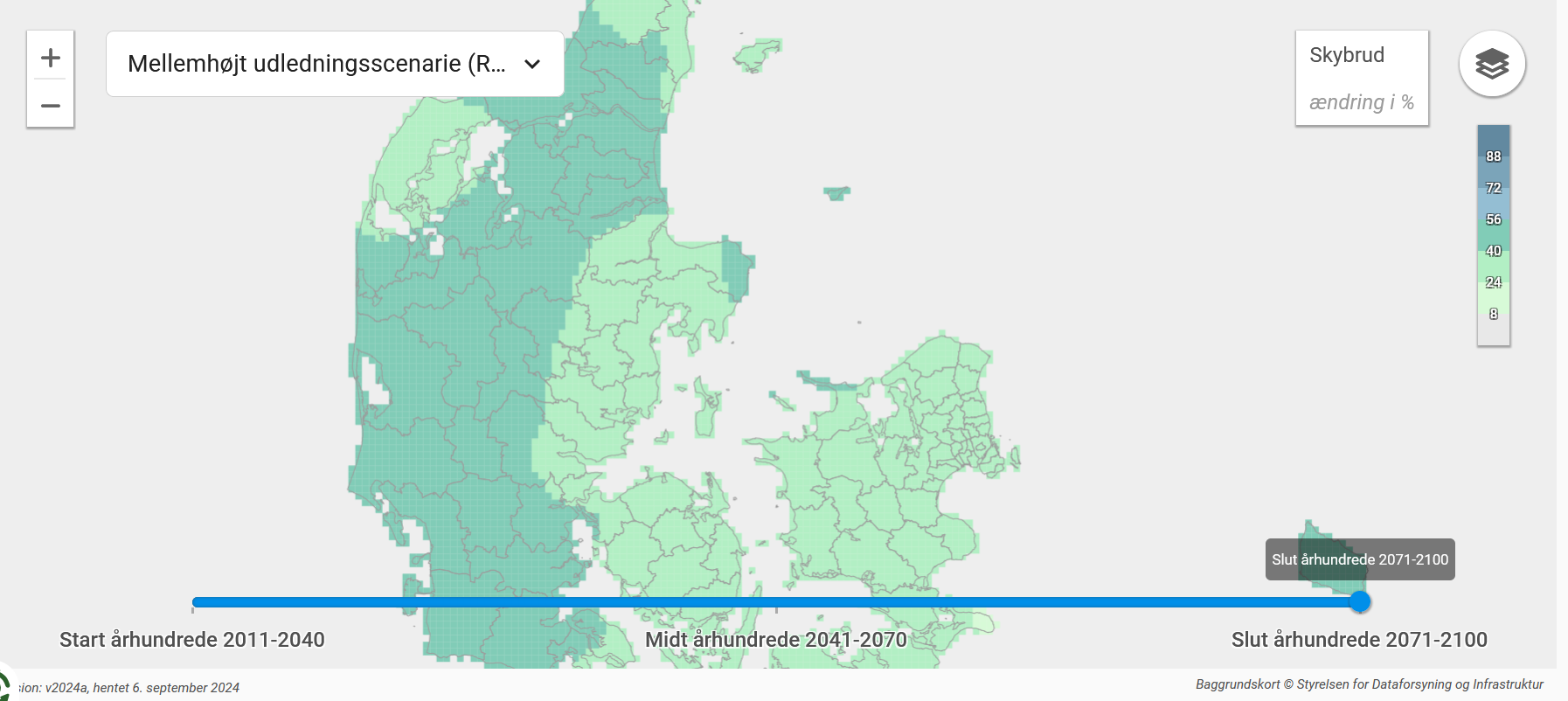
Example of a Climate atlas figure – this is the overview figure, each local authority area is clickable for local information

For audiences that just want a quick message there are these easy to interpret icons with a key message below, like this one about higher water levels.

I was involved in the early stages and to my mind there are 4 crucial elements that have made it very successful:

  1. Legal Requirement: Every local authority (a kommune, don’t think hippies, think regional councils) in Denmark has a legal obligation to make climate adaptation plans and to keep them updated. This element is important as it created awareness of the problem and effects of climate change and the necessity of investigating adaptation options. The initial plans were rather patchy and not very consistent with each other. Many regions had employed a consultant who was also maybe not an expert. Several kommune ended up with data based on CMIP resolution data! Hardly appropriate for a small local region in Denmark (which is barely resolved in most global climate models).
  2. Data Foundation: At the same time we have been dynamically downscaling these simulations for decades, to provide really high quality locally bias corrected data (using also DMI’s long climatological time series to understand if and where biases exist). Colleagues at DMI identified a need to provide this in an easy to use format to everyone in the country. We had long ago discovered that working with motivated kommune employees led to a really good outcome: readable climate variables that are meaningful to an individual city, data formats that can be used by non-scienists (who definitely can’t deal with netCDFs).
  3. Funding: Doing a data project properly requires money. The Climate Atlas is, compared to the cost of not doing anything, extremely cheap, nonetheless, it still costs something. Ear marked funding from the danish state to build up the Climate Atlas from the ground, to develop it as new needs are identified and to improve both communication and presentation has been crucial. Along the way several different needs have arisen (droughts, deep uncertainty in sea level rise), a new version will hopefully be coming soon.
  4. Intense engagement: Probably the most crucial aspect to getting the climate atlas off the ground and into use has been communication over and over and over again. Not just initially with kommune to find out what they need (building on many years of background experience first), but also reaching out to special interest groups raning from local farmers in mid-west Jylland to sewage engineers, high school teachers and property developers. This continues, but has undeniably been helped by Denmark’s open trusting society and generous tradition of cultural meetings, continuing education and festivals.

The climate atlas in Denmark is the example I know best, we should be rightly proud of the team that constructed, maintain and continue to develop it. Other countries certainly have similar products in the Nordic and Blatic countries, and likely elsewhere, a network meets annually within the region to discuss developments etc. After a coincidental meeting, DMI was also invited to help develop one for Ghana, which is ongoing, and of course, will have completely different needs and requirements, However, the decision early one to base the back end of the Climate Atlas on open tools: python, cdo, github and CORDEX simulations, makes a lot of the learnings transferable.

If you want to know more, contact my colleagues at the Klima Atlas! I’m happy to put you in touch..

*As an aside, it’s interesting how many of the climate science and policy community have moved over to Blue Sky. It was rather quiet for a while but activity seems to have picked up. I’m not abandoning mastodon, which I actually prefer, but I’m happy to see an alternative to what has become known as Birdchan. I’d urge you to try it if you’re interested in a social media presence in a slightly more appealing environment. There are a number of handy tools, including fedica, that allow you to crosspost to multiple channels at the same time (including X, mastodon, bsky, TikTok and threads) and I’m also using the OpenVibe app, which has a common timeline from multiple platforms.
On Climate Grief..

A short post today sparked by this comment piece in Nature on climate grief.

I’ve been asked before, often frequently in fact*, about how depressing it must be to be a climate scientist. And I usually waffle something about how, my job is very interesting and that there’s always hope out there somewhere. Like many people working in the climate space, I’m aware of the multiplicity of research out there suggesting that hope is essential for action, and so that’s what I try to emphasise.

And it is not inaccurate in fact, my job really is fascinating! And very often I get buried in learning something new and often surprising that is incredibly rewarding. I’m also surrounded by thoughtful, creative and incredibly smart and supportive colleagues. It’s a stimulating environment (both metaphorically and literally) and I’m learning new stuff all the time. It can sometimes be surprisingly fun. Occasionally, I’m even fortunate enough to go to Greenland.

Flying a UAV to measure icebergs in Greenland this year: Fieldwork is often uncomfortable, tedious and boring, but sometimes it can be surprisingly fun. Especially when learning new stuff. And the results of this research are consequential when it comes to sea level rise adaptation.

I’m sure that working in an emergency department or as a war photographer or social worker in a deprived community is considerably tougher mentally than how I have it..

On the other hand, Kimberley Miner’s piece resonated. Especially this year, where there have just been *so many* extreme events – including some that have a direct bearing on my own work. It has been exhausting keeping on top of what’s going on – and trying to communicate the impacts of that often feels like a moral duty as much as a part of my job. But it’s not always easy to cross that boundary. I rarely talk about my work in a social context (certainly if not with other scientists), it’s not exactly conducive to a party atmosphere. But I know police officers, social workers, soldiers and medics who are the same, I do not think climate scientists are alone in this respect.

I think she is also correct to point out that long working hours, stress, competition for resources and simple exhaustion don’t help. Given the academic environment, many of us work too much and don’t take the time to rest and recuperate. (Yes, I’m also writing this on a Sunday morning, where I’m also going through emails, editing comments on a paper and preparing for a new student to start next week…). It’s hard to keep perspective and emotions under control under those circumstances.

So what about the solutions?

Well, again I’d echo the original piece. Find the time and places that give you rest .

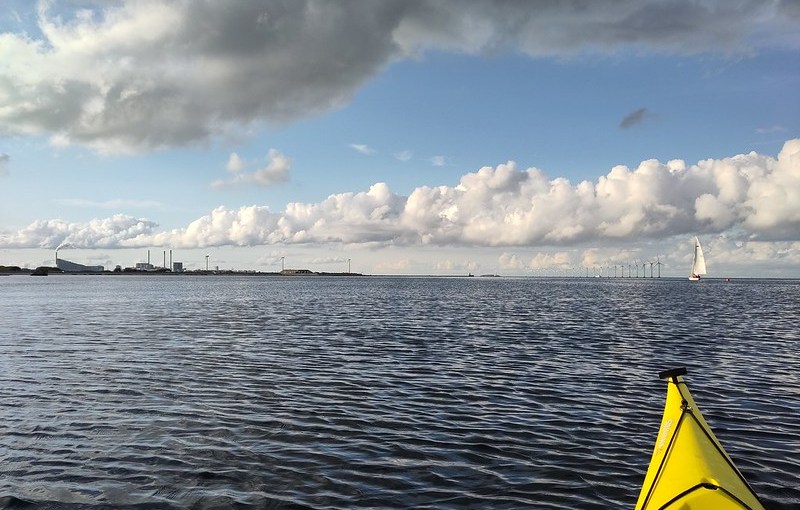
I jealously guard the time each week when I go out in my kayak on the Øresund, a sport I’ve enjoyed since my teens acquired a new urgency in preventing burn-out (particularly during the COVID times). It’s also often the time I get my best ideas and can work through issues that are bothering me to find the right way forward.

Paddlingon the Øresund, the wind turbines and the Copenhill facility are a reminder that we have solutions for the climate crisis. Even if it is not going as fast as it should…

And then, to continue a theme of posts this summer, it’s also about focusing on what can I do to feel empowered again. And I think this is also correct:

“After decades of working to convince the public that climate change is real, … we need to work on solutions…. The current generation of climate scientists needs to move on from education and advocacy to providing solutions for mitigation, adaptation and resilience. The best treatment for climate grief, .. is knowing you’ve made a contribution to reducing emissions or building resilience.”

Dave Schimel to Kimberly Miner

At work, the development of climate services and better focusing how we deal with climate impacts has become a constant and important theme and I agree with that completely.

But it’s important to remember too that many of us became climate scientists because we found it deeply interesting to work to understand the earth’s processes. Even if science has an even better understanding now, there is still much motivation in taking that deep dive.

At home, our own family lifestyle is in constant improvement to reduce our impact. The usual stuff: car free, vegetarian towards vegan lifestyle, train rather than plane as much as possible. This autumn, I’m adding a new wildflower patch to my garden to encourage the insects and pollinators even more. Individual actions won’t save the world or prevent the climate crisis alone, but they can help us to feel more in control and motivated.

Il faut cultiver notre jardin.

Voltaire

And a new update pointing at an interesting piece about how to incorporate this into an educational context with “critical hope”, which is sort of what I’m talking about here too.

This is where the notion of “critical hope” emerges as a compelling concept to explore.

Critical hope embodies an educational paradigm rooted in the art of envisioning and living an alternative narrative to the status quo.

This paradigm is fortified by a comprehensive scrutiny of our current predicament – urging learners and educators to not only understand the challenges we face but also to actively participate in reshaping our collective future.

Sean Porter, wonkhe.com

I like this framing, but I do think we also have to remember that personal accountability and individual change is not going to solve the climate crisis. For that we need governaments and municipalities as well as business on board and, crucially, leading.

*There’s a whole other conversation we could have about how it’s very often women researchers who are asked about their feelings. Though I would also point out that for example, my colleague at GEUS Jason Box has also been open about this in this piece.