In yesterday’s post I rather skated over the justice and equity point that although “We” can adapt to climate change impacts, it’s going to be expensive and perhaps difficult in terms of planning.
Climate adaptation will also most likely (going by previous history), be unevenly spread and probably not focussed on those feeling the biggest impacts, but those most able to pay for it.
This is something I’ve been pondering for a while, and I’m not really sure how to grasp it, but perhaps more and better work with the social scientists is necessary?
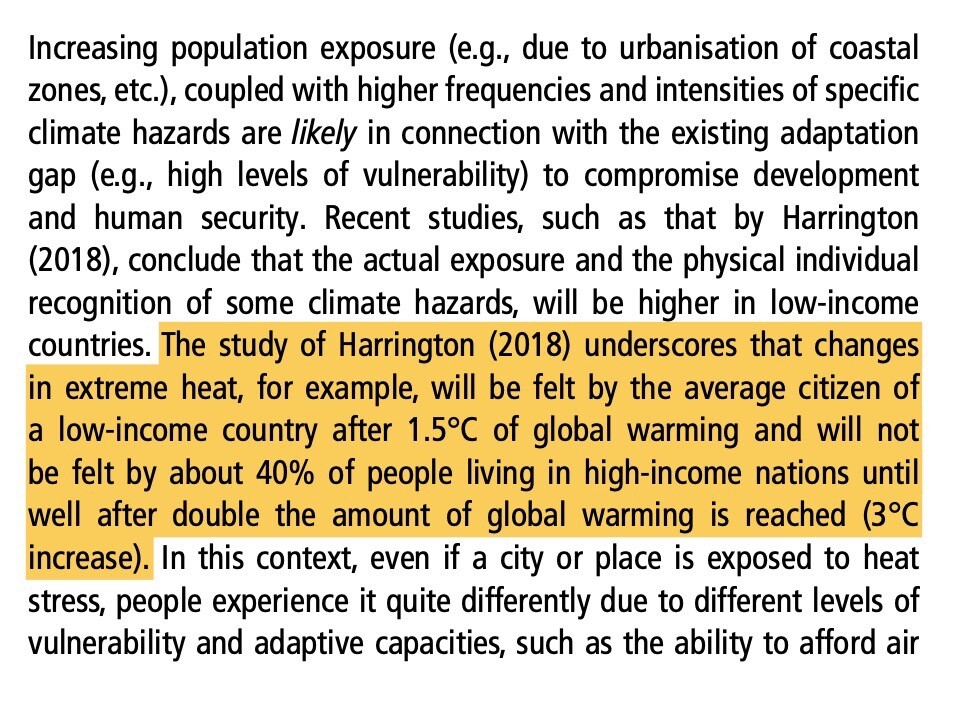
I was struck yesterday by this related snippet from the IPCC AR6 WGII report, posted by David Ho (and I gather courtesy Eric Rostrom), pointing out that heatwave impacts will be unevenly distributed between high and low income people.
At the same time, I also read an interesting piece in the Danish newspaper this weekend suggesting that heatwave exposure is a new marker of class, even in Europe. With the working class toiling in fields, roads, kitchens and on building sites, while the higher educated white collar professionals both able to take advantage of air conditioning and to afford time off in cooler places. This is not a new argument. But it is yet another argument for unions and robust government regulation to try to limit heatwave morbidity and mortality where this is possible. Trades unions may not be able to solve all problems, but they can definitely help when it comes to working conditions!
On a similar note, but outside Europe, the Economist has an unexpectedly excellent piece on how meteorology can help to mitigate weather and climate driven disasters . The whole piece is worth a read as it very much aligns with developments I can see at DMI. They point out for example the great possibilities offered by AI methods in weather forecasting, and how they can be applied to climate models (something I hope to start working on this year), as well as the dangers that AI could be used to undermine the robust national infrastructure that machine learning models are in fact built on.
However, the most important point is that so often, the main challenge is getting extreme weather warnings and other important information out to people affected.
“24 hours’ notice of a destructive weather event could cut damage by 30%, and that a $800m investment in early-warning systems for developing countries could prevent annual losses of $3bn-16bn.”
The world’s poor need to know about weather disasters ahead of time from TheEconomist https://www.economist.com/leaders/2023/07/27/the-worlds-poor-need-to-know-about-weather-disasters-ahead-of-time
If 3 out of 4 of the world’s population owns a mobile phone, then this is an obvious place to start to leverage. (We are already working on this, DMI have new projects with Ghana and Tanzania to develop a climate atlas for this kind of risk mitigation.) So with the WMO focusing on better warnings and communication channels by 2027, perhaps some of the worst impacts of climate change supercharged weather events like heatwaves and floods can be mitigated.
The piece concludes:
No breakthroughs are required to put this right, just some modest investment, detailed planning, focused discussion and enough political determination to overcome the inevitable institutional barriers. It is not an effort in the Promethean tradition of MANIAC’s [sic – an early pioneering weather supercomputer] begetters; it will neither set the world on fire nor model the ways in which it is already smouldering. But it should save thousands of lives and millions of livelihoods.
And this is probably generally true of the way we should think about climate change adaptation in the near and short term: how to leverage the best possible information to help make decisions and nudge behaviour to remove people from harm.
And now back to my last day of holiday…

 Sterna Paradisaea