Climate adaptation will also most likely (going by previous history), be unevenly spread and probably not focussed on those feeling the biggest impacts, but those most able to pay for it.
This is something I’ve been pondering for a while, and I’m not really sure how to grasp it, but perhaps more and better work with the social scientists is necessary?
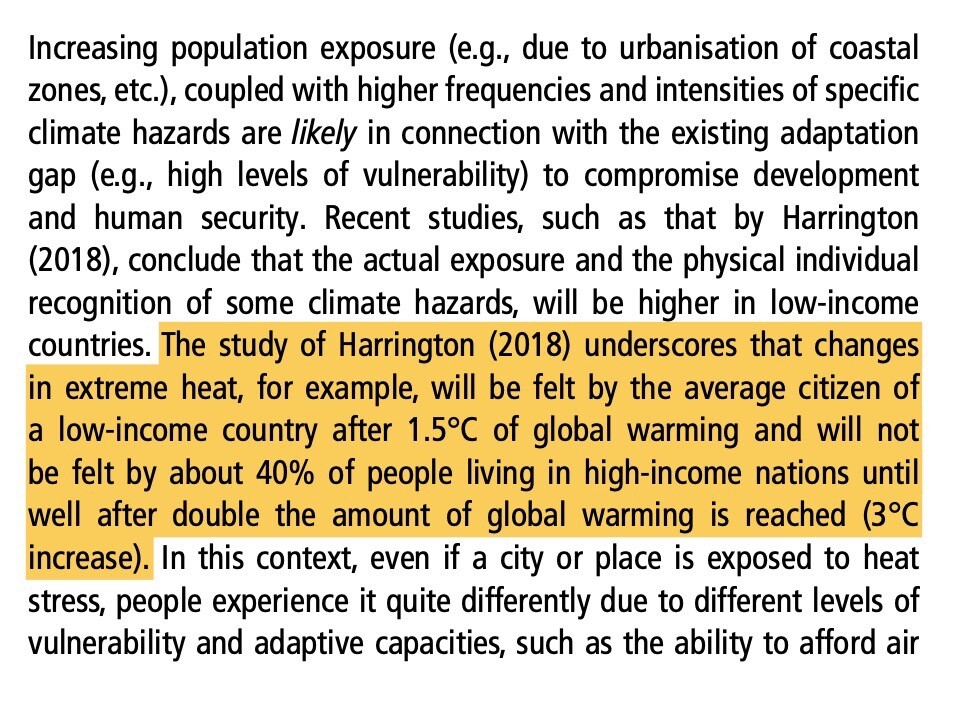
I was struck yesterday by this related snippet from the IPCC AR6 WGII report, posted by David Ho (and I gather courtesy Eric Rostrom), pointing out that heatwave impacts will be unevenly distributed between high and low income people.
At the same time, I also read an interesting piece in the Danish newspaper this weekend suggesting that heatwave exposure is a new marker of class, even in Europe. With the working class toiling in fields, roads, kitchens and on building sites, while the higher educated white collar professionals both able to take advantage of air conditioning and to afford time off in cooler places. This is not a new argument. But it is yet another argument for unions and robust government regulation to try to limit heatwave morbidity and mortality where this is possible. Trades unions may not be able to solve all problems, but they can definitely help when it comes to working conditions!
On a similar note, but outside Europe, the Economist has an unexpectedly excellent piece on how meteorology can help to mitigate weather and climate driven disasters . The whole piece is worth a read as it very much aligns with developments I can see at DMI. They point out for example the great possibilities offered by AI methods in weather forecasting, and how they can be applied to climate models (something I hope to start working on this year), as well as the dangers that AI could be used to undermine the robust national infrastructure that machine learning models are in fact built on.
However, the most important point is that so often, the main challenge is getting extreme weather warnings and other important information out to people affected.
“24 hours’ notice of a destructive weather event could cut damage by 30%, and that a $800m investment in early-warning systems for developing countries could prevent annual losses of $3bn-16bn.”
No breakthroughs are required to put this right, just some modest investment, detailed planning, focused discussion and enough political determination to overcome the inevitable institutional barriers. It is not an effort in the Promethean tradition of MANIAC’s [sic – an early pioneering weather supercomputer] begetters; it will neither set the world on fire nor model the ways in which it is already smouldering. But it should save thousands of lives and millions of livelihoods.
And this is probably generally true of the way we should think about climate change adaptation in the near and short term: how to leverage the best possible information to help make decisions and nudge behaviour to remove people from harm.
An ultra-quick post today. I have been spending a lot of time lately writing a grant proposal (and occasionally tweeting about it on the #DACEA3 hashtag). Finally it’s in and after a celebratory beer or two at the famous Mikeller last week I have managed to get around to a very brief summary of what it’s all about…
Around 17,000 years ago, Lake Victoria more or less completely dried out. I still find this absolutely staggering. In fact, the lake has dried out and reformed at least 3 times since it first formed about 400,000 years ago.
Lake Victoria is the largest lake in Africa and indeed the tropics, containing 2.75 cubic kilometres of water (though compared to the 2,850,000 cubic kilometres of water in the Greenland ice sheet that seems small, which merely goes to prove how much of our fresh water is locked up in the ice sheets), making it the 9th largest lake by volume in the world.
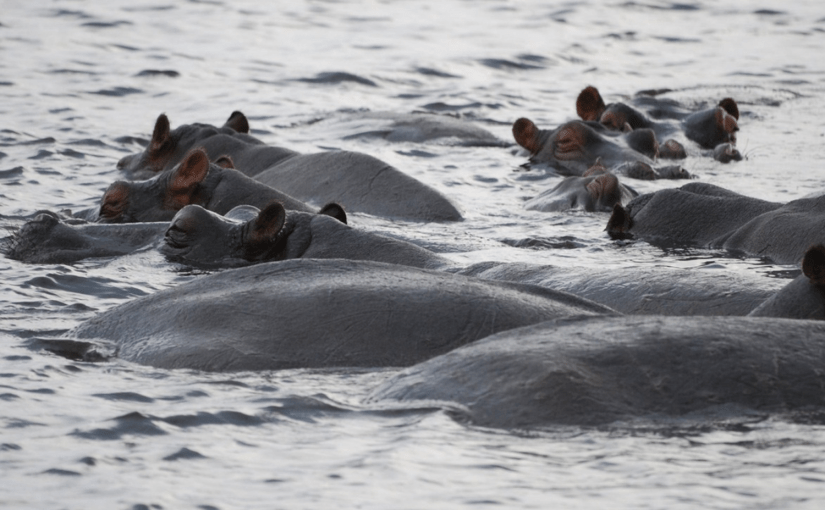
Gratuitous wildlife shot: A raft of hippos chilling out in the river. Photo credit: Ruth Mottram
Clearly, the disappearance and later reappearance of the lake, and others in the region speaks to monumental shifts in the climate. The East African Rift Valley lakes are largely fed by the East African rains, long and short, delivered by the shifting position of the Intertropical Convergence Zone as the Earth’s seasons change bringing those life-giving rains.
This grant proposal started as idle speculation around the coffee machine (in the grand old scientific tradition) about how this was climatically possible and could it happen again? My colleague (and talented PI on the proposal) Peter Thejll had been reading a book about John Hanning Speke and Richard Burton (not that one) and their famous search for the source of the Nile and has some personal African connections, which prompted the conversation and it seemed obvious to try and find out what happens to the local circulation to allow the lake to dry out. A quick google search revealed an old friend, Dr. Sarah Davies at Aberystwyth University was researching this topic actively and it all fell into place.
Now, I can guess what you’re thinking – this is usually a glaciology or Arctic Climate blog, where on earth has all this Africa stuff come from? Well what happens in the Arctic does not necessarily stay in the Arctic.
There are a number of hypotheses as to the drivers of these changes in African rainfall, among which is the interesting observation that the periods of greater aridity correlate remarkably well with Heinrich events in the North Atlantic.
Heinrich events were first identified as layers of sediment most likely transported into the North Atlantic Ocean by icebergs, known as ice rafted debris – IRD. The southerly position of many of these layers thousands of kilometres from any ice sheets either at the present day or in the past suggests a truly extraordinary amount of icebergs and cold fresh water were discharged over a relatively short period of time, from a large ice sheet. The source of these sediments is most likely the gigantic Laurentide ice sheet of North America, but there is also some evidence of smaller contributions from the British and Fenno- Scandian ice sheets (which may or may not have been joined together across the North Sea depending on how you interpret the evidence). The physics behind this is that as the enormous amount of cold fresh water was discharged into the North Atlantic, the temperature and salinity changes were sufficient to push, or keep the ITCZ far to the south, preventing the rains one East Africa.
On the other hand, other research has linked the failure of the rains to El Niño and related phenomena such as the Indian Ocean dipole and the Walker circulation. Still other scientists have noted that these drying periods seem to correlate with orbital changes in the earth which would affect the seasonality, that is the annual cycle of seasons. It is known as orbital forcing as the Earth’s seasons are driven by changes in our orbit around the sun (have a look at the excellent Orbit documentary from the BBC for a very easy to follow and beautifully filmed introduction to the importance of our orbit around the sun if you’re not familiar with Milankovitch cycles etc).
Milankovitch cycles shown from ocean cores and an Antarctic ice core at the bottom compared with the theoretical cycles. Image: By Incredio (Own work) [CC BY 3.0 (http://creativecommons.org/licenses/by/3.0)], via Wikimedia CommonsAll of these hypotheses can be supported by correlations with palaeo evidence, but to really disentangle the connections between different regions of the world and how they affect each other’s weather and climate, we need to use a climate model. Luckily, at DMI we have the perfect tool to hand, a global climate model including ice sheets, EC-Earth. Furthermore we also have a high resolution regional climate model, HIRHAM5, my usual tool of choice. Our friends Morten Dahl Larsen and Martin Drews at the Danish Technical University are experts in using hydrology models so the answer is obvious.
We want to use these model tools and an extensive archive of observations, helpfully curated by our project partners Sarah Davies and Henry Lamb at Aberystwyth University to test all these different ideas. As an extra spinoff from the project, the Aberystwyth group have been intensively involved with the collection and analysis of a new lake sediment core from Chew Bahir in Ethiopia, so it’s going to be pretty exciting seeing if we can get the models to replicate these kind of records.
There is of course an extra urgency to this project. It’s not just a somewhat obscure academic question. A recent paper showed that the long rains have significantly reduced over the last decade, and about 300 million* people live in this region and rely on these rains for drinking water, hydroelectric power and agricultural production. During this period we have also seen rapid changes in the Arctic. Of course the two trends may not be connected, or may be linked via a common third factor which is why the physics of climate are so important to understand.
UPDATE 2: I had no time originally in the writing of this to add a little about our other project associate. One of the best things about doing science are the very smart and friendly people you meet along the way. Social media has really helped here to keep in touch as it is a nomadic lifestyle. By sheer chance I noticed a familiar name in a tweet that seemed to have some direct relevance to the proposal as we were writing it.
John Marsham was an old friend from my student days at Edinburgh University who I had slightly lost touch with. Thanks to the efforts of facebook we were soon back in touch and he is one of the Investigators on the HyCRISTAL project, part of the hugely important Future Climates for Africa Project, funded by the Department for International Development (DFiD) and the Natural Environment Research Council (NERC) in the UK. DACIA has some really obvious parallels with this project, though where we would like to concentrate on past climates, they will be focusing on present day and future climates. We hope therefore to send our PhD student to collaborate with the HyCRISTAL and FCFA projects where our insights from palaeomodelling palaeodata can make a real difference to the way future climate change is adapted to in East Africa. It will be very nice to collaborate with John’s group at Leeds as well as the Aberystwyth group, now we just have to hope we get the money to do it..
Or, to put it another way, “bless the rains down in Africa” ** (As an aside, for years I had always heard this as “I miss the rains down in Africa”, assuming it was about someone from Africa who missed being there).
UPDATE 1: Having viewed the original pop video again, I am rather troubled by the casual racism, sexism and naked orientalism on display (yes it was the 70s but still…) so I think I prefer to post instead this particularly witty deconstruction courtesy of @spaceforpootling
*(based on a back of the envelope calculation based on population statistics from Wikipedia if you know the correct number do let me know).
**(Apologies if you now have cheesy 1970’s pop music going round your head all day… 🙂 )


![Milankovitch cycles shown from ocean cores and an Antarctic ice core at the bottom compared with the theoretical cycles. Image: By Incredio (Own work) [CC BY 3.0 (http://creativecommons.org/licenses/by/3.0)], via Wikimedia Commons](https://sternaparadisaea.net/wp-content/uploads/2015/09/ice_sheet_velocity_rain.png)

 Sterna Paradisaea
![Image: By Incredio (Own work) [CC BY 3.0 (http://creativecommons.org/licenses/by/3.0)], via Wikimedia Commons](https://commons.wikimedia.org/wiki/File:MilankovitchCyclesOrbitandCores.png)