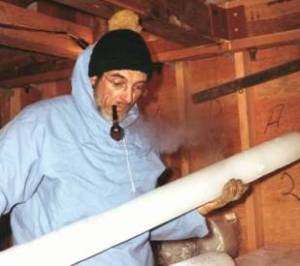
A Svalbard Field Journal, part 1.

This is a piece about field work I did in Svalbard in 2010. I’m not sure it really belongs here, but I hope it is interesting to read about what Arctic fieldwork is really like. I have been tremendously lucky to have had several opportunities to work in the Arctic, but as I hope this makes clear, it’s quite often a big slog with uncertain outcomes.

The sun rises early in March in Svalbard but it is not yet hitting the town, we are before the Solfest in Longyearbyen, and I am lying in bed alternately wishing I could sleep longer and being hugely excited at the prospect of getting out in the field again. With the light comes the cold, it is -26C outside with a fresh wind and some light snow falling, not brilliant weather for fieldwork. I am 12 weeks pregnant and the nausea comes early and remains all day but I hope the cold dry air on the glacier will help. In spite of that, I know my fieldwork opportunities will likely significantly reduce when the baby arrives so I’m determined to do one last big trip.

Down at UNIS (the university centre on Svalbard), our boxes are already packed with equipment, we just need to get them on the sledges, pick up our snowscooters and go. This is prime fieldwork and study time and the logistics centre is bustling with students, excited to be out on their first trip, and the long-termers getting ready to set up experiments. I’ve already got my scooter gear sorted out, huge padded suit, enormous padded boots, crash helmet, thin woollen undergloves, leather gauntlets, neoprene face mask. It feels a bit ridiculous inside but I know I’ll need it later on the scooter and the glacier.

Packing a sledge is an artform, one which, over the course of the week, I will gradually start to master, but for now I’m pretty useless and just try and hold stuff when asked and keep out the way while my colleague C gets on with showing me how it’s done.

Finally, we’re off, later, as usual, than we’d wanted, but all the kit is with us and we’re making good time. Our route intially lies up Adventdalen (named for the old whaler Adventure which explored this area). In summer this is a more-or less impassable morass of braided streams, gravel, mud and silt, glacially scoured rocks brought down by an ever shifting river. When the cold comes, and the river and the soil freeze, and then the snow falls, this is the main highway out of town.

We follow a long straight line of multiple overlaid scooter trails; riding a scooter is like riding a motorbike, fast, loud and exciting. I get up to 80km/h on the straight, in spite of towing a trailer, and wonder vaguely if the foetus can feel the vibrations. I thank UNIS silently for having such good kit, the heated handlebars of the scooter are essential, and in spite of the boots my feet are already getting chilly, I remember to wiggle my toes to keep them warm and, as we peel away from the main trails and slowly motor up ever narrower valleys and gullies, I lift my goggles momentarily to allow the frozen condensation on the inside to clear.

We are heading to Tellbreen (breen meaning the glacier in Norwegian, the “tell” in question being, I suspect, William Tell), a small and rather unimportant glacier about an hour and a half from Longyearbyen. A number of small and unrelated projects are going on there this year and there is a weather station lower down that we will be using. We will be working very high up on the glacier near the col at the top where the glacier divides in two. It falls fairly steeply down from this point and I struggle to get the scooter with the trailer up. I realise too late I haven’t given it enough power and there is a slow inevitable deceleration as the scooter digs itself into the soft snow. Fresh soft snow on a slope is the hardest for a scooter to deal with and I have just made the classic mistake. I determine not to make it worse and wait for my colleague C to return with the spade. You don’t drive anywhere in Svalbard without a spade. It’s not a bad dig-in and within half an hour we’re finally at the top of the glacier.

C and a student came out in late Autumn and put two tarpaulins on the glacier surface. These will be the baselines for our experiments. Their positions marked with 2m long bamboo canes. Very little of the canes are showing through the snow and it takes us a while to locate them. The wind is getting fresher and blowing snow through the pass, we are in an incredibly exposed position and I am even more thankful for UNIS equipment. Our first task is to dig a work trench. This will give us protection from the wind but will also be where we stick our temperature sensors into the snow. We will be placing two large water canisters in the snow pack and letting the water, with a dye added, drip through the snow and refreeze. At the second site the canister will be directly on the glacier surface. The temperature sensors will record the effect the water has on the snow temperature at different depths. At the end of the experiments we will dig through the snow to find the ice, record how far it has run and how thick it is. The dye will tell us on which day the water ran through.

It sounds like a simple and very esoteric set of experiments, but it is actually intended to help us shed light on a very difficult problem. Most of the glaciers in the Arctic melt, at least partly, in summer, but the water does not run off, it refreezes in the snow or on the surface of the glacier, forming superimposed ice. It is almost impossible to distinguish superimposed ice from normal glacier ice remotely so while we can measure melt directly by satellite, we have little idea how much of it remains on the glacier and how much is lost to the ocean. The GRACE and GOCE missions give us another way to measure mass loss over large regions but for climate models like the one I run in Denmark, where we make future projections of glaciated regions, we still need to factor this in. The work C and I are engaged in is aimed at developing an approximation we can put into the model to take this into account. In Antarctica the problem doesn’t occur as most of the glaciers there don’t melt.

We have brought a snow blower with us to plough the snow away and it is making short work of the trench, there is still a lot of digging to do though, and I reflect that whenever I am in the Arctic I seem to find myself doing a lot of digging either for latrine pits, to examine glacier sediments or to clear snow. At the Greenland ice core sites high up on the ice sheet, famously the first thing you’re given when you arrive is a spade.

I try and cut some blocks of snow to use as a wall against the wind but the snow is too soft and my efforts are only partly successful. Thankfully though, C had thought to bring some wide boards and we use these to cover the trench so we can work sheltered from the howling wind. It has taken us almost all day to dig the trench and the hole for the first water canister. Now it’s starting to get dark and we really need to leave before driving down the glacier gets too hazardous. We hurriedly stick the sensors in the snow pack, I’ll have to measure the spacings accurately tomorrow, fill the canister with dye and warm(ish) water and open the tap to a dripping position. As the wind gets even stronger we cover over the trench as far as we can, gather our stuff, shouting at each other to be heard over the wind and get out of there.

By the time we’re off the glacier it’s almost completely dark and I am grateful for the strong headlights on the scooter, even so it’s a much slower trip back as we carefully try to avoid the rocks and hard ice chunks that litter the track. I am exhausted with the work and the fatigue of early pregnancy, but high as a kite with the successful completion of the work we’ve managed today – I wasn’t sure we’d manage as much as we did. Tomorrow we do the second experiment, but for now it’s time for a beer (for C) and an orange juice a big plate of chips and a hamburger in the pub for me. I had barely managed to eat anything all day, it’s too cold and I simply wasn’t hungry enough to attempt it. I am extremely thirsty, the work was physical and sweaty, but in the cold you don’t feel the thirst, and I always forget to drink.

I fall into bed at 10pm, ready to do it all over again tomorrow.

To be continued….
New Year’s Day

New Year’s Day

I am writing this from a hospital bed in Copenhagen.

At this time of year it is commonplace to make some resolutions about how we want our lives to be changed, whether weight loss, reduction in alcohol or giving up smoking. Conventional wisdom has it that we should tell other people of our intentions to make it harder for us to fail.  In any case, it has not been my habit to make resolutions at new year, since I prefer to evaluate my life and try to make adjustments as I go on. In fact I think I once read that the beginning of spring was a better time to make resolutions. However, this year I plan to make an exception. In fact I have made two resolutions this year and this blog post encapsulates both.

I am writing from a hospital bed because the recently hatched sterna chick is  ill and needs some extra care. Fortunately she is getting it and improving by the day. There is however nothing quite like being on a children’s ward to put a few things into perspective. While waiting to be admitted I was alarmed to see a young woman running out of the ward sobbing hysterically. I have no idea what caused such distress and I don’t really want to speculate, but the fact is our children are the most precious things in our lives and we would do anything to protect them.  It is only very recently that we have become complacent about childhood survival rates to the extent that small groups of well organised, but badly misguided anti-vaccination activists have been able to derail public health, leading to epidemics of measles, whooping cough and mumps for instance. Low take up of vaccinations pose a serious risk to those, like the sterna chicks with background health issues. A further risk is the transmission of everyday diseases

There are all sorts of grim lists available on the Internet based on how many germs or bacteria we get contact with every day. In fact, it seems to me that it is an amazing testament to the immune system that we aren’t ill more often. However, watching the medical staff taking such high precautions with hygiene, and seeing how ill some of the children on this ward are is more than enough to convince me. My first resolution is that this year I am going to wash my hands properly. That is, will wash them thoroughly, regularly and with proper soap. More than that, I will make sure the rest of the sterns family do too.

My second resolution can also be summed up in this blog. I started it with all sorts of bold ambitions, but it all too quickly became a millstone, or else a way to avoid doing “real writing” of papers. It is however painfully clear to me I really need to get over my mental block, and cultivate writing as a habit.

My second, much more difficult resolution is thus to write something, anything, for at least 10 minutes every day of the year. Some of those ramblings will never see the light of day. Some will be professional and used for publications and others will end up being posted here. So see this as my statement of intent.  I will not post every day or perhaps even every week, but the main thing will be to force myself to the keyboard. This blog may not ever see a lot of posts, but it will be my sounding board and practice page, comments more than welcome.  I hope you feel like coming along for the ride.

Tulipa

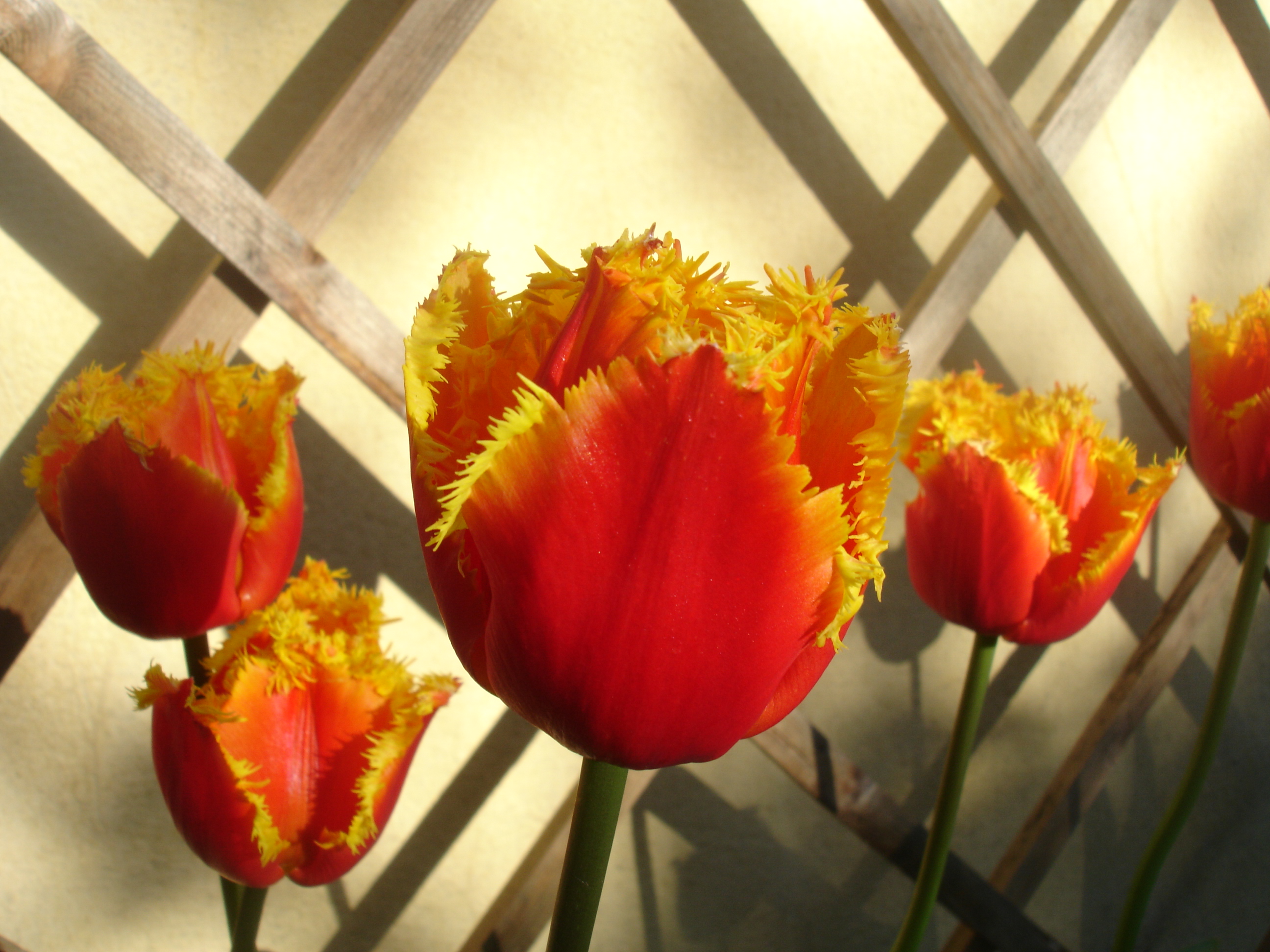
I mowed the lawn for the first time last weekend.

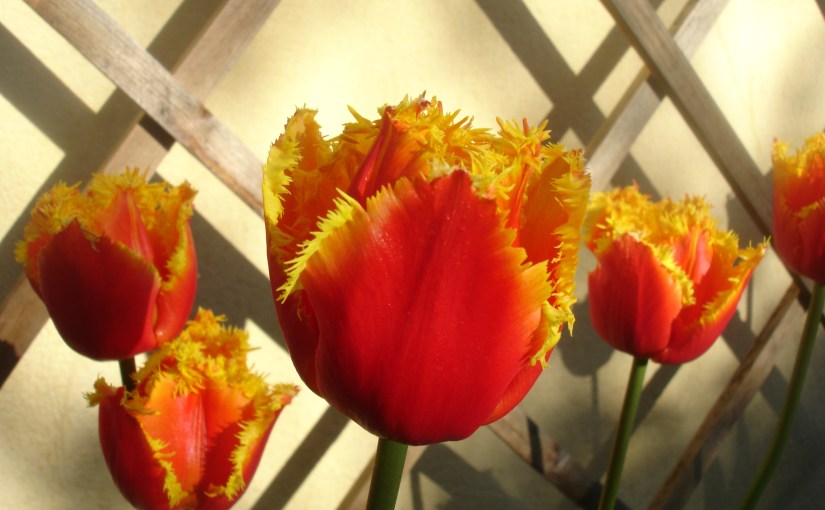
This mundane task was made much easier by these beauties, smiling over me.

Red and yellow tulips with a frilled edge around the petals

I believe the variety is called “Jet fire” which seems highly appropriate. I had never really appreciated tulips until a few years ago when we planted some “queen of the night” – dramatic dark purple flowers that really caught your attention, especially when combined with vivid orange tulips; the glaucous foliage of both setting off the combination beautifully.

Dark purple queen of the night tulip
Our last remaining ‘Queen of the night’

Then a few trips to Holland happened, I visited the famous Keukenhof gardens and the bollenstreek. and I learned to love the tulip. Eventually when I got married I even had yellow tulips in my bouquet (though mainly because they were in season and I wanted to have locally grown flowers).

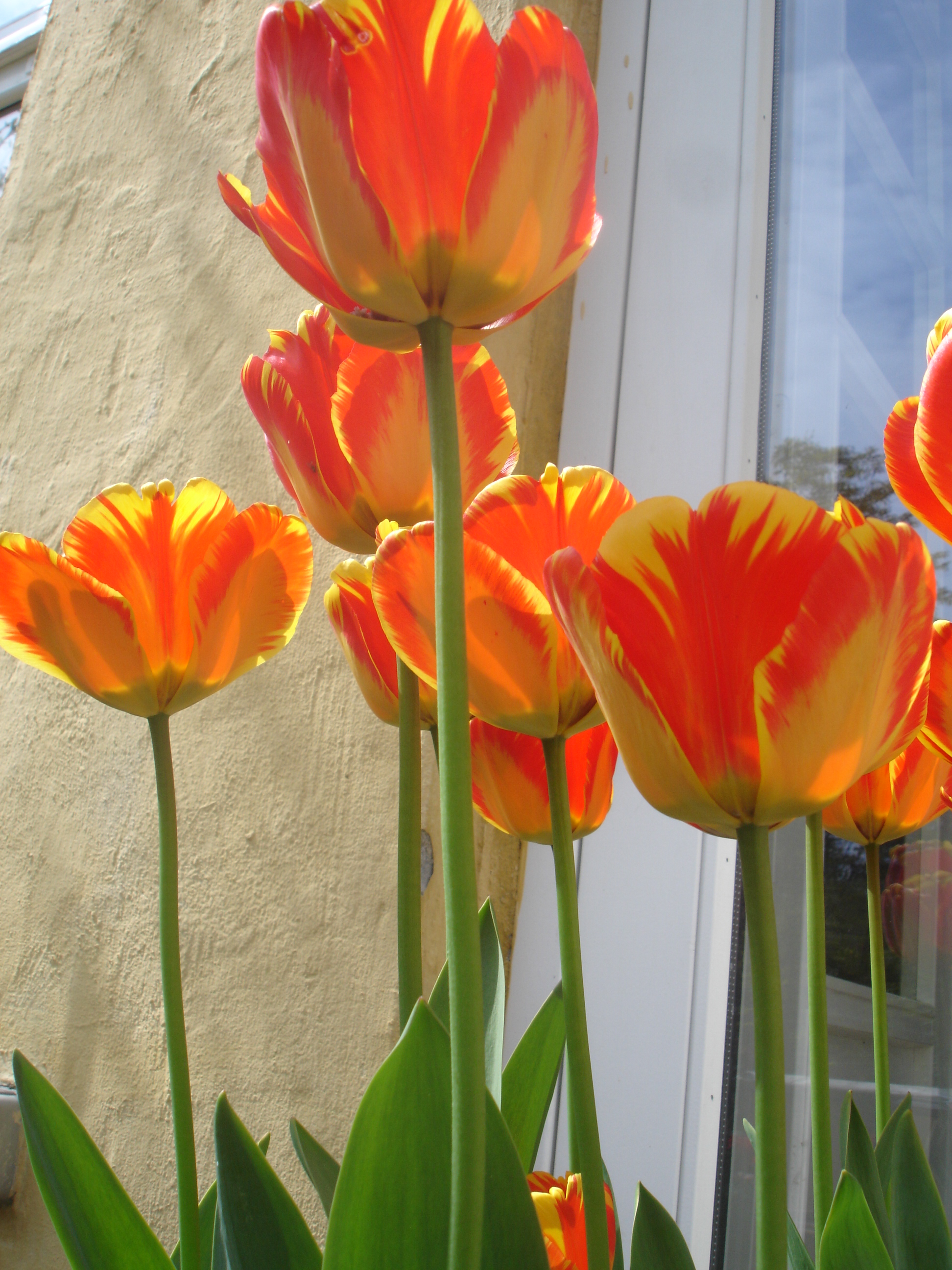
This year we also have this variety in a pot, though I’m not sure what they are called.

Red and yellow streaked tulips

Their bright colours really make a difference after the long dark winter and I am so happy to see them come up again – still glorious even in a second year. More than any other spring flower, tulips for me embody the transition from winter to spring to summer.

As I had my camera out in the garden I could not resist taking a few more photos. The internal parts of the tulip are extraordinary in close up. The stamen with the fine powder pollen on the anthers, surrounding the pistil and the deep black of the central petals have always reminded me of big dramatic bumble bees.

Sexual organs of the tulip
Inside a tulip: click to enlarge

It is not surprising to me that Elizabeth Blackadder, has chosen red and yellow tulips for some of her most dramatic flower paintings. They simply sparkle with life and vitality. They flower themselves to exhaustion after a couple of years, often requiring 5 years or more to come back to flowering. Truly a passionate plant.

And yet, the frilling and streaking of the tulip petals is actually caused by a virus. This must be a rare case of a pathogen enhancing natural beauty. I had assumed that these were a modern variation added by skillful breeders but on a recent trip through Schiphol airport in Amsterdam I had the opportunity to visit the Rijksmuseum’s Dutch Flowers exhibition. There, in one of the first paintings I looked at from the 17th century was a tulip beautifully streaked with colours.

An anonymous painting of the most expensive tulip ever sold, the Semper Augustus.
Image from wikimedia commons

I had seen Dutch flower paintings before, having been inspired to look up a few after reading The Morville Hours by Katherine Swift (a beautiful book, a meditation on time passing and the natural world but touching on many subjects). However, I had never appreciated how vividly beautiful such paintings were until seeing them in reality.

Unfortunately, the mosaic virus that causes such beautiful patterning weakens the bulbs through the generations to such an extent that eventually they no longer reproduce, and many of the original varieties from the 17th century no longer exist other than in oil paintings.

Note: I haven’t written anything on this blog for a long time for which I apologise – a combination of too little time due to work/family commitments and a lack of inspiration, but I have good intentions at least to continue posting here items that interest me semi-regularly over the summertime. Thanks for reading. 
Note: I have also had to change my web address to sternaparadisaea.net since my .com domain expired this year and, due to illness I did not renew it in time. 

The mind altering effects of google

When it first became popular, google was seen as the hero against the evil empire of microsoft, but as is often the way success and growth have seen increasing concern at how powerful the company is that basically controls how the world (except maybe for China – a pretty big exception!) finds information. This week a new study showed that the world wide web, and in particular the search technology that makes it navigable like google, are changing the way we process and store information in our minds.

We are now much more likely to look up information than to remember it, but more subtly, the study also showed we are more likely to remember where the information is than what it is. Much like the famous study of London taxi drivers’ brains, it appears the internet is changing the actual shape of our brains.

I find this a fascinating result for all sorts of reasons. I am aware that my natural impatience means I am ever less likely to finish reading to the end of a newspaper article, which apparently just makes me yet another one of the 90% so of the population who are the same. Our attention spans appear to be getting shorter as we search for ever more (and probably shallower and less nuanced) pieces of information.

Of course, the same accusations of intellectual corruption were made of novels in the 18th and 19th century, and probably of books in general before that. The fact is though that in pre- or barely literate cultures, what would now be considered astonishing feats of memory were more or less routine; whether people were reciting the long lists of the ancestors, the Mahabharata, Homer’s Odyssey or  the King James bible, it was all learned by rote and memorised. I doubt many modern humans could, or would even be inclined to learn to do the same. This is not only due to the fact that we can easily access the texts at google books, or just go out and buy them, it is probably also that we don’t have the time or the motivation to do so. There is a positive side to this as well of course, if we can store and retrieve information easily, we have more time to learn and create and interact and share. We don’t actually need to memorise these things, and so, the apparently almost endless flexibility of our brains is freed up to do other things.

Still, there is something communally binding about a collectively shared story that is performed, revised and kept alive through being shared. A few years ago my father told me he was learning poems off by heart on his morning commute to work (by tram at the time) and I have always been full of admiration for those who can recite poems by heart at parties or round campfires. So, in an effort to prevent my attention span wandering even further off, and in the hope I’ll actually have something to contribute at the next party, I’m going to have a go at actually memorising a piece of literature. Now all I have to do is find a piece to memorise. Perhaps google can help me out ….

Love Letter to Copenhagen

On my way to work every morning I cycle down several tree lined streets – the lime trees are now in flower and the scent will always remind me of Copenhagen in the summertime. I wrote this piece last year and was reminded of it this morning by the perfume, so I dug it out and adapted it a bit, if I get time I’ll add photos later.

It’s mid June and after a baking hot May it’s cooler and humid in Copenhagen. The city is getting very quiet as the locals start to go off to their summer houses on the coast, or in Sweden, for the month of July, leaving the streets to tourists and musicians here for the jazz festival. In some ways it’s the best time of year to actually be in the city. The boulevards and streets are lined with sweet lime trees which has a very beautiful scent and the city is perfumed with it.

The parks and gardens are filled with flowers and in the evenings the remaining residents sit out in the parks with little barbecues. There are lots of areas set aside for sports and games and local teams spring up seemingly spontaneously to play street hockey, table tennis and football.

The zoo has a big elephant enclosure with an outdoor area open to the rest of the big Frederiksberg park, of which the zoo area is a small part. The elephants have a big natural pool and sandy beach and many of the park visitors outside the zoo spend time watching the younger elephants bathe and play in the water and throwing the sand over their backs, sending the ducks scurrying off in a panic with their ducklings trailing behind.

Cycling through the city is wonderful just now, especially in the evenings and especially if there’s no place you really need to be; the smell of flowers and charcoal smoke and grilled food all mixed in together, music being played in little bars and big open squares, even the careless tourists who forget to look for bikes before crossing the cycle lanes are tolerated with amusement, not everyone is so lucky to have a lifestyle like this after all. It really feels like a blessed place and a blessed time to live.

Update: I notice a friend, Kitty B. over at these sublime days has a post about childhood memories. I think the lime tree will be my memory of Copenhagen, and some day, when the Sterna family finally have a nest of our own, we will plant a lime tree so the scent will always remind us of this place.

Return to the Academy

The Sterna family are just back from a holiday at the Hay Festival. This is a wonderful event with a very diverse range of speakers, in fact it was impossible to see everything that interested me. One of events I missed was Bettany Hughes talking about her book The Hemlock Cup, which is about Socrates and his city of Athens, though I have listened to excerpts of the book on Radio 4. However, the subject of the talk led me to think that the festival itself could be considered as a modern form of Plato’s Academy, where problems are posed and discussed in a group of like-minded people. Though of course unlike Plato’s academy, all events were open to the public, even non-geometers (famously above the door to the Academy a Greek phrase ‘let none but geometers enter here’ was inscribed).

However, the concept that discussion of ideas, culture, nature, and the rest of the world can revitalise and refresh is central to the festival (along perhaps with selling books).The natural environment also helps, with beautiful green countryside all around. Sometimes it felt like wandering back in time to a lost world, or at least one I hadn’t thought existed anymore. And then along came the next talk on the secret mathematicians (Marcus du Sautoy),secular philosophy (A.C. Grayling), the smartness of the corvids (Nicky Clayton), the process of aging (Lewis Wolpert) or even the biography of the Ordnance Survey (Rachel Hewitt)  to bring us back to earth.

My other personal highlight was Dara O’Briain, surely one of the funniest people around today? I last saw him many years ago as a student, and now here he is talking about how old he feels when he’s talking to students and the problems of young parenthood. Dara – we’ve grown up together…

There is much more to be written about the festival, which is held every year in the small village of Hay – On- Wye that straddles the English/Welsh border, but frankly, it’s all been said before and like the Academy probably much more interesting to attend than hear about. See you next year.

A space of one’s own

‘a woman must have money and a room of her own if she is to write’

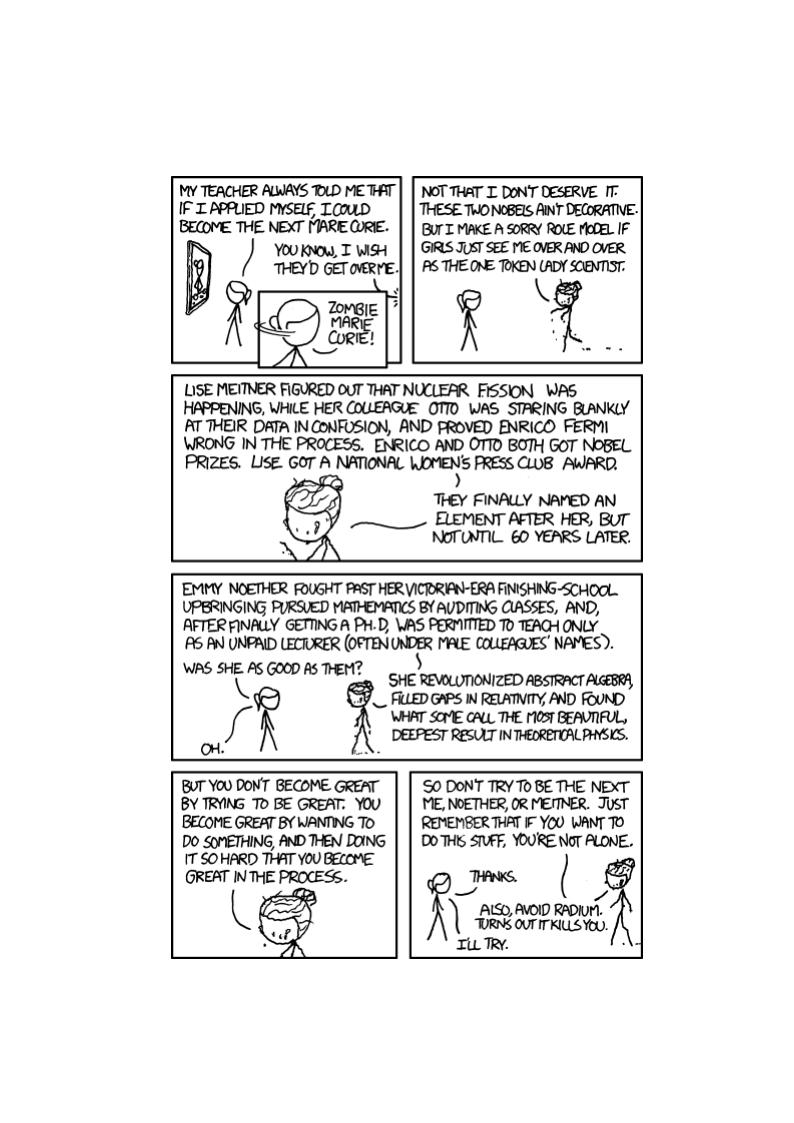
The famous opening of Virginia Woolf’s extended essay ‘ A Room of One’s Own’ is the starting point for this post. It was just as applicable to science in the days of the ‘gentleman amateur’ as it was to literature and to an extent it is still true today. In Virginia’s day of course a woman was lucky to get a decent education, never mind the kind of fulfilling job that a woman of her intellectual powers clearly wanted and needed.Which is why the rare exceptions such as Marie Curie and Lise Meitner are so inspiring.

XKCD cartoon about Marie Curie

I started this blog (which has been shamefully empty of new posts for the last couple of months) while I was on leave looking after the sterna chick, I am now back at work and settling in to the daily life of a scientist again. I was reminded of this quote because while I was on leave I literally felt like I had no space or time to work. This may not have been quite true, but sleep, house work and some relaxing quality time with the male sterna were also important variables to factor in to the time equation for me. By going back to work I have not only got the money, but also the room of my own (well shared with a very quiet office mate) that Virginia quite clearly pined for. I can now finally get down to the work that has been niggling at me for the last 8 months. This is not to say that I am stressed out about work, to the contrary, I find my work rewarding, challenging, intellectually stimulating and a fundamental part of my identity.

I may not be able to make a great contribution to literature like Virginia Woolf, and science, certainly these days, progresses in small increments rather than big steps, so I’m not expecting to discover an entirely new chemical element or explain nuclear fission (which would be a bit bizarre given my field anyway). I hope though, that at least in a small way, my work will help to advance the body of knowledge and thus fulfil the promise that a room of one’s own holds.

Living in interesting times

There has never been a better time to be a glaciologist. The old curse about living in interesting times, which is perhaps dubiously ascribed to a chinese saying, seems particularly relevant to science in general and ice and climate specialists in particular right now. We have access to a truly phenomenal range of resources that help us track the changes in the earth system; we can bounce radio waves off rocks buried under 4km of ice and use lasers to measure the height of clouds or the depths of a crevasse with decimetre precision. The GRACE and GOCE satellites whizz around the planet and the tiny relativistic accelerations and decelerations of paired satellites measure the seasonal ebb and flow of groundwater, snowfall and ice melt; and we can use the time signals of the GPS constellation of satellites to measure the millimetre by millimetre relaxation of whole continents as the glaciers melt. We do live in the future.

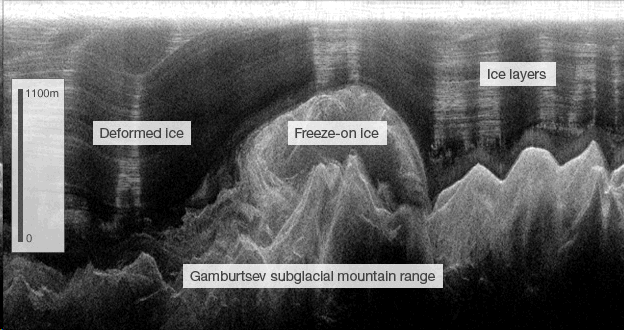
The planet often seems to me to be very full of people and every corner well explored, but these new techniques still demonstrate that we have large gaps and science is probably the most fundamental form of exploration. This week a paper in Science demonstrated the importance of the freezing on of ice at the bottom of the Antarctic ice sheet (see this article on the BBC science page for a very readable summary). As a process it’s been well known for some decades that liquid water can exist due to the huge pressures under the ice sheets and that this does indeed freeze on at the bed of glaciers. The ice core drilled out of the Antarctic ice sheet at Vostok station lies directly above a lake roughly the size of lake Ontario, known as lake Vostok and shortly to be drilled into directly for the first time. The drilling hit frozen lake water some hundreds of metres before it stopped, with some intriguing hints of lifeforms found within the lake ice.

What is a surprise in the latest work, an airborne radar mission to the Gamburtsev Range (a mountain range the size of the European Alps in East Antarctica but don’t try looking for it on Google Earth because it is also, like Lake Vostok, buried under 4km of ice) is that up to 25% of the total thickness of the ice sheet in this area results from the freezing on of liquid water underneath the ice. This is largely because that water is squeezed up against the mountain sides where the ice is thinner and the pressure consequently lower.

Ice Radar

I first saw some of this work presented at a conference at Northumbria University in 2009, even then, when the actual data was still being analysed, it was clearly very exciting work with many implications for our knowledge of both process and feedback and implications. There are also some important implications for how we evaluate the state of the cryosphere, and neither this process, nor many others relating to how water flows over, through and under ice, what we term glacier hydrology, are captured in current ice sheet models.

Of course, the old curse is famously double-edged, the reason we have access to such great tools and have been able to make so much progress is related to the fact that the climate is changing and the cryosphere is demonstrating behaviour of great concern to the millions of people who live in coastal regions or who depend on snow and ice for water sources. It is up to glaciologists to disentangle important processes from the trivial, to define the current state of the cryosphere and project how it will change. This new work shows just how much we still need to know and how seemingly trivial processes may complicate the picture. Just as well those satellites are continuing to fly.

Welcome to the future.

XKCD cartoon on flying cars

The life expectancy of the glaciologist

Willi Dansgaard died recently. He gave his name to one half of the Dansgaard-Oeschger events, a sequence of rapid (relatively speaking) climate fluctuations that occurred during the last glacial period where rapid warming (of up to 8C over a matter of a few decades) is followed by a long slow cooling over a few hundreds of years. These events are mostly known from the Greenland ice cores,  but there is evidence that they are in fact a worldwide phenomenon.

Willi Dansgaard with ice core
Willi Dansgaard with ice core (taken from the obituary published by DMI)

Willi Dansgaard will probably be mostly celebrated as the “founder” of ice core science, though of course many people helped to develop the ideas and techniques, some of them are still working in Copenhagen today. Remarkably for a scientist you’ve probably never heard of, a full obituary is given in the LA Times

In the last year or two several eminent glaciologists have passed away, almost all of them well into their 80s and 90s, while some of the founders of the modern discipline, including John Nye and John Glen (who together formulated “Glen’s Flow Law” for ice that describes how glaciers move), are still active in attending meetings and producing papers.

For a profession that specialises in the study of cold, dangerous places (more on my own encounter with mortality on a glacier in a later post) glaciologists seem in general to reach a respectable, and healthy old age. I wonder if this is due to the fact that science teaches a healthy inquisitive attitude to life that keeps people young? Or perhaps those attracted to field based research are naturally likely to be more interested in outdoor activities that help keeping active and fit? On the other hand perhaps it just reflects the fact that people are living longer and healthier lives in general?

Either way, I hope I manage to have as long a productive and healthy life as some of the guiding lights of my profession, even if I can’t hope to replicate their genius.

Science under attack

I had planned another subject for todays blog, but having watched the recent Horizon programme on science under attack on BBC iplayer (still available for those with a British IP address) I thought it tied in rather neatly with why I decided to start this blog.

In the first place the idea came to me to start a blog as a way of practicing my own writing skills. Then secondly I thought I might have something interesting to say. When people find out I’m a climate scientist I often get all sorts of questions about climate change ranging from the basic (is it really happening?) to the more nuanced and complex (how do models work?) to, unfortunately, yet another repetition of the usual climate myths (see below). This blog should be a small window on the world where I write about things that interest me and hopefully are interesting to others.

Cartoon from the Union of Concerned Scientists

As I looked in to the world of blogging, and in particular into blogging on climate related themes, a huge number of blogs came up. Unfortunately, many of them are rather weak on science and very overtly political. In fact a quick scan of the google hits brings up rather more blogs and websites by what might (kindly) be called “sceptics” (or otherwise known as “deniers”) than blogs created by scientists. There is some really good material on the web dealing with climate related issues, for example the excellent Realclimate.org blog but in many other places there is a lot of dross and the same empty myths endlessly recycled and repeated (for example, “it’s the little ice age”, “it was warmer in the Medieval period”, “it’s sun spots” etc etc), largely I’m afraid due to lazy and/or politically motivated journalism. All of these common myths have been explained over and over again, usually by people far better qualified, and far more skilled in writing than I, yet somehow they seem to persist.

As the Horizon documentary made clear, this is a source of immense frustration to many in the climate field, including myself, so I feel the time has come to stick my head above the parapet so to speak and start broadcasting my own opinions. At least I hope it will be a small addition to the counterbalancing work done by people like Real Climate and maybe it will help open some minds.

The same documentary blamed scientists for being poor communicators and I would tend to agree with that, it’s hard to talk about uncertainties in models for examples when even the word uncertainty is used very differently in science than in everyday life. On the other hand, this article on communication in the journal Nature by Tim Radford suggests that in fact scientists can be good communicators and he cites such luminaries as Carl Sagan, E.O. Wilson, Stephen Jay Gould and even Richard Dawkins (although I fear the latter has alienated a large part of the audience with his agressive approach to atheism). These are all great examples of great communicators of science, and though I fear I couldn’t possibly get close to their talent, I hope that this blog will help to develop my skills further.

One further point, Ben Goldacre, the Guardian’s excellent bad science columnist is a witty, knowledgeable and hard working advocate of good science who works tirelessly against vested interests, quackery, big pharma and other ‘enemies of reason’. In this post about the Copenhagen climate summit he explores the psychology of climate science and why it is so difficult to communicate. He points out that

‘climate science is difficult. We could discuss everything you needed to know about MMR and autism in an hour: the experimental techniques of epidemiology and other disciplines, how they’ve been misrepresented, the results, strengths, and weaknesses of the key studies. Climate change will take two days of your life, for a relatively superficial understanding: if you’re interested, I’d recommend the IPCC website itself, where they have a series of three executive summaries for policy makers, which are perfectly good pieces of humourless popular science writing.’

This is very true and I am certainly not going to use this blog to explain all issues related to climate change research. In fact, I aim to produce pieces about all sorts of scientific curiosities, natural wonders and society’s response to these. I have imposed two other conditions on myself. Firstly, I should not spend more than an hour on any one post and secondly, I want to post at least twice a week. I’ve broken the latter already, but thanks to my friend Heather I’ve been inspired to try again.

Enjoy.