The International Cryosphere Climate Initiative has put together a new petition for scientists to sign. I’m a little sceptical that this kind of “clicktivism” makes much difference, but there are many many lobbyists from polluting industries at the COP28 and rather fewer scientists. And how else to draw attention to what is one of the most visible and urgent effects of climate change?
The petition is aimed at:
” all cryosphere scientists globally; as well as those working on emissions pathways: and those in the social sciences with research on adaptation, loss and damage and health impacts. This includes research and field associates, as well as doctoral students — because you are the future, and will be dealing with the impacts of climate change in the global cryosphere throughout your lives, as well as your professional careers.”
ICCI
The list of signatories so far already includes many rather senior scientists, so take this as a challenge to add your signature if you work in the cryosphere/climate space. It takes only a minute to sign and there are many familiar names on the list.
I’m not sure how else to emphasise the urgency of real action at COP 28.
As a coincidence though, and as I posted on mastodon the image below appears in Momentum, a plug-in on my web browser with a new photo every day. Today’s is this beautiful image of the Marmolada glacier in Italy by Vicentiu Solomon.
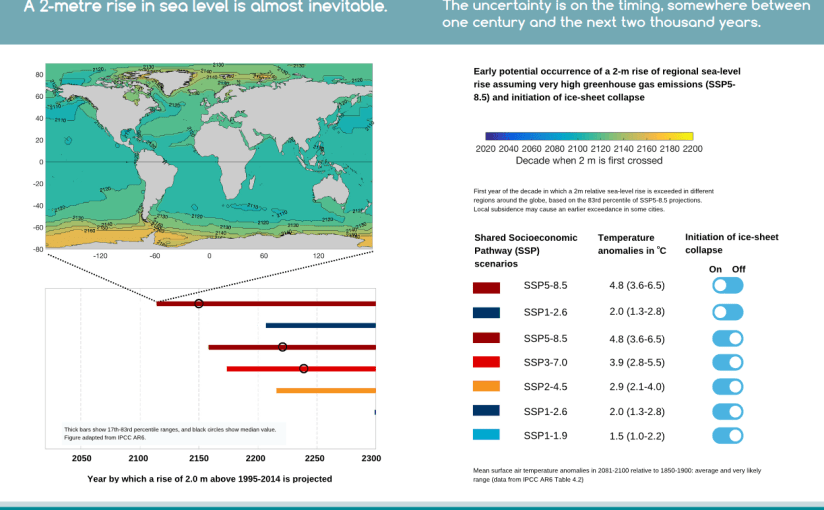
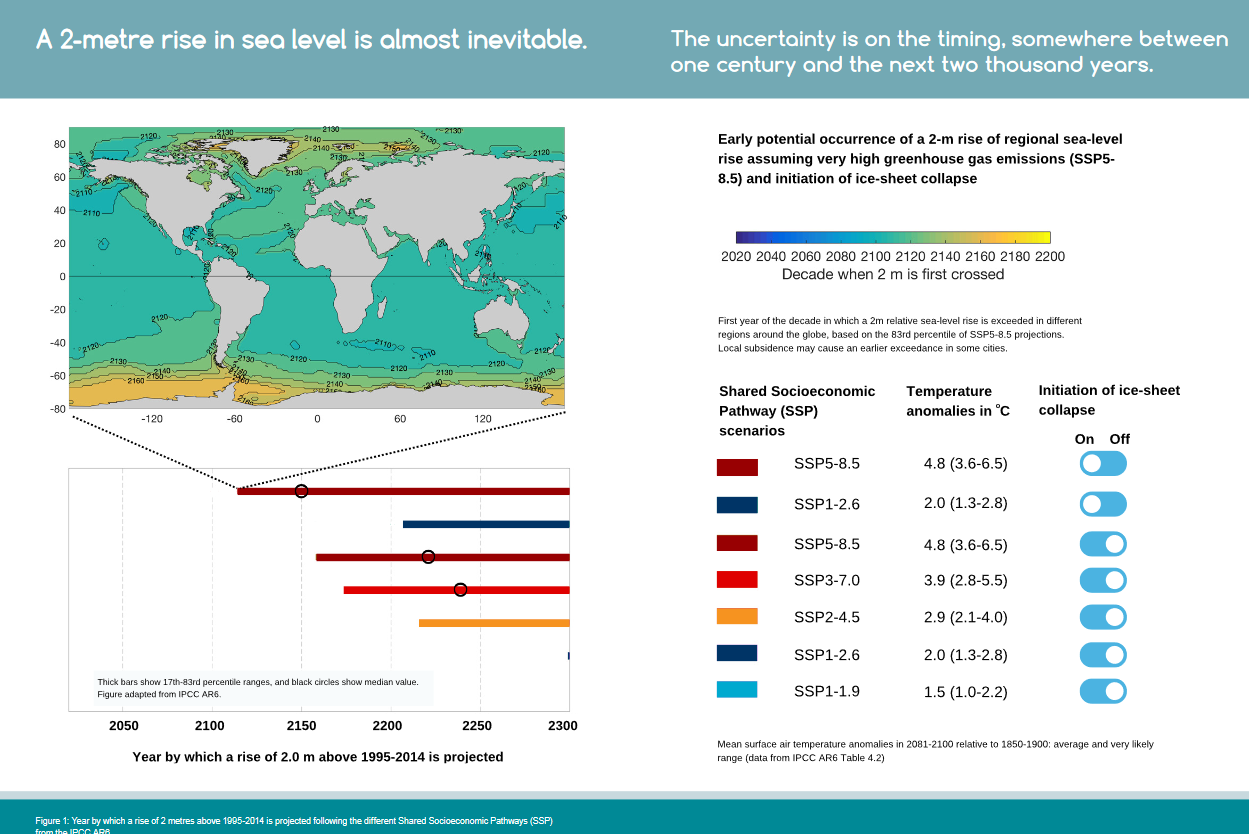
It’s a gorgeous but very sad picture – this is one of the faster disappearing #glaciers in the world and to hear more about the consequences of cryosphere loss, take a look at the policy brief produced by the PROTECT project on the sea level rise contributions from glaciers and ice sheets. It also contains this eye opening graphic:
A 2 metre rise in sea level is almost inevitable. The uncertainty is on the timing which is somewhere between one century and the next 2 thousand years, depending on where you are in the world, but, more importantly given COP28, how fast fossil fuels are phased out. You can download the whole thing here.
The Danish online popular science magazine is currently running a series on tipping points in the Earth system with a series of interviews with different scientists. They asked me to comment on the extraordinary low sea ice in Antarctica this year. You can read the original on their site here. But I thought it might be interesting for others to read in English the piece which is a pretty fair reflection of my thinking. So I’m experimenting a little with DeepL machine translation which I consider much more reliable that google’s competitor. I have not edited anything in the below! I have been promising a piece on West Antarctica for a while – which I’m still working on, but hopefully this is interestign to read to be going on with!
A sudden and surprising loss of sea ice in Antarctica could be a sign that we are approaching something critical that we need to prepare for, warns an ice researcher from DMI. The climate seems to be changing before our eyes.
In Antarctica, there has been a sudden, violent and in many ways unexplained lack of sea ice, which normally melts in the summer and re-forms in the winter.
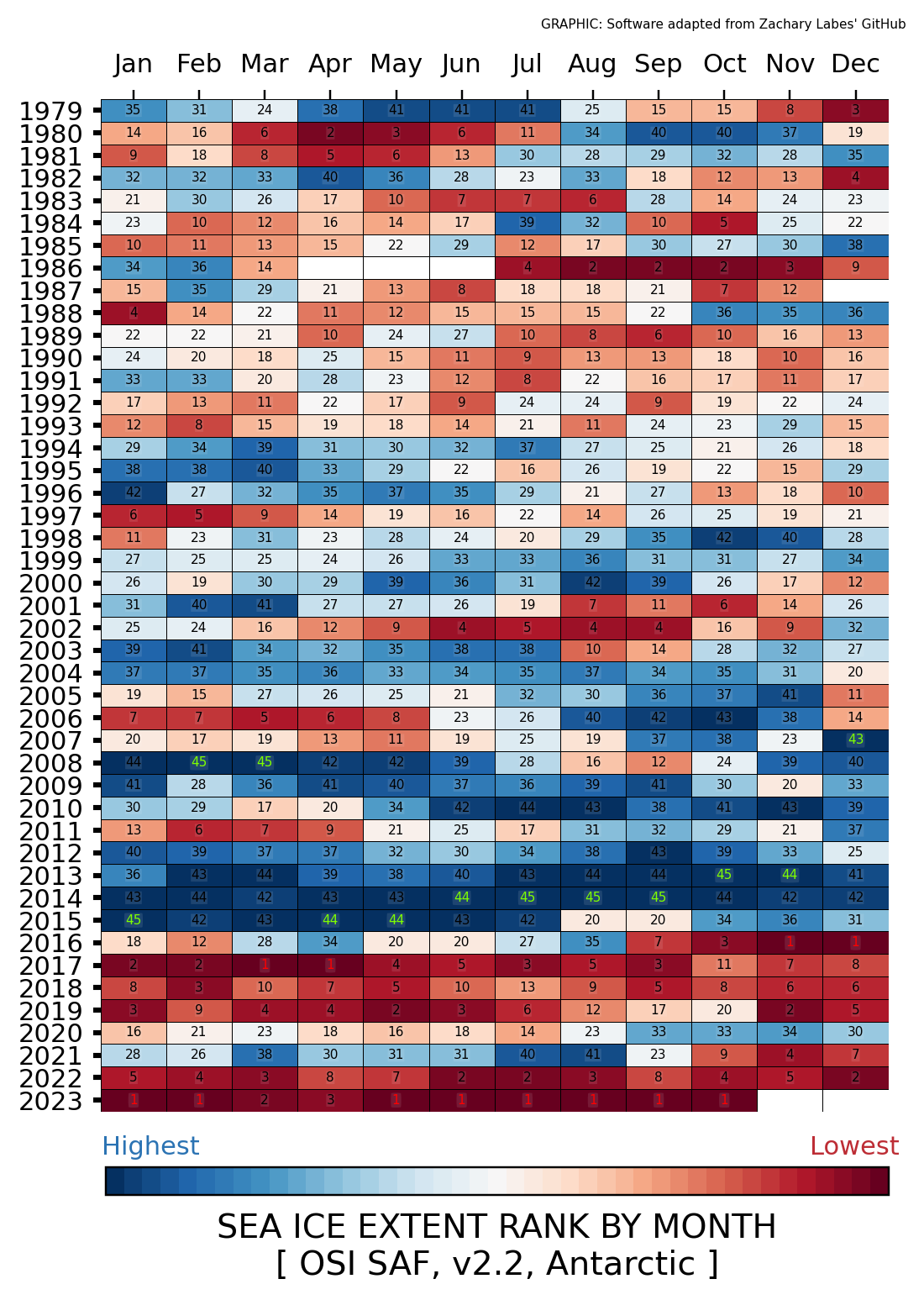
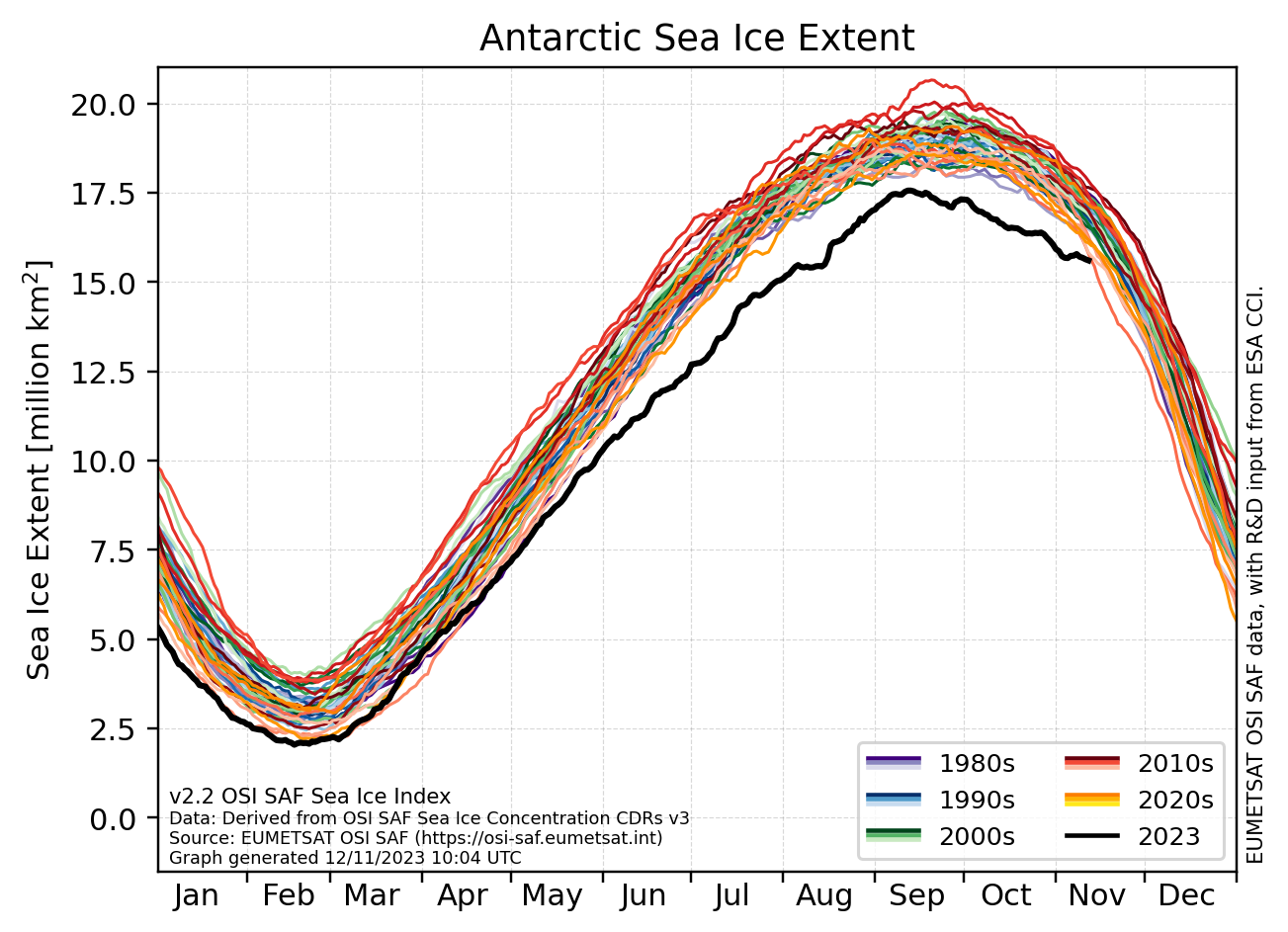
Monthly sea ice extent ranked by month also processed by OSI SAF. 2022 and 2023 are both extremely low.
Since then, some of what was lost has been recovered, but when the sea ice peaked in September 2023, 1.75 million square kilometres of sea ice was still missing. This is equivalent to about 40 times the area of Denmark.
“The melting sea ice in Antarctica is not unexpected in itself, because we have long predicted that it would disappear due to global warming,” Ruth Mottram, senior climate researcher and glaciologist at the Danish Meteorological Institute (DMI) tells Videnskab.dk.
The climate seems to be changing before our eyes.
2023 has seen record high temperatures both on land and in the sea, which you can read more about in the article ‘Is the climate running out of control like in ‘The Day After Tomorrow’?
“But to suddenly have a very, very large disappearance like that is a big surprise. We can’t explain why it happened, and our models can’t recreate it either,” she says, but adds that over time, the models are getting closer to reality.
Disturbances in the Earth’s system are probably connected
Videnskab.dk has in a series asked five leading Danish scientists to assess the state of the climate from their chair – in this article Ruth Mottram.
The OCEAN:ICE project The researchers in OCEAN:ICE, led by Ruth Mottram as principal investigator, will take measurements below the ocean surface. This will provide more knowledge about the temperatures in the ocean around Antarctica. They will also calculate how fast the ice is melting in Antarctica due to ocean processes and warming in the air. They will also investigate what the lack of sea ice means for the rest of the Antarctic system. Ruth Mottram cites as examples: How does it affect ecosystems? For example, many animals feed on the small crustacean krill, whose life is affected by sea ice. Will more waves now reach the Antarctic ice sheet and perhaps lead to more icebergs and more melting? Will glaciers and icebergs become more sensitive to heat? Or, on the contrary, will less sea ice trigger more snow over the continent, which could even stabilise the glaciers? More specifically, researchers will focus their efforts on seven areas, which you can read more about on the OCEAN:ICE website.
In the project, researchers will, among other things, take measurements under the sea surface in Antarctica to gain more knowledge about how the ocean and ice interact.
Is melting sea ice linked to warm water in the Atlantic?
In the North Atlantic, sea surface temperatures in some places have been as much as five degrees above normal.
To an outsider, it seems obvious that this could have something to do with melting sea ice.
However, according to Ruth Mottram, the two factors are not necessarily directly related. Sea ice in Antarctica melts from below. Therefore, the temperature at the bottom of the sea is far more important than the temperature at the surface.
“But if there’s one thing I’ve learnt over the past 15 years working at DMI, it’s how interconnected the whole world is. So I think we’re seeing some disturbances throughout the Earth system that are unlikely to be completely independent of each other,” she says to Videnskab.dk.
Ocean Professor Katherine Richardson made the same point earlier in the series. You can read about it in the article ‘Professor: The oceans are warming much faster than expected’.
Lack of knowledge and observations
Ruth Mottram emphasises that far more observations from Antarctica are needed before we can say anything definite about the causes of the rapidly shrinking sea ice, but: “It could indicate that the Antarctic sea ice has a critical tipping point like the Arctic, where for a number of years we see a slow decline year by year, and then suddenly it drops to a new stability where it is very low compared to before.””But we don’t know, because there are parts of the system that we don’t understand and that we haven’t observed yet,” explains Ruth Mottram.
Possible reasons why sea ice is disappearing
Ruth Mottram talks a lot with international colleagues about why the sea ice is currently experiencing a significant decline.
She explains that there are different theories, for example that warmer water from below is coming into contact with the sea ice and melting it from below, and that warmer air may be feeding in from above.
In Antarctica, the direction and strength of the wind has a big impact on the state of the ice (click here for a scientist’s timelapse of how Antarctic weather changes rapidly).
Perhaps the sea ice has been hit by “a very unfortunate event”, where it is both being hit by warm water from below and being affected by weaker winds from changing directions, which is holding back the recovery of sea ice.
Again, more research is needed.
Melting ice also contributes to sea level rise, and the Earth is actually designed so that melting in Antarctica hits the northern hemisphere much harder than melting in Greenland. So, bad news for the ice in Antarctica is bad news for Denmark.
Even more bad news is on the horizon.
The natural weather phenomenon El Niño looks set to get really strong over the next few months. A so-called Super-El Niño will likely only make the world’s oceans even warmer.
“We know that the ocean is going to be really, really important in the future in terms of how fast the Antarctic ice is melting and what that will mean for sea level rise,” says Ruth Mottram. We can’t just wish the world would look different
The climate scientist does not fear huge increases or a violent change in climate overnight, as depicted in the 2004 disaster film ‘The Day After Tomorrow’. She points out that even abrupt shifts in the Earth’s past climate have occurred over decades or centuries, not a few months or years. Still, Ruth Mottram thinks it makes sense to start talking a little more openly about how we tackle severe sea level rise – which on a smaller scale can still be sudden – and large-scale climate change.
The Antarctic ice sheet is the largest on the planet
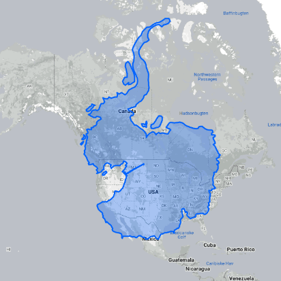
Figure made on http://www.thetruesize.com showing how Antarctica is roughly 1.5 times the size of the USA.
The Antarctic ice sheet contains around 30 million cubic kilometres of ice. This means that around 90 per cent of all fresh water on Earth is frozen in Antarctica.
If all the ice sheet in Antarctica melts, the world’s oceans will rise by around 60 metres. Even if we stay within the framework of the Paris Agreement, we risk that melting Antarctic ice from Antarctica will cause sea levels to rise by 2.5 metres.
Ruth Mottram notes that the more we exceed the limits of the Paris Agreement, the faster sea levels rise – and slower if we act quickly and stay close to the set limits of preferably 1.5 and maximum 2 degrees of temperature rise compared to the 1800s.
“The Earth’s climate system may be shifting towards a new equilibrium, which could result in a different world than we have grown up with,” continues Ruth Mottram.
“It is already affecting us and will do so increasingly in the future. That doesn’t mean it will be a total disaster, but we will probably get to the point where we have to adjust our lifestyles and societies.”
“It won’t necessarily be simple or easy to do so, but we can’t just wish for the world to be different than it is,” says Ruth Mottram.
“We are in the process of allowing future generations to accept that large areas of land will become uninhabitable because the water level rises too much,” he says. ‘Bipolar’ researcher: Keep an eye on Greenland too
In the short term, Ruth Mottram is interested in finding out what the consequences of El Niño will be and how Antarctica will change over the next few years.
But she also has her sights set on Greenland.
“Because there have been so many weather events elsewhere, it has gone a bit unnoticed that we’ve had a really high melt season in Greenland this year.
“It can give us the opportunity to see very concretely how weather and climate are connected. That’s why the next few years will be really interesting in Greenland,” says Ruth Mottram, who has also conducted research in the Arctic for many years.
The next article in Videnskab.dk’s series on the state of the climate will focus on Greenland.
The project is led by Professor Christine Hvidberg at the Niels Bohr Institute and there is a really nice interview with her on their website about our plans that’s worth a read. I’m co-PI and lead on surface mass balance processes and coupled climate models within the project so I thought it might be worth giving a quick overview of what we hope to achieve.
TL;DR? We will be improving estimates of and assessing the uncertainties in sea level rise projections from the two big ice sheets in Greenland and Antarctica.
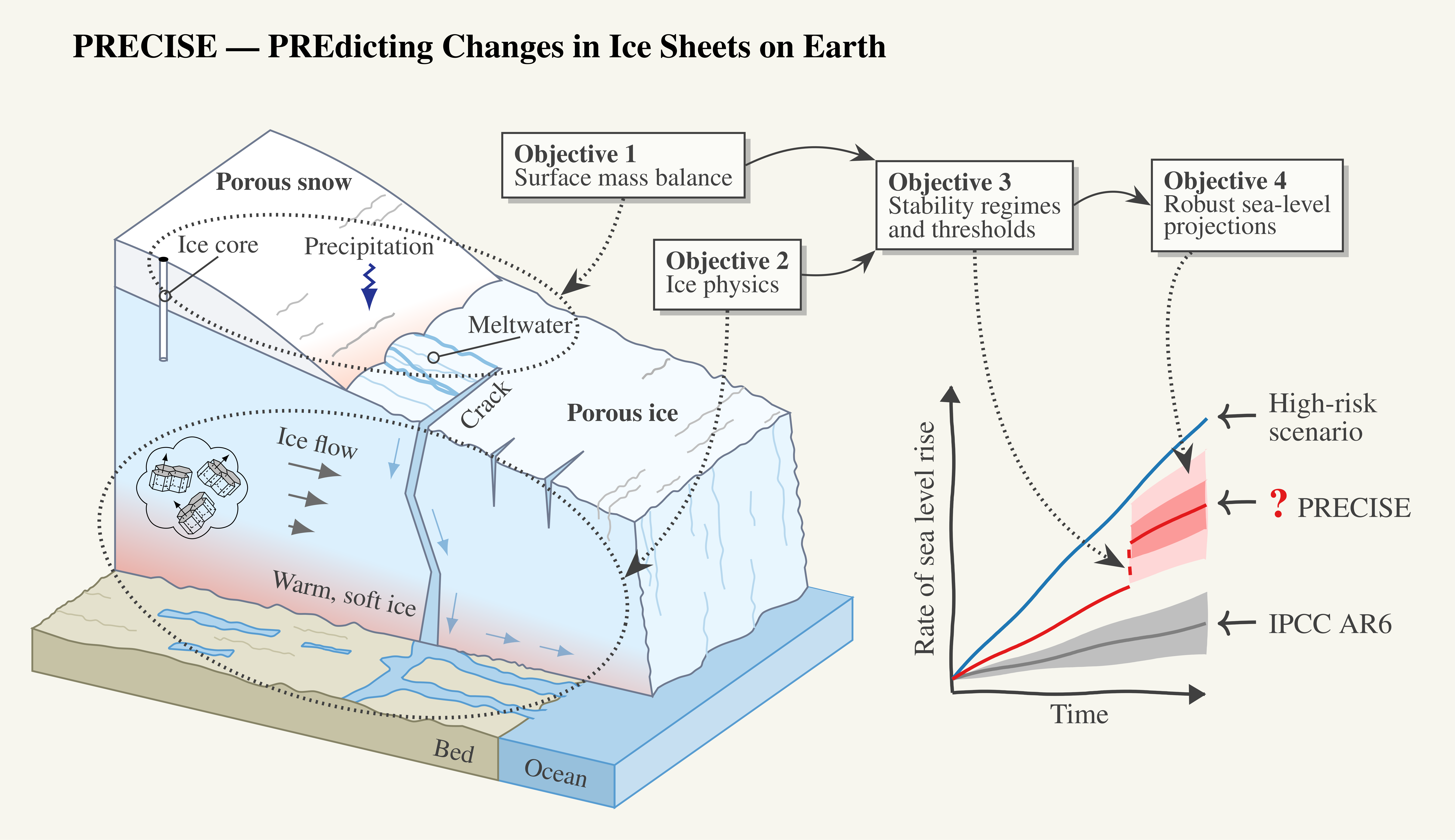
Every science proposal has a graphic like this somewhere showing how the whole project hangs together. This is ours…
Slightly longer version: we’re using new approaches from materials science to incorporate “new” physics in ice sheet models. We’re also integrating in-situ observations and satellite data into our model frameworks and using these to train machine-learning tools. My work package will emulate our physics based numerical climate models to expand the ensemble and generate a statistical approach for assessing ice sheet stability as well as investigating important feedbacks between different elements of the earth system. Finally, we (or rather my colleague Christian Rodehacke and his postdoc) will run our coupled climate – ice sheet model (EC-EARTH-PISM), including these advances, to generate new sea level rise projections.
The outputs from all these experiments will be communicated and developed in collaboration with the Danish Klima Atlas (Climate Atlas) to ensure we are focused on the right kind of data and time periods for use by stakeholders and local populations when it comes to adaptation planning.
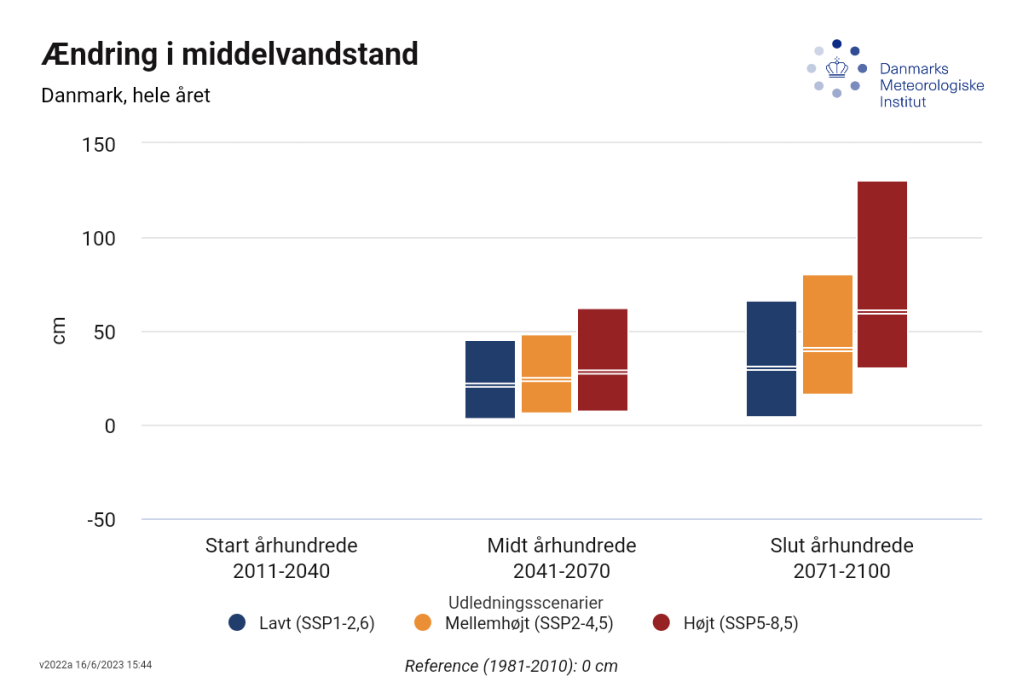
Current projections of change in average sea level around Denmark from the klima atlas
So why this project?
One of the most iconic images to come out of the last IPCC 6th asessment report (at least in my little corner of the climate science universe) is this one on sea level rise projections out to 2100.
Much of climate science has, at least to some extent been “solved”. At least in the sense that we understand the mechanisms and processes quite well and the remaining uncertainty is to some extent tinkering around the edges, often bound up with uncertainty on scenario, or related to impacts – there’s still quite large uncertainty on what will happen to the Amazon rainforest at different levels of emissions for example. However, sea level rise is really an exception to this. It’s very difficult to be sure that some very unpleasant surprises are really implausible.
The IPCC for example, concluded that sea level rise of 15 metres or more by 2300 can’t be ruled out, even if it seems rather unlikely. And this poses a pretty large problem to planners, politicians, stakeholders and providers of coastal services. Working out how far and how fast we expect the sea to rise is really our challenge.
But there is also a risk of abrupt and extreme sea level rise that could come round the corner to surprise us. However, it’s hard to know how likely this is or even how to evaluate that risk.
Where PRECISE differs is that we have the flexibility within this project to develop new and innovative techniques that we’re not quite sure will work: especially the development of machine learning tools.
The EU science budget is a brilliant thing, but risky research is difficult to get through, the Move Nordisk challenge centres allow us to try really new and, yes, risky techniques. Though climate is a new topic for them, so we’re very much test bunnies in this new phase of funding science for them.
So what are we going to be doing practically?
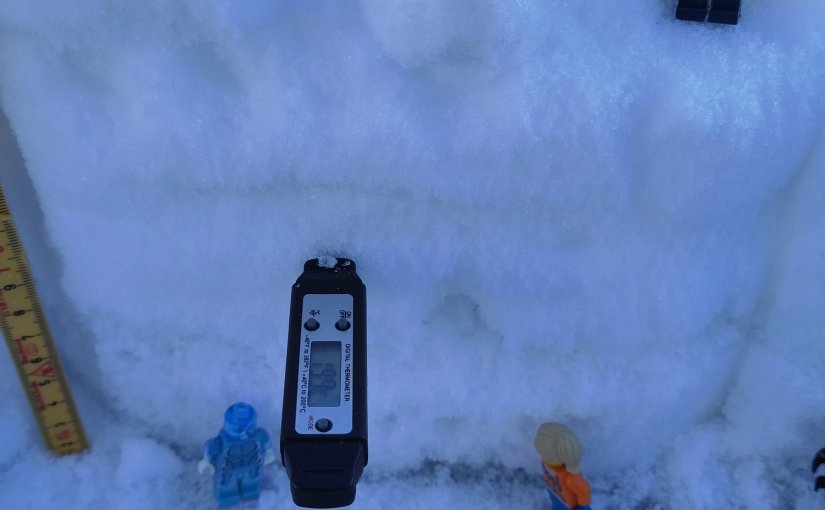
Measuring snow pack properties in Greenland, with the help of the Lego scientists..
Our partners at NBI include Joachim Mathiesen, Helle Astrid Kjær, Aslak Grinsted and Nicholas Rathmann. They will be focusing on assembling field data from both ice sheets, and developing new physical solutions for ice sheet models based on solutions from materials science. They will be looking at phase field approaches for ice flow, at new solutions for calving and ice fracture and integrating these into ice dynamical models. NBI will also be doing fieldwork to collect new surface mass budget (SMB) data from the ice sheets.
A new ice fracture appears, how to understand and model these is a key part of the NBI contribution in PRECISE project.
The SMB part of the work is part that I’m especially involved in. Not just in modelling SMB with our climate and weather models as we do on the polar portal but also in getting a much better understanding on the uncertainty in these models associated with precipitation (which is much higher than that associated with e.g. temperature, especially when it is snowfall). So new observations with a high time resolution will be key for improving our current snowpack models.
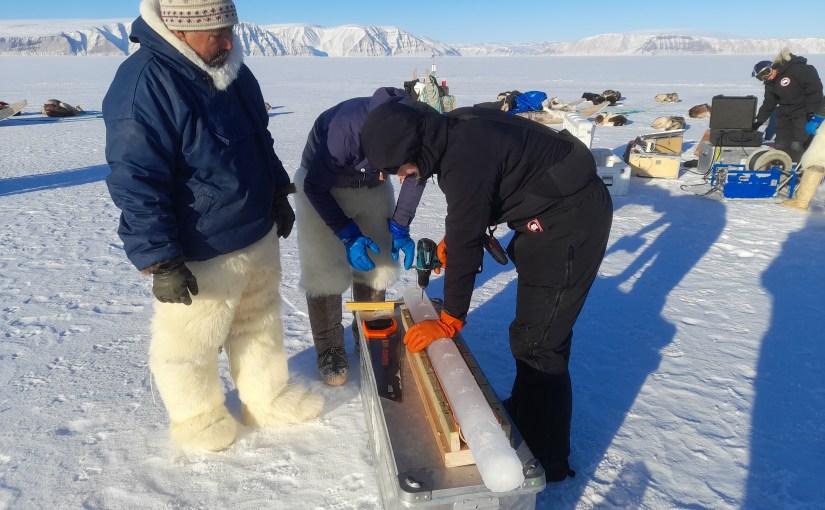
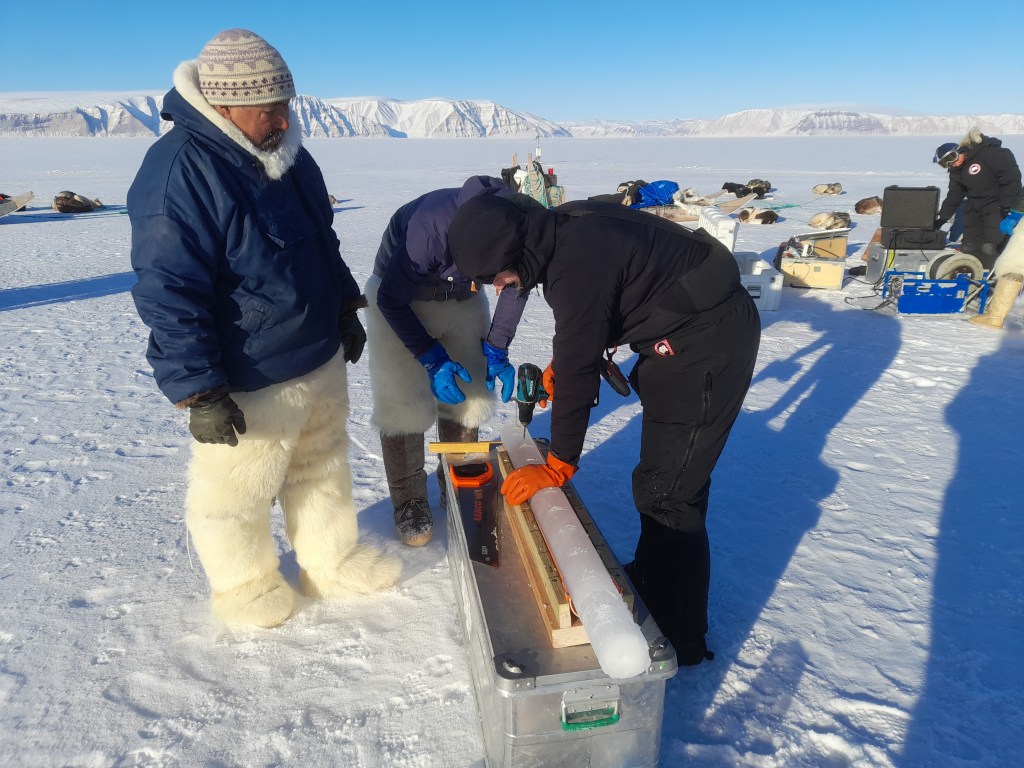
A shallow ice core, in this case sea ice, but part of the fieldwork will focus on taking more of these samples and doing isotope analysis on situ to get high quality data on snowfall accumulation
We will also be working on bringing regional climate emulators into use over both ice sheets to see how varying starting conditions will vary the outcomes. We know that on a chaotic system like weather starting conditions are key and emulators allow us to do many many more experiments than with our physics based numerical codes alone. It’s pretty cutting edge stuff right now but I know several groups are working on this – including this fantastic paper that recently came out of the Delft/Leuven group, which really shows what is possible
Our other collaborator, Hilmar Gudmundsson at University Northumbria Newcastle will be working on implementing these processes in ice sheet models and examining how plausible instability in ice sheet simulations is using ensembles of multiple model simulations. They will also be using and developing their ice shelf emulator to look at basal melting and investigating the potential instabilities in Antarctic ice shelves that could lead to abrupt sea level rise.
The project will receive 42 million Danish kroner in total (about 5 million euros) of which 8 million dkk will fund work at DMI, work to be carried out by 2 postdocs and a PhD student (so if this sounds like something you’d be interested in working on do get in touch) over the next 6 years from September. In fact most of the funding we have received will go directly to early career scientists, there is nothing in the budget for us seniors! Naturally this has some disadvantages, but given the rapidly aging population within Europe and European science, I see it as a positive and we have lots of cool summer schools, bootcamps and other networking activities planned that will hopefully reach out beyond PRECISE to the rest of the ice sheet – climate community.
My employer DMI, and specifically my team at the National Centre for Climate Research are recruiting.
Not an earth-shattering revelation perhaps but these are premium research jobs, and this is probably a once in a generation opportunity in Denmark.
Let me explain. They are full time and permanent positions, working right at the cutting edge of both basic climate research, and importantly, climate services. You can see the full adverts at the links below:
DMI scientists collaborating with local hunters in the field in Greenland
I call these positions once in a generation positions because these kind of positions just don’t come up very often. Part of the reason these are now available is related to the generation change* that is coming to DMI. Right now we are fortunate also to have a number of large EU funded projects as well as danish funding for our Climate Atlas and new hydrology department which is giving us the opportunity to plan for the long term.
Sea level rise is an existential threat for Denmark, at least in the long term and we are putting a great deal of effort not just into the science of melting ice, tipping points and so forth to try and assess the potential risks, but also into planning climate adaptation and mitigation in the short and medium term.
The new positions related to climate and ice sheets and sea level rise will have some flexibility with them in terms of how the jobs evolve and research directions. There will certainly be opportunities for whoever is hired to steer in their own direction and initiate their own research programmes within the broad frame of the topics. I can certainly also only praise the management for the generally supportive and research positive encouragement.
I’d like to help cast the net wide and deep to get as strong a pool of candidates as possible, so please do feel free to get in touch with me either here or via the usual email, and other social media feeds if I can help at all. And if you have good students, postdocs or others, please do share.
We will be holding some “open house” events where you can come in person to visit DMI or sign on in a virtual event to hear more about the positions, about DMI and what it’s like to work in Denmark. Again get in touch to hear more about those.
*”Generations skift” in Danish – I have not looked at the statistics but I suspect many public institutes, including weather and climate services are greying. There was an expansion during the 80s and 90s as numerical techniques became more widespread and integrated into weather prediction and by extension climate – many of the staff employed then are getting close to retirement. In my view DMI is wise to start trying to replace these staff now so there will be continuity and knowledge exchange before it becomes a problem.
In the before times I would usually spend this week walking around a world class city humming an old 80’s hit (- don’t ask me why it was so durable in my head, probably something to do with being an impressionable age at a time when access to pop music meant half an hour on a Thursday evening).
Anyway, it is the time for EGU… Sadly I will not be wandering the streets of the ever beautiful (and most livable) capital of Austria this year. I have to get some actual work done, but I’m following the #EGU23 on mastodon and hoping to catch a few highlights on the sides. I do have a poster, which will be capably presented by PolarRES PI Priscilla Mooney and my DMI Colleague Abraham Torres on Thursday.
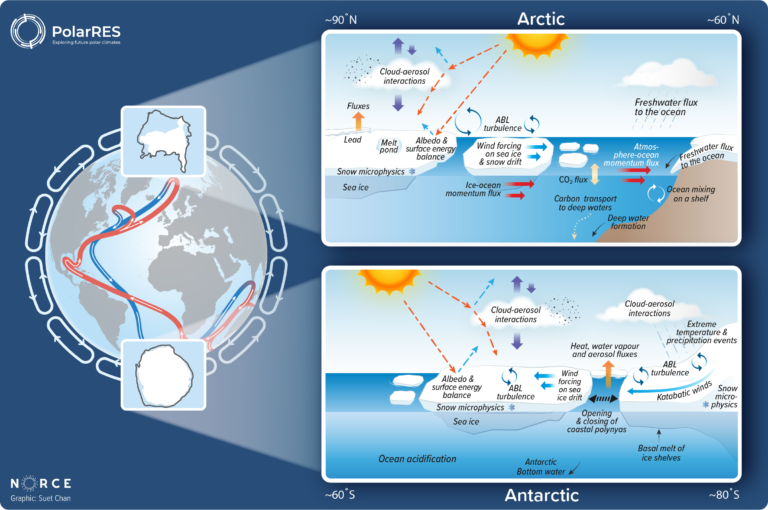
The topic is our PolarRES project – an ambitious Horizon 2020 effort to produce a large ensemble of regional climate simulations over both poles. These are state-of-the-art regional climate models run at unprecedented high spatial resolution and all data will be made open access and free via the CORDEX project.
I will also put it here later – feel free to comment here or ask questions on mastodon or get in touch by email if it sounds exciting.
Other posters and talks I’ve contributed to from PolarRES are
Kristiina Verro’s talk on HCLIM_Arome results from the Antarctic peninsula:
Verro, K., van de Berg, W. J., Orr, A., Landgren, O., and van Ulft, B.: New non-hydrostatic polar regional climate model HCLIM-AROME: analysis of the föhn event on 27 January 2011 over the Larsen C Ice Shelf, Antarctic Peninsula, EGU General Assembly 2023, Vienna, Austria, 24–28 Apr 2023, EGU23-13864, https://doi.org/10.5194/egusphere-egu23-13864, 2023.
Abraham Torres joined our group last year and is primarily working on PolarRES also. He will show some of our preliminary HCLIM results for both the Arctic and the Antarctic
Torres-Alavez, A., Landgren, O., Boberg, F., Christensen, O. B., Mottram, R., Olesen, M., Van Ulft, B., Verro, K., and Batrak, Y.: Assessing Performance of a new High Resolution polar regional climate model with remote sensing and in-situ observations: HCLIM in the Arctic and Antarctica, EGU General Assembly 2023, Vienna, Austria, 24–28 Apr 2023, EGU23-14090, https://doi.org/10.5194/egusphere-egu23-14090, 2023
Quentin Glaude is a collaborator from Liege in the Horizon 2020 PROTECT project on sea level rise contributions from the cryosphere . Baptiste Vandecrux, a former PhD student with me here and now working at GEUS is also presenting some work based on the same models as Quentin, with a comparison to the PROMICE observation statons on the Greealnd ice sheet. It’s very cool application of machine learning and the results are very interesting.
Glaude, Q., Noel, B., Olesen, M., Boberg, F., van den Broeke, M., Mottram, R., and Fettweis, X.: The Divergent Futures of Greenland Surface Mass Balance Estimates from Different Regional Climate Models, EGU General Assembly 2023, Vienna, Austria, 24–28 Apr 2023, EGU23-7920, https://doi.org/10.5194/egusphere-egu23-7920, 2023
Vandecrux, B., Fausto, R. S., Box, J. E., Covi, F., Hock, R., Rennermalm, A., Heilig, A., Abermann, J., Van As, D., Løkkegaard, A., Fettweis, X., Smeets, P. C. J. P., Kuipers Munneke, P., Van Den Broeke, M., Brils, M., Langen, P. L., Mottram, R., and Ahlstrøm, A. P.: Historical snow and ice temperature compilation documents the recent warming of the Greenland ice sheet, EGU General Assembly 2023, Vienna, Austria, 24–28 Apr 2023, EGU23-9080, https://doi.org/10.5194/egusphere-egu23-9080, 2023.
Nicolaj Hansen (who finished his PhD with me and Sebastian Simonsen at DTU Space last year) has just submitted a beauty of a paper which he will talk about – also partof PROTECT.
Hansen, N., Sørensen, L. S., Spada, G., Melini, D., Forsberg, R., Mottram, R., and Simonsen, S. B.: ICESat-2 Ice Sheet Mass balance: Going below the surface, EGU General Assembly 2023, Vienna, Austria, 24–28 Apr 2023, EGU23-12349, https://doi.org/10.5194/egusphere-egu23-12349, 2023
Mathias Larsen is a current Phd student with me and is presenting a poster on the CARRA dataset and an application in surface mass balance modelling. This work falls under the danish National center for klima forskning
Larsen, M., H. Mottram, R., and L. Langen, P.: CARRA-driven simulation of Greenland Ice Sheet surface mass balance at 2.5 km resolution, EGU General Assembly 2023, Vienna, Austria, 24–28 Apr 2023, EGU23-5852, https://doi.org/10.5194/egusphere-egu23-5852, 2023
Last year I co-organised a bootcamp for early career researchers on Arctic processes in the CMIP6 models. It was super fun and would not have been possible without the support offered by Anne Fouilloux, Tina Odaka and colleagues from the Pangeo project. Their poster is super interesting and if you’re interested in optimising the use of big climate data, go and check it out!
Fouilloux, A., Marasco, P. L., Odaka, T., Mottram, R., Zieger, P., Schulz, M., Coca-Castro, A., Iaquinta, J., and Eynard Bontemps, G.: Pangeo framework for training: experience with FOSS4G, the CLIVAR bootcamp and the eScience course, EGU General Assembly 2023, Vienna, Austria, 24–28 Apr 2023, EGU23-8756, https://doi.org/10.5194/egusphere-egu23-8756, 2023.
Excitingly, at least 3 of the projects at the bootcamp will also be presented at EGU this year. So, lots to be getting on with, for now, here’s a link to Ultravox’s finest…





 Sterna Paradisaea