Looking backwards…

This is the first in a two-parter. At this time of year, posts making bold statements about what happened last year and what we plan to do this year start to become prominent. The last few years I have spent a few hours in the first week of January reviewing what worked, what was fun and what was cool, what was awful and what definitely was a waste of time. I’m not honestly sure that any of this is of interest to anyone except me, so read on, but you have been warned..

2024: Themes of this year: Greenland, Machine Learning, people, and big data…

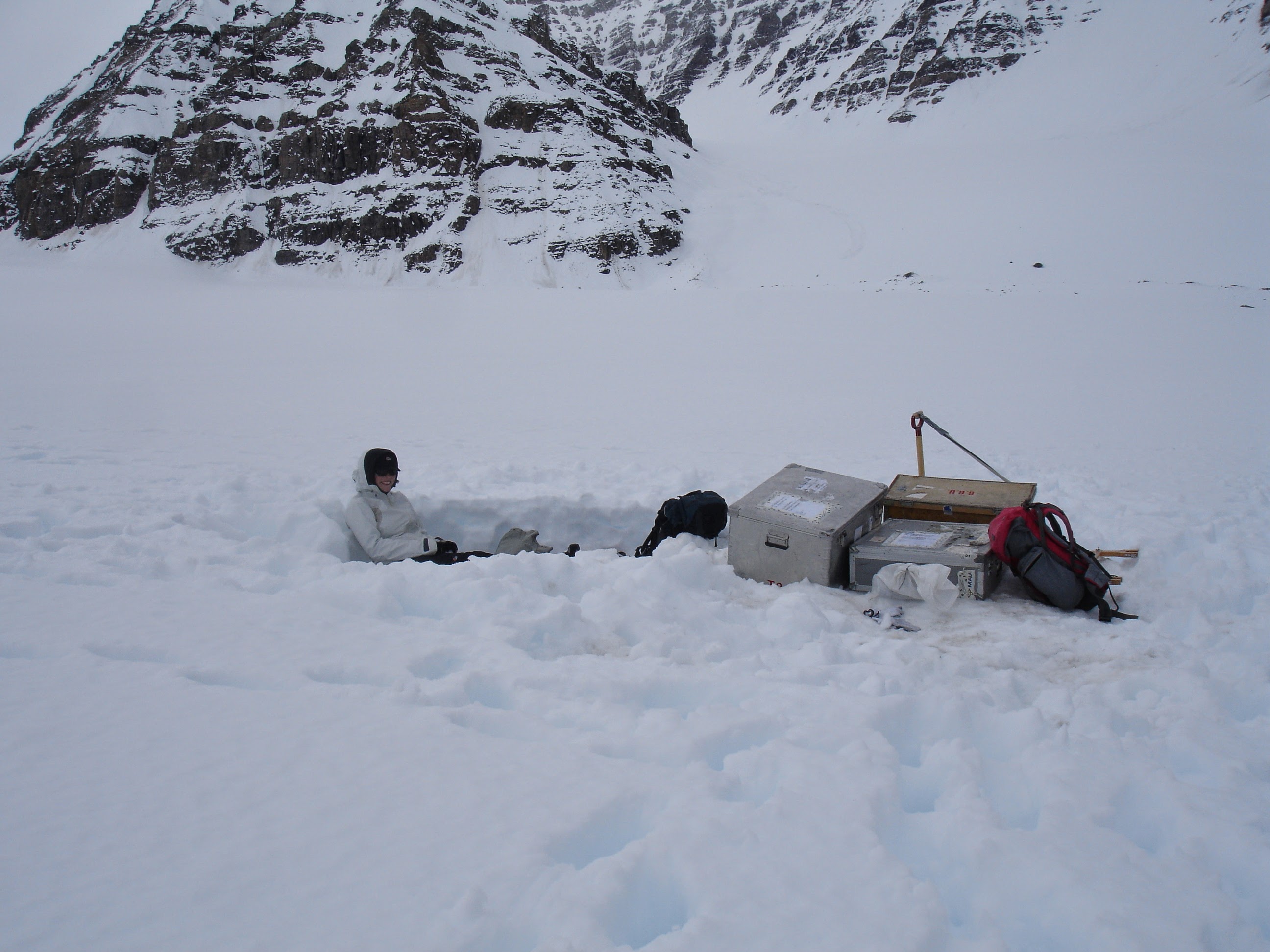
I visited the world’s largest island 3 times this year – a rather unprecedented number of times for me, with fieldwork in April (it was very cold and there was a lot of snow) to continue a soon to be submitted for publication set of observations in the melange zone and then to establish a new snow observation site.

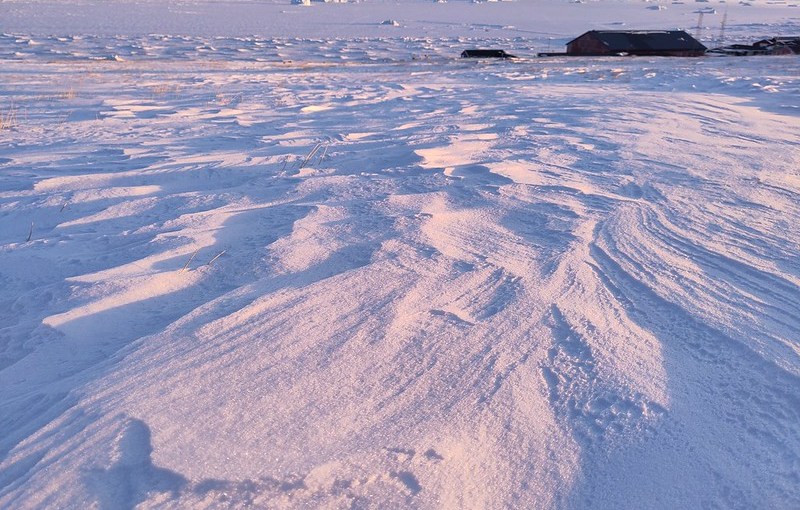
View from Qaanaaq at evening in early April 2024.

In late May and early June, after a slightly longer than expected stop in Ilulissat, we made it to bring in the instruments before the sea ice break-up and happily my new snow observations seem to be working. Now I just need to do set-up the data processing chain, which will be 2025’s paying myself first.

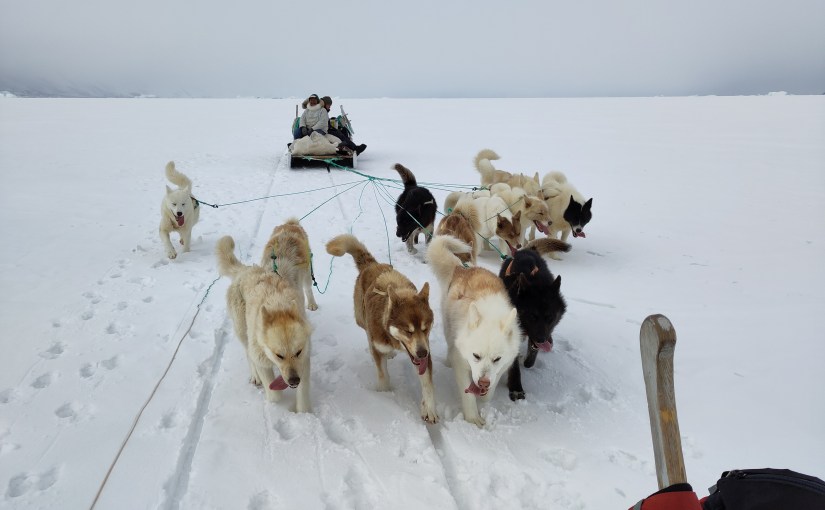
Working with scientists from the Greenland natural resources institute and local hunters on the sea ice.

The final trip was in October for a workshop with scientists in Greenland about climate change impacts in Greenland, the subpolar gyre and AMOC for the UN Ocean decade. It was a memorable meeting for the sheer range and quality of science presented as well as for being stranded in Nuuk by a broken aeroplane in quite ridiculously beautiful weather (I mostly stayed in my hotel room to write the aforementioned paper, sadly. In 2025 I will work on my priorities) .

Apart from fieldwork I have really tried hard on publications this year. I have (like many scientists I suspect), far more data sitting around on hard drives than I have published. It’s a waste and it’s also fun to work on actual data instead of endless emails. This is something I intend to continue focusing on the next few years as well. There is gold in them thar computers…

We had a couple of writing retreats were very successful. These I plan to continue also and the PRECISE project grant is happily flexible enough to do this. I probably achieve as much in terms of data processing and paper writing in 3 focused days as I would in 3 months in the office. It paid off too. I managed to co-author 8 papers published this year (including my first 1st-author paper in ages – a workshop report, but nevertheless it counts.). Some of these are still preprints, so will change, and there are a couple more that have been submitted but are not yet available as preprints. I will submit two more papers in the next 3 weeks as well (1 first author), so January 2025 is going to be the 13th month of 2024 in my mind.

Bootcamps have been a theme the last 3 years, I organised the first in 2022 and so far there have been 4 publications from that first effort. There was another this year in June, ( I have attended them in 2023 and 2024 but was not organising) where we really got going on a project for ESA that I have had my eye on for a while – I hope the publication from that will be ready in the Spring this coming year.

Machine Learning: This was the year I really got machine learning. I’ve been following a graduate course online, and learning from my colleagues and students about implementations. I understand a lot more about the architecture and how to in practice apply neural networks and other techniques like random forests now. This is not before time, as we intend to implement these to contribute to CMIP7 and the next IPCC report. We still have a lot of work to do, but the foundation is laid. And it’s been fun to learn something that, if not exactly new, is a new application of something. In fact the biggest barrier has really been learning new terminology. We have also been fortunate that Eumetsat and the ECMWF have been very helpful in providing us with ML-optimised computer resources to test much of these new models out on. We’re actually running out of resources a bit though, so it’s time to start investigating Lumi, Leonardo and the new Danish centre Gefion to see what we can get out of these.

People: This year our research group has grown with another 2 PhD students, and at the end of the year we also employed a new post-doc. I think it’s large enough now. I’m very aware that if I don’t do my job properly, then not only the research but the people will suffer, so developing people management skills is really important. In any case it’s extremely stimulating to work with such talented young people and I’m really excited to see where the science will take us, given the skills in the team. I hope I have been good enough at managing such a large and young team, but I have my doubts. A focus for 2025 for sure.

Data: This has been the year of big data, not necessarily just for ML purposes but also in the PolarRES project the production and management of an enormous set of future climate projections at very high resolution. More on this anon. Suffice to say, it has taken a lot of my time and mental energy and it’s probably not the most exciting thing to talk about, but we now have 800 Tb of climate simulation data to dig into. I suspect that rewards of this will be coming for years. There has also been a lot of digging into satellite datasets and the bringing together of the two has been very rewarding already. It’s a rich seam, to continue the metaphor, that will be producing scientific gold for many years.

Projects: we have gone in the final year of two projects, PROTECT and PolarRES, both of which will finally end in 2025. We also arrived at the half way point of OCEAN:ICE. So rather than being a year of starts, it has been a year where we have started to prepare for endings – actually this is a fun part of many projects where a lot of the grunt work is out the way and we can start to see what we have actually found out. It can also be a slog of confusing data, writing and editing papers and dealing with h co-author comments. I’ve definitely been in that process this year, hopefully with some of the outputs to come next year…

Proposals: I started 2024 writing a proposal. Colleagues were in 3 different consortia for the same call, alas ours didn’t get funded, but 2 of the others did and will start this year. That is a good result for DMI and our group. I wrote another proposal in the Autumn and contributed to a 4th and finally at the end of the year I heard that both will *likely* be funded (but are currently embargoed and in negotiation, so no more will be said now). It sometimes feels that spending so much time and energy on proposal writing is putting the cart before the horse, but in fact I find proposal writing something akin to brainstorming. It’s essential of course to ensure we can continue to do the science we want, but it can also help us to clarify our ideas and make sure we’re not on the wrong track. It’s also a good way to keep track of what the funders are actually wanting to know and to help us focus on policy relevance.
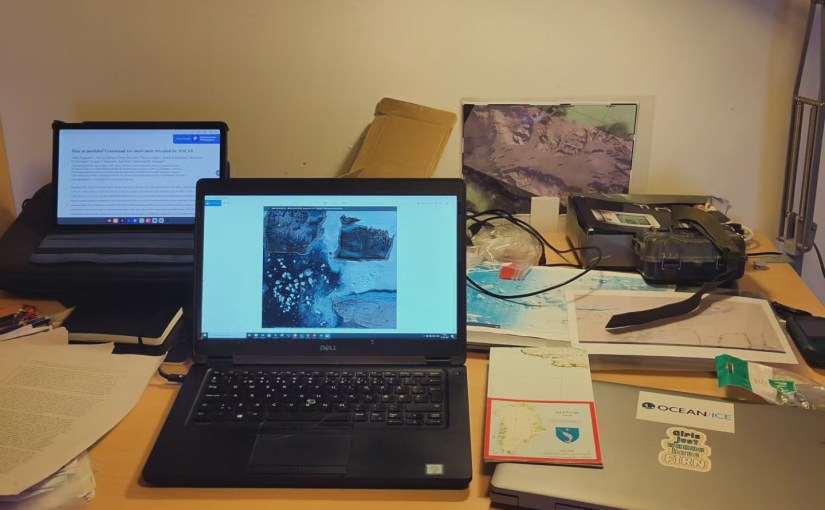
There was also an incredible number of meetings, reports, milestones and deliverables, but you probably don’t want to hear about that…

Also missing from this summary is personal life, and, well that is not for sharing publically, but suffice to say, I learnt about raising teenagers, I also had some very good times with friends and family, to all of whom I immensely grateful for being a part of my voyages around the sun.

Anyway, reading all that back, I’m not surprised I ended the year exhausted! I am not planning on quite such a slog in future. I should probably pace myself a bit more this year, the plans for which will be the subject of next week’s post.

Small differences that make a really big difference.
I’m a co-author on a new paper that has just come out in GRL. It’s based on simulations we did with our collaborators in the PROTECT project on sea level contributions from the cryosphere.  What Glaude et al shows is that, to quote the first of the 3 key points:

“With identical forcing, Greenland Ice Sheet surface mass balance from 3 regional climate models shows a two-fold difference by 2100”

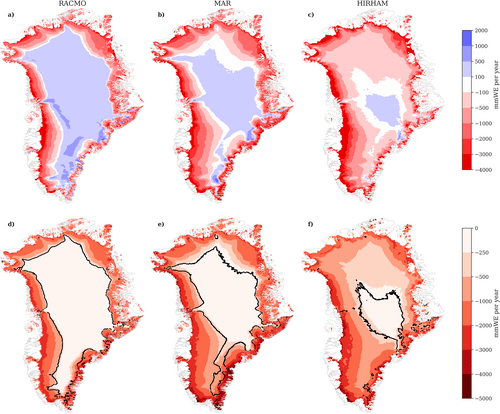
In perhaps more familiar terms, if you run 3 regional climate models (that is a climate model run only over a small part of the world, in this case Greenland) with identical data feeding in from the same global climate model around the edges, you will get 3 quite different futures. Below you can see how the 3 different models think the ice sheet will look on average between 2080 and 2100. The model on the right, HIRHAM5 is our old and now retired RCM. It has a much smaller accumulation area left by the end of the century than the other two, which have much more intense melt going on in the margins.

Greenland Ice Sheet annual surface mass balance (a, b, c, 2080–2099 average) and annual surface mass balance anomaly (d, e, f, 2080–2099 average relative to 1980–1999) [mm WE/yr]. From left to right, RACMO (a and d), MAR (b and e), and HIRHAM (c and f). The equilibrium line (SMB = 0) is displayed as a solid black line in (d-f). Glaude et al., 2024, GRL.

In fact, by the end of the century, although the maps above seem to show HIRHAM having much more melt, there is in fact more runoff from the MAR model, because of this intense melt.

Spatially aggregated annual GrIS SMB anomalies (a), total precipitation (PP, b), and runoff (RU, c) [Gt/yr]. The solid lines represent the anomalies using a 5-year moving average, while the transparent lines display the unfiltered model output.

The surface mass balance (SMB) at the present day is in fact positive. This often surprises people, but SMB as the name suggests, only describes surface processes. Ice sheets can (and do) also lose a lot of ice by calving and subglacial and submarine melt. As SMB should balance everything if a glacier is to remain stable or even grow, present day SMB is usually 300 to 400 GT positive at the end of each year, and even so the Greenland ice sheet loses, net around 270Gt per year.

Our work here shows that, at least under this pathway, not only does SMB become net negative in itself by the middle of this century, there are significant differences in SMB projections between the estimates of how negative it will be, between the three RCMs. The global model we used, CESM2 under the high-end SSP5-8.5 scenario, is famously a warm scenario, but our estimated end of the century SMBs are extraordinary : (−964, −1735, and −1698 Gt per year, respectively, for 2080–2099). As I’ve discussed previously, one gigatonne is a cubic kilometre of water, 360Gt is roughly 1mm global mean sea level rise. (Though note your local sea level rise is *definitely* not the same as global average!) Even the lowest estimate here the  is giving around 3 mm of global average sea level rise from surface melt and runoff *alone* by the end of this century each year. That’s pretty close to the modern day observed sea level rise from all sources.

And this is in spite of the fact that at the present day, the 3 models are rather similar in their estimates of SMB. The Devil is as usual in the details.

We attribute these startling divergences in the end of the century results to small differences in 1) the way melt water is generated, due to the albedo scheme (that is how the ice sheet surface reflects incoming energy); 2) but also due to the cloud parameters that control long-wave radiation at the surface, which again can promote or suppress melting. (We really need to know how much liquid water or ice there are in clouds, as this paper also emphasises in Antarctica); and 3) mainly down to the way liquid water that percolates down from the surface is handled in the snow pack. That is, how much air there is in the snowpack, how warm the snow is and how much refreezing can occur to buffer that melt.

The problem is that all of these processes happen at very small scales, from the mm (snow grains and air content), to the micron scale (cloud microphysics). That means that even in high (~5km) resolution regional models, we need to use parameterisations (approximations that generalise small scale processes over larger spatial and/or time scales). Small differences between these parameterisations add up over many decades.  Essentially,  much like the famous butterfly flapping its wings in Panama and causing a hurricane in Florida, the way mixed phase clouds produce a mix of water vapour and ice over an ice surface might ultimately determine how fast Miami will sink beneath the waves.

More data would certainly help to refine these parameterisations. The main scheme to work out how much liquid can percolate into snow was originally based on work by the US Army engineers in the 1970s. More field data with different types of snow would surely help refine these. Satellite data will be massively helpful, if we can smoothe out some wrinkles in how clouds (there they are again) affect surface reflectivity.

These 3 different types of processes also interact with each other in quite complex ways and ultimately affect how much runoff is generated as well as the size of the runoff zone in each model. So integration of many different types of observations is crucial.

“Different runoff projections stem from substantial discrepancies in projected ablation zone expansion, and reciprocally” as we put it in Glaude et al., 2024.

The timing and magnitude of the expansion of the runoff zone is quite different between the models, but all of them show a very consistent increase in melt and runoff over the next 80 years.

It’s probably also important to understand a couple of key points:

Firstly we ran a very high emissions pathway: SSP5-85 is probably not representative of the path we will follow in emissions (at least I hope not), but in this study we wanted to address the spread on different model estimates. And this is a way to get a good check on the sensitivity.

Secondly, the ice sheet mask and topography in these runs is kept fixed all the way through the century. This means we do not account for any elevation feedbacks (as the ice sheet gets lower because of melt, a larger area becomes vulnerable to melt because it’s lower and thus warmer), but we also don’t account for ice that has basically melted away no longer contributing to calculated runoff later in the century. Ice sheet dynamics are also not factored in.

Finally, we ran different resolution models, and that can have an impact particularly on precipitation and is one of the reasons why the new models we developed and have run in PolarRES (and which are now being analysed), have used a much more consistent set-up.

The 3 models we used, MAR, RACMO and HIRHAM have all been used in many different studies over both Greenland and Antarctica, but we haven’t really done a systematic comparison of future projections before. I think this work shows we need to get better at doing this to capture the uncertainty in the spread, especially when you consider that we’re now looking at using these models as training datasets for AI applications: training on each one of these models would give quite different results long-term. We need to think about how to both improve numerical models and capture that spread better. But ultimately, it’s how fast we can reduce greenhouse gas emissions and bend the carbon dioxide curve down that will determine how much of Greenland we will lose, and how quickly.

All data and model output from these simulations is available to download on our servers (we’re transitioning to a new one download.dmi.dk, not everything has been moved there yet). We also of course have data over land points and the surrounding seas, and we’ve run many more global climate models through the regional system to get high resolution (5km!) climate data also looking at different emissions pathways, if you’re interested in looking at, analysing or using any of this data – get in touch!

My warmest thanks to Quentin Glaude who led this analysis and special thanks to our colleagues in the Netherlands, France and Belgium for running these models and contributing to the paper analysis. Clearly, we have much work to do to get better at this ahead of CMIP7.

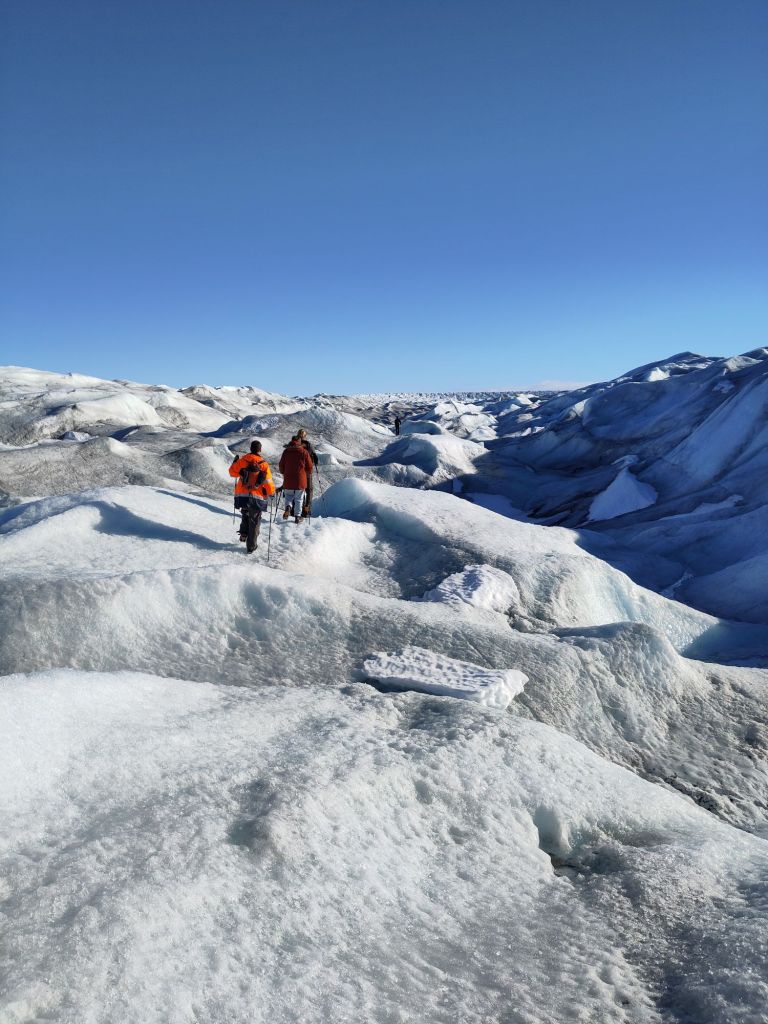
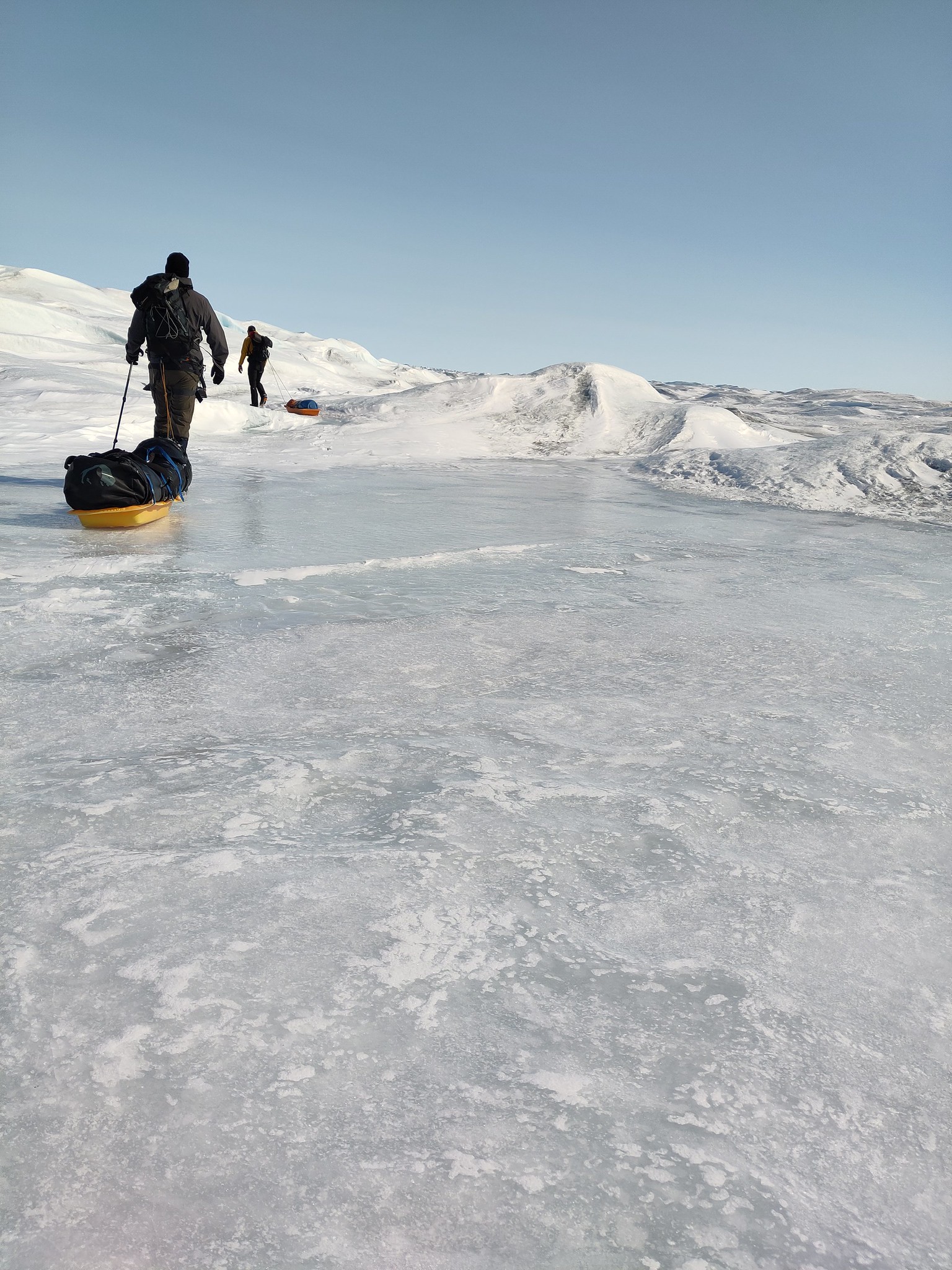
Group field trip the Greenland ice sheet: it’s important to see what you’re modelling actually looks like….

The curious case of the moving trees…

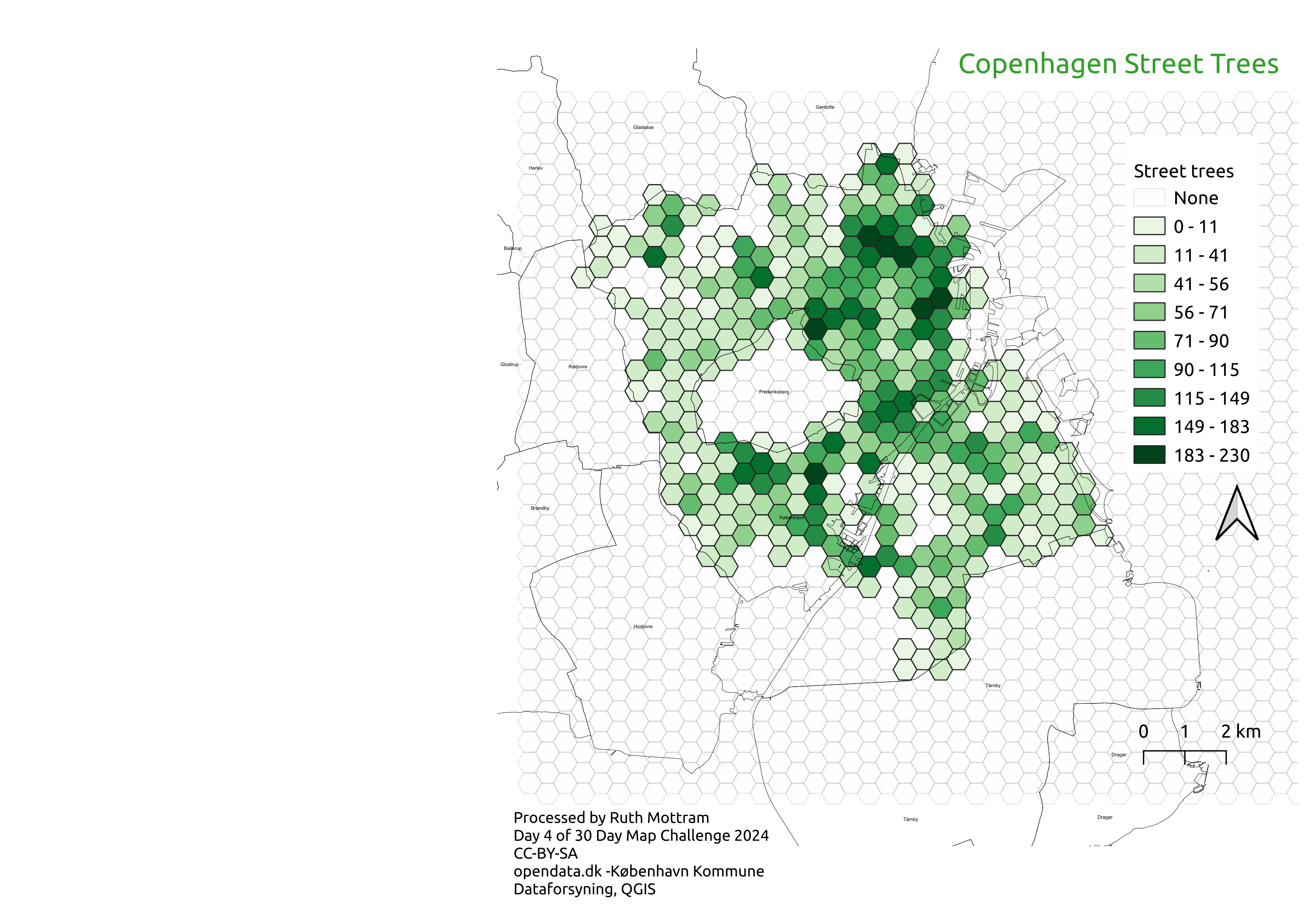
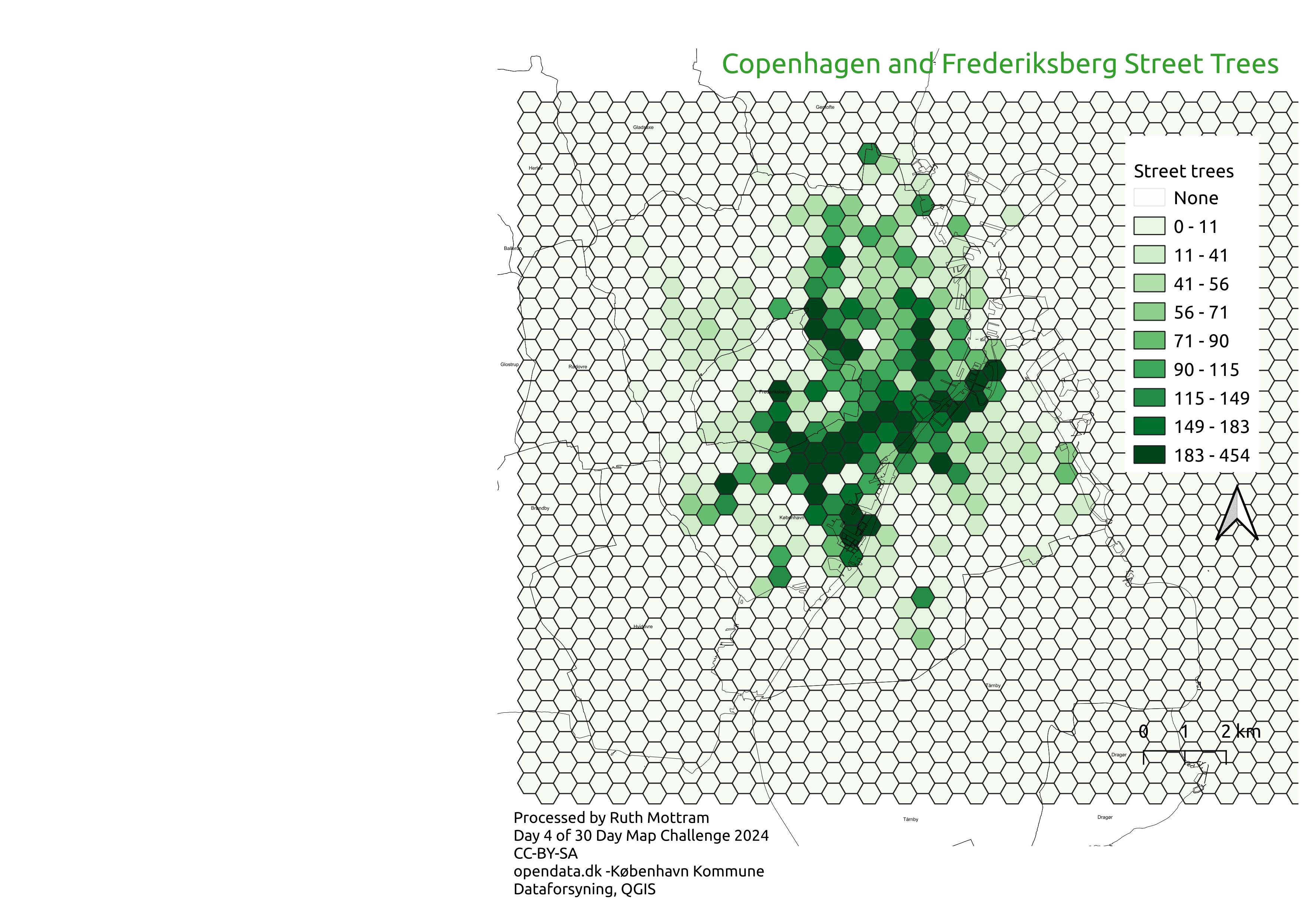
Yesterday in 30 Day Map Challenge I rather hurriedly made a map showing the density of street trees in Copenhagen shown as hexagons. However, there is a big gap in the overall map, because the dataset I used only covered Copenhagen Kommune (local authority) area and Frederiksberg is a separate local authority area where I could not find the data. This was, to put it mildly a little irritating.

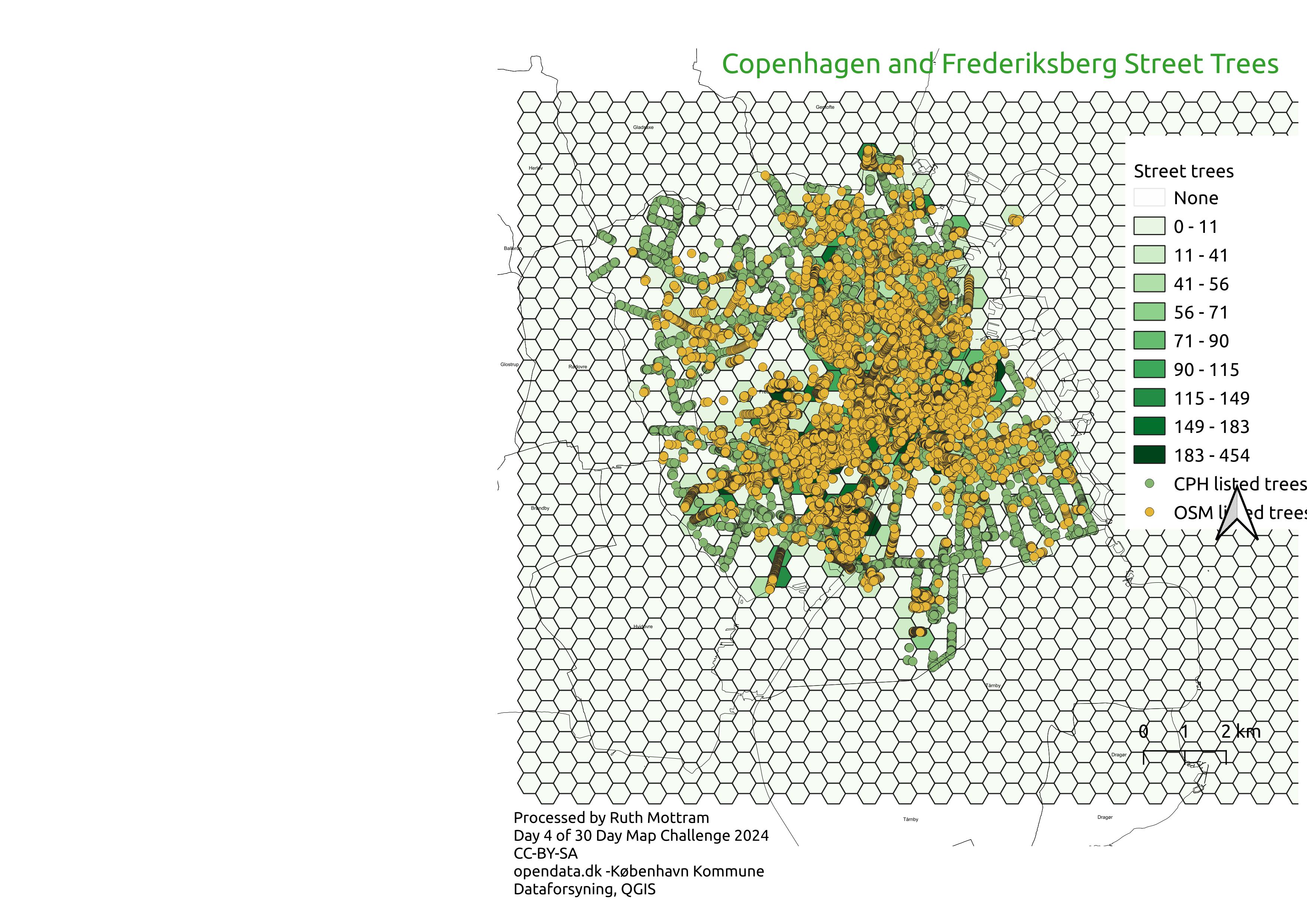
A fellow mastodon user (@tlohde) suggested using the outputs from openstreetmap to fill out the gaps. (And even helpfully provided some code to do so, which should tell you a lot about why I like mastodon so much). A very hurried 10 minutes reprocessing gives the revised map on the below, which has happily filled in much of the Frederiksberg gap. However, a closer comparison with the previous version above shows that, it’s not nearly the same…

The first thing to note is that the maximum number of trees in a polygon from the OSM data is 454, almost twice the 230 from the Copenhagen city council data set. The second thing is that I’m unsure exactly what time periods the Copenhagen data is from. It’s possible there has been a wholesale planting since the original data was collected, but there is no date on the opendata.dk page to indicate when it was sampled, so I can’t know how up to date it is. Openstreetmap may also be missing data of course (and a small remaining gap in northern Frederiksberg suggests it might be). However, the whole central axis of the plot has changed too.

I overlaid the individual trees on the map plot, the two are quite similar, and the long lines suggest tat plantings are following major roads in the city. I wonder however if the main difference is one of definition. Perhaps street trees from the Copenhagen kommune dataset does not include parks and of course those on private property, compared to those in OSM?

Does it really matter? Well maybe. Street trees provide a valuable service in communities: they shade the streets in hot summer days (and can lead to substantial cooling). They also soak up rainwater and their flowers and fruit feed city ecosystems, quite apart from their aesthetic properties. How to protect, conserve and expand the numbers if we don’t know where they are? Or are not for that matter?

I don’t really have time to dig down into this mystery further. 30 Day Map challenge is really about the tools but either way it’s a lesson. No matter how clever the tool, if the underlying data is missing, wrong or otherwise biased in someway, the map will also be wrong.

I’m tempted to add, that all maps are wrong, but some of them are useful..

Paying yourself first..

The personal finance community have an important concept of “paying yourself first”*, by which they mean, that when your salary or other form of payment comes in, the first thing you should do is put a given percentage, 10% is commonly used, into a savings account. Only then should you consider spending the rest of your income.

I kind of like this as a concept, and I think it could very usefully be applied to other areas of my life, notably, which is where of course it comes into this blog, science. As I’ve got more senior I’ve found I’m spending more and more time on managerial tasks, meetings, emails, reports, proposals, supervision and less and less on actual science. This is probably fine, it’s the way of the world, but it’s also a pity when part of (most of?) the joy of science is really in the doing. That’s why we put up with paltry wages, high workloads, social media hostility and the rest.
Actually doing science is so much fun.

Admittedly, some of it is more type 2 fun (best enjoyed retrospectively, as anyone who has spent a month CMORising model output or digging snow pits in freezing driving snow conditions can tell you), than type 1 fun (enjoyed in the moment). Nonetheless, I occasionally feel I’m in danger of losing the thread of why I started in this career in the first place.

Type 2 fun: It took us 4 hours to locate and dig that lot out in wind and occasional blizzard conditions.

Autumn was absolutely and ridiculously hectic, many project meetings, as well as technical conferences and symposia, proposal deadlines, deliverable deadlines and one-off workshops. I welcome November with open arms. Finally time to do some actual work again! And in the way of paying myself forward, I have started two different but related tracks to get back into the groove this month.

The first, you can already see some entries for here on a dedicated page. The idea is a new map, according to the prompts from the website 30DayMapChallenge , every day. I’m certainly not going to make all 30. I will be doing well if I manage 10, but already after only 2 days, I can feel my geospatial mojo coming back. There’s nothing like practicing your GIS skills to make you want to do more of them

The second is , academic writing month. I have 3 papers I’d really like to submit before the end of this year. I’m very close with one, fairly close with the second and to be entirely honest I’m not really sure where I am with the third… Now it may seem unwise to commit to 2 daily activities in November, while recovering from September and October, but in fact they’re pretty complementary. I plan to post maps that are relevant to, or even actually from the papers, and just the process of looking at data is a motivation to get the work done.

So my commitment to is:

  1. I will have the first 2 papers submitted by end November
  2. I will write at least 20 minutes per day – every day!
  3. I will write at least 8 hours per week
  4. I will rediscover the joy of science.

Let’s call it paying myself first…

*Far be it from me to offer financial advice, but if I was a young graduate student, I’d be saving up pretty hard on whatever meagre wages I have. The research field can be fickle with contracts, even permanent jobs have to continue raising money and we can’t keep up the pace for ever. Nonetheless, I wouldn’t swap it for another job…

A Climate Atlas is discovered..

This post is in response to a thread posted on blue sky* by Jeremy Bassis and a discussion between Felicity mcCormack and Gavin Schmidt. All these people are well-respected climate scientists and the original thread was posted as a result of a Nature piece about operationalising climate models (and sea level rise), like we forecast the weather. This is something I’ve been thinking about for a while too, as sea level rise is an undeniable existential threat to my home country…

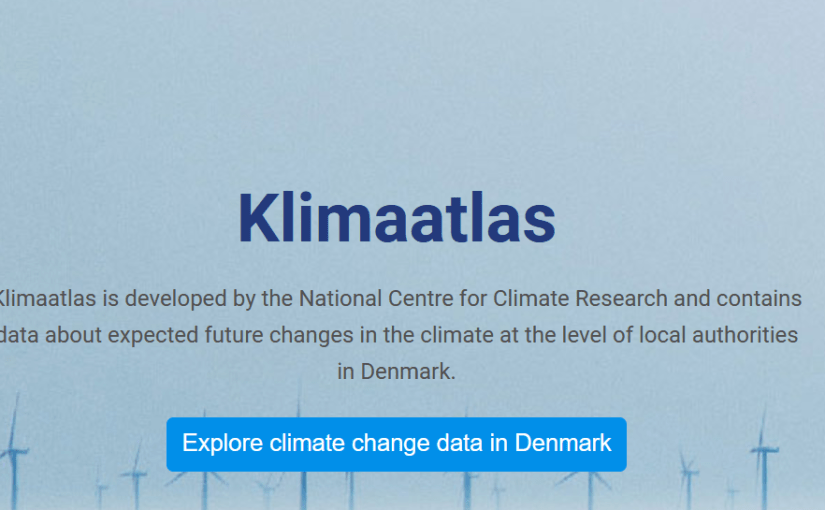
Anyway, I replied with a link to the Danish Climate Atlas – which to my mind is very much a model for how climate information should be done. I can’t give a full overview of the Climate Atlas, largely because it’s not my story to tell, but as Jeremy asked me to talk more in depth about it, and given the 300 character limit, I thought I’d formulate a few thoughts here first before sharing…

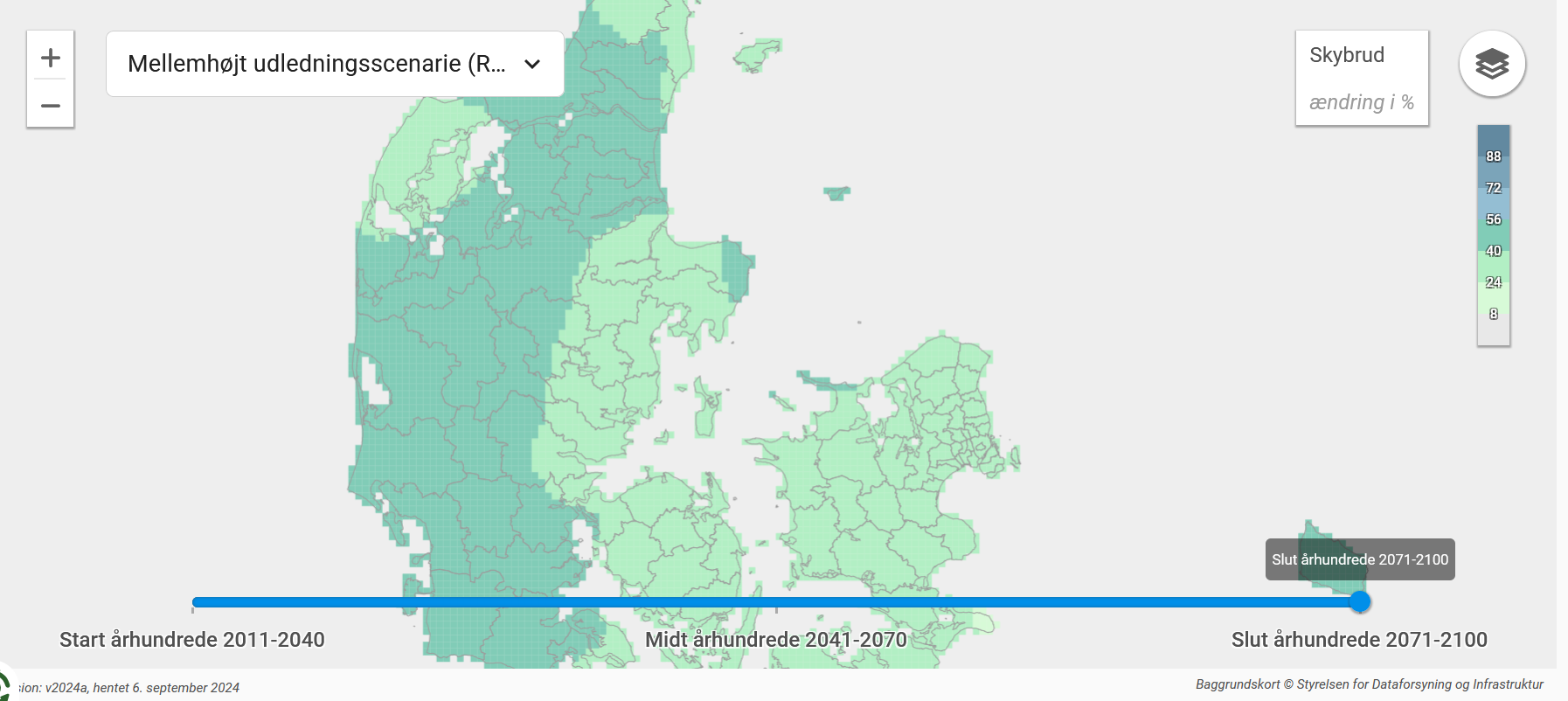
The climate atlas is not a book but a web frontpage that allows anyone with an internet connection to get high quality climate information at a local scale in Denmark. The map interface makes it easy and intuitive to use, and for detail a whole bunch of reports and datasets in different formats can be downloaded (everything from ASCII to GIS to netcdf). You can explore it here. All the data is given on a kommune (local authority) level except for sea level rise data which is divided up by coastal stretches.

Example of a Climate atlas figure – this is the overview figure, each local authority area is clickable for local information

For audiences that just want a quick message there are these easy to interpret icons with a key message below, like this one about higher water levels.

I was involved in the early stages and to my mind there are 4 crucial elements that have made it very successful:

  1. Legal Requirement: Every local authority (a kommune, don’t think hippies, think regional councils) in Denmark has a legal obligation to make climate adaptation plans and to keep them updated. This element is important as it created awareness of the problem and effects of climate change and the necessity of investigating adaptation options. The initial plans were rather patchy and not very consistent with each other. Many regions had employed a consultant who was also maybe not an expert. Several kommune ended up with data based on CMIP resolution data! Hardly appropriate for a small local region in Denmark (which is barely resolved in most global climate models).
  2. Data Foundation: At the same time we have been dynamically downscaling these simulations for decades, to provide really high quality locally bias corrected data (using also DMI’s long climatological time series to understand if and where biases exist). Colleagues at DMI identified a need to provide this in an easy to use format to everyone in the country. We had long ago discovered that working with motivated kommune employees led to a really good outcome: readable climate variables that are meaningful to an individual city, data formats that can be used by non-scienists (who definitely can’t deal with netCDFs).
  3. Funding: Doing a data project properly requires money. The Climate Atlas is, compared to the cost of not doing anything, extremely cheap, nonetheless, it still costs something. Ear marked funding from the danish state to build up the Climate Atlas from the ground, to develop it as new needs are identified and to improve both communication and presentation has been crucial. Along the way several different needs have arisen (droughts, deep uncertainty in sea level rise), a new version will hopefully be coming soon.
  4. Intense engagement: Probably the most crucial aspect to getting the climate atlas off the ground and into use has been communication over and over and over again. Not just initially with kommune to find out what they need (building on many years of background experience first), but also reaching out to special interest groups raning from local farmers in mid-west Jylland to sewage engineers, high school teachers and property developers. This continues, but has undeniably been helped by Denmark’s open trusting society and generous tradition of cultural meetings, continuing education and festivals.

The climate atlas in Denmark is the example I know best, we should be rightly proud of the team that constructed, maintain and continue to develop it. Other countries certainly have similar products in the Nordic and Blatic countries, and likely elsewhere, a network meets annually within the region to discuss developments etc. After a coincidental meeting, DMI was also invited to help develop one for Ghana, which is ongoing, and of course, will have completely different needs and requirements, However, the decision early one to base the back end of the Climate Atlas on open tools: python, cdo, github and CORDEX simulations, makes a lot of the learnings transferable.

If you want to know more, contact my colleagues at the Klima Atlas! I’m happy to put you in touch..

*As an aside, it’s interesting how many of the climate science and policy community have moved over to Blue Sky. It was rather quiet for a while but activity seems to have picked up. I’m not abandoning mastodon, which I actually prefer, but I’m happy to see an alternative to what has become known as Birdchan. I’d urge you to try it if you’re interested in a social media presence in a slightly more appealing environment. There are a number of handy tools, including fedica, that allow you to crosspost to multiple channels at the same time (including X, mastodon, bsky, TikTok and threads) and I’m also using the OpenVibe app, which has a common timeline from multiple platforms.

Breaking up is hard to do…

Way back in the mists of time, that is, early April, I and colleagues deployed some instruments on the sea ice in front of a number of glaciers in Northern Greenland, which I wrote a little bit about here.

Trusted global GPS tracker buoy
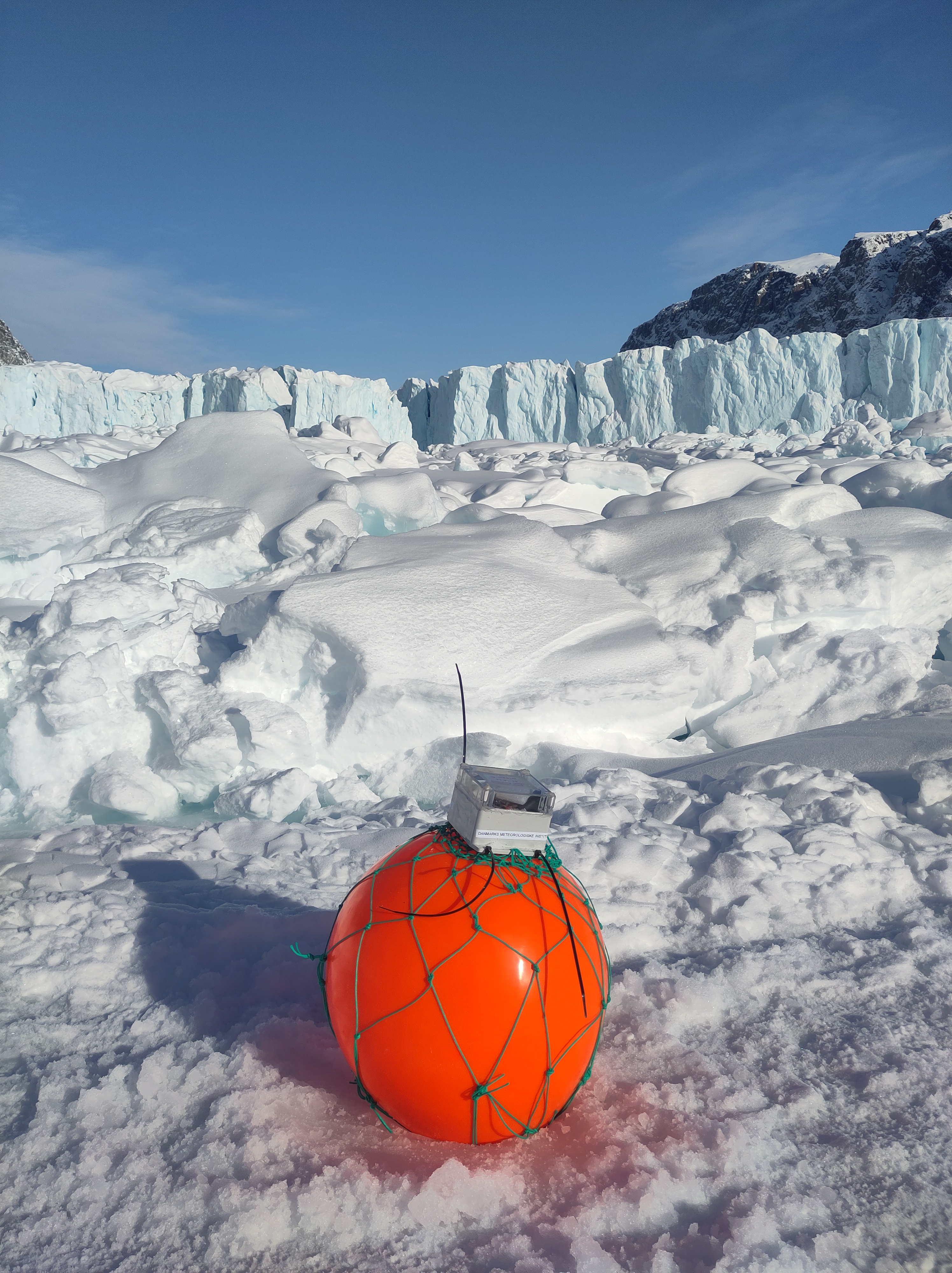
Open met buoy

Since then I’ve mostly been letting them get on with reporting their data back and occasionally checking on the satellite imagery to see how it’s looking in their surroundings.

It was about -30C and very cold when I left them out, so it’s sometimes quite hard to visualise just how much things will change over only a few months and to remember that at some point, they’ll need collecting

After a fairly melty start (yes, that is actually a technical term) to July, particularly in the northern part of the ice sheet (which you can see on the polarportal, see also below right) it’s time to start anticipating their collection.

We have a lot of advantages when it comes to coordinating this kind of project now, compared to the bad old days when imagery and communication were both scarce and expensive

For starters, there is Sentinel Hub’s EO browser, a course in which should be a requirement for every earth science adjacent subject in my opinion. EO Browser produces superb pre-processed imagery for free, such as this one, from the European Space Agency’s Sentinel-2 satellite yesterday

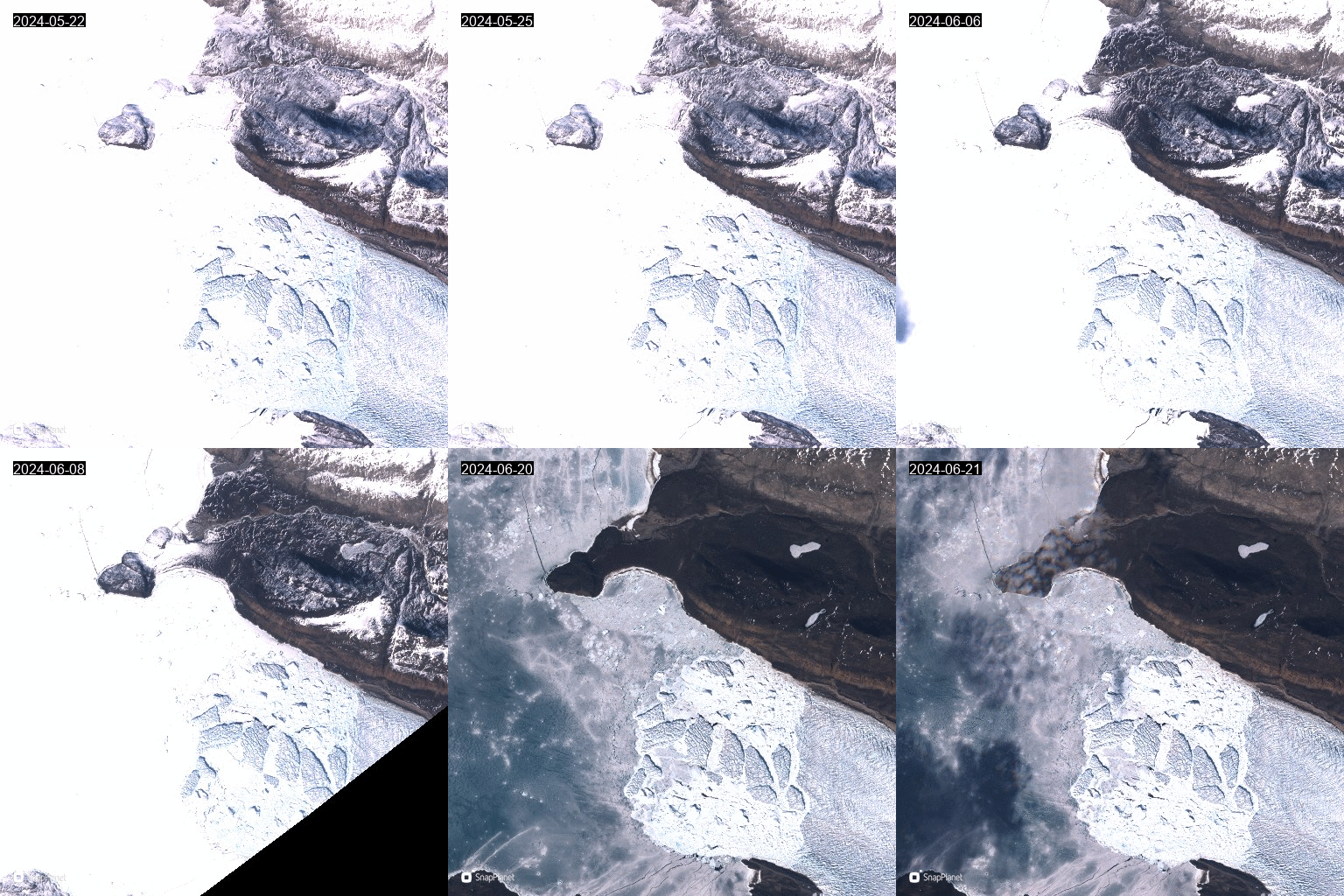
As you can see, the sea ice is still there but fracturing and patches of open water (in blue green) are now becoming visible.

Sentinel 2 satellite image processed on EO browser showing sea ice and ice bergs in front of Tracy and Farquhar glaciers.

If you’re out and about and only have your phone, there is also the excellent snapplanet.io app on your smartphone, with which you can create instagram ready snapshots of the planet or even animated gifs, with high resolution imagery a link away…

Now that’s what I call a fun social media* application…

Animated gif of satellite images showing the front of Heilprin glacier with icebergs and landfast sea ice.

Anyway, back to the break up. Every year, the sea ice forms in the fjord from October/November onwards, by December it’s often thick enough to travel on and then from April it starts to thin and melt and by late June large cracks are starting to form, allowing the surface meltwater to drain through. For a look at what happens if you get a large amount of melt from, say, a foehn wind, before the cracks start to open up, see this iconic photo taken by my colleague Steffen Olsen in 2019.

An extremely rare event, that nevertheless went viral

The other advantage we have working in this fjord is our collaboration with the local hunters and fishers. In winter they use dog sleds for hunting and accessing fishing sites, and to take us and our equipment out on to the ice. In summer, they are primarily using boats for fishing, hunting narwhal and, hopefully, collecting our equipment! Our brilliant DMI colleague Aksel who lives and works in the local settlement is also a huge help in assisting with communication and generally being able to get hold of things and people when asked.

Winter travel

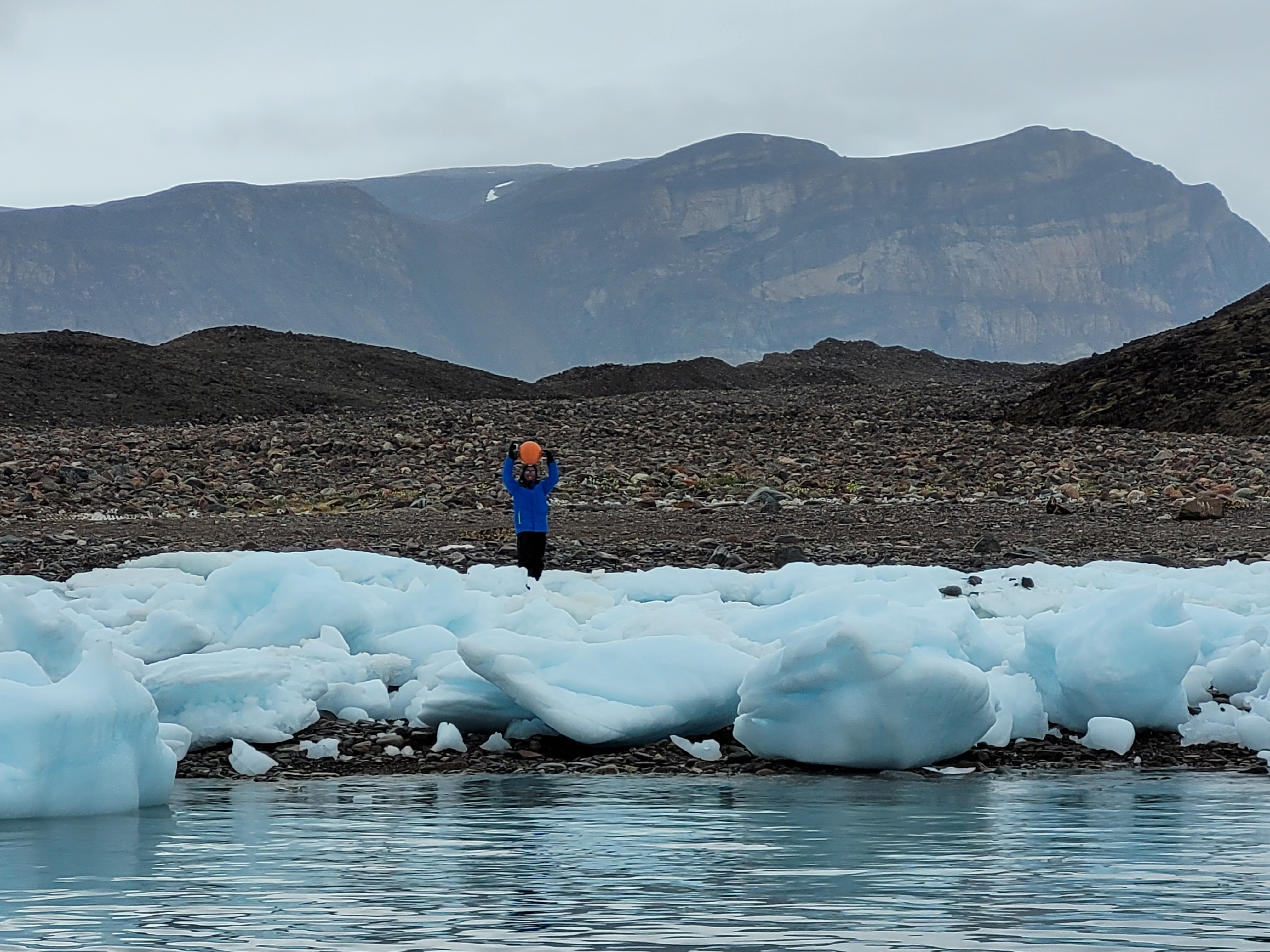
We offer a reward for each buoy that is found and brought back to our base in Qaanaaq, so many of them in fact make their own way home. But we also work with our friends on a kind of remote treasure hunt, challenge Anneka style, with someone at home watching their positions come in via the satellite transmissions and sending updated information via sms to an iridium phone to the hunters on the boat…

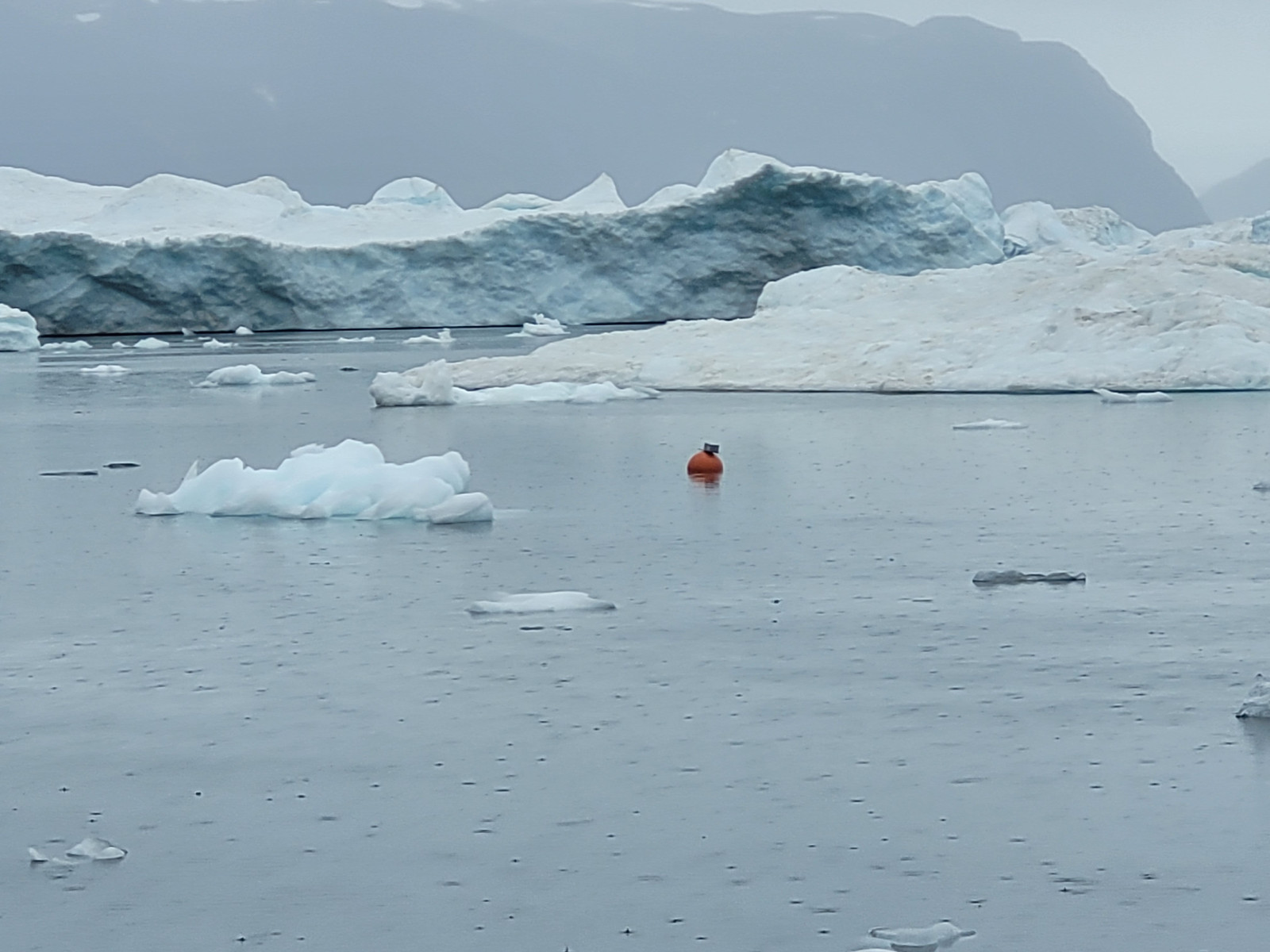
I’m told it’s tremendous fun, with sharp eyes required, as even a bright orange plastic globe can be challenging to spot.

A floating trusted buoy in 2022.

I’ve never participated in this treasure hunt myself sadly, on land we generally see something like a spaghetti of arrows and spots via the Trusted global web api:

GPS positions from a trusted buoy.

We then have to try and superimpose these movements on the latest satellite images to work out if the buoy is floating or not, and then check to see if there is sufficient open water for a collection. Naturally working with local knowledge for this part is also absolutely vital.

One of our buoys is found…

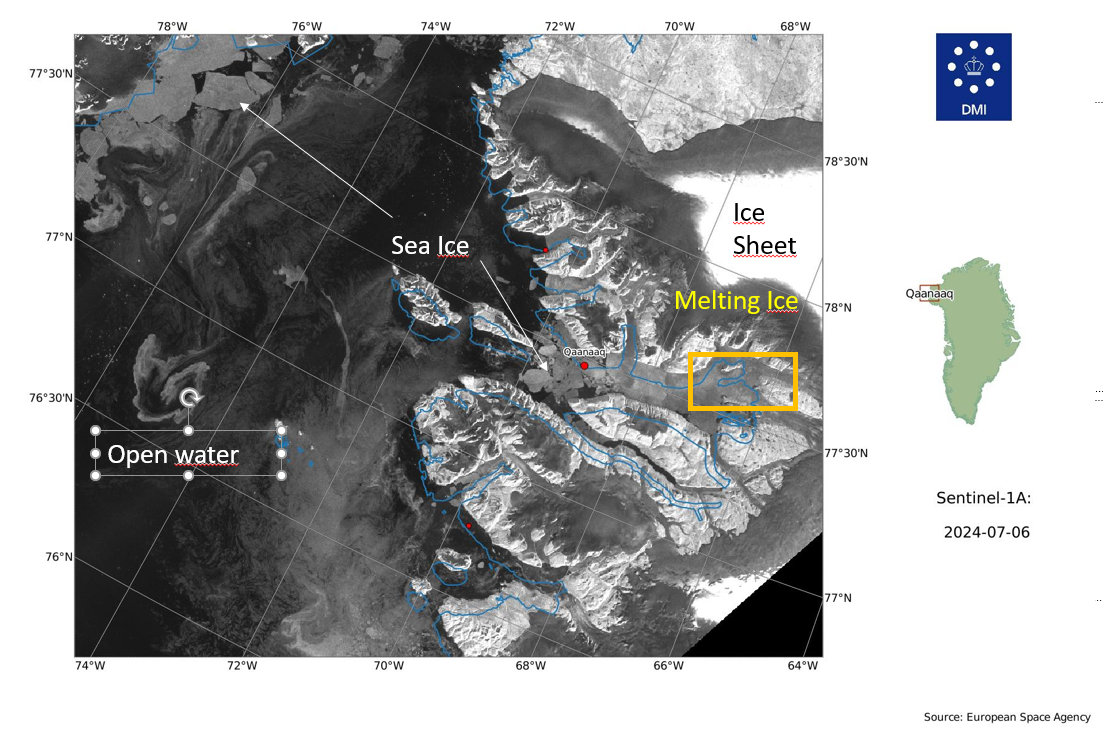
The latest satellite images look like the ice has already broken up into large flakes close to Qaanaaq. I’ve annotated the Sentinel-1 image below as it is from a radar satellite that can see through clouds and the images can be a bit confusing if you’re not used to looking at them.

The scale of the massive melt on the ice sheet from the last few days is clearly visible in the dark grey rim on the glaciers. The open sea water is black and the sea ice shows up as geometric greys. This one is downloaded from the automatic archive my colleagues at DMI maintain around the whole coast of Greenland. It can be a handy quick check too.

Annotated satellite image of Kangerlussuaq/Inglefield Bredning (Gulf of Inglefield) fjord. The orange box shows where our study glaciers are located.

So, although the ice is starting to break up it’s at the tricky stage where it’s far from navigable by dog sled and certainly too difficult for boats, so it’s not quite the time to send out hunting parties for GNSS buoys.

It also means that when I go on holiday next week, I will not be quite leaving all this behind. I and my colleague in this project will be monitoring the movements of the buoys and the satellite pictures, as well as relying on our friends in the local community to let us know how the ice is looking and if they can get out to rescue our brave little sensors.

In the mean time I have plenty of data to start analysing and writing up. As ever massive thanks to the people of Qaanaaq and my cool colleagues for putting up with me and our GPS buoys. We hope to submit our first paper pretty soon..

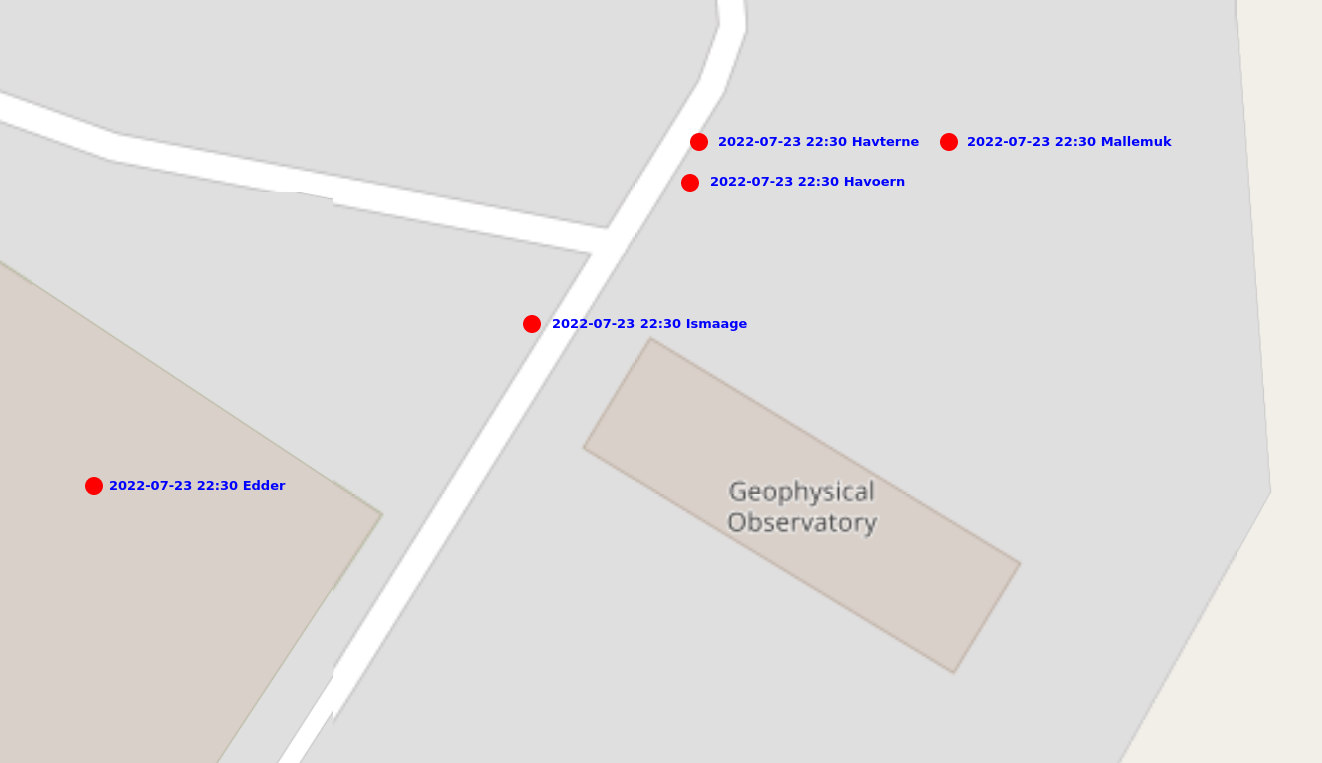
Hopefully I’ll soon be able to look at a map like this one to see where they are (note that the precision on these buoy positions isn’t great, probabaly because they were thenbeing stored in a metal container).

*Yes, I’m probably a nerd. I’m a lot of fun** at parties too though.

**For a given value of “fun”.

Icebergs of Ilulissat

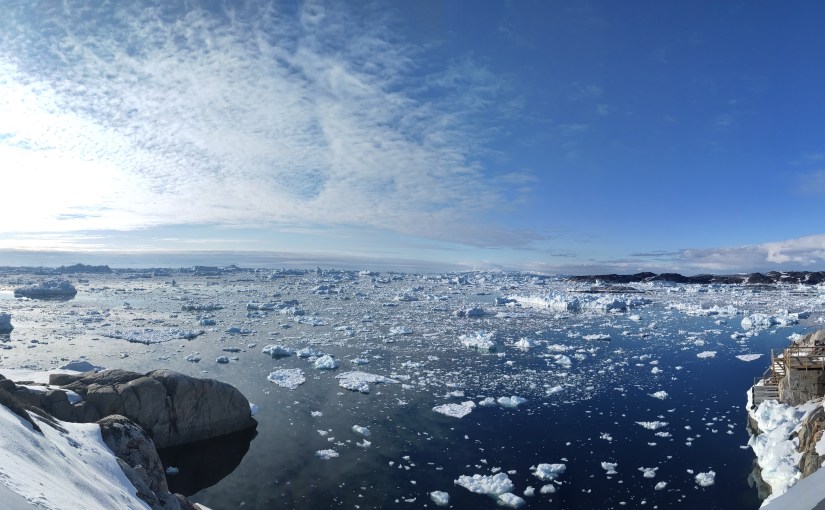
Icebergs in Ilulissat drift around the bay, sometimes fast, sometimes slow, sometimes they don’t move at all. They are drenched in the beautiful but sometimes stark light of the polar day. It’s scientifically interesting to watch them and speculate on their past trajectory and their likely future. It’s also extremely beautiful.

I’m once more on my way north to Qaanaaq, but this time I’ve been lucky enough to be able to enjoy some days off in Ilulissat. It’s an astonishing beautiful place, famous for the icebergs that come pouring out of the Ilulissat ice fjord just round the corner.

Normally, we’re only in town for one night as we have to switch planes to get to our field sites and this requires an overnight stay so it has been brilliant to be able to use a little holiday here.

Panorama over the bay in Ilulissat on a sunny evening

I have been using the time to work on some papers and try to clear some of the back log of reports and emails, but there has at least been some time for a couple of hikes in the back country nearby. I could post several hundred photos of icebergs and other magnificent views, but I was struck by the movement of icebergs in the bay outside my window while I was working yesterday.

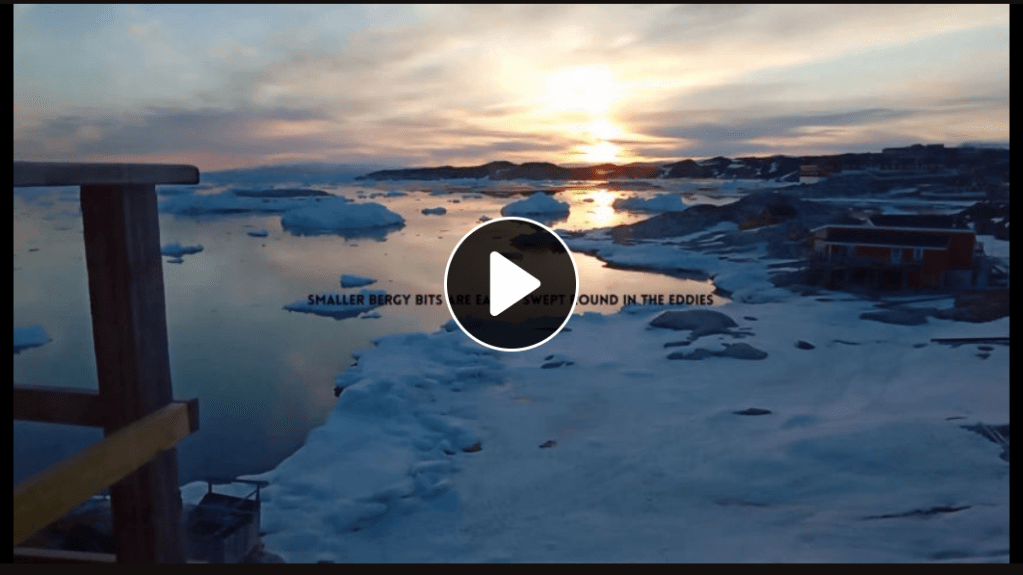
Sometimes the big bergs seemed to move more, sometimes they seem stuck. I wanted to check this so I set up a time lapse on my tablet in the window of the guest house I’m staying in overnight (bearing in mind it’s the Polar Day so doesn’t actually get dark). I think it actually ran out of power before covering the full six hours I set it up for, so I’m now trying a full day. However, it was enough to show my perception was basically right and I have come to the conclusion the changing movement is related to the tides.

You can see the full almost a minute long film at my peertube account below.

This is also a bit of an excuse to play around with video editing a little, in this case I’m trying out canva, and to advertise my peertube account @icesheets_climate on TILvids.com.

As I’ve alluded to before, I’m trying out the non-corporate social media fediverse and it’s actually quite fun, though the videos are a bit time-consuming so I’m not quite sure how regularly I will manage to post these on my channel, but the clue is in the name on what most of them are about I guess…

Another iceberg near Ilulissat, this time one we visited by boat…

But I have gratuitously many photos on my pixelfed account and no doubt more to come. I’m also planning some icebreaker shorts describing different elements of the environment that I’m working on. We’ll have to see how much time I have to actually get those finished, they typically take a while!

Of course, these are not just pretty pictures – I have a professional interest in icebergs – my PhD was about ice fracture and applying models of crevasse formation to describe a new parameterisation of calving. One of the projects I’m working on in northern Greenland, (funded by the danish state through the National Centre for Climate Research, NCKF) is also focused on calving processes, and specifically the role of ice melange in the system. In fact, one of the papers I’ve been working on this week analyses those iceberg related datasets. It’s immensely valuable and rare that I have the opportunity to be able to focus on the process in the field at the same time as writing the paper.

I have 2 more days in Ilulissat, so no doubt there will be more walks around town and more iceberg photos, but I have sent the iceberg paper back to my co-authors now, so it’s time to focus on a new paper – and the climate of the polar regions in the future.

The Greenland ice sheet

Student in Denmark and looking for a job?

At DMI we’re currently recruiting for student helpers to work in the National centre for climate research (NCKF) as a part time study job.

(Note that this is a special category of internship type job for students in receipt of a student grant in Denmark only and therefore has limited hours).

It’s a very exciting project, funded by the European Space Agency and in collaboration with the Horizon Europe project PolarRES.

The successful student will be using new satellite datasets to evaluate the performance of new state of the art climate models over the Greenland and Antarctic ice sheets. As you can probably imagine, we’re looking for a student with some experience of coding, in e.g. python and an interest in climate and ice sheet modelling.

The job posting is in Danish (machine translation works, try DeepL). It’s not actually required to speak Danish, however note bold text above!

Full details of the position are : here

Deadline 5th May.

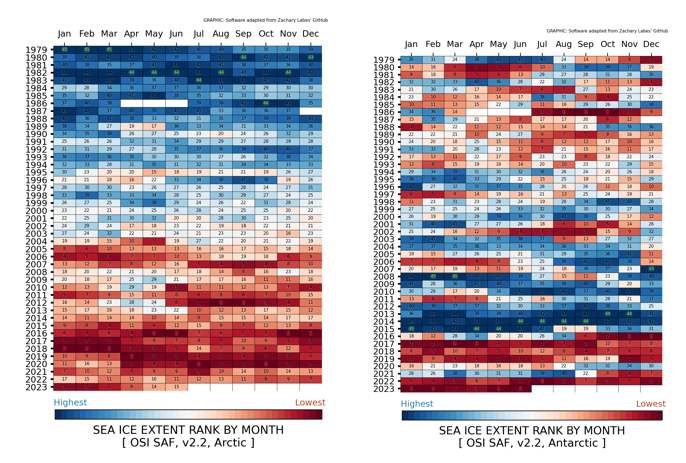
Previous student assistants have produced detailed atlases of results and visualisations like this one based on satellite observations of sea ice.

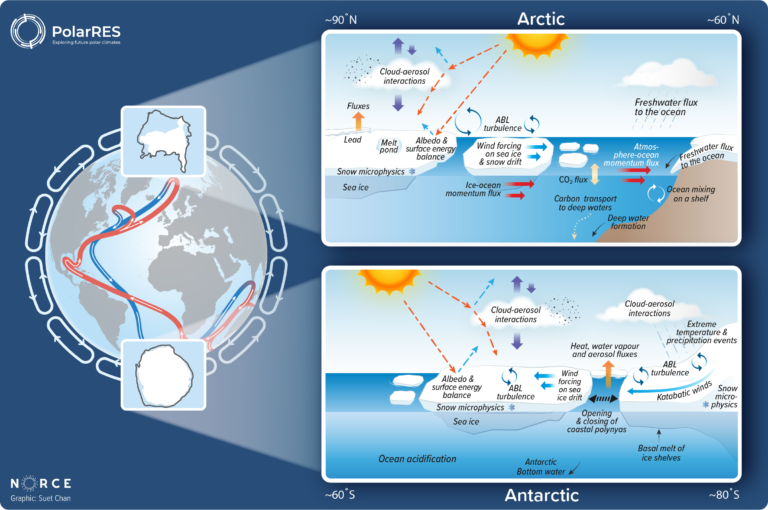
Processes that are part of the PolarRES project.

Heading North again…

I’m lifting my head from the semi-organised chaos that is my office, my home office, our family basement and the office workshop to write a quick post. This might be for reasons of despairing procrastination.

The reason for the chaos is that fieldwork season has come round again and on Friday I and my DMI colleague Steffen will be off to Northern Greenland once again. I’ll try to post a few photos to pixelfed (and perhaps even Instagram, though I swore off Meta products after the Brexit fiasco).

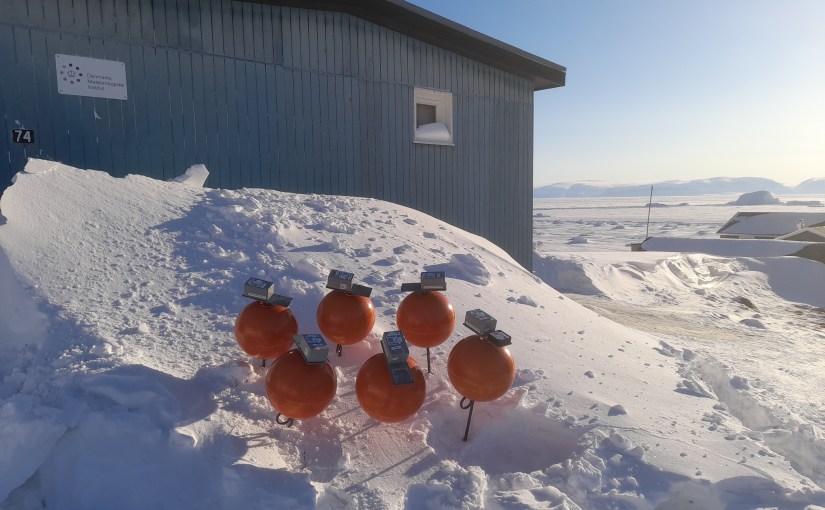
Buoys with GNSS and iridium transmitters (designed and assembled for us by Trustedglobal) ready to be taken out and deployed on the sea ice in northern Greenland. DMI’s geophysical facility building in the background.

This year my focus is again on the melange zone and we’ll be placing our instruments out to record the break-up of the fast ice. I also hope to get time to establish a new snow measurement programme – which I partly piloted last year. However, we will only be 2 scientists instead of the team of 4 this year, so this may have to wait until the second fieldwork period we have planned in early June (when the sea ice starts to break up). We are fortunate indeed that the local hunters, who still live a semi-subsistence lifestyle, are both incredibly competent and helpful and willing and eager to help when we go out on fieldwork.

This photo and excerpt was part of my contribution to a display at the Ocean decade conference in Barcelona next week. Last year we tested an open science variant of the trusted buoys above known as an Open Met Buoy. It’s incredibly smart, and completely open. You can download full instructions and make it and programme it yourself, or , as I did, order them from the german labmaker company who specialise in building open science kit.

Last year was a test of concept, and noone was more astonished than I was that the final set up not only survived the ice break up and floated safely down the fjord, we also managed to retrieve them and I hope they are waiting patiently in Qaanaaq so I can reprogramme and redeploy this year.

I wrote this piece on our work last year, promising a whole load of posts I didn’t end up having time to write. Sadly even my lego scientists never got an update. So instead of promising a whole lot of new posts, let me know what you’d like to see and read about either in the comments here or on my mastodon feed, and I’ll try to make some time to answer one or two of them while we go.

The area we travel to is going through very rapid changes now – not just climatic and environmental, but, perhaps even higher impact, social and cultural. I am privileged to be abel to witness it and we try hard to leave as little impact as possible.

At this stage it’s hard to imagine I’ll ever be ready to leave, but the clock is ticking down..

When is an Arctic bias not an Arctic bias?

I was going to blog about this cool new paper that my colleagues at DMI have produced, but John Kennedy has as always done such a good job I will just point you over there…

Wondering whether a warm bias in the Arctic in ERA5 affects our estimates of global temperature change.

When is an Arctic bias not an Arctic bias?