Bless the rains down in Africa #DACEA3

An ultra-quick post today. I have been spending a lot of time lately writing a grant proposal (and occasionally tweeting about it  on the #DACEA3 hashtag).  Finally it’s in and after a celebratory beer or two at the famous Mikeller last week I have managed to get around to a very brief summary of what it’s all about… 

Around 17,000 years ago, Lake Victoria more or less completely dried out. I still find this absolutely staggering. In fact, the lake has dried out and reformed at least 3 times since it first formed about 400,000 years ago.

Lake Victoria is the largest lake in Africa and indeed the tropics, containing 2.75 cubic kilometres of water (though compared to the 2,850,000 cubic kilometres of water in the Greenland ice sheet that seems small, which merely goes to prove how much of our fresh water is locked up in the ice sheets), making it the 9th largest lake by volume in the world.

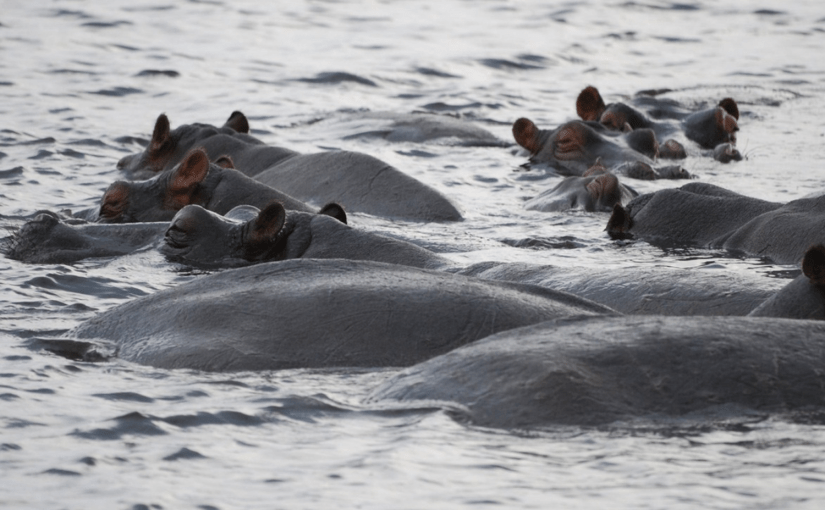
Gratuitous wildlife shot: A raft of hippos chilling out in the river. Photo: Pim Bussink
Gratuitous wildlife shot: A raft of hippos chilling out in the river.
Photo credit: Ruth Mottram

Clearly, the disappearance and later reappearance of the lake, and others in the region speaks to monumental shifts in the climate. The East African Rift Valley lakes are largely fed by the East African rains, long and short, delivered by the shifting position of the Intertropical Convergence Zone as the Earth’s seasons change bringing those life-giving rains.

This grant proposal started as idle speculation around the coffee machine (in the grand old scientific tradition) about how this was climatically possible and could it happen again? My colleague (and talented PI on the proposal) Peter Thejll had been reading a book about John Hanning Speke and Richard Burton (not that one) and their famous search for the source of the Nile and has some personal African connections, which prompted the conversation and it seemed obvious to try and find out what happens to the local circulation to allow the lake to dry out. A quick google search revealed an old friend, Dr. Sarah Davies at Aberystwyth University was researching this topic actively and it all fell into place.

Now, I can guess what you’re thinking – this is usually a glaciology or Arctic Climate blog, where on earth has all this Africa stuff come from? Well what happens in the Arctic does not necessarily stay in the Arctic.

There are a number of hypotheses as to the drivers of these changes in African rainfall, among which is the interesting observation that the periods of greater aridity correlate remarkably well with Heinrich events in the North Atlantic.

Heinrich events were first identified as layers of sediment most likely transported into the North Atlantic Ocean by icebergs, known as ice rafted debris – IRD. The southerly position of many of these layers thousands of kilometres from any ice sheets either at the present day or in the past suggests a truly extraordinary amount of icebergs and cold fresh water were discharged over a relatively short period of time, from a large ice sheet. The source of these sediments is most likely the gigantic Laurentide ice sheet of North America, but there is also some evidence of smaller contributions from the British and Fenno- Scandian ice sheets (which may or may not have been joined together across the North Sea depending on how you interpret the evidence). The physics behind this is that as the enormous amount of cold fresh water was discharged into the North Atlantic, the temperature and salinity changes were sufficient to push, or keep the ITCZ far to the south, preventing the rains one East Africa.

On the other hand, other research has linked the failure of the rains to El Niño and related phenomena such as the Indian Ocean dipole and the Walker circulation. Still other scientists have noted that these drying periods seem to correlate with orbital changes in the earth which would affect the seasonality, that is the annual cycle of seasons. It is known as orbital forcing as the Earth’s seasons are driven by changes in our orbit around the sun (have a look at the excellent Orbit documentary from the BBC for a very easy to follow and beautifully filmed introduction to the importance of our orbit around the sun if you’re not familiar with Milankovitch cycles etc).

Milankovitch cycles shown from ocean cores and an Antarctic ice core at the bottom compared with the theoretical cycles. Image: By Incredio (Own work) [CC BY 3.0 (http://creativecommons.org/licenses/by/3.0)], via Wikimedia Commons
Milankovitch cycles shown from ocean cores and an Antarctic ice core at the bottom compared with the theoretical cycles.
Image: By Incredio (Own work) [CC BY 3.0 (http://creativecommons.org/licenses/by/3.0)], via Wikimedia Commons
All of these hypotheses can be supported by correlations with palaeo evidence,  but to really disentangle the connections between different regions of the world and how they affect each other’s weather and climate, we need to use a climate model. Luckily, at DMI we have the perfect tool to hand, a global climate model including ice sheets, EC-Earth. Furthermore we also have a high resolution regional climate model, HIRHAM5, my usual tool of choice. Our friends Morten Dahl Larsen and Martin Drews at the Danish Technical University are experts in using hydrology models so the answer is obvious.

We want to use these model tools and an extensive archive of observations, helpfully curated by our project partners Sarah Davies and Henry Lamb at Aberystwyth University to test all these different ideas. As an extra spinoff from the project, the Aberystwyth group have been intensively involved with the collection and analysis of a new lake sediment core from Chew Bahir in Ethiopia, so it’s going to be pretty exciting seeing if we can get the models to replicate  these kind of records.

There is of course an extra urgency to this project. It’s not just a somewhat obscure academic question. A recent paper showed that the long rains have significantly reduced over the last decade, and about 300 million* people live in this region and rely on these rains for drinking water, hydroelectric power and agricultural production. During this period we have also seen rapid changes in the Arctic. Of course the two trends may not be connected, or may be linked via a common third factor which is why the physics of climate are so important to understand.

UPDATE 2: I had no time originally in the writing of this to add a little about our other project associate. One of the best things about doing science are the very smart and friendly people  you meet along the way. Social media has really helped here to keep in touch as it is a nomadic lifestyle. By sheer chance I noticed a familiar name in a tweet that seemed to have some direct relevance to the proposal as we were writing it.

Hycristal

John Marsham was an old friend from my student days at Edinburgh University who I had slightly lost touch with. Thanks to the efforts of facebook we were soon back in touch and he is one of the Investigators on the HyCRISTAL project, part of the hugely important Future Climates for Africa Project, funded by the Department for International Development (DFiD) and the Natural Environment Research Council (NERC) in the UK. DACIA has some really obvious parallels with this project, though where we would like to concentrate on past climates, they will be focusing on present day and future climates. We hope therefore to send our PhD student to collaborate with the HyCRISTAL and FCFA projects where our insights from palaeomodelling palaeodata can make a real difference to the way future climate change is adapted to in East Africa. It will be very nice to collaborate with John’s group at Leeds as well as the Aberystwyth group, now we just have to hope we get the money to do it..

Or, to put it another way, “bless the rains down in Africa” ** (As an aside, for years I had always heard this as “I miss the rains down in Africa”, assuming it was about someone from Africa who missed being there).

UPDATE 1: Having viewed the original pop video again, I am rather troubled by the casual racism, sexism and naked orientalism on display (yes it was the 70s but still…) so I think I prefer to post instead this particularly witty deconstruction courtesy of @spaceforpootling

*(based on a back of the envelope calculation based on population statistics from Wikipedia if you know the correct number do let me know).

**(Apologies if you now have cheesy 1970’s pop music going round your head all day… 🙂 )
Rain rain go away…

My 2 kids were singing the rain rain go away rhyme during last weekend’s epic rainfall in Copenhagen and it reminded me that I have not yet put up a post about a paper I was a co-author on this summer related to late summer/autumn rainfall and the effects on the Greenland ice sheet, so here goes….

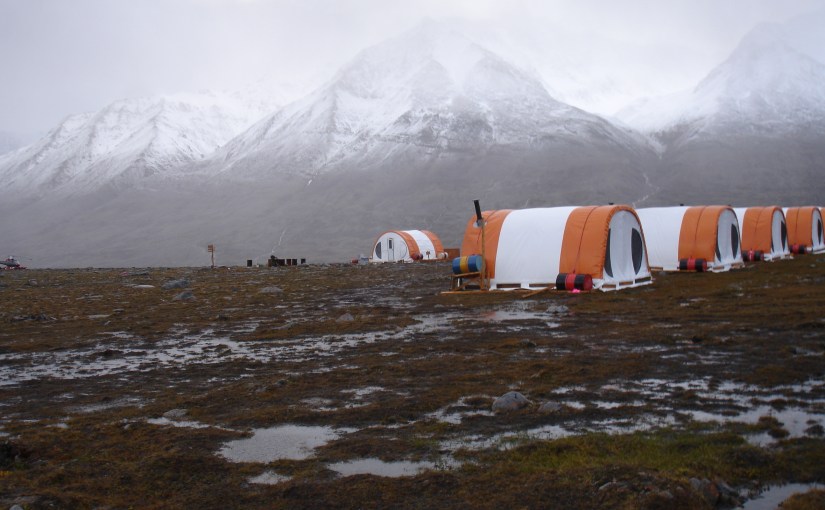
Mostly when we think of precipitation in Greenland we think of snow in the winter, but it does rain quite a lot, as I know from personal experience (see photo taken as the clouds started to clear one September field season in Eastern Greenland…). This paper in Nature Geoscience by Sam Doyle and co-authors including myself shows that when rain falls on the ice sheet at the “wrong” time of year it can have a very far-reaching effect, causing the speed up of a large area across the ice sheet.

Rain clouds over the Stauning Alps of Eastern Greenland after the third day of rain... Exploratory mining camp tents in the foreground.
Rain clouds over the Stauning Alps of Eastern Greenland after the third day of rain…
Exploratory mining camp tents in the foreground.

The important caveat is that rainfall during the main part of the melt season is more or less evacuated away quickly. Glaciers – and the Greenland ice sheet is basically a very big glacier – develop a drainage system more or less analogous to large underground sewers during the melt season. These tend to close down during the colder accumulation season and reopen by the sheer pressure of water running through them when the melt season starts. Rainfall during that crucial late summer/early autumn period when the drainage is closing down and therefore less efficient at evacuating surplus liquid water is therefore not able to move away from the glacier very easily and forces its way through any way it can find.

During this period, most of the snow will have melted off the surface, leaving vast areas of bare ice. By contrast, rain on snow in the early part of the melt season when there is a thick snow pack is more likely to refreeze inside the snow. In late summer however, there will be a relatively short period between rain falling and accumulating in the glacier drainage system.

In practice this means the water makes its way to the bed of the glacier through moulins and englacial channels, where it more or less hydraulically jacks up the glacier over a large region, allowing the ice to flow to the margins faster. There may then also be a knock-on effect with increased calving of icebergs at outlet glaciers. in 2011, the field team were able to measure both the rain fall and the following cascade of processes in a range of different datasets as shown below:

Rainfall (a,b) over the ice sheet runs off the bare ice quickly as shown by discharge stations on a number of rivers in western Greenland (c). This triggers acceleration  across a wide area, shown by GPS stations on the ice sheet at 10 different locations (d). Figure taken from the paper
Rainfall (a,b) over the ice sheet runs off the bare ice quickly as shown by discharge stations on a number of rivers in western Greenland (c). This triggers acceleration across a wide area, shown by GPS stations on the ice sheet at 10 different locations (d). Figure taken from the paper

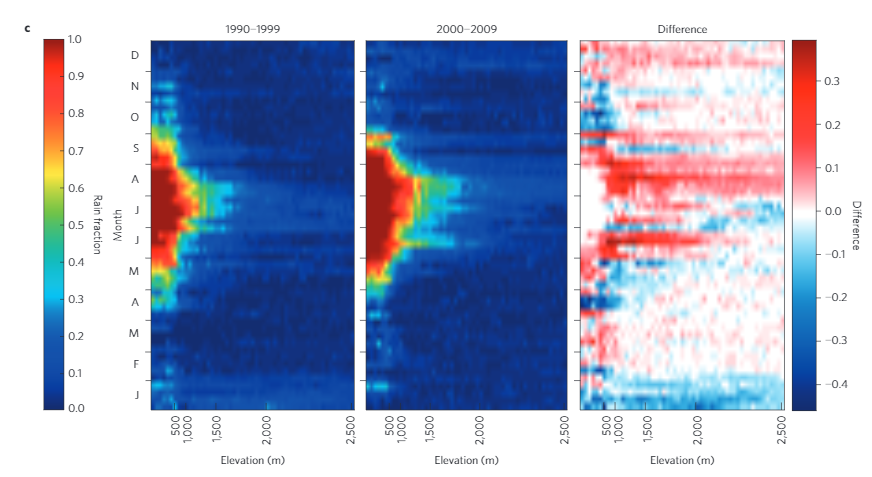
My contribution to the paper was in the form of some HIRHAM5 model runs for Greenland which show the last decade has seen a significant increase in rainfall events in the summertime compared with the previous decade. We chose as a study region the K-transect of weather stations in western Greenland. These are operated by Utrecht University and have a long time-series of data which previous work has shown our model can replicate quite nicely. The model is forced by the ERA-Interim reanalysis, a data set based on weather forecast models with real observations included in it run for the whole world so we are pretty confident the rainfall patterns are realistic. There are actually two interesting points illustrated in the picture below taken from the paper. Firstly that there is more rain falling and secondly that this rain is falling at higher elevations on the ice sheet, potentially causing a much wider area of the ice sheet to be affected by late-summer rainfall events.

The decadal change in rainfall events is partly due to a persistent North Atlantic Oscillation anomaly which has funnelled storms over the western edge of the ice sheet. There is also some evidence that the stratospheric Rossby waves have become more “wavy” over the same period, due to the increasing warming and vanishing sea ice in the Arctic. This hypothesis was articulated in a very nice paper by Francis and Vavrus but it remains a very open area of research as we just don’t have a lot of evidence right now.

We do know that the Arctic is one of the fastest warming regions on the planet and this will certainly have a knock-on effect on the Greenland ice sheet both in terms of melting and, perhaps, in the frequency of storms bringing rain over the ice sheet in the future. I am now preparing a new study to see if we see a signal along these lines in our future simulations of the Greenland domain.

Rainfall events at a weekly timestep over the K-transect in western Greenland  for two different decades and the difference between the two. The second decade has many more rainfall events that reach to a much higher elevation than the first decade.
Rainfall events at a weekly timestep over the K-transect in western Greenland for two different decades and the difference between the two. The second decade has many more rainfall events that reach to a much higher elevation than the first decade.

Conversion Factors

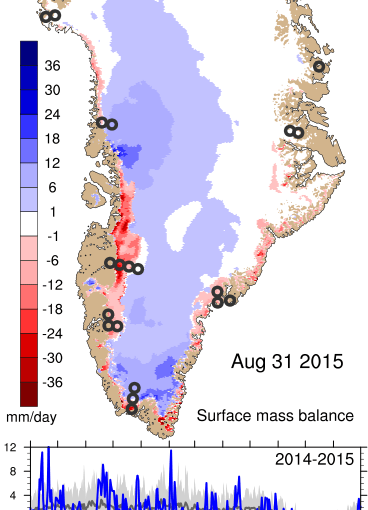
The official end of the hydrological year in Greenland (1st September to 31st August) means I am rather busy writing reports to give an overview of where the ice sheet is this year and what happened. I will try to write a quick blogpost about this in the next week or so (in case you’re curious here’s a quick plot to show the entire annual SMB, see also: http://polarportal.dk/en/groenlands-indlandsis/nbsp/isens-overflade/)

Daily and accumulated surface mass budget of the Greenland ice sheet, 31st August, 2015, last day of the hydrological year
Daily and accumulated surface mass budget of the Greenland ice sheet, 31st August, 2015
Anyway, as I find I am constantly switching between Gigatonnes (or indeed Gigatons), cubic kilometres and sea level equivalent, here is a quick and handy guide to converting different units of mass, for my own use as much as anyone else.

1 gigatonne is 1 billion metric tonnes  (or 1 milliard if you like the old British style, that is one thousand million).

However, on the Polar Portal we usually reckon everything in water equivalent. This is to save having to distinguish between snow (with a density between ~100 kg/m3 when freshly fallen and ~350 kg/m3 m when settled after a few days), firn (snow that has survived a full annual cycle with a density up to ~800 kg/m3) and glacier ice (anything from ~850 kg/m3 to 900+). Water has a density (at 4C) of 1000 kg/m3

1 gigatonne of ice will still weigh 1 gigatonne when it is melted but the volume will be lower since ice expands when it freezes.

1 metric tonne of water is 1 cubic metre and 1 billion metric tonnes is 1 km3 (a cubic kilometre of water)

A cubic kilometre of ice does not however weight 1 gigatonne but about 10% less because of the density difference.

100 gigatonnes of water is roughly 0.28mm of sea level rise (on average, note there are big regional differences in how sea level smooths itself out).

Finally, 1 mm sea level rise is 360 Gt of ice (roughly the number of days in a year) 

EDIT: – thanks to ice sheet modeler Frank Pattyn and ice core specialist Tas van Ommen on Twitter for pointing out I’d missed this last handy conversion. Interestingly and probably entirely coincidentally this is very close to the amount of mass lost by the Greenland ice sheet reported by Helm et al., 2014 for the the period January 2011 – January 2014 (pdf here) of 375 +/-24 km3 per year.

Over the last 10 years or so, Greenland has lost on average around 250 Gigatonnes of ice a year (Shepherd et al., 2012), contributing a bit less than a millimetre to global sea level every year with some big interannual variability. This year looks like it will be a comparable number but we will have to wait for the GRACE satellite results in a couple of months to fill in the dynamic component of the mass budget and come up with our final number.

Of course, gigatonnes and cubic kilometres are rather hard to visualise so we have skeptical science to thank for this post that tries. And as aside, Chris Mooney wrote a nice piece in the Washington Post on the difficulties of visualising how much ice is being lost which contains the immortal  line “Antarctica is clearly losing billions of African elephants worth of ice each year”.

Calling all students…

I’m off to the UK next week for a workshop at Sheffield University where we will discuss the Surface Mass Balance of the Greenland Ice Sheet. The ISMASS workshop includes all the main modelling groups and observation groups who are involved in assessing surface mass balance in Greenland. I will be representing DMI’s Greenland SMB work there (not an easy task condensing it down to a 20 minute talk!).

In the course of preparing my presentation I have been making plots and figures and really investigating some exciting results. Sadly, I very rarely get the chance to spend time on this these days and I am keen to recruit students to assist in this work. Should any potentially interested students want to discuss this at Sheffield do let me know.

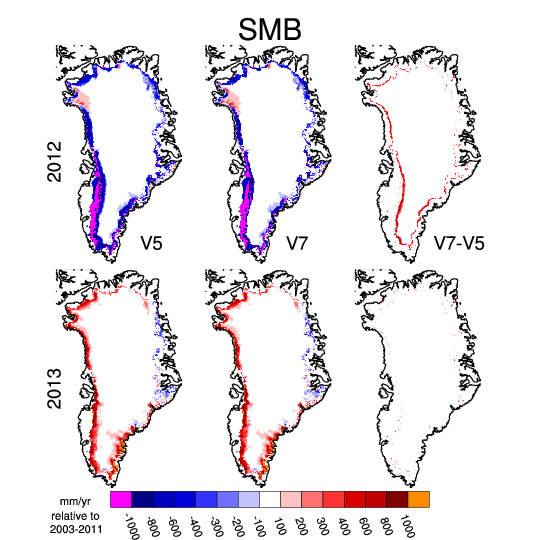
At the risk of spoilers in my presentation, here for example is one showing how different ways of characterising the surface snow pack affects our estimates for surface mass balance, and how the effects of the specific changes can be very different in different years.

Surface mass balance map plots of Greenland
Surface mass balance for the hydrological year (Sep -Aug) ending in 2012 and 2013 calculated using HIRHAM5 with 2 different surface schemes. The maps on the right show the difference between the 2.

As I mentioned I rarely get enough time to analyse the output from our runs and I would be very happy to hear from any students who are interested in doing a project on our simulations. We have lots of MSc and Bachelors projects already listed on our website at DMI but we are always happy to hear new ideas from students on related topics. I have terabytes of data from simulations I would like to be properly analysed and this could be very interesting given we are talking about Greenland and the Arctic in the present day and in the future. It’s a really nice opportunity to work with some cutting edge research. I am also happy to hear from students who would like to do a summer project and for the right candidate I would be able to look into a paid “studentmedarbejderhjælper” position for a few months, especially if you are already a trained computer science candidate….

If you are an undergraduate looking into an MSc, I urge you to consider Denmark. EU citizens usually qualify for generous support grants (rare these days!) as we have a shortage of candidates wanting to study in the sciences in Copenhagen. The research and teaching are world class and done in English at MSc level. The possibilities for projects in Greenland are literally endless.

If you want any more details or to talk about any of the possibilities, do get in touch!

Changes in SW Greenland ice sheet melt

A paper my colleague Peter Langen wrote together with myself and various other collaborators and colleagues has just come out in the Journal of Climate. I notice that the Climate Lab Book regularly present summaries of their papers so here I try to give a quick overview of ours. The model output used in this run is available now for download.

The climate of Greenland has been changing over the last 20 or so years, especially in the south. In this paper we showed that the amount of melt and liquid water run off from the ice sheet in the south west has increased at the same time as the equilibrium line (roughly analogous to the snow line at the end of summer on the ice sheet) has started to move up the ice sheet. Unlike previous periods when we infer the same thing happened this can be attributed to warmer summers rather than drier winters.

Map showing area around Nuuk
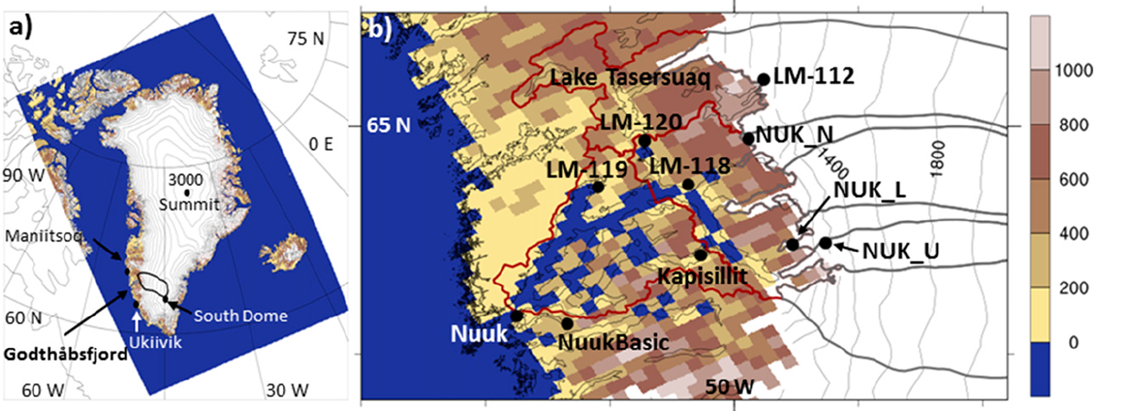
The area we focus on in this study is in SW Greenland close to Nuuk, the capital. White shows glaciers, blue is sea, brown is land not covered by ice.

We focused on the area close to Nuuk, the capital of Greenland, as we had access to a rather useful but unusual (in Greenland) dataset gathered by Asiaq the Greenland survey. They have been measuring the run off from a lake near the margin of the ice sheet for some years and made this available to us in order to test the model predictions. This kind of measurement is particularly useful as it integrates melt and run-off from a wider area than the usual point measurements. As our model is run at 5.5 km resolution, one grid cell has to approximate all the properties of a 5.5 km grid cell. Imagine your house and how much land varies in type, shape and use in a 5.5 km square centred on your house and you begin to appreciate the problems of using a single point observation to assess what is essentially an area simulation! This is even more difficult in mountainous areas close to the sea, like the fjords of Norway or err, around south west Greenland (see below).

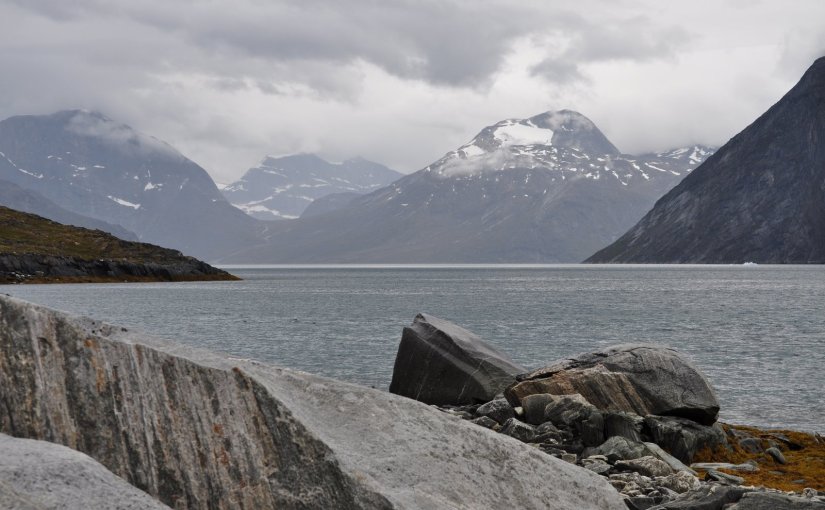
Represent this in a 5.5km grid cell, include glacier, sea and mountain...  Godthåbsfjord near Nuuk in August
The beautiful fjords near Nuuk. Represent this in a 5.5km grid cell…

The HIRHAM5 model is one of very few regional climate models that are run at sufficiently high resolution to start to clearly see the climate influences of mountains, fjords etc in Greenland, which meant we didn’t need to do additional statistical downscaling to see results that matched quite closely the measured discharge from the lake.

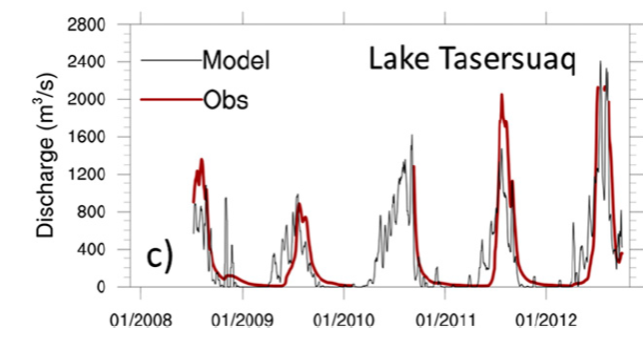
Graph comparing modelled versus measured discharge as a daily mean from Lake Tasersuaq near Nuuk, Greenland. The model output was summed over the Tasersuaq drainage basin and smoothed by averaging over the previous 7 days. This is because the model does not have a meltwater routing scheme so we estimated how long it takes for melt and run-off fromt he ice sheet to reach this point.
Graph comparing modelled versus measured discharge as a daily mean from Lake Tasersuaq near Nuuk, Greenland. The model output was summed over the Tasersuaq drainage basin and smoothed by averaging over the previous 7 days. This is because the model does not have a meltwater routing scheme so we estimated how long it takes for melt and run-off from the ice sheet to reach this point.

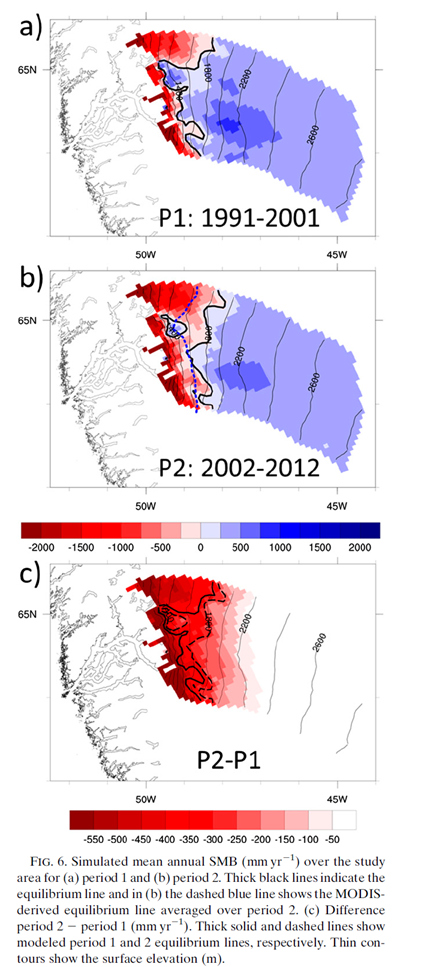
We were pretty happy to see that HIRHAM5 manages to reproduce this record well. There’s tons of other interesting stuff in the paper including a nice comparison of the first decade of the simulation with the last decade of the simulation, showing that the two look quite different with much more melt, and a lower surface mass balance (the amount of snowfall minus the amount of melt and run – off) per year in recent years.

Red shows where more snow and ice melts than falls and blue shows where more snow falls than is melted on average each year.

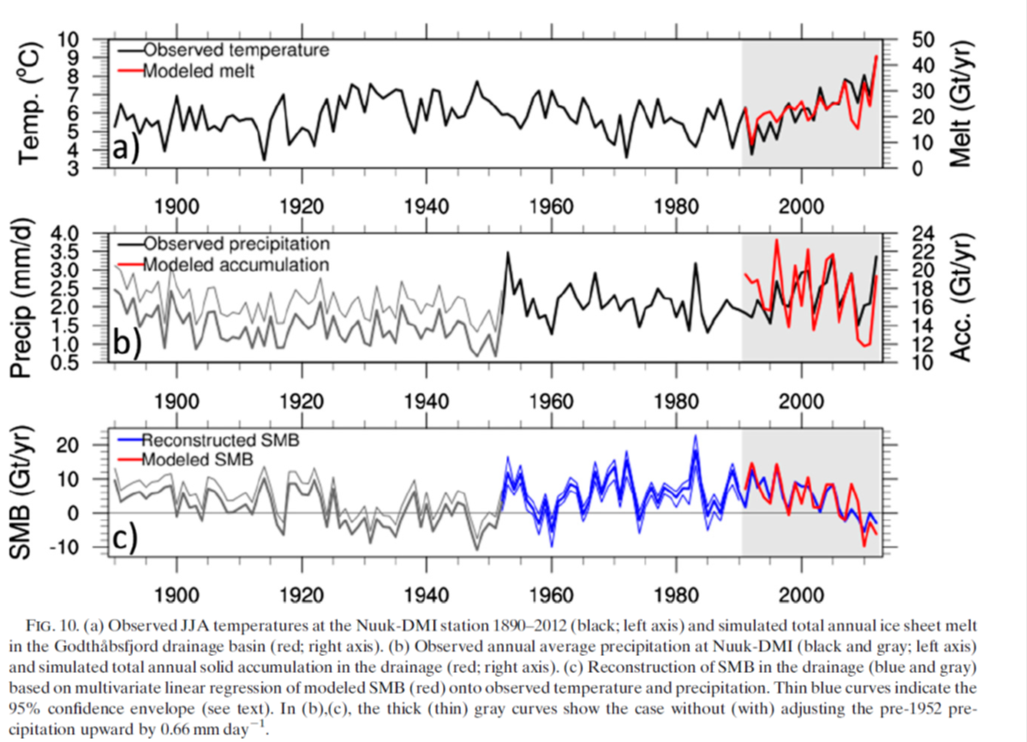
Now, as we work at DMI, we have access to lots of climate records for Greenland. (Actually everyone does, the data is open access and can be downloaded). This means we can compare the measurements in the nearest location, Nuuk, for a bit more than a century. Statistically we can see the last few years have been particularly warm, maybe even warmer than the well known warm spell in the 1920s – 1940s  in Greenland.

Graphs comparing and extending the model simulation back in time with Nuuk observations

There is lots more to be said about this paper, we confirm for example the role of increasing incoming solar radiation (largely a consequence of large scale atmospheric flow leading to clearer skies) and we show some nice results which show how the model is able to reproduce observations at the surface, so I urge you to read it (pdf here) but hopefully this summary has given a decent overview of our model simulations and what we can use them for.

I may get to the future projections next time…

The Present Day and Future Climate of Greenland

Regional Climate Model Data from HIRHAM5 for Greenland

In this post I am linking to a dataset I have made available for the climate of Greenland. In my day job I run a Regional Climate Model (RCM) over Greenland called HIRHAM5 . I will write a simple post soon to explain what that means in less technical terms but for now I just wanted to post a link to a dataset I have prepared based on output from an earlier simulation.

Mean annual 2m  temperature over Greenland (1989 - 2012) from HIRHAM5 forced by ERA-Interim on the boundaries
Mean annual 2m temperature over Greenland at 5km resolution (1989 – 2012) from HIRHAM5 forced by ERA-Interim on the boundaries [Yes I know it’s a rainbow scale. Sorry! it’s an old image – will update soon honest…]

This tar file gives the annual means for selected variables at 0.05degrees (5.5km) resolution over the Greenland/Iceland domain.

I am currently running a newly updated version of the model but the old run gave us pretty reasonable and could be used for lots of different purposes. I am very happy for other scientists to use it as they see fit, though do please acknowledge us, and we especially like co-authorships (we also have to justify our existence to funding agencies and governments!).

This is just a sample dataset we have lots of other variables and they are available at 3 hourly, daily, monthly, annual, decadal timescales so send me an email (rum [at] dmi [dot] dk) if you would like more/a subset/different/help with analysis of data. This one is for the period 1989 – 2012. I have now updated it to cover up to the end of 2014. The new run starts in 1979 and will continue to the present and has a significantly updated surface scheme plus different SST/sea ice forcing and a better ice mask.

I have also done some simulations of future climate change in Greenland at the same high resolution of 5km using the EC-Earth GCM at the boundaries for RCP4.5 and RCP8.5 scenarios which could be fun to play with if you are interested in climate change impacts in Greenland, Iceland and Arctic Canada.

Mean annual 2m temperature change between control period (1990 - 2010) and end of the century (2081 - 2100) under RCP45 from HIRHAM5 climate model runs forced by EC-Earth GCM at the boundaries
Mean annual 2m temperature change between control period (1990 – 2010) and end of the century (2081 – 2100) under RCP45 from HIRHAM5 climate model runs forced by EC-Earth GCM at the boundaries.  This plot shows the full domain I have data for in the simulations.

This run should be referenced with this paper:

Quantifying energy and mass fluxes controlling Godthåbsfjord freshwater input in a 5 km simulation (1991-2012), Langen, P. L., Mottram, R. H., Christensen, J. H., Boberg, F., Rodehacke, C. B., Stendel, M., van As, D., Ahlstrøm, A. P., Mortensen, J., Rysgaard, S., Petersen, D., Svendsen, K. H., Aðalgeirsdóttir, G.,Cappelen, J., Journal of Climate (2015)

http://journals.ametsoc.org/doi/abs/10.1175/JCLI-D-14-00271.1 

PDF here

Finally I should acknowledge that this work has been funded by a lot of different projects:

Picture4

The Arctic Tern

Sterna Paradisaea is the Arctic tern. This amazing little bird lives around 30 years in the wild and every year completes the longest migration in the world, flying from the Arctic, where it breeds, to the Antarctic to feed. It sees more daylight than any other creature and is not only a great endurance flier but a marvellously agile one, a true aerial acrobat like a marine version of the more familiar swallow. It is also a brave parent, chasing away much bigger animals from it’s ground nesting colonies and braving attacks by skuas and other aerial pirates to feed its young.

It has been my privilege and delight to observe these birds while doing fieldwork in Iceland, Svalbard and Greenland. Some years ago while working out of UNIS in Svalbard, I found a desk in an empty office that overlooked a colony. Over 4 short weeks, albeit of continuous daylight, I was able to watch the spectacular aerial courtship displays, the ultra brief matings, the brooding of eggs, the feeding and raising of young and the eventual fledging of new individuals. I had never known I was a nascent birdwatcher before this.

I have decided to start a blog, partly to share my opinions with the world (and thus avoid boring my long-suffering friends), but mainly to improve my writing by preparing short easy to read pieces in an every day style.  I chose the Arctic tern as a symbol of the wide range of subject areas I want to cover. I also like to think that as scientists we are in a constant chasing of the light, and in my field of climate research especially, trying to evade and chase off predators and pirates.

As a scientist, I often feel I am not very good at communicating with non-scientists and I hope this blog will provide me with some good practice and discipline, and of course I hope it will provide you, dear reader, with some interesting diversion. Please feel free to comment and provide feedback on my subjects and my writing style.