Freshwater Writing

It’s always nice to kick off a week with notification that a paper you have co-authored has been published.

In this case, and due to a magnificent effort by lead author Gavin Schmidt (who heaven knows must have many other things on his plate at NASA GISS right now), the” Datasets and protocols for including anomalous freshwater from melting ice sheets in climate simulations ” is now out in Geoscientific Model Development.

If that sounds a bit clunky, well it is. The idea is that the paper is a technical guidance, to help climate models (specifically for CMIP7), to include the effects of ice sheets into the earth system, without having to actually include a full ice sheet model, which turns out to be quite hard, particularly in Antarctica.

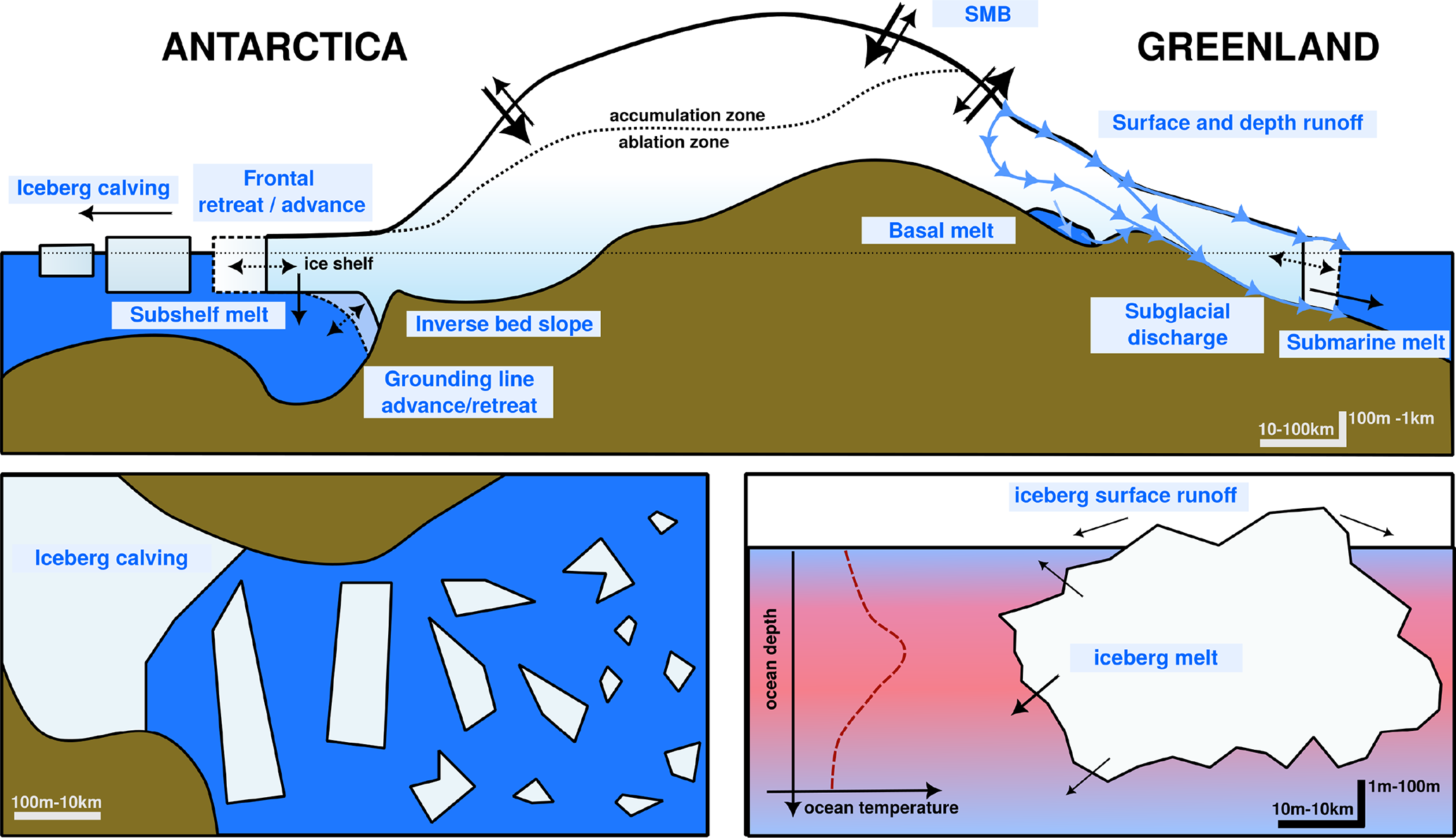
Even so there’s a lot of general interest in the paper, including how this is usually done now (there are a range of different approaches, each with their quirks). And then a particularly nice and clear section is given on all the many different ways that ice sheets lose ice. The figure below from the paper  shows some of these and as they all have different downstream effects on ocean circulation, sea ice and of course sea level rise, it’s important to work out how to include them efficiently. The paper as it stands is a really nice introduction to the subject.

Figure 1 from Schmidt et al., 2025 showing a schematic of how ice sheets lose ice.

Icebergs are particularly interesting as a source, as the meltwater from these can take years to be added to the ocean, in which time, they will have drifted hundreds or thousands of kilometres. We have some suggestions on those too.

In any case, we hope this paper, which grew out of a technical online workshop on the subject, partly organised by our Ocean Ice project, will turn out to be a useful source for the groups that actually run the global climate models for CMIP and the IPCC. Many of these models are still in development or being initialised now, so time is already short for those of us involved in the technical parts of the exercise. The publishing process is slow, but this is also why preprints are so valuable. This paper in its submitted form has been up for months, it’s only now the final version is ready, but it hasn’t changed much. While it feels hard enough keeping up with published papers that preprints feel like a distraction, science is moving so fast, it’s probably essential. Maybe I’ll write more about that later. Of course preprints (and indeed published papers) can lead you astray, especially in fields you don’t know much about (as COVID was a helpful reminder), so perhaps sensibly the IPCC insists on acceptance of manuscripts before including them in their reports. Nonetheless, keeping up with preprints is now probably almost as important for scientists as keeping up with the published literature.

On the subject of the IPCC, I was reminded this weekend that it’s now less than 500 days until the submission deadline for the working group 1 part of the next IPCC report (AR7), so it’s time to start thinking about what are the priorities to get into the scientific literature to inform this effort. IPCC can only report published work, and doesn’t do its own, so now is the moment to pull out that unfinished but crucial piece of evidence of something or other relevant and get it submitted.

Not coincidentally, it’s time to talk about Academic Writing Month (AcWriMo). I actually try to write all through the year but November is time for a final push to try and meet my (usually far too ambitious) annual goals.

I had intended to start AcWriMo again this year, I’ve  a huge backlog of papers to get done and it seemed a good way to start. However, a big proposal writing effort (more on here if the funding comes through) and a Hackathon (of which more also anon), both extremely rewarding and in fact also involving a lot of writing, somewhat derailed the first 10 days of my effort… 

Now however it is time to focus on the remaining almost 3 weeks of November. The plan is one hour per day, except weekends, just focused on papers. I’ve put it in my calendar already. Let’s see if I can stretch more than that. Also non- negotiable is daily exercise. The fresh air and time away from the computer is almost as important as sitting down to do the work.

I’ve got an almost done experimental protocol to write for the PolarRES project (which finishes his month, so there’d be a nice symmetry to getting that done). And then there’s the much delayed reply to reviewers on our ice mélange study in NW Greenland as my main foci, but I also want to help my Hackathon group get their project knocked into shape, so some time will be spent there.

I’ve also got various diverse co-authored papers I need to contribute to, read,edit and give my options on. I hate to become a roadblock for colleagues so that also needs some attention but I’m for sure already out of time.

So if you want to see all stages of the sausage being made, follow along with the hashtag (#AcWriMo25) on socials, but hopefully you won’t see me there much because I .

The curious case of the moving trees…

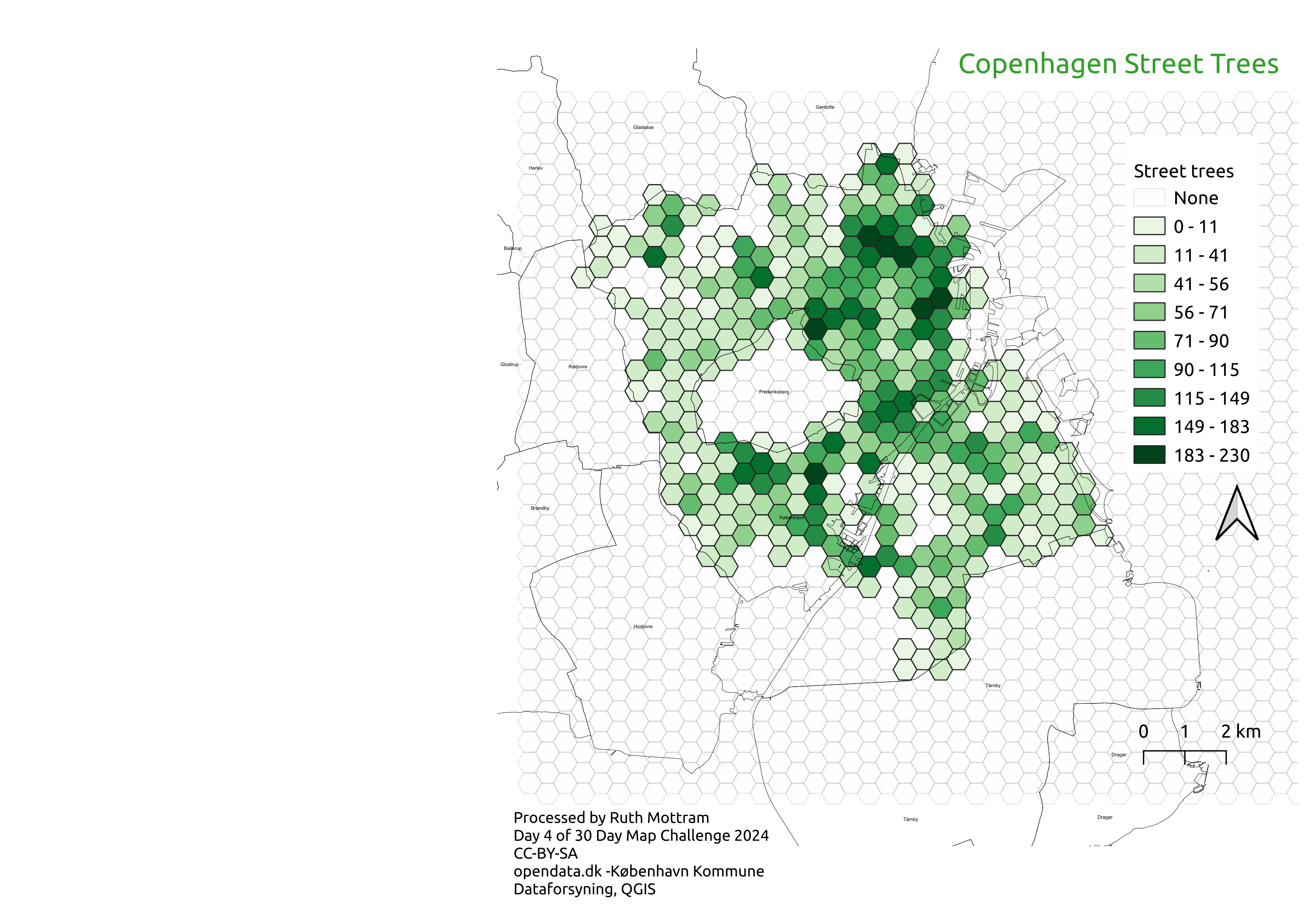
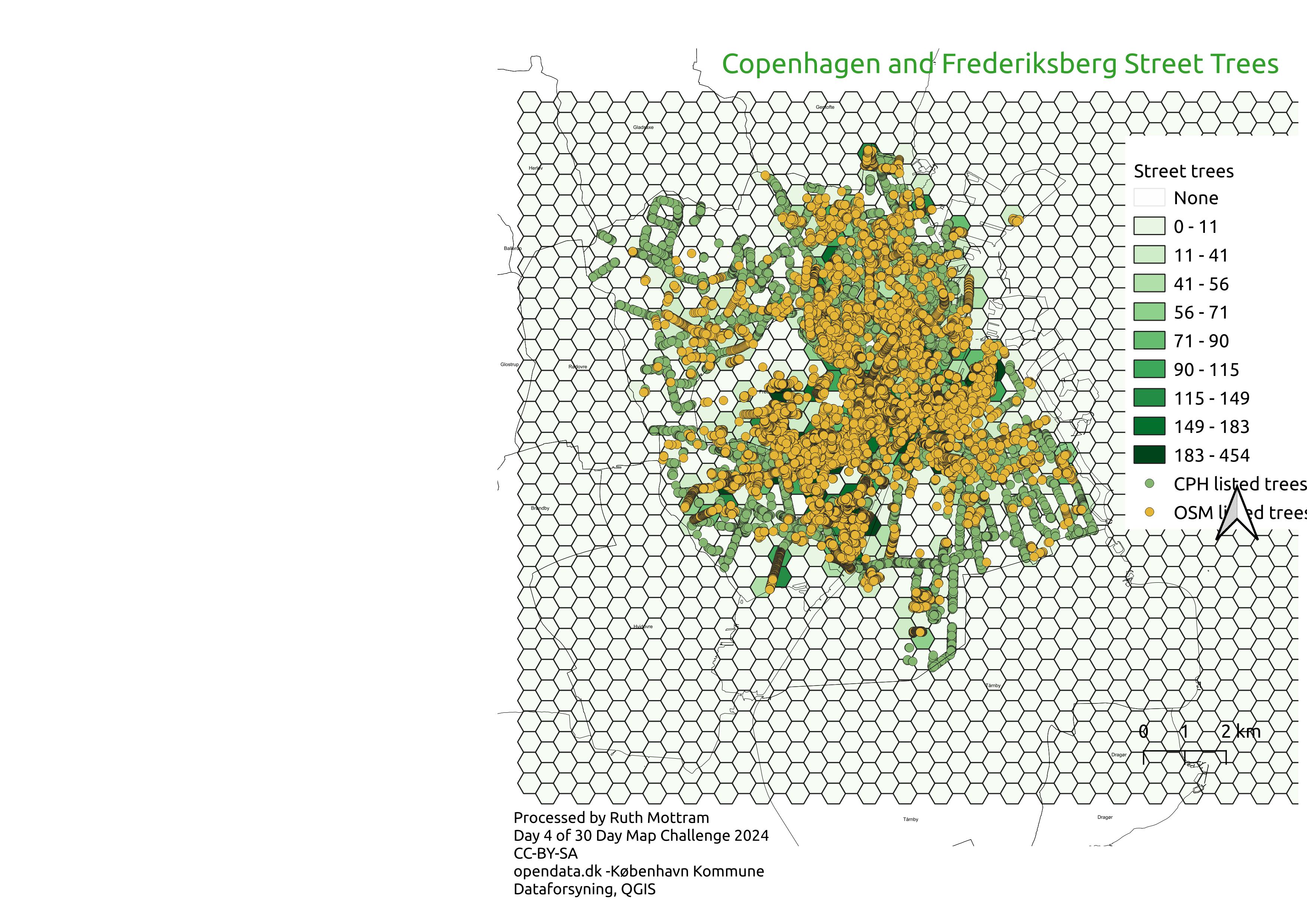
Yesterday in 30 Day Map Challenge I rather hurriedly made a map showing the density of street trees in Copenhagen shown as hexagons. However, there is a big gap in the overall map, because the dataset I used only covered Copenhagen Kommune (local authority) area and Frederiksberg is a separate local authority area where I could not find the data. This was, to put it mildly a little irritating.

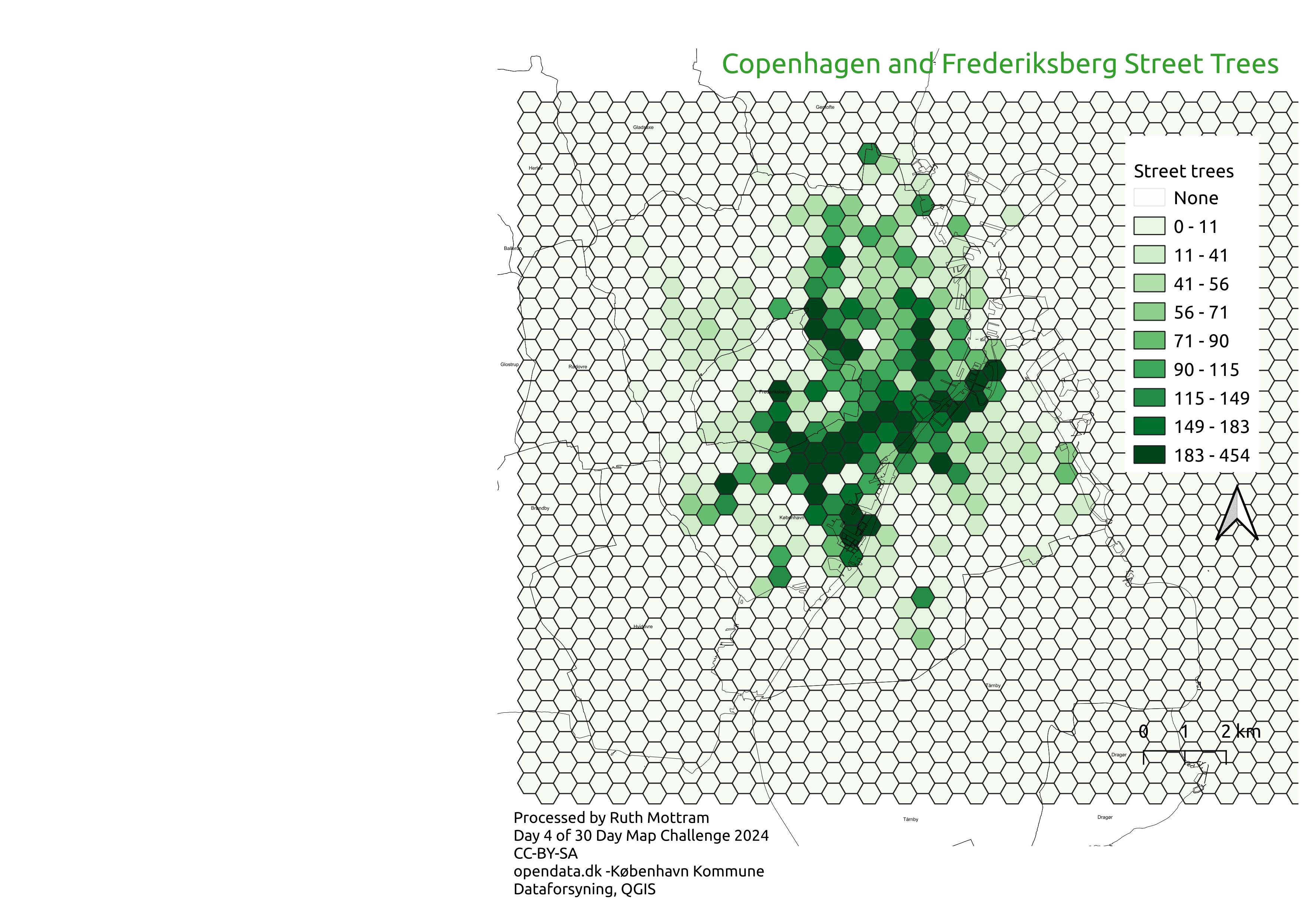
A fellow mastodon user (@tlohde) suggested using the outputs from openstreetmap to fill out the gaps. (And even helpfully provided some code to do so, which should tell you a lot about why I like mastodon so much). A very hurried 10 minutes reprocessing gives the revised map on the below, which has happily filled in much of the Frederiksberg gap. However, a closer comparison with the previous version above shows that, it’s not nearly the same…

The first thing to note is that the maximum number of trees in a polygon from the OSM data is 454, almost twice the 230 from the Copenhagen city council data set. The second thing is that I’m unsure exactly what time periods the Copenhagen data is from. It’s possible there has been a wholesale planting since the original data was collected, but there is no date on the opendata.dk page to indicate when it was sampled, so I can’t know how up to date it is. Openstreetmap may also be missing data of course (and a small remaining gap in northern Frederiksberg suggests it might be). However, the whole central axis of the plot has changed too.

I overlaid the individual trees on the map plot, the two are quite similar, and the long lines suggest tat plantings are following major roads in the city. I wonder however if the main difference is one of definition. Perhaps street trees from the Copenhagen kommune dataset does not include parks and of course those on private property, compared to those in OSM?

Does it really matter? Well maybe. Street trees provide a valuable service in communities: they shade the streets in hot summer days (and can lead to substantial cooling). They also soak up rainwater and their flowers and fruit feed city ecosystems, quite apart from their aesthetic properties. How to protect, conserve and expand the numbers if we don’t know where they are? Or are not for that matter?

I don’t really have time to dig down into this mystery further. 30 Day Map challenge is really about the tools but either way it’s a lesson. No matter how clever the tool, if the underlying data is missing, wrong or otherwise biased in someway, the map will also be wrong.

I’m tempted to add, that all maps are wrong, but some of them are useful..

Icebergs of Ilulissat

Icebergs in Ilulissat drift around the bay, sometimes fast, sometimes slow, sometimes they don’t move at all. They are drenched in the beautiful but sometimes stark light of the polar day. It’s scientifically interesting to watch them and speculate on their past trajectory and their likely future. It’s also extremely beautiful.

I’m once more on my way north to Qaanaaq, but this time I’ve been lucky enough to be able to enjoy some days off in Ilulissat. It’s an astonishing beautiful place, famous for the icebergs that come pouring out of the Ilulissat ice fjord just round the corner.

Normally, we’re only in town for one night as we have to switch planes to get to our field sites and this requires an overnight stay so it has been brilliant to be able to use a little holiday here.

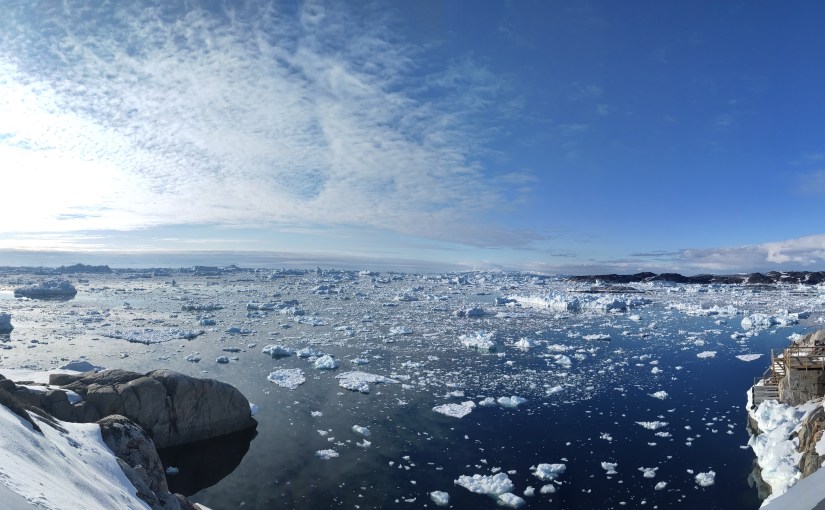
Panorama over the bay in Ilulissat on a sunny evening

I have been using the time to work on some papers and try to clear some of the back log of reports and emails, but there has at least been some time for a couple of hikes in the back country nearby. I could post several hundred photos of icebergs and other magnificent views, but I was struck by the movement of icebergs in the bay outside my window while I was working yesterday.

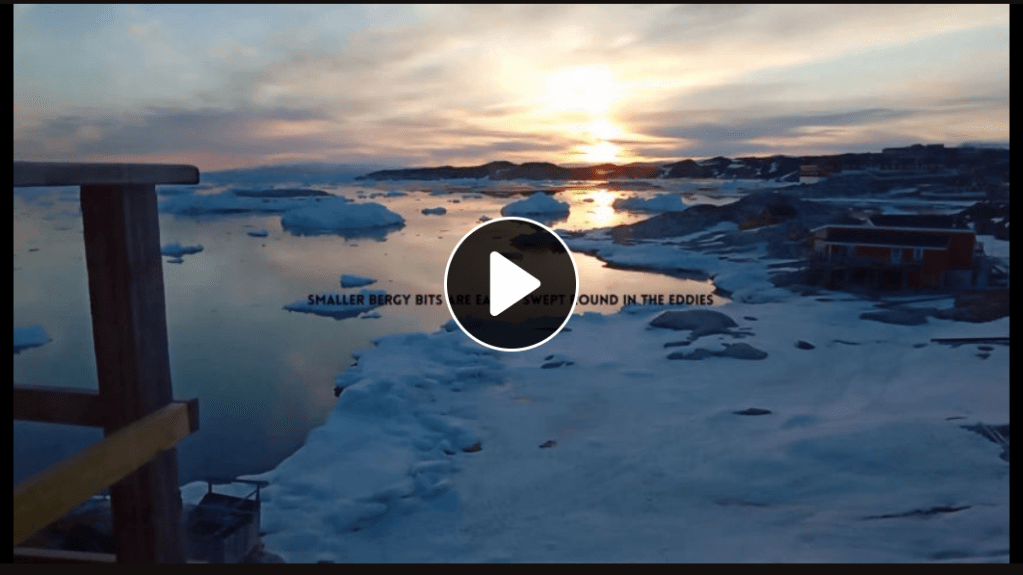
Sometimes the big bergs seemed to move more, sometimes they seem stuck. I wanted to check this so I set up a time lapse on my tablet in the window of the guest house I’m staying in overnight (bearing in mind it’s the Polar Day so doesn’t actually get dark). I think it actually ran out of power before covering the full six hours I set it up for, so I’m now trying a full day. However, it was enough to show my perception was basically right and I have come to the conclusion the changing movement is related to the tides.

You can see the full almost a minute long film at my peertube account below.

This is also a bit of an excuse to play around with video editing a little, in this case I’m trying out canva, and to advertise my peertube account @icesheets_climate on TILvids.com.

As I’ve alluded to before, I’m trying out the non-corporate social media fediverse and it’s actually quite fun, though the videos are a bit time-consuming so I’m not quite sure how regularly I will manage to post these on my channel, but the clue is in the name on what most of them are about I guess…

Another iceberg near Ilulissat, this time one we visited by boat…

But I have gratuitously many photos on my pixelfed account and no doubt more to come. I’m also planning some icebreaker shorts describing different elements of the environment that I’m working on. We’ll have to see how much time I have to actually get those finished, they typically take a while!

Of course, these are not just pretty pictures – I have a professional interest in icebergs – my PhD was about ice fracture and applying models of crevasse formation to describe a new parameterisation of calving. One of the projects I’m working on in northern Greenland, (funded by the danish state through the National Centre for Climate Research, NCKF) is also focused on calving processes, and specifically the role of ice melange in the system. In fact, one of the papers I’ve been working on this week analyses those iceberg related datasets. It’s immensely valuable and rare that I have the opportunity to be able to focus on the process in the field at the same time as writing the paper.

I have 2 more days in Ilulissat, so no doubt there will be more walks around town and more iceberg photos, but I have sent the iceberg paper back to my co-authors now, so it’s time to focus on a new paper – and the climate of the polar regions in the future.

The Greenland ice sheet

Heading North again…

I’m lifting my head from the semi-organised chaos that is my office, my home office, our family basement and the office workshop to write a quick post. This might be for reasons of despairing procrastination.

The reason for the chaos is that fieldwork season has come round again and on Friday I and my DMI colleague Steffen will be off to Northern Greenland once again. I’ll try to post a few photos to pixelfed (and perhaps even Instagram, though I swore off Meta products after the Brexit fiasco).

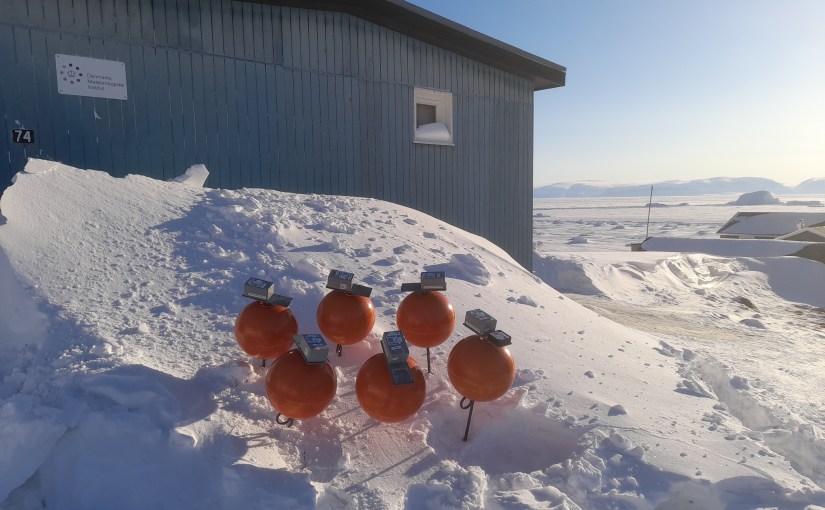
Buoys with GNSS and iridium transmitters (designed and assembled for us by Trustedglobal) ready to be taken out and deployed on the sea ice in northern Greenland. DMI’s geophysical facility building in the background.

This year my focus is again on the melange zone and we’ll be placing our instruments out to record the break-up of the fast ice. I also hope to get time to establish a new snow measurement programme – which I partly piloted last year. However, we will only be 2 scientists instead of the team of 4 this year, so this may have to wait until the second fieldwork period we have planned in early June (when the sea ice starts to break up). We are fortunate indeed that the local hunters, who still live a semi-subsistence lifestyle, are both incredibly competent and helpful and willing and eager to help when we go out on fieldwork.

This photo and excerpt was part of my contribution to a display at the Ocean decade conference in Barcelona next week. Last year we tested an open science variant of the trusted buoys above known as an Open Met Buoy. It’s incredibly smart, and completely open. You can download full instructions and make it and programme it yourself, or , as I did, order them from the german labmaker company who specialise in building open science kit.

Last year was a test of concept, and noone was more astonished than I was that the final set up not only survived the ice break up and floated safely down the fjord, we also managed to retrieve them and I hope they are waiting patiently in Qaanaaq so I can reprogramme and redeploy this year.

I wrote this piece on our work last year, promising a whole load of posts I didn’t end up having time to write. Sadly even my lego scientists never got an update. So instead of promising a whole lot of new posts, let me know what you’d like to see and read about either in the comments here or on my mastodon feed, and I’ll try to make some time to answer one or two of them while we go.

The area we travel to is going through very rapid changes now – not just climatic and environmental, but, perhaps even higher impact, social and cultural. I am privileged to be abel to witness it and we try hard to leave as little impact as possible.

At this stage it’s hard to imagine I’ll ever be ready to leave, but the clock is ticking down..

Sea Ice loss in Antarctica: Sign of a tipping point?

The Danish online popular science magazine is currently running a series on tipping points in the Earth system with a series of interviews with different scientists. They asked me to comment on the extraordinary low sea ice in Antarctica this year. You can read the original on their site here. But I thought it might be interesting for others to read in English the piece which is a pretty fair reflection of my thinking. So I’m experimenting a little with DeepL machine translation which I consider much more reliable that google’s competitor. I have not edited anything in the below!
I have been promising a piece on West Antarctica for a while – which I’m still working on, but hopefully this is interestign to read to be going on with!

A sudden and surprising loss of sea ice in Antarctica could be a sign that we are approaching something critical that we need to prepare for, warns an ice researcher from DMI.
The climate seems to be changing before our eyes.

2023 has seen record high temperatures both on land and in the ocean, which you can read more about in the article ‘Is the climate running out of control like in ‘The Day After Tomorrow’?

In Antarctica, there has been a sudden, violent and in many ways unexplained lack of sea ice, which normally melts in the summer and re-forms in the winter.

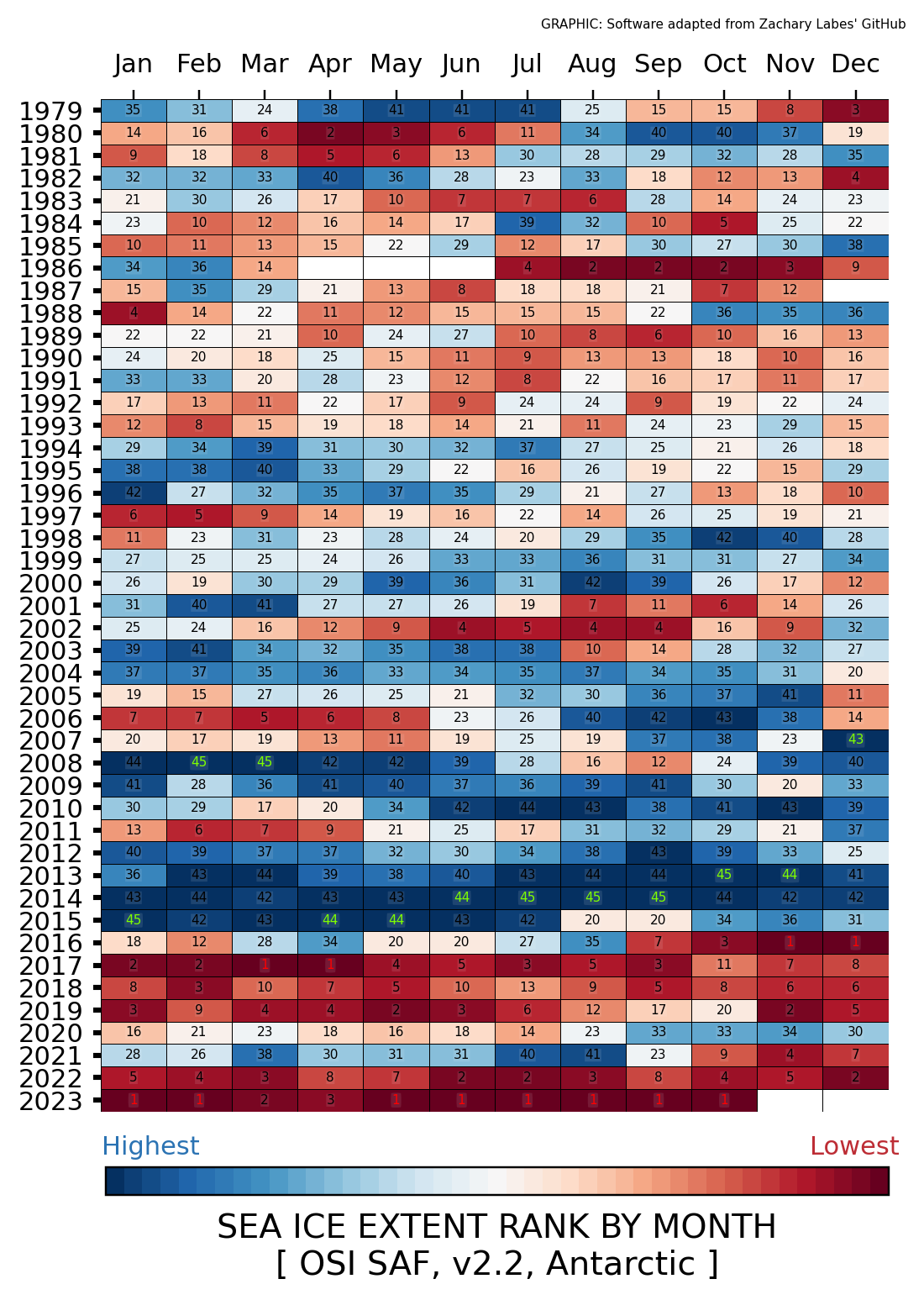
Monthly sea ice extent ranked by month also processed by OSI SAF. 2022 and 2023 are both extremely low.

In August, you could read on Videnskab.dk that the continent had failed to restore so much sea ice compared to normal that it was equivalent to the size of the world’s largest island, Greenland, or about 50 times the area of Denmark.

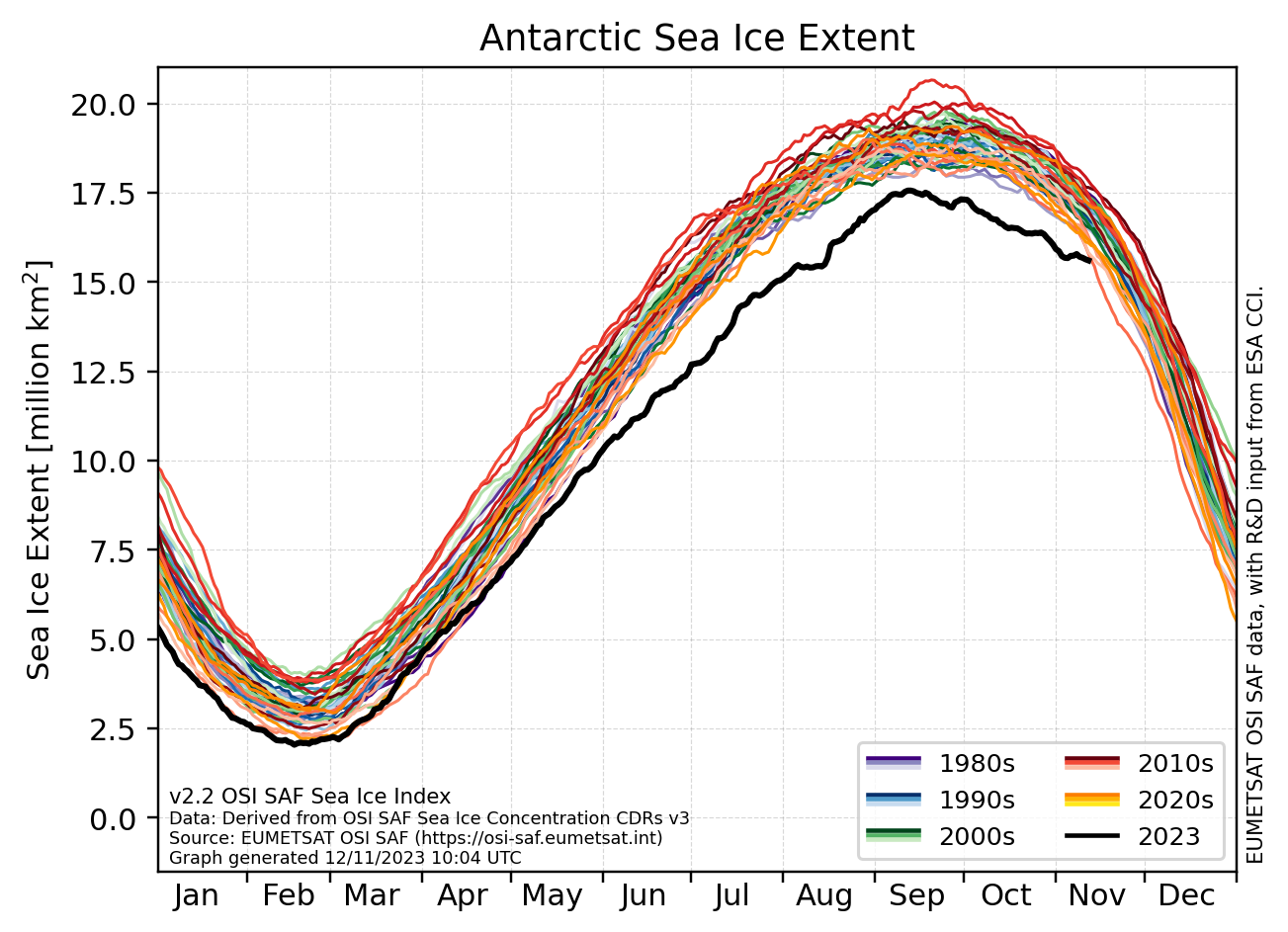
Since then, some of what was lost has been recovered, but when the sea ice peaked in September 2023, 1.75 million square kilometres of sea ice was still missing. This is equivalent to about 40 times the area of Denmark.

Antarctic sea ice extent in 2023, produced by the Eumetsat satelliute processing facility OSI SAF. The plot is updated daily and can be downloaded from: https://osisaf-hl.met.no/v2p2-sea-ice-index along with other data products.

This is by far the lowest amount of sea ice ever measured in Antarctica.

“The melting sea ice in Antarctica is not unexpected in itself, because we have long predicted that it would disappear due to global warming,” Ruth Mottram, senior climate researcher and glaciologist at the Danish Meteorological Institute (DMI) tells Videnskab.dk.

The climate seems to be changing before our eyes.

2023 has seen record high temperatures both on land and in the sea, which you can read more about in the article ‘Is the climate running out of control like in ‘The Day After Tomorrow’?

“But to suddenly have a very, very large disappearance like that is a big surprise. We can’t explain why it happened, and our models can’t recreate it either,” she says, but adds that over time, the models are getting closer to reality.

Disturbances in the Earth’s system are probably connected

Videnskab.dk has in a series asked five leading Danish scientists to assess the state of the climate from their chair – in this article Ruth Mottram.

Ruth Mottram is head of the European research project OCEAN:ICE.

The OCEAN:ICE project
The researchers in OCEAN:ICE, led by Ruth Mottram as principal investigator, will take measurements below the ocean surface. This will provide more knowledge about the temperatures in the ocean around Antarctica.
They will also calculate how fast the ice is melting in Antarctica due to ocean processes and warming in the air. They will also investigate what the lack of sea ice means for the rest of the Antarctic system.
Ruth Mottram cites as examples:
How does it affect ecosystems? For example, many animals feed on the small crustacean krill, whose life is affected by sea ice. Will more waves now reach the Antarctic ice sheet and perhaps lead to more icebergs and more melting? Will glaciers and icebergs become more sensitive to heat? Or, on the contrary, will less sea ice trigger more snow over the continent, which could even stabilise the glaciers?
More specifically, researchers will focus their efforts on seven areas, which you can read more about on the OCEAN:ICE website.

In the project, researchers will, among other things, take measurements under the sea surface in Antarctica to gain more knowledge about how the ocean and ice interact.

Is melting sea ice linked to warm water in the Atlantic?

In the North Atlantic, sea surface temperatures in some places have been as much as five degrees above normal.

To an outsider, it seems obvious that this could have something to do with melting sea ice.

However, according to Ruth Mottram, the two factors are not necessarily directly related. Sea ice in Antarctica melts from below. Therefore, the temperature at the bottom of the sea is far more important than the temperature at the surface.

“But if there’s one thing I’ve learnt over the past 15 years working at DMI, it’s how interconnected the whole world is. So I think we’re seeing some disturbances throughout the Earth system that are unlikely to be completely independent of each other,” she says to Videnskab.dk.

Ocean Professor Katherine Richardson made the same point earlier in the series. You can read about it in the article ‘Professor: The oceans are warming much faster than expected’.

Lack of knowledge and observations

Ruth Mottram emphasises that far more observations from Antarctica are needed before we can say anything definite about the causes of the rapidly shrinking sea ice, but: “It could indicate that the Antarctic sea ice has a critical tipping point like the Arctic, where for a number of years we see a slow decline year by year, and then suddenly it drops to a new stability where it is very low compared to before.””But we don’t know, because there are parts of the system that we don’t understand and that we haven’t observed yet,” explains Ruth Mottram.

Possible reasons why sea ice is disappearing

Ruth Mottram talks a lot with international colleagues about why the sea ice is currently experiencing a significant decline.

She explains that there are different theories, for example that warmer water from below is coming into contact with the sea ice and melting it from below, and that warmer air may be feeding in from above.

In Antarctica, the direction and strength of the wind has a big impact on the state of the ice (click here for a scientist’s timelapse of how Antarctic weather changes rapidly).

Perhaps the sea ice has been hit by “a very unfortunate event”, where it is both being hit by warm water from below and being affected by weaker winds from changing directions, which is holding back the recovery of sea ice.

Again, more research is needed.

Melting ice also contributes to sea level rise, and the Earth is actually designed so that melting in Antarctica hits the northern hemisphere much harder than melting in Greenland. So, bad news for the ice in Antarctica is bad news for Denmark.

Even more bad news is on the horizon.

The natural weather phenomenon El Niño looks set to get really strong over the next few months. A so-called Super-El Niño will likely only make the world’s oceans even warmer.

“We know that the ocean is going to be really, really important in the future in terms of how fast the Antarctic ice is melting and what that will mean for sea level rise,” says Ruth Mottram.
We can’t just wish the world would look different

The climate scientist does not fear huge increases or a violent change in climate overnight, as depicted in the 2004 disaster film ‘The Day After Tomorrow’. She points out that even abrupt shifts in the Earth’s past climate have occurred over decades or centuries, not a few months or years. Still, Ruth Mottram thinks it makes sense to start talking a little more openly about how we tackle severe sea level rise – which on a smaller scale can still be sudden – and large-scale climate change.

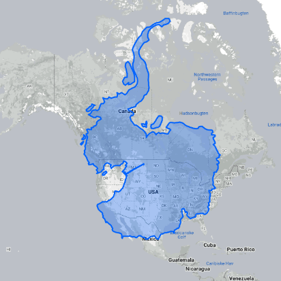
The Antarctic ice sheet is the largest on the planet

Figure made on http://www.thetruesize.com showing how Antarctica is roughly 1.5 times the size of the USA.

The Antarctic ice sheet contains around 30 million cubic kilometres of ice. This means that around 90 per cent of all fresh water on Earth is frozen in Antarctica.

If all the ice sheet in Antarctica melts, the world’s oceans will rise by around 60 metres. Even if we stay within the framework of the Paris Agreement, we risk that melting Antarctic ice from Antarctica will cause sea levels to rise by 2.5 metres.

Ruth Mottram notes that the more we exceed the limits of the Paris Agreement, the faster sea levels rise – and slower if we act quickly and stay close to the set limits of preferably 1.5 and maximum 2 degrees of temperature rise compared to the 1800s.

“The Earth’s climate system may be shifting towards a new equilibrium, which could result in a different world than we have grown up with,” continues Ruth Mottram.

“It is already affecting us and will do so increasingly in the future. That doesn’t mean it will be a total disaster, but we will probably get to the point where we have to adjust our lifestyles and societies.”

“It won’t necessarily be simple or easy to do so, but we can’t just wish for the world to be different than it is,” says Ruth Mottram.

In another article in Videnskab.dk’s climate series, Professor Jens Hesselbjerg Christensen notes that the world’s finance ministers – including Denmark’s – must pull themselves together and find money to slow climate change by, among other things, putting a cap on greenhouse gas emissions.

“We are in the process of allowing future generations to accept that large areas of land will become uninhabitable because the water level rises too much,” he says.
‘Bipolar’ researcher: Keep an eye on Greenland too

In the short term, Ruth Mottram is interested in finding out what the consequences of El Niño will be and how Antarctica will change over the next few years.

But she also has her sights set on Greenland.

“Because there have been so many weather events elsewhere, it has gone a bit unnoticed that we’ve had a really high melt season in Greenland this year.

“It can give us the opportunity to see very concretely how weather and climate are connected. That’s why the next few years will be really interesting in Greenland,” says Ruth Mottram, who has also conducted research in the Arctic for many years.

The next article in Videnskab.dk’s series on the state of the climate will focus on Greenland.

Translated with DeepL

Musings in summer 2023: impacts + adaptation

I was talking to some friends today about climate change – in the light of the latest #AMOC paper, suggesting a tipping point. I’m far from an expert on AMOC so if you’re here for that I suggest this comprehensive piece on real climate from Stefan Rahmstorf.

Or the TL;Dr version in thread form compiled by Eleanor Frajka-Williams, PI of OCEAN:ICE sister project EPOC.

Anyway, the conversation turned to what’s going on this summer.

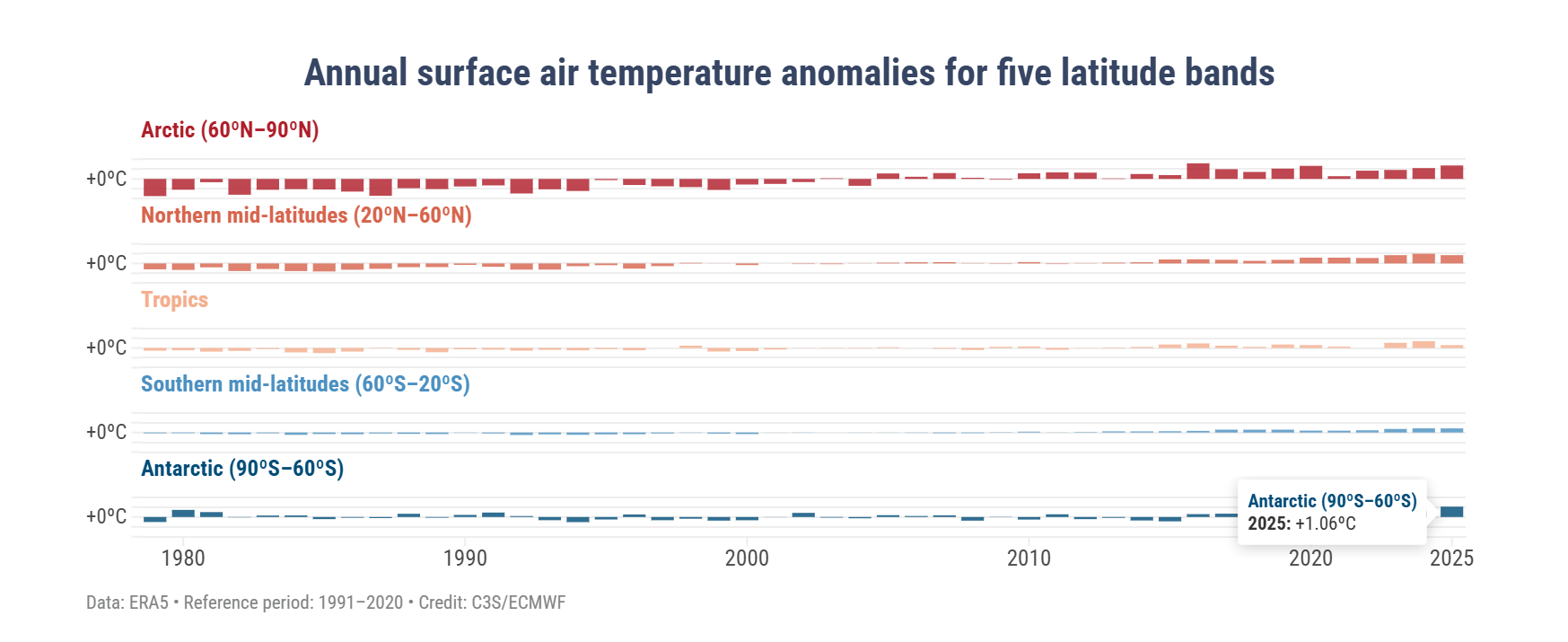
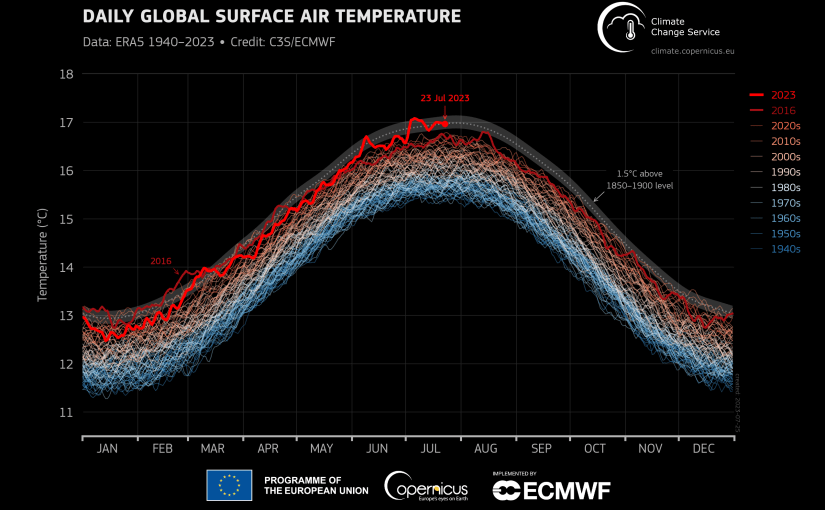
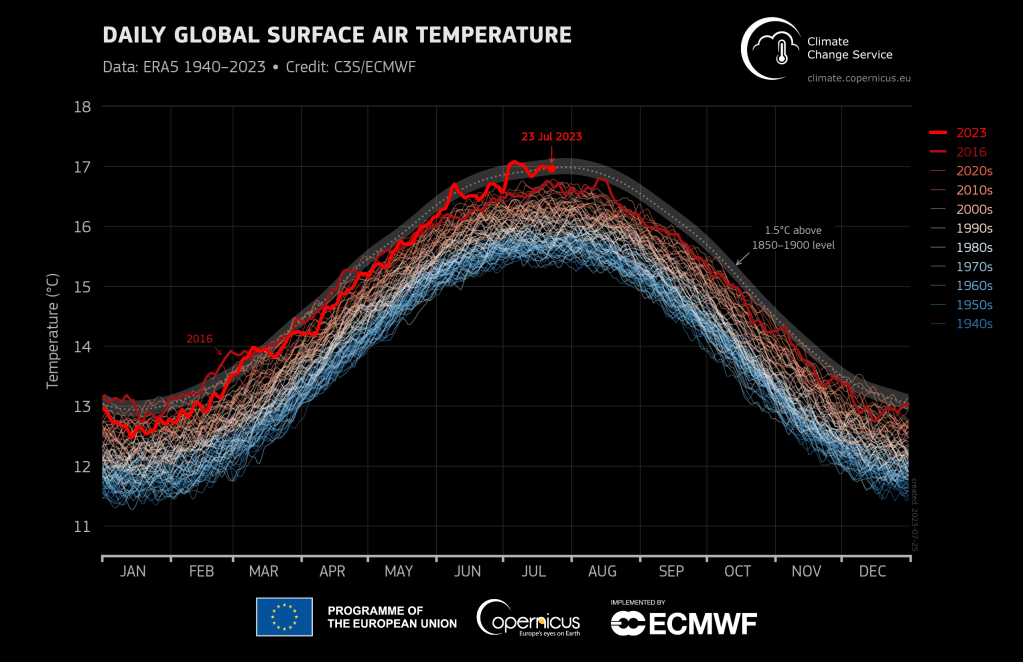
It’s hot, but don’t just take my word for it. Here is the authoritative Copernicus Climate Change Service stating it..

It’s been hot, in short and even if July has been cooler and rainy in Denmark, May and June were hot and record dry..

And it’s fair to say that, as when I’m asked why, or similar questions by journalists, there is an almost overwhelming temptation to say “we told you so”. I think that’s what Antonio Guttieres is getting at here too.

There’s of global boiling is upon us. Apparently. It certainly felt like it on my summer holiday this year…

However, that’s not what I was mostly musing on. Given the apocalyptic heatwaves, strange patterns of warming in the ocean and the Antarctic sea ice loss, it feels a little like end of days.

But pretty much all of these were projected pretty accurately by scientists, even if the timing was a bit off and we’re not entirely sure what is driving that extraordinary downturn in Antarctic sea ice (but do read Zack’s piece linked here, it’s very good).

In many ways, we’re fortunate in Denmark and the rest of rich northern Europe. The worst direct impacts, at least in the near and short term, we can probably adapt to, though it will be expensive. They are mostly engineering challenges with a dollop of social science mixed in. And, we should remember that even in wealthy and well-educated Europe, how heavily climate change impacts us is very much determined by our social class.

However, in the long-term (and I do mean really long-term – on the century to millennia scale), we’re facing something more existential. We’re going to lose a lot of Danish land to sea level rise. Exactly how much will largely be determined over the next 20 to 50 years as there’s a pretty clear relationship between greenhouse gases and melting ice.

But we do have time to prepare for it- and most importantly to have some grown up conversations about our priorities as a society. This is going to require a good bit more social and behavioural science. In the medium term, we will need to prepare for ever more storm surges, but adaptation to coastal flooding also falls into the engineering category.

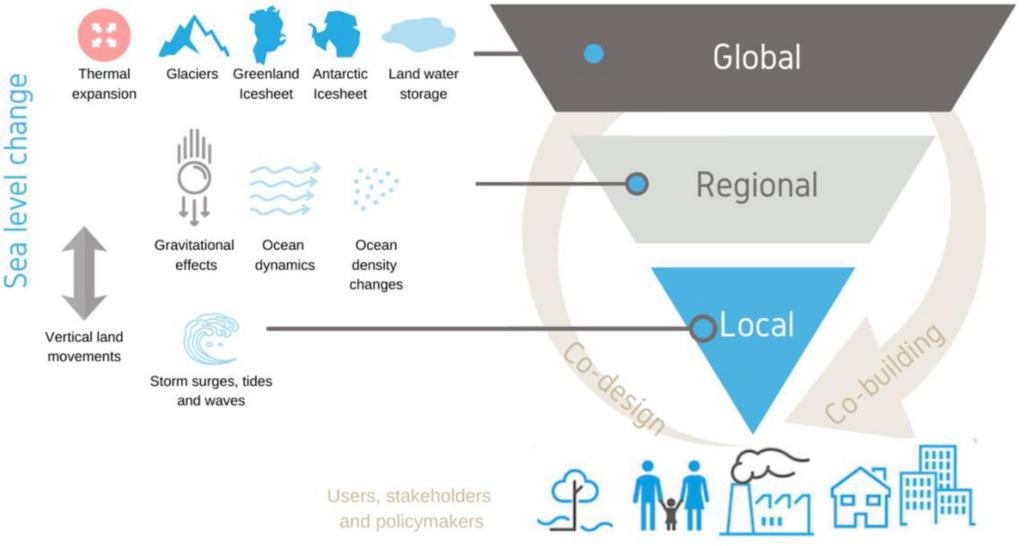
Of course, these local to regional risks still need dealing with and that is largely why my employer has created the awesome Danish climate atlas – to give accurate but also useful climate information to those who need to plan for the future. I suspect an ever greater part of my job will be focused on producing usable projections and climate service information. This is certainly also something we will focus on in the PRECISE project. Being able to make useful sea level rise projections is about more than identifying if an ice sheet is stable* or not, it’s also about how quickly, how likely and how much it is likely to retreat. As we have also focused on at a regional level in the PROTECT project

Figure from our paper in Frontiers describing co-production of useful climate information

So that’s ice sheets and sea level. The tl;dr is, we know they’re melting, we still don’t know by how much and how fast they’ll ultimately melt but we still have time to deal with it, at least in wealthy well educated societies like Denmark,.

There is a whole nother discussion to be had about the global south and less equal societies which I don’t feel confident enough to discuss here.

Where I do think we’re more vulnerable in the shorter and medium term is perhaps surprisingly, food production – and that goes for much of Europe too. It turns out that concentrating large amounts of food production in a few key places might be a big mistake. Especially where those places are vulnerable to drought, heatwaves, over extraction of water, not to mention appalling labour conditions, an over-reliance on groundwater, artificial fertilisers and pesticides.

And then there is some evidence that multiple heatwaves could occur concurrently, threatening food production in compound events across several key regions. Perhaps working out how to make the global food chain less vulnerable to disruption at key points should be more of a focus than it is?

And that’s after the latest banditry from Russia, destroying perfectly good foodstocks and the means to distribute them, has given us a clear wake-up call on the interdependence of human society.

(Anders Puck Nielsen a military commentator has an interesting take on that from a strategic point of view here: https://youtu.be/fvPcPZP-6os which is very interesting for Ukraine watchers)

If I were a wise and concerned government I think I’d be thinking about how exactly we’re going to be feeding our population over the next 5-20 years. Where will be able to produce like Spain and Italy today? Or will diets have to change? How do we persuade people to eat more healthily and ensure that food is equitably spread through society?

This is of course also a part of the job of the other working groups, 2 and 3 of the IPCC – and it’s possibly not just an accident or indeed good lobbying that the new IPCC chair, Jim Skea, is a former WG3 coordinator. Perhaps the IPCC also sees that we have now moved into a new world.

So, these are just some of the things I’m thinking about as I prepare to go back to the office after the summer break next week.

As I observed on Mastodon after the IUGG meeting, and online with this excellent heatmap article. Climate science is entering a new phase. It’s the end of the beginning and it’s time to prepare.

*On the subject of ice sheet stability, Jeremy Bassis has an excellent thread on what this does and does not mean over on Mastodon. Worth checking out

Bringing back the wild to Europe

Today the European Council is debating (behind closed doors), the proposed Nature Restoration Law – there has been heavy lobbying by several EU countries to water down the provisions. I believe this is a mistake and last week I and almost three and a half thousand other scientists signed a petition saying so.

It has now been reopened for signatures. Please do sign if you feel strongly about it. It’s worth a read anyway as the organisers (probably being scientists!) have written out what the agreement means in admirable clarity:

https://umfrage.uni-leipzig.de/index.php/837218?lang=en

Europe is a nature depleted continent already – restoring, or at least preserving what we can is going to be crucial in coming decades. And where Europe leads and sets strict environmental standards, other countries follow.

Rough land which has been allowed to turn into a wildflower haven in Copenhagen

I am a climate scientist who has become increasingly interested in and concerned about biodiversity. I have had a deep love and sense of wonder about nature since I was a kid – and probably my interest in glaciers and weather and climate have in in part grown out of that. I’m not a biodiversity expert, but I am acutely aware of the impact climate change is already having on the biosphere. It is at a fundamental level very hard to separate climate from biodiversity and probably unwise to try.

In the past I’ve considered it was a scientist’s duty to advise impartially and therefore to be politically completely inactive, I have regretfully come to the conclusion that actually, maybe we as a community do need to push a little more firmly in the direction our science is actually pointing us. Perhaps it is in fact irresponsible not to be involved?

As the great atmospheric chemist and Nobel Laureate Sherwood Rowland once said (in 1986!):

“After all, what’s the use of having developed a science well enough to make predictions, if in the end all we’re willing to do is stand around and wait for them to come true?”

Brodeur, 1986

This quote is something I have thought long and hard about myself. And I’m not the only one in the climate field for sure. If our biodiversity colleagues are also wrestling with this, then I also recommend this brilliant piece by NASA GISS scientist Gavin Schmidt in the Bulletin of Atomic scientists.

The petition I linked to above has been organised by german scientists, experts in ecology and biodiversity. They emphasise:

“Being proactive is thus important. We would therefore appreciate if you found your way of communicating this letter in your surroundings, and help delivering the science to whoever may be interested in it. The purpose is not to lobby but rather to support, to offer help, maybe even mediate where possible.”

We’re scientists and we’re also public servants.

Use us to help guide policy. If scientists are ringing alarm bells, then somewhere there is a fire…

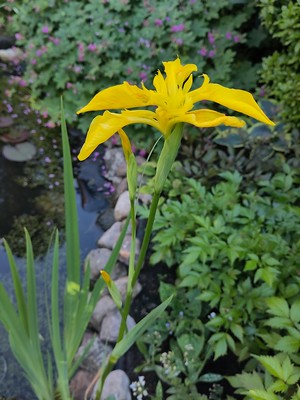
Yellow flag iris around a wildlife rich garden pond.