Off to summer camp

Or rather bootcamp. Or, if you (understandably) dislike the slight military overtones of the metaphor, call it a summer school or a hackathon instead….

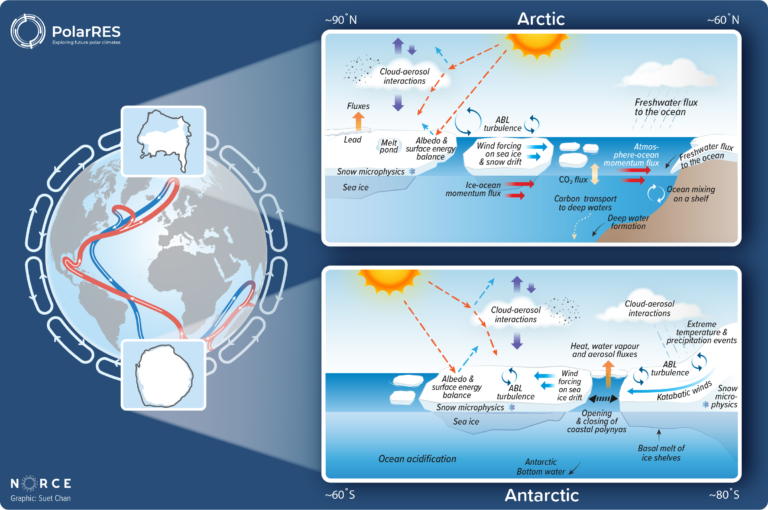
This coming week I will be at the PolarRES Early Career Researcher (ECR) bootcamp for a few days. It’s being held at Søminestation, now a marine biology research station but also rented out for other academic activities, by Roskilde University Centre.
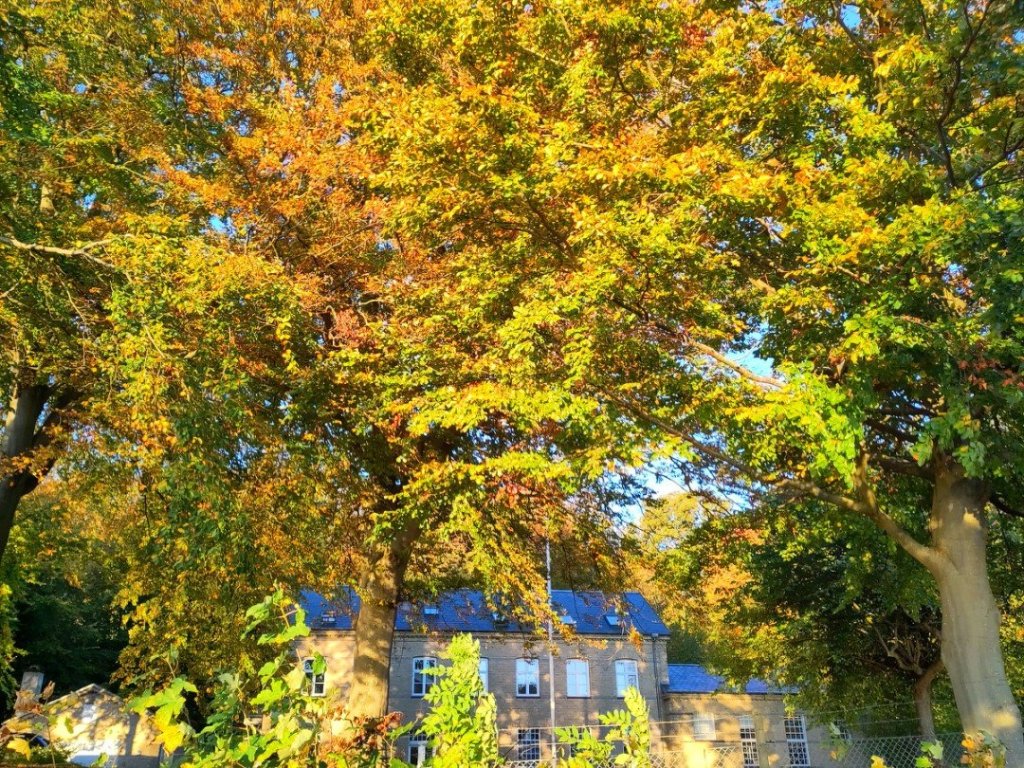
Behind the gorgeous beech trees on the edge of the fjord lies the Søminestation – now administered by Roskilde University Centre (RUC), mostly for marine biology applications I gather…

In a brilliant swords to ploughshares kind of theme, the station was originally owned by the Danish Ministry of Defence for developing and testing torpedoes. Happily, it’s now a place of sanctuary for busy scientists. It’s ridiculously idyllic, right on the edge of the fjord with a tiny beach which makes swimming easy and safe, lots of wildlife to enjoy and a recently renovated interior in impeccable Danish minimalist style.

The buildings are nestled in the forest with trails all around and it’s reached on quiet roads perfect for cycling. Food is delivered daily by a catering company and the bootcamp participants sort their own breakfast and lunches from a large assortment put out in turn by small groups. It’s a really perfect location for team building and reading weeks.

This is actually the 2nd bootcamp I’ve attended there. I organised the last one at the same place last October, in collaboration with many colleagues and fellow members on the NORP panel.

Then, the bootcamp subject was the Arctic and how well the CMIP6 global climate models (as used by the IPCC in their Sixth assessment report) represented the important processes. We had 23 students and 10 mentors, working on various aspects of this big problem for 10 days. We covered everything from sea ice to ocean circulation to atmospheric teleconnections to the Greenland ice sheet (natch). 

This artificial jetty was built to help launch torpedoes on a firing range in the 1930s to 1960s, now it’s a nice spot for a group of young scientists to take a walk and talk

They’re also exhausting. And I don’t think I was the only one who went home after 10 days last year and basically crashed for a week.

On the other hand, there will almost certainly come at least 3 publications from last year’s bootcamp. I wouldn’t be surprised if this year had a similar count. It’s a really brilliant way to get a lot of high quality work done in a short space of time.

It was overall a fantastic experience – albeit rather hectic, not least because we had to delay twice due to Corona, as did many other people so it was back to back with far too many other meetings. However I’d love to do another one, I find them incredibly stimulating and exciting from a scientific viewpoint. So I leaped at the opportunity to come back for a few days for the new PolarRES organised effort.

Dawn swimming in the Holbæk fjord by Søminestation
Don’t get the wrong impression, the work sessions at this bootcamp started at 8.30am and often went long into the evenings.
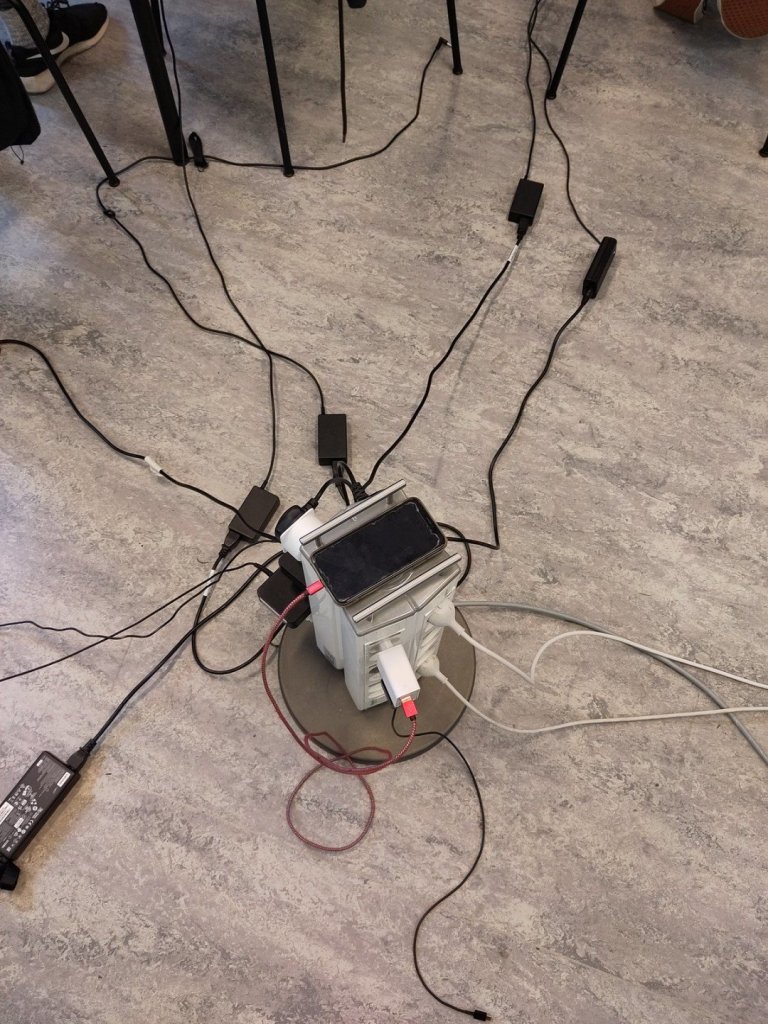
It’s not just the people but the IT equipment that’s working hard… Thanks to strong winds during the bootcamp most of the energy used in Denmark was renewable, but we also relied quite a lot on cloud infrastructure to power data analysis. That’s going to be the next target to decarbonise.

I will sadly not be attending the full week – I have family commitments- but I will lecture the first day (on “Hot topics in polar climate”: would love to hear your ideas on that in the comments…) And I’ll be around a few days to help support the group work as far as I can.

I’m mainly planning on using the time to prepare a talk for the IUGG meeting, and to write a draft paper. Both of these tasks already involve many of the early careerers at the bootcamp so it’s also a great opportunity for me to get a few things done.

It probably points to some of the problems in the working world, that I actually need to leave the office in order to get some work done…

Time to get back to the beach.
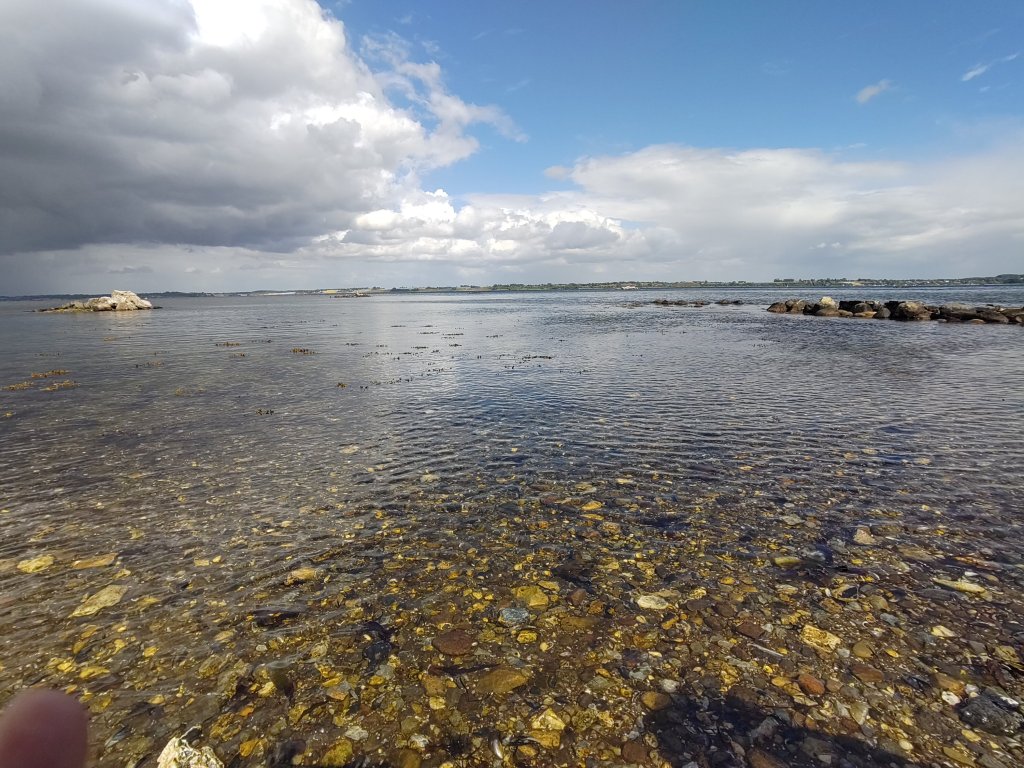

The beach at Søminestation:
“I do not know what I may appear to the world, but to myself I seem to have been only like a boy playing on the seashore, and diverting myself in now and then finding a smoother pebble or a prettier shell than ordinary, whilst the great ocean of truth lay all undiscovered before me.” Attributed to Isaac Newton (allegedly)
Bringing back the wild to Europe

Today the European Council is debating (behind closed doors), the proposed Nature Restoration Law – there has been heavy lobbying by several EU countries to water down the provisions. I believe this is a mistake and last week I and almost three and a half thousand other scientists signed a petition saying so.

It has now been reopened for signatures. Please do sign if you feel strongly about it. It’s worth a read anyway as the organisers (probably being scientists!) have written out what the agreement means in admirable clarity:

https://umfrage.uni-leipzig.de/index.php/837218?lang=en

Europe is a nature depleted continent already – restoring, or at least preserving what we can is going to be crucial in coming decades. And where Europe leads and sets strict environmental standards, other countries follow.

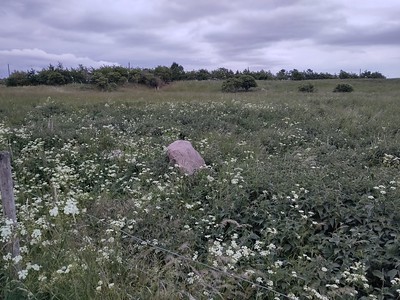
Rough land which has been allowed to turn into a wildflower haven in Copenhagen

I am a climate scientist who has become increasingly interested in and concerned about biodiversity. I have had a deep love and sense of wonder about nature since I was a kid – and probably my interest in glaciers and weather and climate have in in part grown out of that. I’m not a biodiversity expert, but I am acutely aware of the impact climate change is already having on the biosphere. It is at a fundamental level very hard to separate climate from biodiversity and probably unwise to try.

In the past I’ve considered it was a scientist’s duty to advise impartially and therefore to be politically completely inactive, I have regretfully come to the conclusion that actually, maybe we as a community do need to push a little more firmly in the direction our science is actually pointing us. Perhaps it is in fact irresponsible not to be involved?

As the great atmospheric chemist and Nobel Laureate Sherwood Rowland once said (in 1986!):

“After all, what’s the use of having developed a science well enough to make predictions, if in the end all we’re willing to do is stand around and wait for them to come true?”

Brodeur, 1986

This quote is something I have thought long and hard about myself. And I’m not the only one in the climate field for sure. If our biodiversity colleagues are also wrestling with this, then I also recommend this brilliant piece by NASA GISS scientist Gavin Schmidt in the Bulletin of Atomic scientists.

The petition I linked to above has been organised by german scientists, experts in ecology and biodiversity. They emphasise:

“Being proactive is thus important. We would therefore appreciate if you found your way of communicating this letter in your surroundings, and help delivering the science to whoever may be interested in it. The purpose is not to lobby but rather to support, to offer help, maybe even mediate where possible.”

We’re scientists and we’re also public servants.

Use us to help guide policy. If scientists are ringing alarm bells, then somewhere there is a fire…

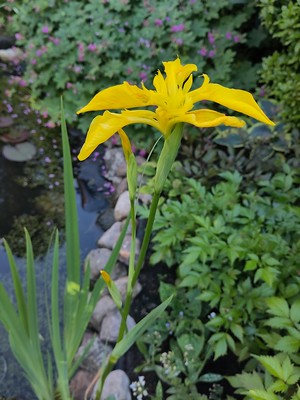
Yellow flag iris around a wildlife rich garden pond.

Oh Vienna…

In the before times I would usually spend this week walking around a world class city humming an old 80’s hit (- don’t ask me why it was so durable in my head, probably something to do with being an impressionable age at a time when access to pop music meant half an hour on a Thursday evening).

Anyway, it is the time for EGU… Sadly I will not be wandering the streets of the ever beautiful (and most livable) capital of Austria this year. I have to get some actual work done, but I’m following the #EGU23 on mastodon and hoping to catch a few highlights on the sides. I do have a poster, which will be capably presented by PolarRES PI Priscilla Mooney and my DMI Colleague Abraham Torres on Thursday.

The topic is our PolarRES project – an ambitious Horizon 2020 effort to produce a large ensemble of regional climate simulations over both poles. These are state-of-the-art regional climate models run at unprecedented high spatial resolution and all data will be made open access and free via the CORDEX project.

I will also put it here later – feel free to comment here or ask questions on mastodon or get in touch by email if it sounds exciting.

Mottram, R., Mooney, P., and Torres, J. A. and the PolarRES Consortium: A first look at the new PolarRES ensemble of polar regional climate model storylines to 2100, EGU General Assembly 2023, Vienna, Austria, 24–28 Apr 2023, EGU23-14470, https://doi.org/10.5194/egusphere-egu23-14470, 2023.

Other posters and talks I’ve contributed to from PolarRES are

Kristiina Verro’s talk on HCLIM_Arome results from the Antarctic peninsula:

Verro, K., van de Berg, W. J., Orr, A., Landgren, O., and van Ulft, B.: New non-hydrostatic polar regional climate model HCLIM-AROME: analysis of the föhn event on 27 January 2011 over the Larsen C Ice Shelf, Antarctic Peninsula, EGU General Assembly 2023, Vienna, Austria, 24–28 Apr 2023, EGU23-13864, https://doi.org/10.5194/egusphere-egu23-13864, 2023.

Abraham Torres joined our group last year and is primarily working on PolarRES also. He will show some of our preliminary HCLIM results for both the Arctic and the Antarctic

Torres-Alavez, A., Landgren, O., Boberg, F., Christensen, O. B., Mottram, R., Olesen, M., Van Ulft, B., Verro, K., and Batrak, Y.: Assessing Performance of a new High Resolution polar regional climate model with remote sensing and in-situ observations: HCLIM in the Arctic and Antarctica, EGU General Assembly 2023, Vienna, Austria, 24–28 Apr 2023, EGU23-14090, https://doi.org/10.5194/egusphere-egu23-14090, 2023

Quentin Glaude is a collaborator from Liege in the Horizon 2020 PROTECT project on sea level rise contributions from the cryosphere . Baptiste Vandecrux, a former PhD student with me here and now working at GEUS is also presenting some work based on the same models as Quentin, with a comparison to the PROMICE observation statons on the Greealnd ice sheet. It’s very cool application of machine learning and the results are very interesting.

Glaude, Q., Noel, B., Olesen, M., Boberg, F., van den Broeke, M., Mottram, R., and Fettweis, X.: The Divergent Futures of Greenland Surface Mass Balance Estimates from Different Regional Climate Models, EGU General Assembly 2023, Vienna, Austria, 24–28 Apr 2023, EGU23-7920, https://doi.org/10.5194/egusphere-egu23-7920, 2023

Vandecrux, B., Fausto, R. S., Box, J. E., Covi, F., Hock, R., Rennermalm, A., Heilig, A., Abermann, J., Van As, D., Løkkegaard, A., Fettweis, X., Smeets, P. C. J. P., Kuipers Munneke, P., Van Den Broeke, M., Brils, M., Langen, P. L., Mottram, R., and Ahlstrøm, A. P.: Historical snow and ice temperature compilation documents the recent warming of the Greenland ice sheet, EGU General Assembly 2023, Vienna, Austria, 24–28 Apr 2023, EGU23-9080, https://doi.org/10.5194/egusphere-egu23-9080, 2023.

Nicolaj Hansen (who finished his PhD with me and Sebastian Simonsen at DTU Space last year) has just submitted a beauty of a paper which he will talk about – also partof PROTECT.

 Hansen, N., Sørensen, L. S., Spada, G., Melini, D., Forsberg, R., Mottram, R., and Simonsen, S. B.: ICESat-2 Ice Sheet Mass balance: Going below the surface, EGU General Assembly 2023, Vienna, Austria, 24–28 Apr 2023, EGU23-12349, https://doi.org/10.5194/egusphere-egu23-12349, 2023

Mathias Larsen is a current Phd student with me and is presenting a poster on the CARRA dataset and an application in surface mass balance modelling. This work falls under the danish National center for klima forskning

Larsen, M., H. Mottram, R., and L. Langen, P.: CARRA-driven simulation of Greenland Ice Sheet surface mass balance at 2.5 km resolution, EGU General Assembly 2023, Vienna, Austria, 24–28 Apr 2023, EGU23-5852, https://doi.org/10.5194/egusphere-egu23-5852, 2023

Last year I co-organised a bootcamp for early career researchers on Arctic processes in the CMIP6 models. It was super fun and would not have been possible without the support offered by Anne Fouilloux, Tina Odaka and colleagues from the Pangeo project. Their poster is super interesting and if you’re interested in optimising the use of big climate data, go and check it out!

Fouilloux, A., Marasco, P. L., Odaka, T., Mottram, R., Zieger, P., Schulz, M., Coca-Castro, A., Iaquinta, J., and Eynard Bontemps, G.: Pangeo framework for training: experience with FOSS4G, the CLIVAR bootcamp and the eScience course, EGU General Assembly 2023, Vienna, Austria, 24–28 Apr 2023, EGU23-8756, https://doi.org/10.5194/egusphere-egu23-8756, 2023.

Excitingly, at least 3 of the projects at the bootcamp will also be presented at EGU this year. So, lots to be getting on with, for now, here’s a link to Ultravox’s finest…

Q is for Qaanaaq

Back in Denmark after 2 weeks in Greenland. Always a bit strange to come back, not just that transition from Arctic cold to European Spring but the sheer abundance of the fertile mid-latitudes, colours, plants, trees, the sheer number of people.

Not to mention that expedition frame of mind, where you are really focused on accomplishing a given set of often quite complex tasks (almost) without distraction. It is the ultimate deep work task, and naturally readjusting to family life, not to mention the tsunami of work tasks left on hold is… difficult.

This particular deep fieldwork has been carried out in Qaanaaq, Northern Greenland, as I’ve written about before. The community of about 600 people (and maybe a 1000 dogs), was established in the 1950s when the US established the Thule air base. It is almost the most northern settlement in Greenland – and certainly the largest. The small village of Siorapaluk is about 45km (or 6 hours by dog sled) further away.

The town was formerly a summer hunting spot, but after Thule was decided on, the community was moved to Qaanaaq year round. It has an association with the famous Danish explorer Knud Rasmussen, whose old house is a museum (allegedly. I’ve never actually had time to visit it..)

DMI established a geomagnetic observatory there in the 1950s and today its part of the Comprehensive Test Ban Treaty Organisation network that DMI operates on behalf of the Danish government from what we now call the DMI geophysical facility. There is transnational access to this via the INTERACT network.

This year we again visited the glaciers at the head of the Inglefield Fjord – expanding a new research programme we piloted last year. We also did a lot of work on the sea ice – not just Steffen Olsen‘s ocean programme, but a new NCKF research programme looking at biological productivity and carbon cycling in the fjord, led by Anna Pedersen, a DMI PhD student also at the University of Southern Denmark. I and another colleagues also did a lot of work on snow processes that is something of a pilot programme for a processes project we’d like to establish next year that will also involve (hopefully) our weather forecasting colleagues and perhaps also the GEUS PROMICE programme.

All of this work involved 6 days of travelling over and camping on the sea ice, plus an additional day trip. We were lucky with the weather, although it was *extremely* cold, around -25 to -28C most days, and dipping well below -30C at night (though being after the equinox it was never truly pitch dark). However, in general there was little wind, no fresh snow (which can really slow the dogs down as they struggle to pull through deep soft snow) and the sun shone every day. This meant we basically managed to achieve the full planned programme – including our extra-optimistic goals – which almost never happens in fieldwork.

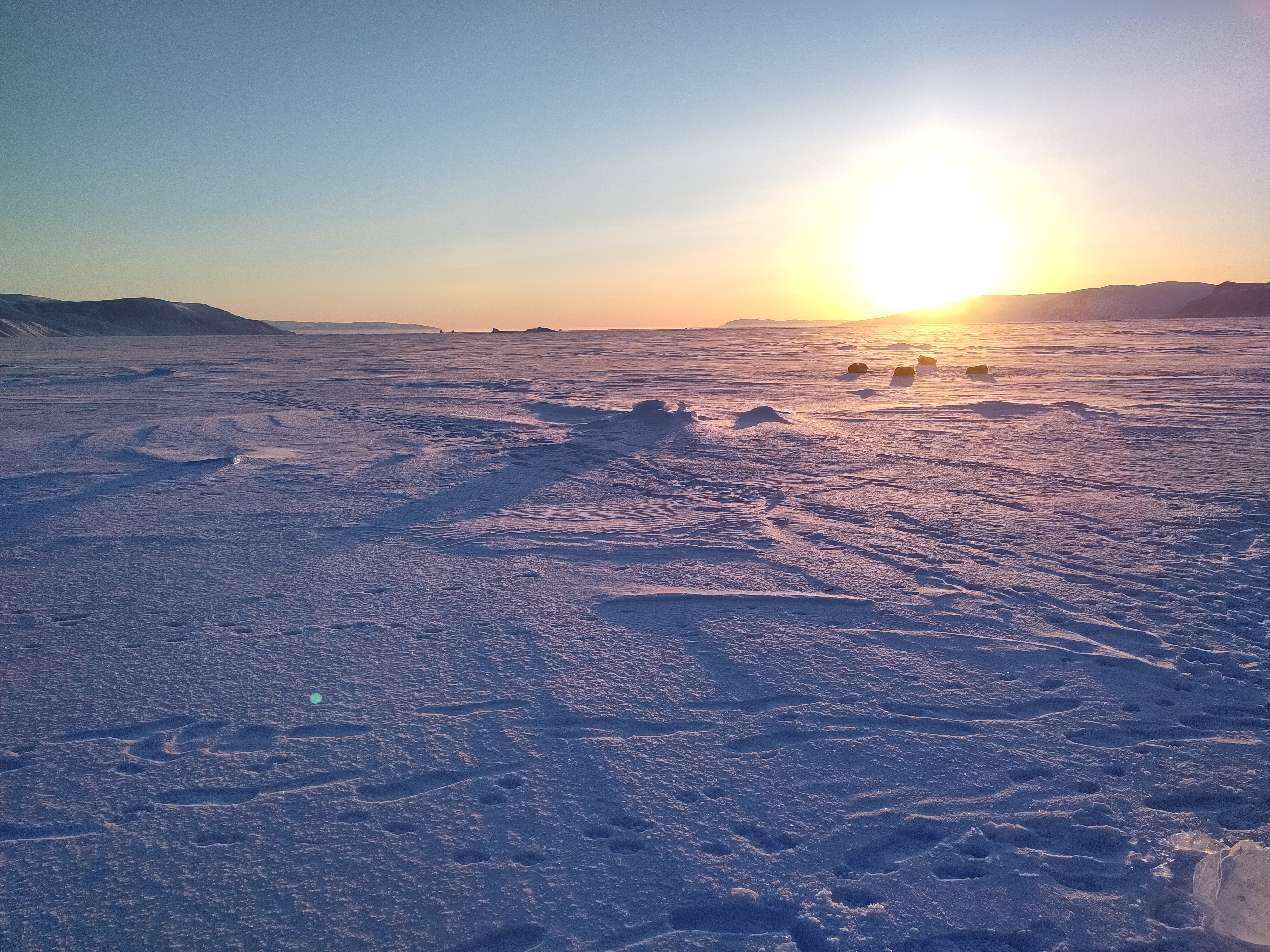
Camping on the sea ice at sunset. Northern Greenland
This work by Ruth Mottram is licensed under a Creative Commons Attribution-NonCommercial-ShareAlike 4.0 International License.

I intend to write a whole series of posts based on what we have been doing scientifically and technically as well as some general observations. There have been various hints already in my preferred social network. The whole trip was super inspiring, it’s always valuable to get out and observe the real world when you’re trying to model it, understand it and make projections of sea level rise.

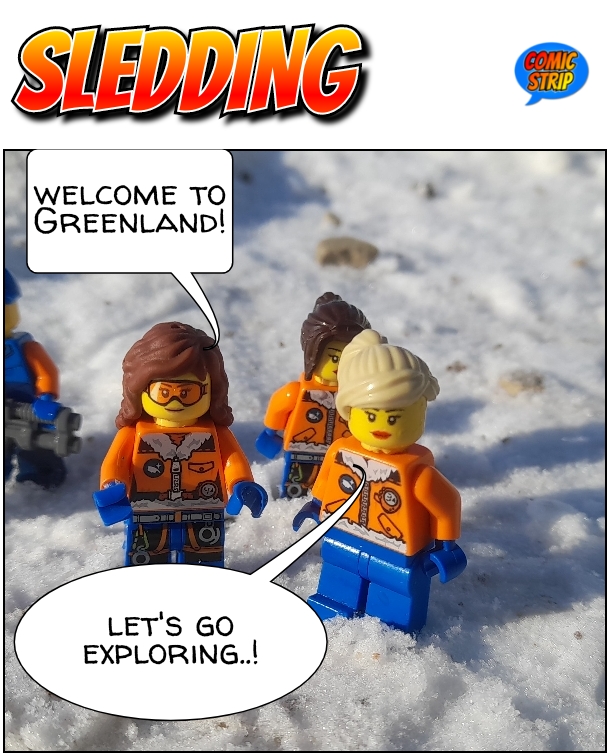
I also promised to make another Lego scientists series and took quite a few photos in between times to do so. However, the research programme was packed, so I had no time at all to make the comic during fieldwork, that will have to wait a few weeks.

Expect my pixelfed account to host gratuitous numbers of dog pictures. And ice pictures. And unexpectedly clear blue skies. For now it’s time to unpack, get the washing machine going and spend some time with my family.

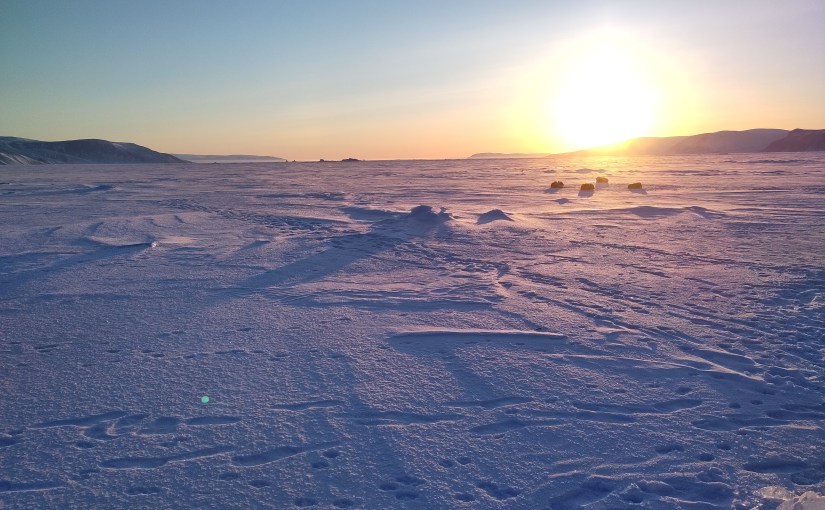
Sunset over sea ice near Qaanaaq, North West Greenland
This work by Ruth Mottram is licensed under a Creative Commons Attribution-NonCommercial-ShareAlike 4.0 International License.

As ever, thanks to my amazing colleagues Steffen Malskær Olsen, Andrea Gierisch and Anna Pedersen for an incredible trip and to DMI station manager in Qaanaaq Aksel Ascanius without whom most of this work would be impossible.

Special thanks to our friends in Qaanaaq, the local hunters, whose unfailing energies and knowledge are absolutely essential to these scientific projects. We literally could not do this without them and of course their dogs.

I must also credit DMI and the Danish Government for funding via the National Center for Klima Forskning and thanks also to Horizon Europe projects PROTECT on sea level rise and PolarRES for additional inspiration and funding and to my colleagues at the Horizon Europe/NERC project OCEAN:ICE for indulging my two weeks away. All three projects will benefit from the insights gained in this fieldwork.

The further adventures of batgirl…

I wrote this series of comics to amuse and inform my kids while I was on fieldwork a few years ago. It turned out to be quite a success and my kids classes both read the Danish versions at their school.

Last year I started https://icemangoeshome.wordpress.com/more-arctic-adventures/ the further adventures of batgirl on the ice with her new friends the Lego scientists and a couple of stowaways.. but last year’s season was extremely busy and I never managed to finish it.

I asked yesterday on mastodon if I should do another this year, and the only feedback I got was I should try to finish the one I started last year. So maybe that’s what I’ll try to do. It’s always challenging fitting around field tasks though so no promises.

This is just a quick post from the airport: you’ve been warned, bat girls and her friends are on their way back with a new season!

A New Arctic Adventure

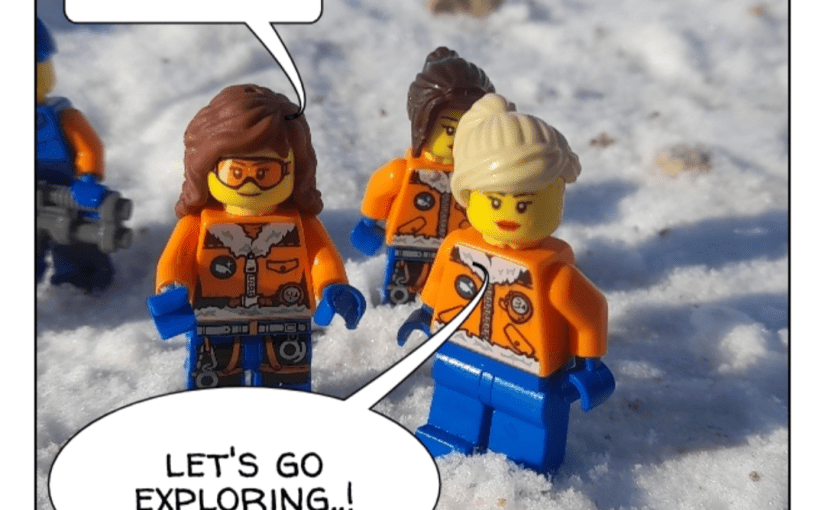
Lego figures in the snow

How climbing made me a better scientist

Non-exhaustive list of (occasionally erroneous) reasons why climbing makes me science better (and explaining inter alia why I interview awfully). Prompted by this stupid tweet1: How can being a rock climber (or a baker, or a stand-up comedian, or…) make you a better researcher? Scientists share their thoughts (and their hobbies) in this #NextGenSci: https://t.co/v8JoesyzJ2 […]

How climbing made me a better scientist

Low Antarctic sea ice

I’ve often been contacted by various journalists to comment on different science stories, usually related to Greenland, the ice sheet or more generally glaciers and climate change. This makes sense, I’ve spent the last 20 years studying the interactions between the climate system and the cryosphere.

Last week, I was asked to comment on the record minimum Antarctic sea ice extent (scroll to the bottom to see what I had to say). While sea ice is not exactly my area, it’s pretty close, and I have looked into it in some detail given that I am also part of the ESA Climate change initiative for sea ice.

Update: I just became aware that the ever entertaining and informative Dr Ella Gilbert has a superb video over on youtube which discusses all of this in some detail. She’s far more engaging than I am so I’m just going to drop the link here. You can probably skip the rest of this post..

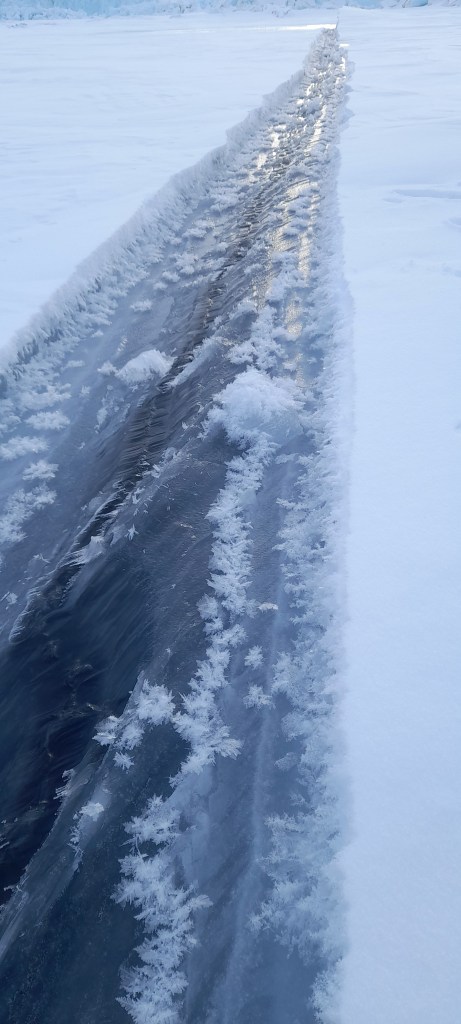
Last year, whilst working on the sea ice, I had to acknowledge to my sea ice colleagues – it is an awful lot more interesting than I’d originally thought. Probably the moment when I really got it though, was when my colleague Andrea urged me to taste the frost flowers we had just spotted growing next to a sea ice lead, as in this this picture on the left.

They are delicate, soft, and almost fizzy with salt. How can you not wonder about their formation and wonder about the role of sea ice in the fjord system?

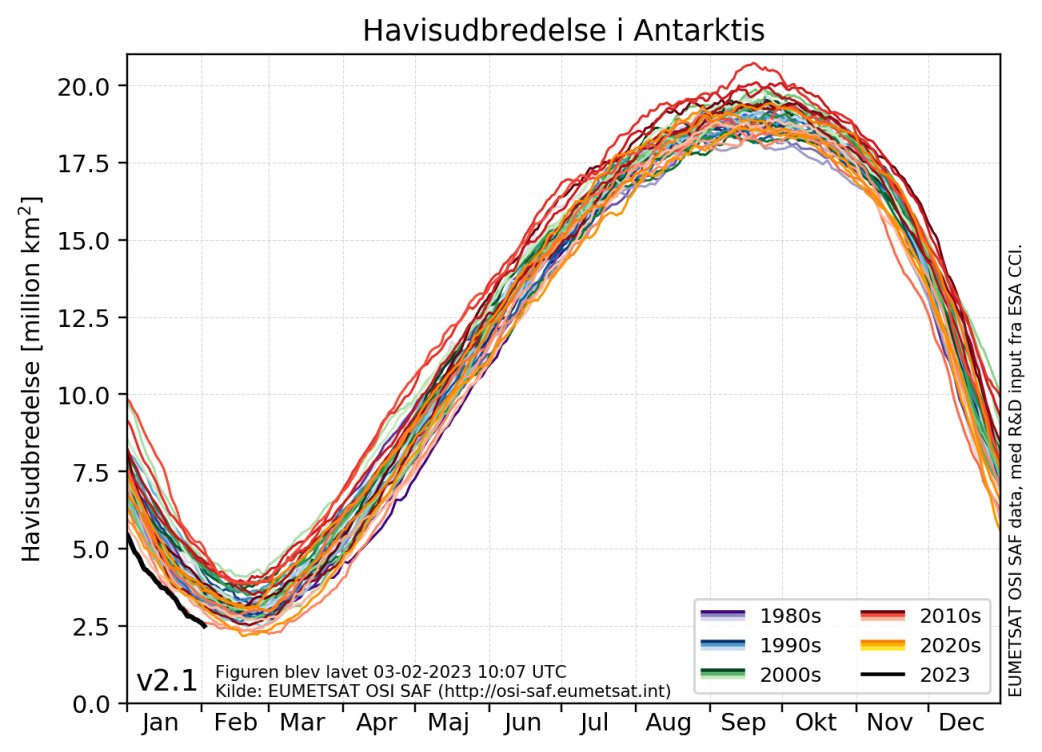
Back to Antarctic sea ice: The current wave of media stories has been about the new record low sea ice area. The annual minimum, reached in February was about 1.7 million km2, or about 1 million km2 less than the average sea ice extent at the annual minimum. As the figure below shows, there is a really clear annual cycle with sea ice growing from February to September, when it reaches it’s maximum, and then declining again to February the following year when it reaches a minimum extent.

This graphic, made by MetNo scientists based on the OSI SAF dataset that my colleagues at DMI also work on, shows the annual cycle in sea ice extent, that is for each individual year, how much sea ice is there around the whole of Antarctica.

This pattern is pretty similar to the Arctic where the sea ice has a maximum area in Feb/March and a minimum area in September.

If you sum this whole area around Antarctica up to one number per year, there is no clear trend – in fact until 2016, Antarctic sea ice appeared to be increasing, in direct opposition to the Arctic area which has crashed over the last 30 years. Then things have changed.

The figure below, plotted by my colleague Gorm Dybkjær and presented at the Danish Antarctic science seminar clearly shows this. Blue colours indicate above average sea ice area, red colours below average.

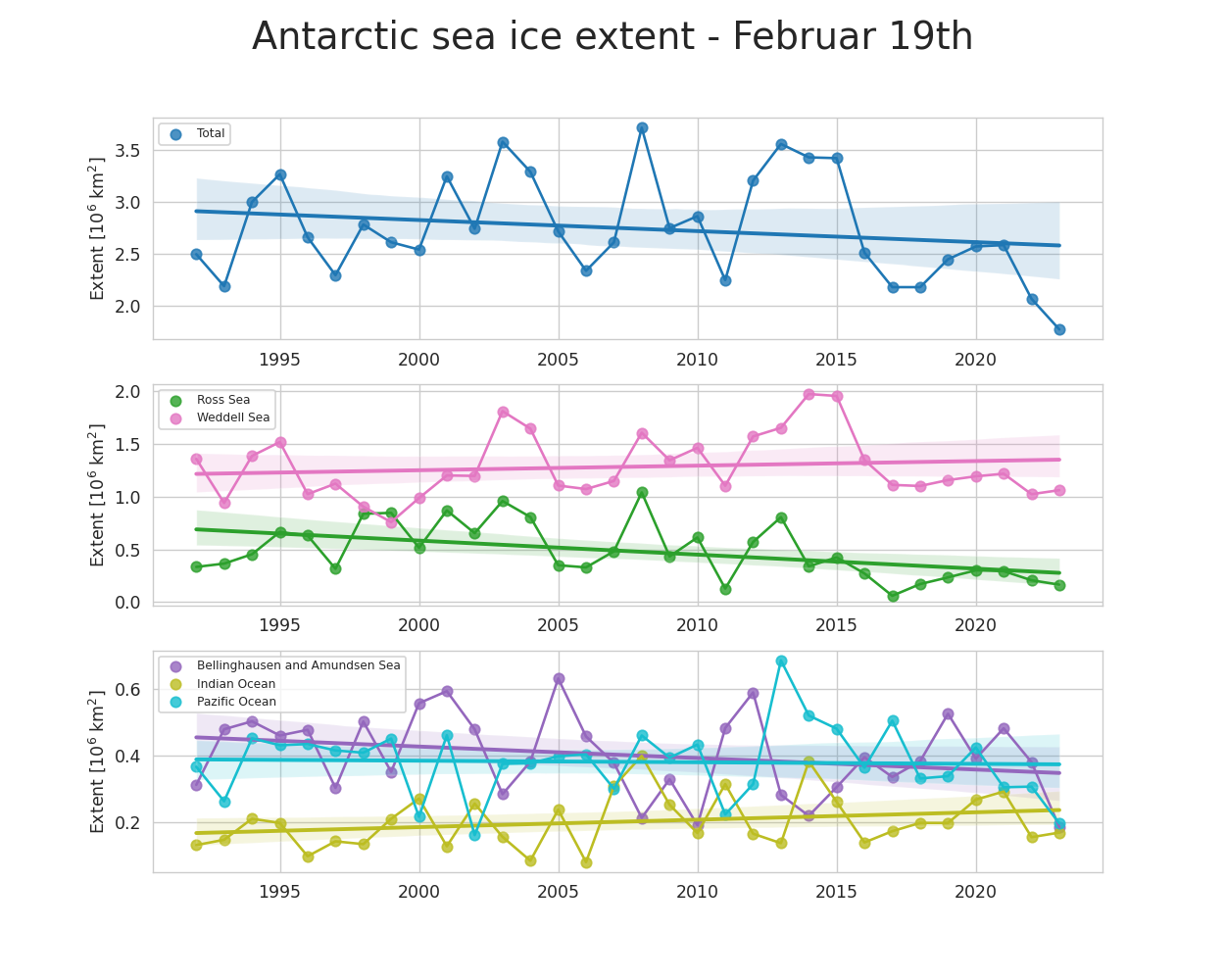
However, as many others have also pointed out, although the overall trend was increasing up to 2016, that increase largely came from one basin, the Weddell Sea, which in contrast to the Ross Sea, Bellingshausen Sea and Amundsen Sea sectors*, was increasing it’s area covered by sea ice. Now all sectors have seen a decrease.

Figure posted by Lars Kaleschke on mastodon (#FF) showing how the Antarctic sea ice trend looks when broken down into basins

There are good reasons to be cautious interpreting these changes. Antarctica is a big place. There is a lot of climate variability and some of the patterns we know are pushing will affect different parts of the continent in opposite directions.

I tried to get this across in the clip below. Let me know if you think I succeeded…

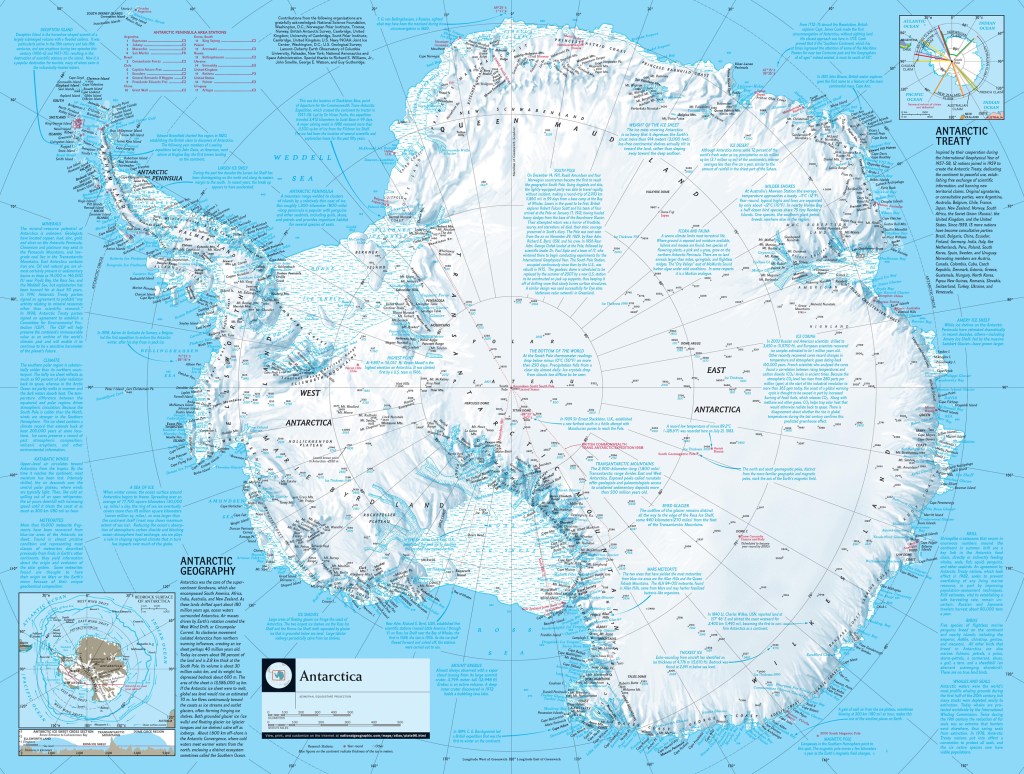
*Yes I know it’s confusing. Maybe this National Geographic Map helps?

A door closes, another opens…

It’s time to say goodbye to Twitter..

I posted towards the end of last year about my early explorations of the fediverse (the federated universe – seriously it’s awesome check it out) of apps and websites that can talk to each other but cover a vast range outside of the walled gardens of the corporate controlled internet. Like many people who were (probably far too) intensely online, the changes at Twitter were forcing me away from that platform, which I had been on for a decade. And on which I had more than 10,000 followers

After a few weeks I was completely enraptured by the community on mastodon, far more independently minded, creative and yes, that awful tech bro cliche, disruptive. It was, as is also now fast becoming a bit of cliche, like going back to 2011 Twitter.

On mastodon, as of February 2023 I now have 3600 followers and follow about 2000 accounts. I get far far more interesting interaction and discussion than on my old twitter account with three times as many followers. I’m not the only one noticing this. To be clear it’s taken some “work” to get there. Finding new accounts, dealing with a less than intuitive UX and working out what is of general interest has taken some time. If htis post makes you curious, I recommend the feditips page as a good starting point.

I’m now a fully signed up active member of the fediverse with a pixelfed account (think instagram before the annoying tiktok immitation and with a lot fewer “influencers”), 2 mastodon accounts (probably soon to be amalgamated to one tbh) and some tentative explorations of friendica (a bit like facebook when it still seemd like a cool way to keep in touch with friends and family abroad, jury is still out on this one tbh, I’m trying to keep it for personal friends and family only).

Blogging also seems to have come back into my purview. And it’s fun, thinking about writing and science in quite a different way to the one imposed by the 280 character limit (some of us remember when it was 140).

A few months down the line and while activity on mastodon has subsided since the first waves in 2022, the hard core who are still here are REALLY cool. I feel refreshed and revitalised after checking the stream in a way I have not experienced for a long time on twitter.

It’s also made me reflect on the way I had used social media in the past (probably far too much time spent there if I’m honest with myself). I had accumulated a lot of followers and could quite happily spend hours browsing the algorithmic feed, but especially recently, a lot of that browsing was like snacking on cookies, it was time that would have been more fufilling going in depth on a project or enjoying my leisure time without thjat SoMe filter. At some point twitter helped to find good stuff too, but even before the Musk takeover and mass departures it wass getting harder and harder to find genuinely interesting stuff amid the flood of witty oneliners and outrage driven algorithmically pushed tweets.

After the takeover there has been poisonous floodtide of misinformation and anti-science drivel, not to mention anti-semitism, racism and general bigotry. The climate denial that has arisen since Elon Musk bought the platform wasn’t even this bad during climategate. I have no idea why it has got this awful again recently. I assume the same state actors and misinformation manipulators and their bot armies. Either way, even though I missed some accounts and friends, I no longer want to be supporting a billionaire’s hobby project. SO in the best social democratic tradition, I’m withdrawing my (free) labour.

I moved over towards the end of last year and while I kept an eye on the birdsite, I didn’t feel the need to engage there anymore. I was cross-posting exclusively from Mastodon to Twitter until the crossposter service was ended at the end of January. The end of the open API this week is probably the final end for me. I may post links to my blog for a little while longer, but probably that’s just prolonging the inevitable.

So now it’s time to take stock. I will hold on to my account, though probably locked to new followers, I may drop in from time to time but I don’t plan to engage over there at all. I have downloaded my archive (while I still could) and started deleting my tweets. As of today there is a year’s worth left. I’ll probably scrap that at some point too.

So, do I miss it? Yes, a bit. More than I missed the swamp of facebook when I left there in 2016. But not as much as I thought I would. Possibly because the discovery of the fediverse is leading me to becoming a far more active netizen again, rather than a passive consumer of snack food. I do miss some accounts and friends who have not moved over, though I hope they will one day.

And the ever wise Danish genre and Grundtvig expert Sune Auken expressed it pretty well in one of his daily reminders: “I know why I left, and I know what I lost, but I’m not going back and I don’t miss the experience of twitter even as I miss excellent friends”

And where from here? Well the cool thing about the fediverse is we are in control, we get to decide (at least to some limited extent) what it should look like in the future. It is not a corporate walled garden, we get to work on and improve it and make it after our own image. The same was once true to some extent of twitter and in fact many of it’s best features were user-driven originally.

More to the point, this whole sorry saga has made me realise two things:
I don’t want to build stuff on someone else’s platform anymore.

I need to be much more mindful of the way I use social media and the internet. I have too many responsibilities to family, friends and work to fritter away a mindless hour on social media snack food. But there is nonetheless value and entertainment in creating and sharing:

The bottom line of this general thinking is that a simple, carefully curated, minimalist digital life is not a rejection of technology or a reactionary act of skepticism; it is, by contrast, an embrace of the immense value these new tools can offer…if we’re willing to do the hard work of figuring out how to best leverage them on behalf of the things we truly care about.

Cal Newport, Digital Minimalism

Danish Antarctic Science

Historically Denmark has not done a huge amount of Antarctic science. We are the only Nordic country (apart from Iceland) without an Antarctic station for example, but quite a lot of research has been done in collaboration with other countries. Of course you could argue that with our natural focus on Greenland and the Arctic, we don’t really need one…

The threat of sea level rise, with a large portion coming to Denmark from Antarctica has rather focused our minds on down south though and on this basis I now have several research projects with an Antarctic ice sheet and climate focus, including PolarRES, PROTECT and the just started OCEAN:ICE – I will write more on all of these at some point.

Of course it’s not just my employer DMI who knows that in spite of being far away, the coldest, driest, windiest continent is important in the global system and especially to Denmark in a sea level rise perspective. We have also been monitoring ozone and sea ice for decades and making ice charts for navigation when required also.

The Danish Technical University have also been flying remote sensing missions in Antarctica for decades and the Niels Bohr Institute have been involved in several big ice core projects, including the oldest ice core currently underway. GEUS and Aarhus University have geological interests and there are various biology research programmes underway too, while the IGN have a project using old soviet spy satellite imagery that sounds like a plot from a cold war novel…

All of which is to say, it’s time for a small get together to find out who is doing what, going where and when and who would like to plan and collaborate together on new and exciting projects.

The Danish Antarctic Science seminar, an annual event, will be held on the 2nd February at DMI this year and online. It covers all sciences, not just climate and ice sheet and this year we’d really like to get a broad group representative of the full spectrum of polar science in Denmark, so do feel free to register and listen in and discuss, even if you have no active or inactive projects in the Antarctic.

Let me know if you are a danish – based scientist and would like to come along or if you are otherwise interested and we’ll see what can be arranged. Deadline for registration is the 30th January!

Ses.

Crane Glacier on the Antarctic peninsula from Sentinel 2 satellite imagery, processed on snap planet

The expedition frame of mind

We will head to the field in Qaanaaq in late March with various instruments.

Update: It’s official now, I have booked my tickets, we have new instruments to deploy and a colleague and I are working on developing a new programme that we can hopefully also fit in alongside the currently planned programme. More on this at some point no doubt. The countdown has begun and I am getting into that fieldwork frame of mind.

I came across this blog post from old friend and former colleague, Karen Darke, who I’m now more or less out of touch with, unfortunately.

She is just back from her incredible Pole of Possibility expedition in Antarctica and she wrote this which I think perfectly summed up that expedition frame of mind..

It’s a really great blog post and well worth a read of the whole thing.

There are people and places I look forward to again but my soul is already grieving for expedition life, for the dualities that it brings: complexity and simplicity, space and confinement, alone-ness and together-ness, vulnerability and strength, connection and disconnection. I miss waking up huddled closely with my tent-mates and the time skiing silently in big open white-scape. I miss the detailed organisation of kit and systems and the contrasting uncertainty of every hour of every day. I miss feeling small and vulnerable as well as strong and capable. I miss the clear, invented purpose of every day.

Karen Darke, Pole of Possibility
One of those moments on a fieldwork expedition when everyone is busy, drilling holes in the ice to send down a CTD, drilling a sea ice core to measure salinity, digging snow pits, deploying instruments. My DMI colleagues Steffen Olsen and Andrea Gierisch are the ocean and sea ice scientists driving this work in close collaboration with our Greenlandis friends, you can read more about their work here: ..

Our fieldwork expeditions are maybe a bit more frenetic than the pole of possibility has been (in some ways, probably not others). We are always racing against the clock and the weather to get as much work done as possible. We probably cover less distance and there is perhaps less physical stress as the dogs do the hard work of pulling, rather than skiing with human muscles. Nonetheless, there is a constant low-level thrum of thinking, planning, checking. Even if there are also often whole hours, where not much other than travel happens and that are extremely valuable thinking time. (And how often do we get that in the modern world?)

Unlike the Antarctic, working with local people in Greenland means that we also see the landscape as a working place, not just a white desert far away and as Karen writes, how true this is:

It is harder than we anticipated to leave, but Antarctica has been a reminder that we are adaptable, resilient, purpose-seeking, capable humans. No matter how harsh our environment may be, we seem to find ways to connect, collaborate and create ways to not only survive, but to thrive.

On a slightly different note, I had momentarily similar thoughts to Karen on the problem of despoiling the landscape with toilet visits the first time I visited Qaanaaq, before realising that when travelling with 30 dogs (as the local people have always done), the problem is rather moot. But as I have written before, it’s easy to fall into the trap of pristinism in the Arctic. Our work on the Arctic environment is a reminder that it really isn’t. Even in Antarctica, environmental pollutants from lead to microplastics have been found, while the curse of overfishing is almost as visible in the Southern Ocean as in the northerly just as climate change is also taking a toll.

But finally, I also find myself fully agreeing with the last part, because although fieldwork is often cold, uncomfortable, difficult, exhausting, boring and tiresome, it’s also often fascinating, rewarding and exciting. And the experience can change us.

Just as a photograph can’t always capture the profundity of a place or a moment, it is sometimes difficult to find words that describe how something has sculpted us. An experience can impact us so deeply that we don’t immediately know how to translate it for others. And may never

I am immensely privileged to be able to do fieldwork in Greenland and I am extermely grateful for the opportunity to do so.