Oh Vienna…

In the before times I would usually spend this week walking around a world class city humming an old 80’s hit (- don’t ask me why it was so durable in my head, probably something to do with being an impressionable age at a time when access to pop music meant half an hour on a Thursday evening).

Anyway, it is the time for EGU… Sadly I will not be wandering the streets of the ever beautiful (and most livable) capital of Austria this year. I have to get some actual work done, but I’m following the #EGU23 on mastodon and hoping to catch a few highlights on the sides. I do have a poster, which will be capably presented by PolarRES PI Priscilla Mooney and my DMI Colleague Abraham Torres on Thursday.

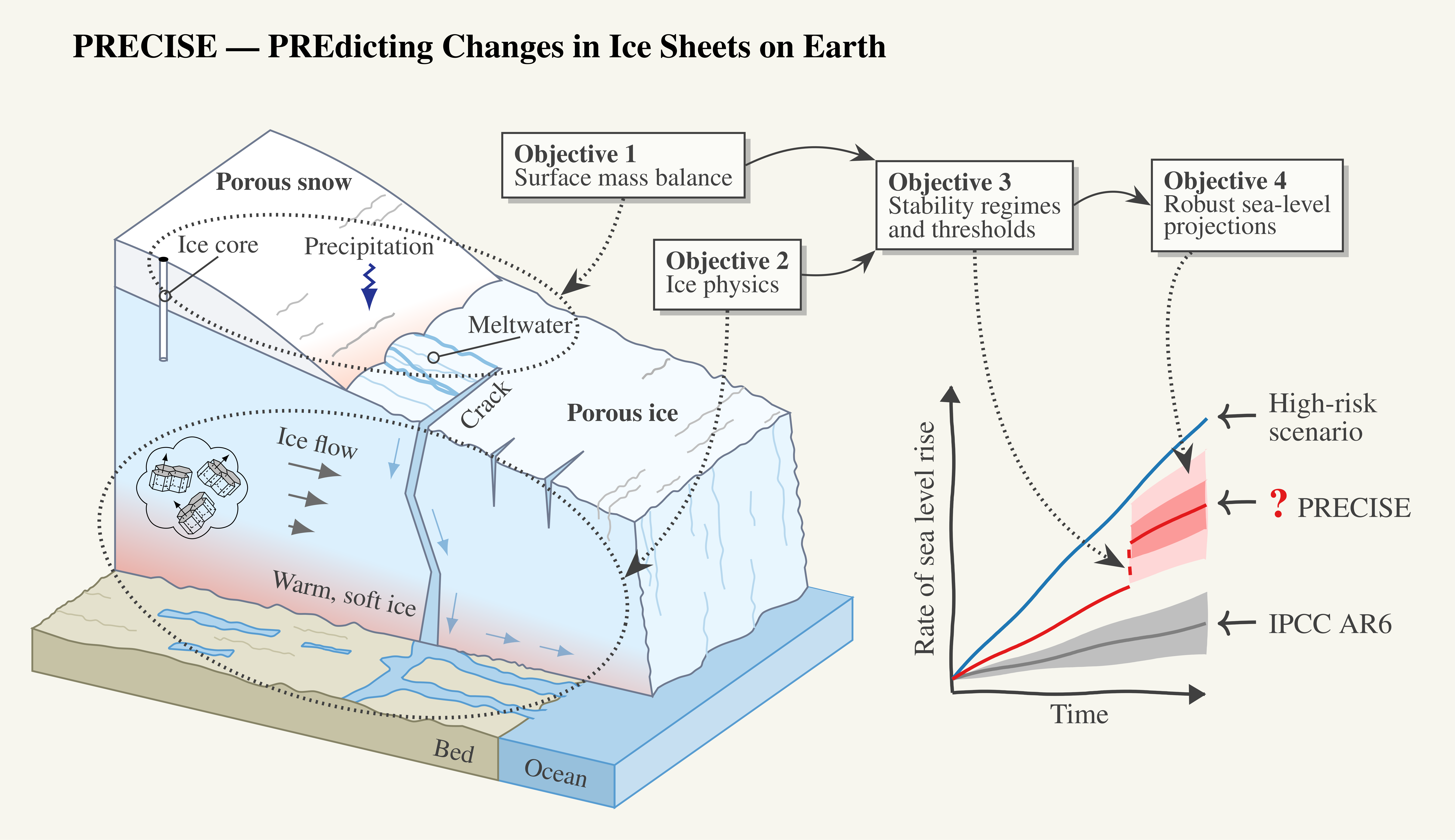
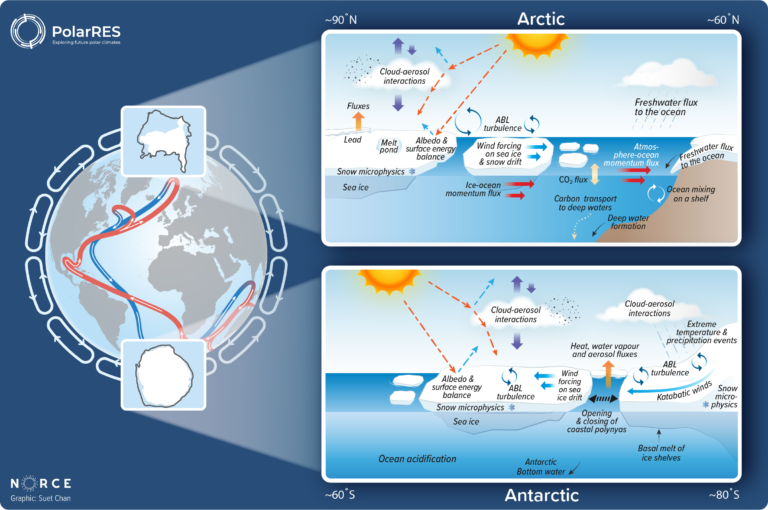
The topic is our PolarRES project – an ambitious Horizon 2020 effort to produce a large ensemble of regional climate simulations over both poles. These are state-of-the-art regional climate models run at unprecedented high spatial resolution and all data will be made open access and free via the CORDEX project.

I will also put it here later – feel free to comment here or ask questions on mastodon or get in touch by email if it sounds exciting.

Mottram, R., Mooney, P., and Torres, J. A. and the PolarRES Consortium: A first look at the new PolarRES ensemble of polar regional climate model storylines to 2100, EGU General Assembly 2023, Vienna, Austria, 24–28 Apr 2023, EGU23-14470, https://doi.org/10.5194/egusphere-egu23-14470, 2023.

Other posters and talks I’ve contributed to from PolarRES are

Kristiina Verro’s talk on HCLIM_Arome results from the Antarctic peninsula:

Verro, K., van de Berg, W. J., Orr, A., Landgren, O., and van Ulft, B.: New non-hydrostatic polar regional climate model HCLIM-AROME: analysis of the föhn event on 27 January 2011 over the Larsen C Ice Shelf, Antarctic Peninsula, EGU General Assembly 2023, Vienna, Austria, 24–28 Apr 2023, EGU23-13864, https://doi.org/10.5194/egusphere-egu23-13864, 2023.

Abraham Torres joined our group last year and is primarily working on PolarRES also. He will show some of our preliminary HCLIM results for both the Arctic and the Antarctic

Torres-Alavez, A., Landgren, O., Boberg, F., Christensen, O. B., Mottram, R., Olesen, M., Van Ulft, B., Verro, K., and Batrak, Y.: Assessing Performance of a new High Resolution polar regional climate model with remote sensing and in-situ observations: HCLIM in the Arctic and Antarctica, EGU General Assembly 2023, Vienna, Austria, 24–28 Apr 2023, EGU23-14090, https://doi.org/10.5194/egusphere-egu23-14090, 2023

Quentin Glaude is a collaborator from Liege in the Horizon 2020 PROTECT project on sea level rise contributions from the cryosphere . Baptiste Vandecrux, a former PhD student with me here and now working at GEUS is also presenting some work based on the same models as Quentin, with a comparison to the PROMICE observation statons on the Greealnd ice sheet. It’s very cool application of machine learning and the results are very interesting.

Glaude, Q., Noel, B., Olesen, M., Boberg, F., van den Broeke, M., Mottram, R., and Fettweis, X.: The Divergent Futures of Greenland Surface Mass Balance Estimates from Different Regional Climate Models, EGU General Assembly 2023, Vienna, Austria, 24–28 Apr 2023, EGU23-7920, https://doi.org/10.5194/egusphere-egu23-7920, 2023

Vandecrux, B., Fausto, R. S., Box, J. E., Covi, F., Hock, R., Rennermalm, A., Heilig, A., Abermann, J., Van As, D., Løkkegaard, A., Fettweis, X., Smeets, P. C. J. P., Kuipers Munneke, P., Van Den Broeke, M., Brils, M., Langen, P. L., Mottram, R., and Ahlstrøm, A. P.: Historical snow and ice temperature compilation documents the recent warming of the Greenland ice sheet, EGU General Assembly 2023, Vienna, Austria, 24–28 Apr 2023, EGU23-9080, https://doi.org/10.5194/egusphere-egu23-9080, 2023.

Nicolaj Hansen (who finished his PhD with me and Sebastian Simonsen at DTU Space last year) has just submitted a beauty of a paper which he will talk about – also partof PROTECT.

 Hansen, N., Sørensen, L. S., Spada, G., Melini, D., Forsberg, R., Mottram, R., and Simonsen, S. B.: ICESat-2 Ice Sheet Mass balance: Going below the surface, EGU General Assembly 2023, Vienna, Austria, 24–28 Apr 2023, EGU23-12349, https://doi.org/10.5194/egusphere-egu23-12349, 2023

Mathias Larsen is a current Phd student with me and is presenting a poster on the CARRA dataset and an application in surface mass balance modelling. This work falls under the danish National center for klima forskning

Larsen, M., H. Mottram, R., and L. Langen, P.: CARRA-driven simulation of Greenland Ice Sheet surface mass balance at 2.5 km resolution, EGU General Assembly 2023, Vienna, Austria, 24–28 Apr 2023, EGU23-5852, https://doi.org/10.5194/egusphere-egu23-5852, 2023

Last year I co-organised a bootcamp for early career researchers on Arctic processes in the CMIP6 models. It was super fun and would not have been possible without the support offered by Anne Fouilloux, Tina Odaka and colleagues from the Pangeo project. Their poster is super interesting and if you’re interested in optimising the use of big climate data, go and check it out!

Fouilloux, A., Marasco, P. L., Odaka, T., Mottram, R., Zieger, P., Schulz, M., Coca-Castro, A., Iaquinta, J., and Eynard Bontemps, G.: Pangeo framework for training: experience with FOSS4G, the CLIVAR bootcamp and the eScience course, EGU General Assembly 2023, Vienna, Austria, 24–28 Apr 2023, EGU23-8756, https://doi.org/10.5194/egusphere-egu23-8756, 2023.

Excitingly, at least 3 of the projects at the bootcamp will also be presented at EGU this year. So, lots to be getting on with, for now, here’s a link to Ultravox’s finest…

Q is for Qaanaaq

Back in Denmark after 2 weeks in Greenland. Always a bit strange to come back, not just that transition from Arctic cold to European Spring but the sheer abundance of the fertile mid-latitudes, colours, plants, trees, the sheer number of people.

Not to mention that expedition frame of mind, where you are really focused on accomplishing a given set of often quite complex tasks (almost) without distraction. It is the ultimate deep work task, and naturally readjusting to family life, not to mention the tsunami of work tasks left on hold is… difficult.

This particular deep fieldwork has been carried out in Qaanaaq, Northern Greenland, as I’ve written about before. The community of about 600 people (and maybe a 1000 dogs), was established in the 1950s when the US established the Thule air base. It is almost the most northern settlement in Greenland – and certainly the largest. The small village of Siorapaluk is about 45km (or 6 hours by dog sled) further away.

The town was formerly a summer hunting spot, but after Thule was decided on, the community was moved to Qaanaaq year round. It has an association with the famous Danish explorer Knud Rasmussen, whose old house is a museum (allegedly. I’ve never actually had time to visit it..)

DMI established a geomagnetic observatory there in the 1950s and today its part of the Comprehensive Test Ban Treaty Organisation network that DMI operates on behalf of the Danish government from what we now call the DMI geophysical facility. There is transnational access to this via the INTERACT network.

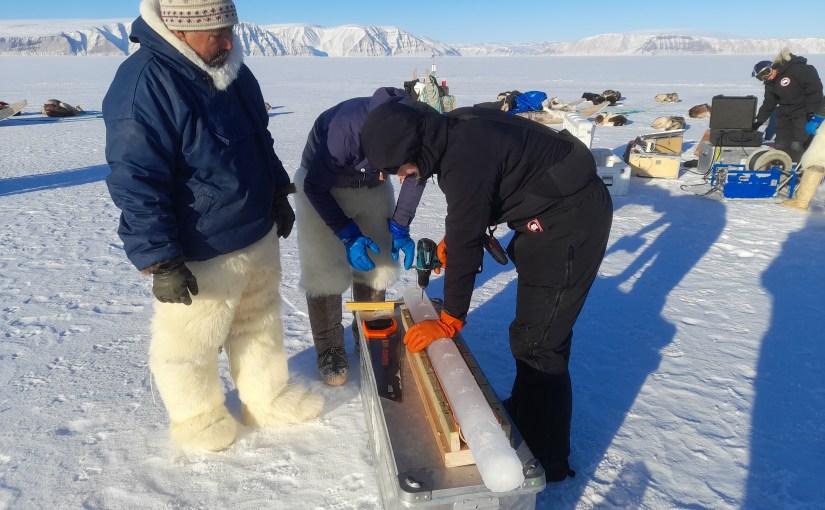
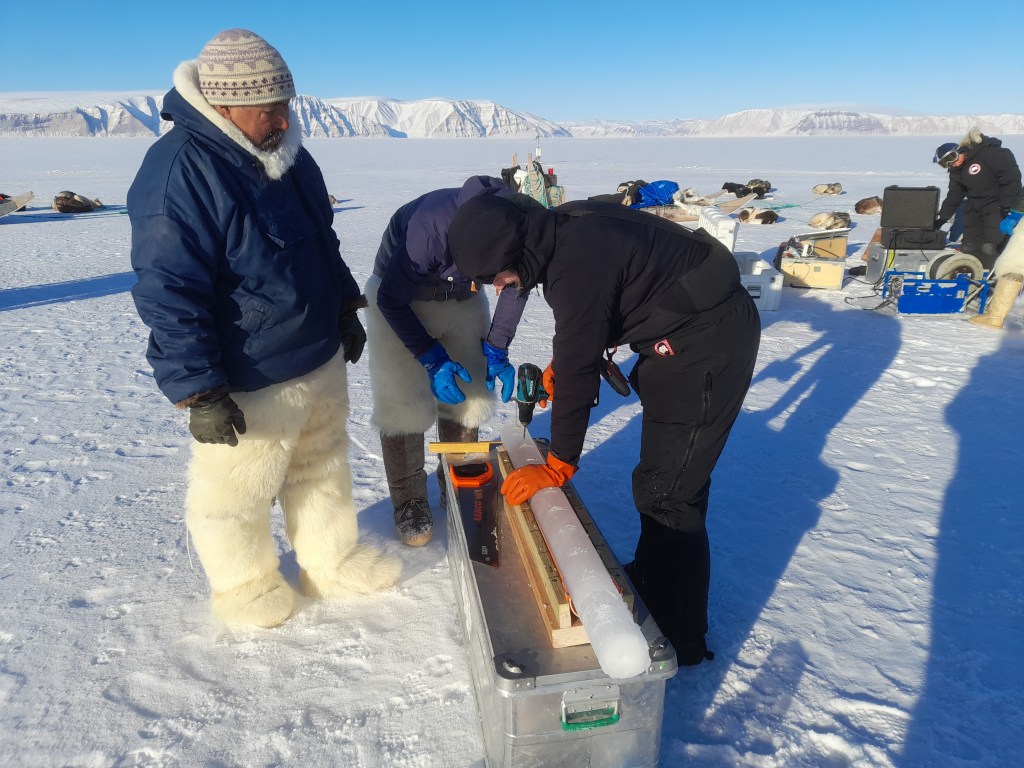
This year we again visited the glaciers at the head of the Inglefield Fjord – expanding a new research programme we piloted last year. We also did a lot of work on the sea ice – not just Steffen Olsen‘s ocean programme, but a new NCKF research programme looking at biological productivity and carbon cycling in the fjord, led by Anna Pedersen, a DMI PhD student also at the University of Southern Denmark. I and another colleagues also did a lot of work on snow processes that is something of a pilot programme for a processes project we’d like to establish next year that will also involve (hopefully) our weather forecasting colleagues and perhaps also the GEUS PROMICE programme.

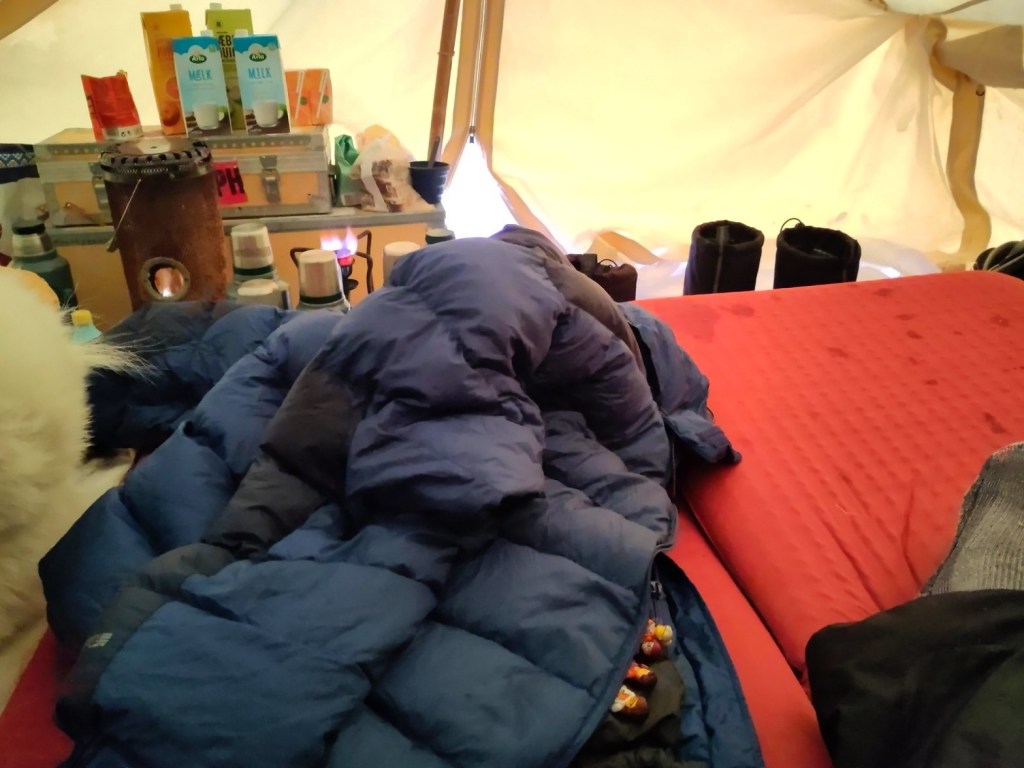
All of this work involved 6 days of travelling over and camping on the sea ice, plus an additional day trip. We were lucky with the weather, although it was *extremely* cold, around -25 to -28C most days, and dipping well below -30C at night (though being after the equinox it was never truly pitch dark). However, in general there was little wind, no fresh snow (which can really slow the dogs down as they struggle to pull through deep soft snow) and the sun shone every day. This meant we basically managed to achieve the full planned programme – including our extra-optimistic goals – which almost never happens in fieldwork.

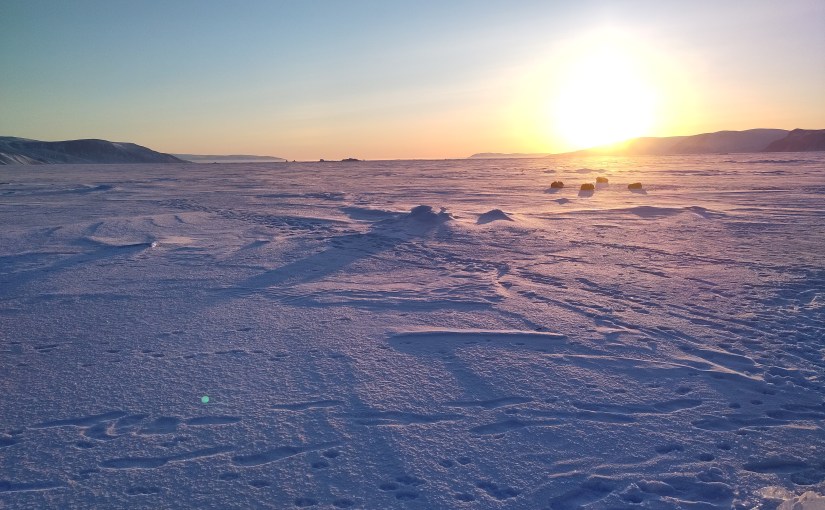
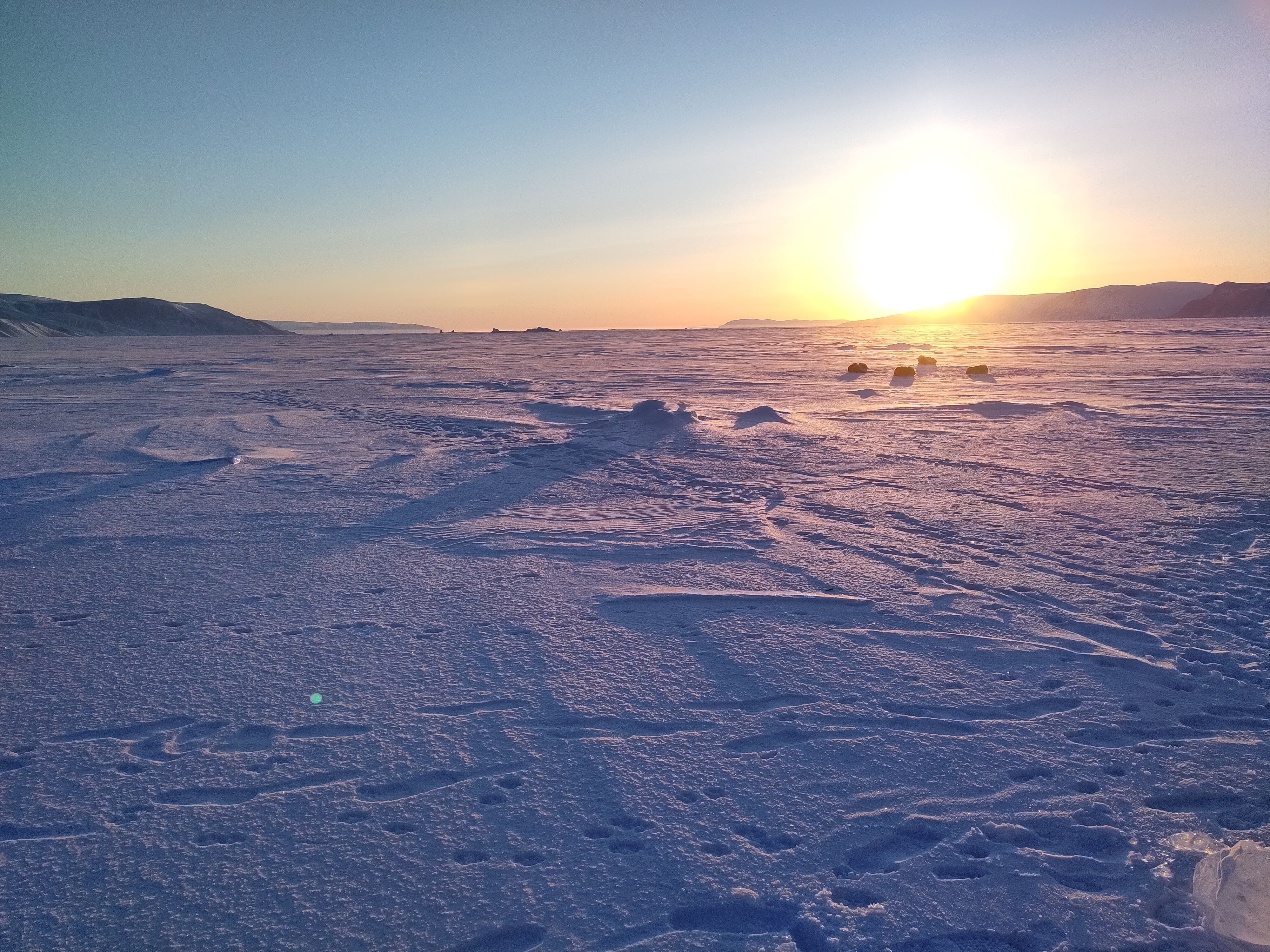
Camping on the sea ice at sunset. Northern Greenland
This work by Ruth Mottram is licensed under a Creative Commons Attribution-NonCommercial-ShareAlike 4.0 International License.

I intend to write a whole series of posts based on what we have been doing scientifically and technically as well as some general observations. There have been various hints already in my preferred social network. The whole trip was super inspiring, it’s always valuable to get out and observe the real world when you’re trying to model it, understand it and make projections of sea level rise.

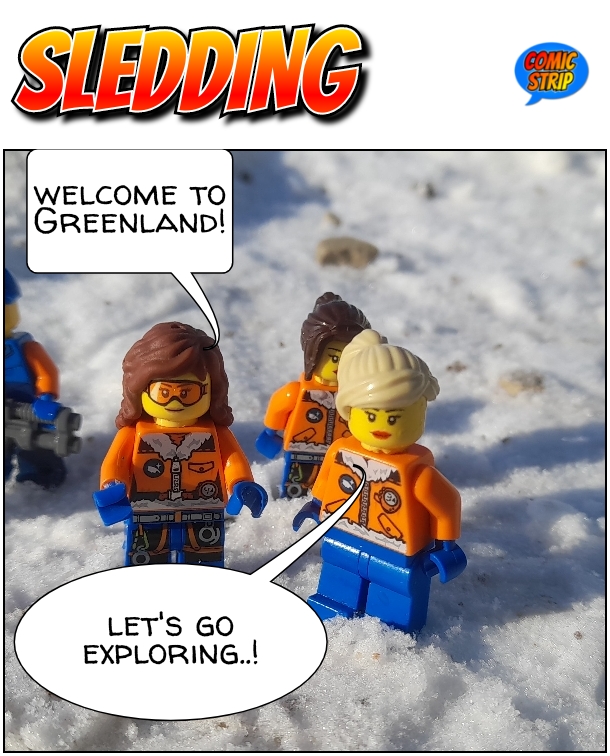
I also promised to make another Lego scientists series and took quite a few photos in between times to do so. However, the research programme was packed, so I had no time at all to make the comic during fieldwork, that will have to wait a few weeks.

Expect my pixelfed account to host gratuitous numbers of dog pictures. And ice pictures. And unexpectedly clear blue skies. For now it’s time to unpack, get the washing machine going and spend some time with my family.

Sunset over sea ice near Qaanaaq, North West Greenland
This work by Ruth Mottram is licensed under a Creative Commons Attribution-NonCommercial-ShareAlike 4.0 International License.

As ever, thanks to my amazing colleagues Steffen Malskær Olsen, Andrea Gierisch and Anna Pedersen for an incredible trip and to DMI station manager in Qaanaaq Aksel Ascanius without whom most of this work would be impossible.

Special thanks to our friends in Qaanaaq, the local hunters, whose unfailing energies and knowledge are absolutely essential to these scientific projects. We literally could not do this without them and of course their dogs.

I must also credit DMI and the Danish Government for funding via the National Center for Klima Forskning and thanks also to Horizon Europe projects PROTECT on sea level rise and PolarRES for additional inspiration and funding and to my colleagues at the Horizon Europe/NERC project OCEAN:ICE for indulging my two weeks away. All three projects will benefit from the insights gained in this fieldwork.

The further adventures of batgirl…

I wrote this series of comics to amuse and inform my kids while I was on fieldwork a few years ago. It turned out to be quite a success and my kids classes both read the Danish versions at their school.

Last year I started https://icemangoeshome.wordpress.com/more-arctic-adventures/ the further adventures of batgirl on the ice with her new friends the Lego scientists and a couple of stowaways.. but last year’s season was extremely busy and I never managed to finish it.

I asked yesterday on mastodon if I should do another this year, and the only feedback I got was I should try to finish the one I started last year. So maybe that’s what I’ll try to do. It’s always challenging fitting around field tasks though so no promises.

This is just a quick post from the airport: you’ve been warned, bat girls and her friends are on their way back with a new season!

A New Arctic Adventure

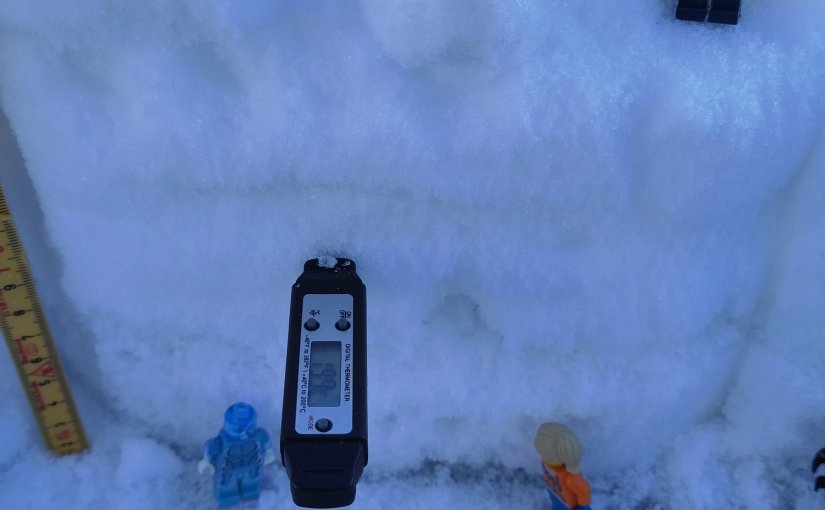
Lego figures in the snow

Natural cycles: oceans and glaciers and volcanoes…

Reblogging this brilliant piece in Ars Technica* with thanks to Andrew Dessler on Mastodon for sharing.

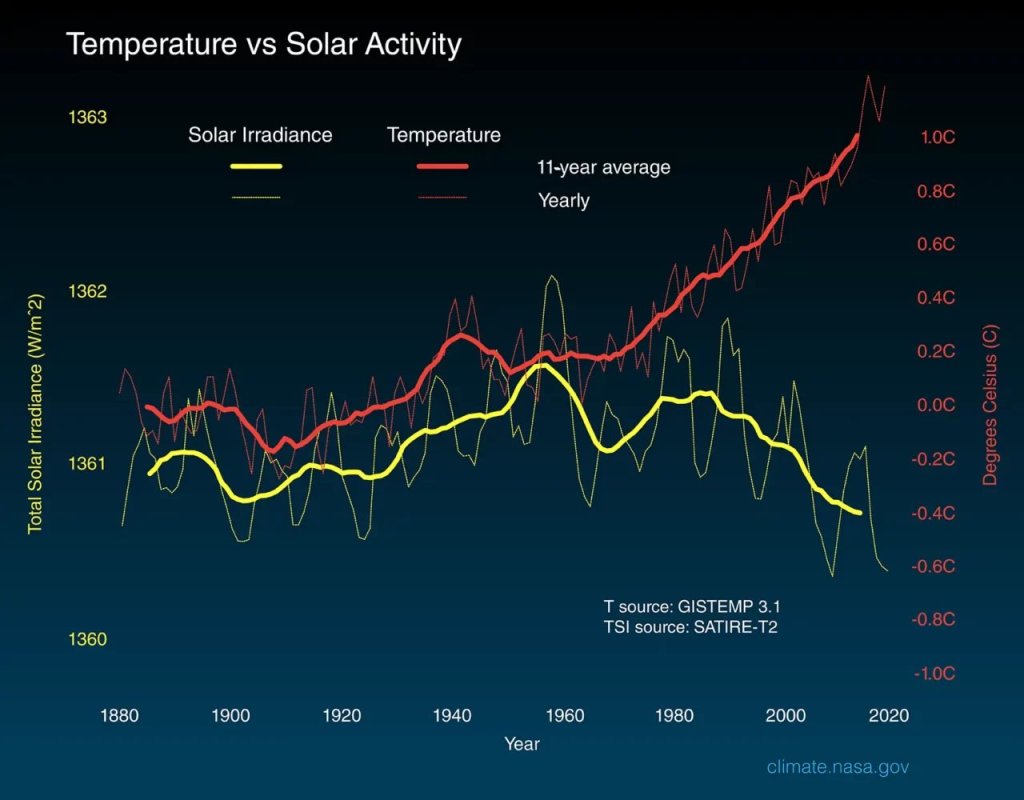
It’s a really thorough introduction to the climate system and all the natural sources of climate variability and cycles of change, including links to sources. Well worth taking your time over with a morning cup of tea and probably I’ll assign it as an introduction text for BSc students (and management) on the big picture of climate change.

I also love it for the introduction where multiple eminent and respected scientists are asked what they’d buy with all the dollars they’d have if they were given one dollar every time someone asked them about “natural climate cycles”. As you might expect, the answers range from heat pumps and solar panels to new bicycles and a time machine.

Not sure what I’d use it to pay for, possibly a new postdoc position to work on snow and ice processes?

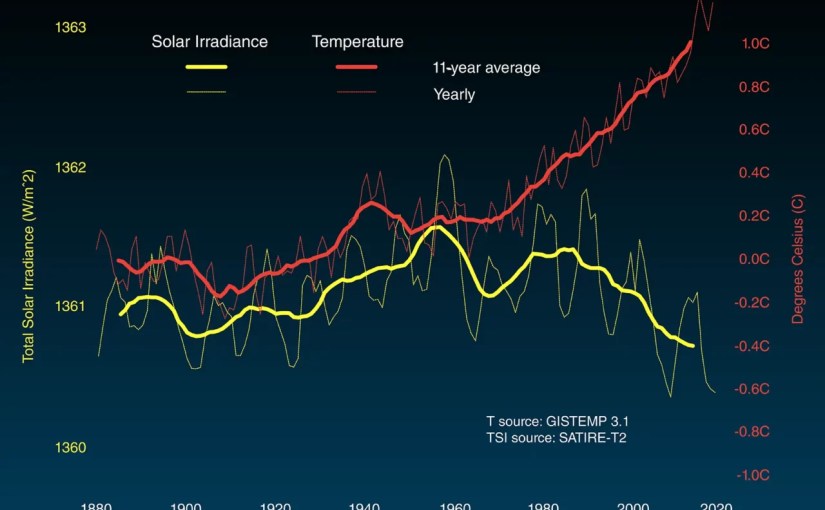
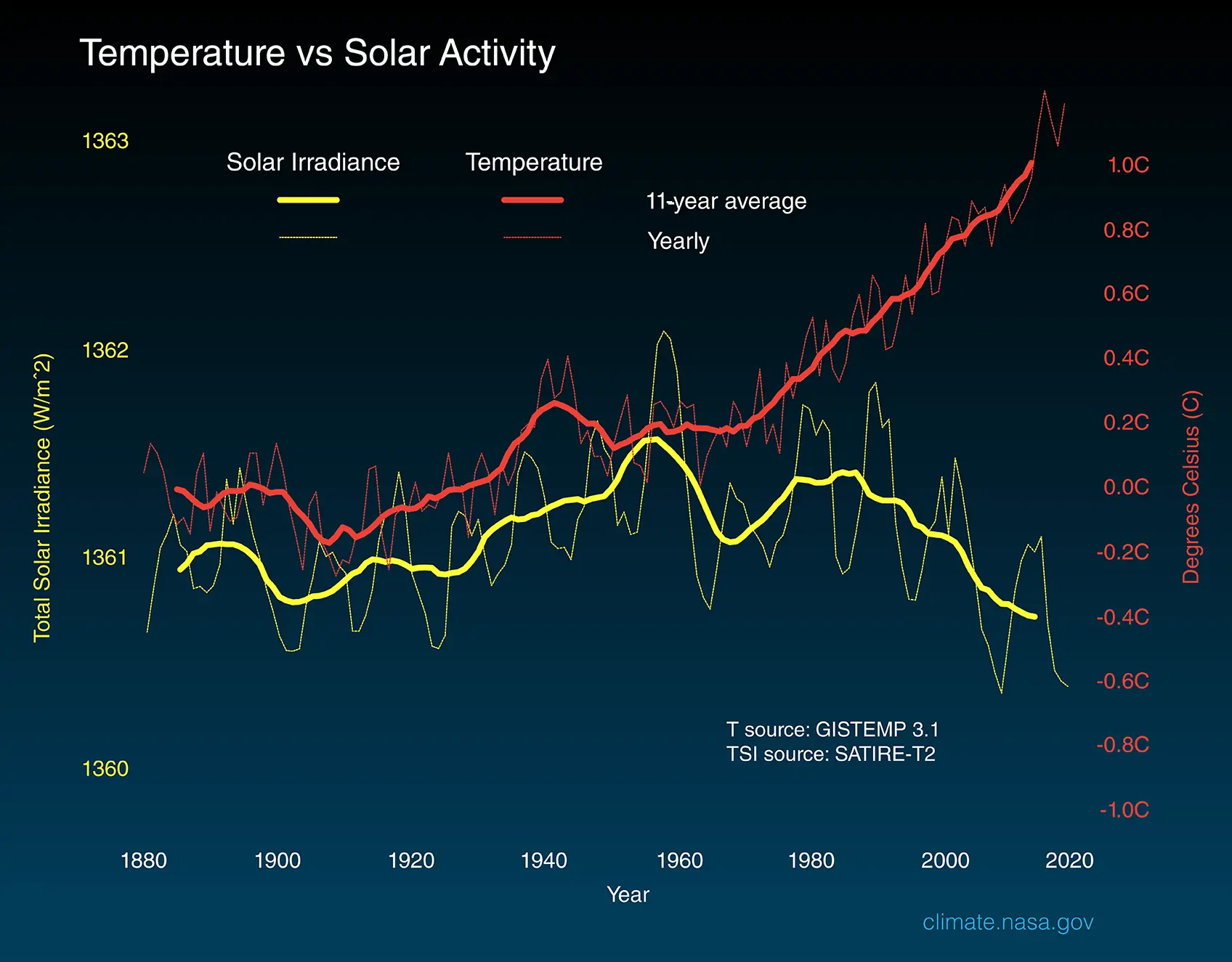
Figure from NASA showing changes in incoming solar and the global temperature

Now that the doubt is out the way, please go and also read this wonderful piece by Rebecca Solnit in the Washington Post about why and how reducing fossil fuel use might lead to abundance and joy and enhanced quality of life (hat tip to David Ho also on mastodon for this one).

*as an aside: I haven’t read Ars Technica in ages. And it’s funny because I remember that when I first started on twitter way back in 2010 there were *a lot* of good articles shared from there on the bird site. Somehow they either were not shared or got suppressed and I stopped seeing them. I’m not sure if that was due to the algorithm or different people I was following. One of the nice things about mastodon is that without an algorithm (and crucially, by following *a lot* of people!) there is a chance to see a much greater diversity of different media. It feels a bit like seeing a different internet, outside the standard walled garden.

Signs of Spring

Currently, I’m very busy getting ready with colleagues to travel to Greenland next week. We have an extremely full programme of fieldwork activities covering oceanography, biology, sea ice, snow and glacier processes as part of our NCKF work. More on these no doubt in a future post…

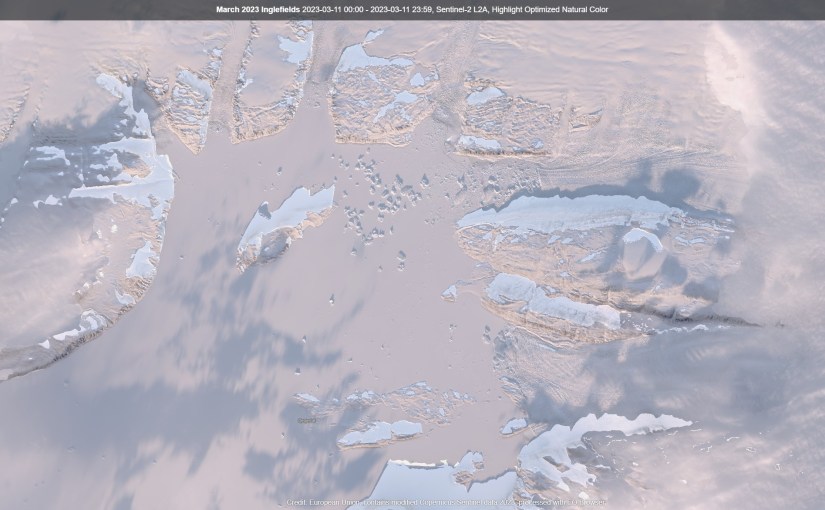
Yesterday, one of my ace DMI colleagues (without whom most of the work we plan would definitely not happen) shared the first optical satellite image of the area this year – taken by ESA’s Sentinel 2 (a truly astonishing source of free imagery and everone should know about it). Because the area is very far north, it has been in the Polar night until now so we have been reliant on the ESA Sentinel 1 imagery based on radar.

First Sentinel-2 optical satellite image of the year downloaded from Sentinel Hub’s EO Browser today. Processing with Sentinel Hubs optimised natural colour filter has introduced some artefacts, notable the brigh white patches which probably represent areas of shadow due to the low solar angle. The area is blanketed in thin cloud and only parts of the glaciers, sea ice and icebergs are clearly visibe.

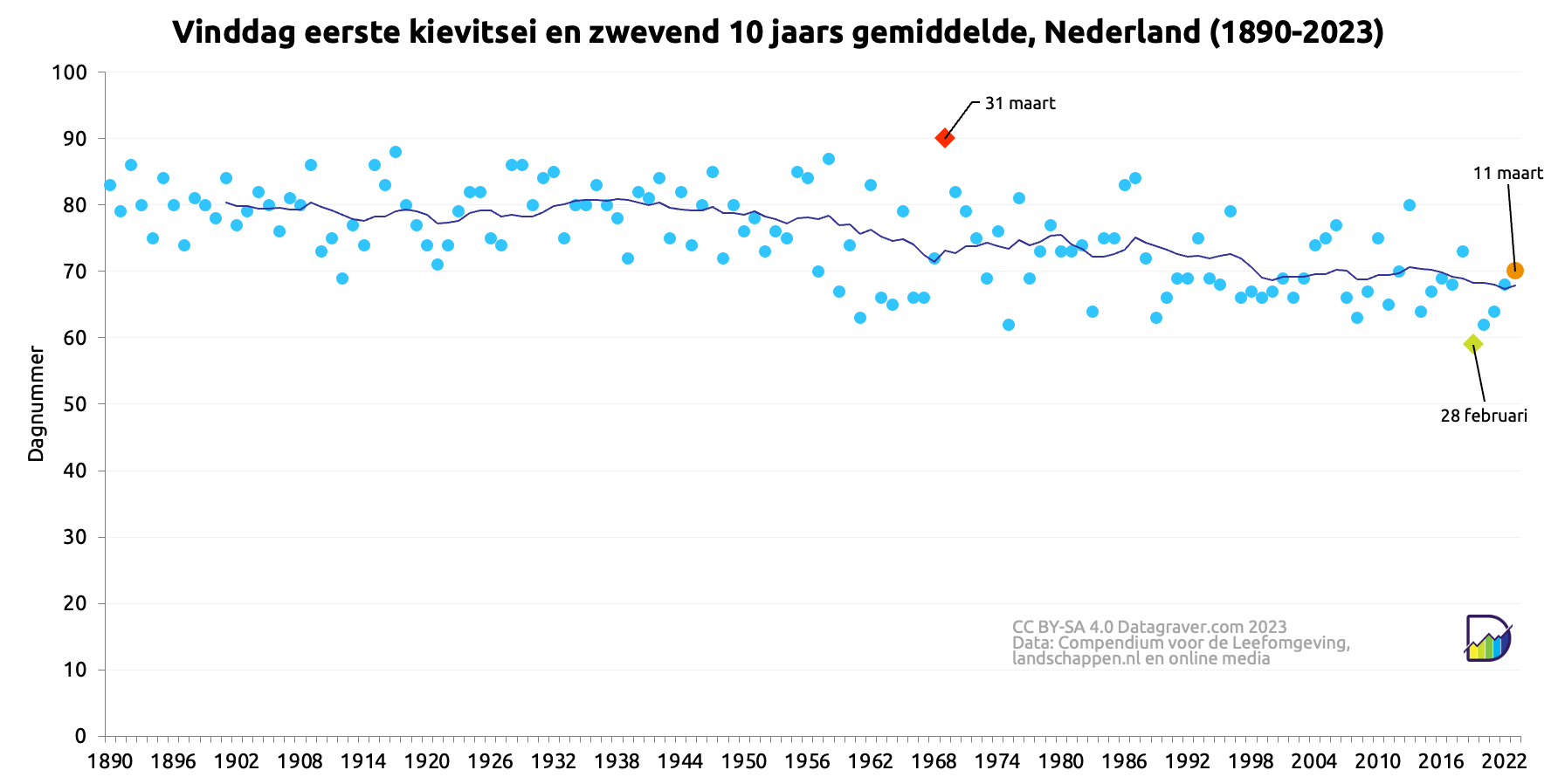
It’s a wonderful thing to see the first satellite image of Spring, akin to other signs like the first cuckoo (in the UK), the first peewit egg (in the Netherlands), and the timing of the cherry blossom in Kyoto.

The first lapwing (peewit) egg of the year was traditionally presented to the Dutch monarch – these days, given the

There was recently a very illuminating thread on phenology on mastodon in reply to a query by Pauline von Hellerman where the Diagram Monkey John Kennedy pointed out the existence of the Pan European Phenology network – not something I was aware of before (though I’d suspected it’s existence) – and who have all sorts of interesting data.

Where biology is clearly showing us earlier springs due to climate change, the date of the first optical image is unlikely to change any time soon due to climate change.

A newer updated version of the Economist’s cherry blossom flowering date plot provided by Datagraver after I posted the old one. See: https://mastodon.social/@Datagraver/110021046678442071

Nor are species assemblages (it’s not quite certain that it’s the same variety of cherry blossom for the whole 1200 year period), or biodiversity losses (the cuckoo is down 65% since the early 1980s alone in the UK, and heaven knows it was not particularly common then) likely to affect it. Not to mention human behaviour changes, the lapwing has gone from being a common agricultural bird to near threatened over the same period, which probably also affects the reliability of that data.

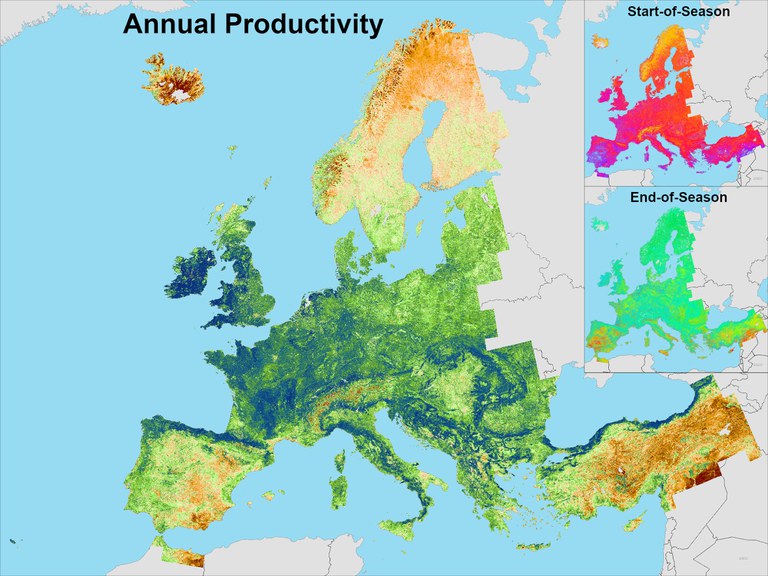
Of course, quite a bit of what you might call bulk phenology can be done by satellite too now…

Copernicus land dataset showing biological activity in Europe basedon satellite data available here

As for Qaanaaq, there is not much in the way of biological phenology, but a compilation and analysis of data on sea ice cover and thickness over the last 60 years would probably be as instructive. Do get in touch if you’re interested in doing this as a student project…

How climbing made me a better scientist

Non-exhaustive list of (occasionally erroneous) reasons why climbing makes me science better (and explaining inter alia why I interview awfully). Prompted by this stupid tweet1: How can being a rock climber (or a baker, or a stand-up comedian, or…) make you a better researcher? Scientists share their thoughts (and their hobbies) in this #NextGenSci: https://t.co/v8JoesyzJ2 […]

How climbing made me a better scientist

Low Antarctic sea ice

I’ve often been contacted by various journalists to comment on different science stories, usually related to Greenland, the ice sheet or more generally glaciers and climate change. This makes sense, I’ve spent the last 20 years studying the interactions between the climate system and the cryosphere.

Last week, I was asked to comment on the record minimum Antarctic sea ice extent (scroll to the bottom to see what I had to say). While sea ice is not exactly my area, it’s pretty close, and I have looked into it in some detail given that I am also part of the ESA Climate change initiative for sea ice.

Update: I just became aware that the ever entertaining and informative Dr Ella Gilbert has a superb video over on youtube which discusses all of this in some detail. She’s far more engaging than I am so I’m just going to drop the link here. You can probably skip the rest of this post..

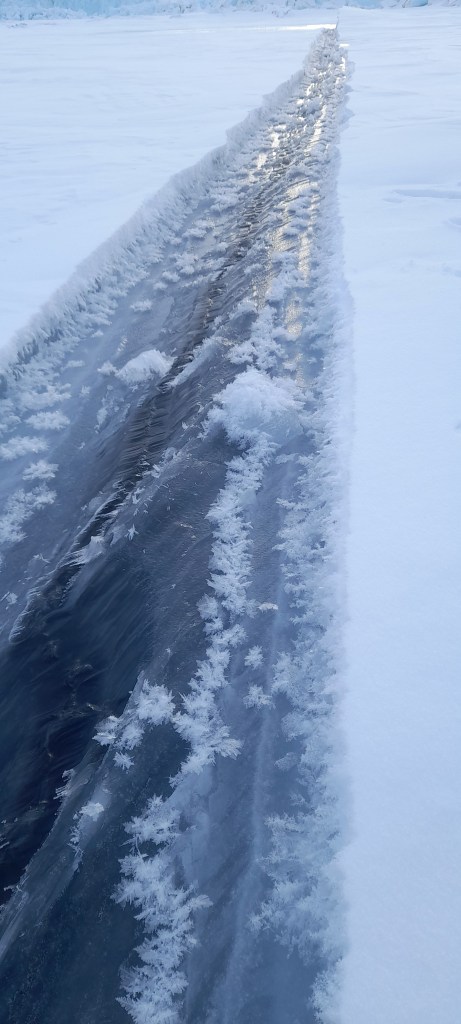
Last year, whilst working on the sea ice, I had to acknowledge to my sea ice colleagues – it is an awful lot more interesting than I’d originally thought. Probably the moment when I really got it though, was when my colleague Andrea urged me to taste the frost flowers we had just spotted growing next to a sea ice lead, as in this this picture on the left.

They are delicate, soft, and almost fizzy with salt. How can you not wonder about their formation and wonder about the role of sea ice in the fjord system?

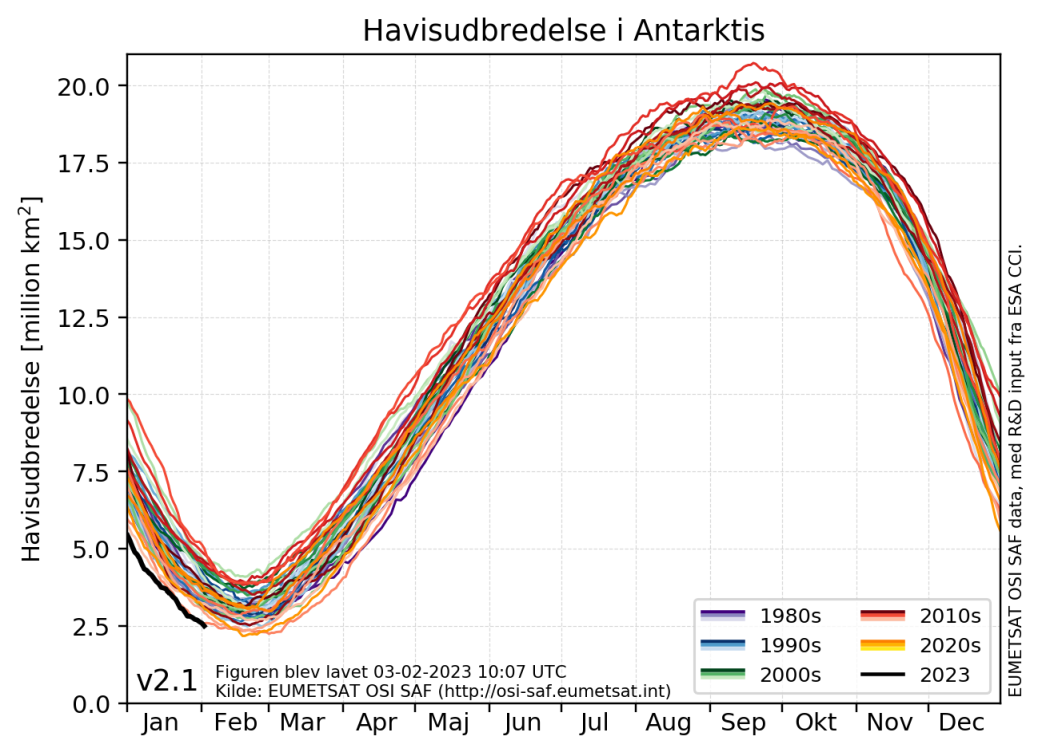
Back to Antarctic sea ice: The current wave of media stories has been about the new record low sea ice area. The annual minimum, reached in February was about 1.7 million km2, or about 1 million km2 less than the average sea ice extent at the annual minimum. As the figure below shows, there is a really clear annual cycle with sea ice growing from February to September, when it reaches it’s maximum, and then declining again to February the following year when it reaches a minimum extent.

This graphic, made by MetNo scientists based on the OSI SAF dataset that my colleagues at DMI also work on, shows the annual cycle in sea ice extent, that is for each individual year, how much sea ice is there around the whole of Antarctica.

This pattern is pretty similar to the Arctic where the sea ice has a maximum area in Feb/March and a minimum area in September.

If you sum this whole area around Antarctica up to one number per year, there is no clear trend – in fact until 2016, Antarctic sea ice appeared to be increasing, in direct opposition to the Arctic area which has crashed over the last 30 years. Then things have changed.

The figure below, plotted by my colleague Gorm Dybkjær and presented at the Danish Antarctic science seminar clearly shows this. Blue colours indicate above average sea ice area, red colours below average.

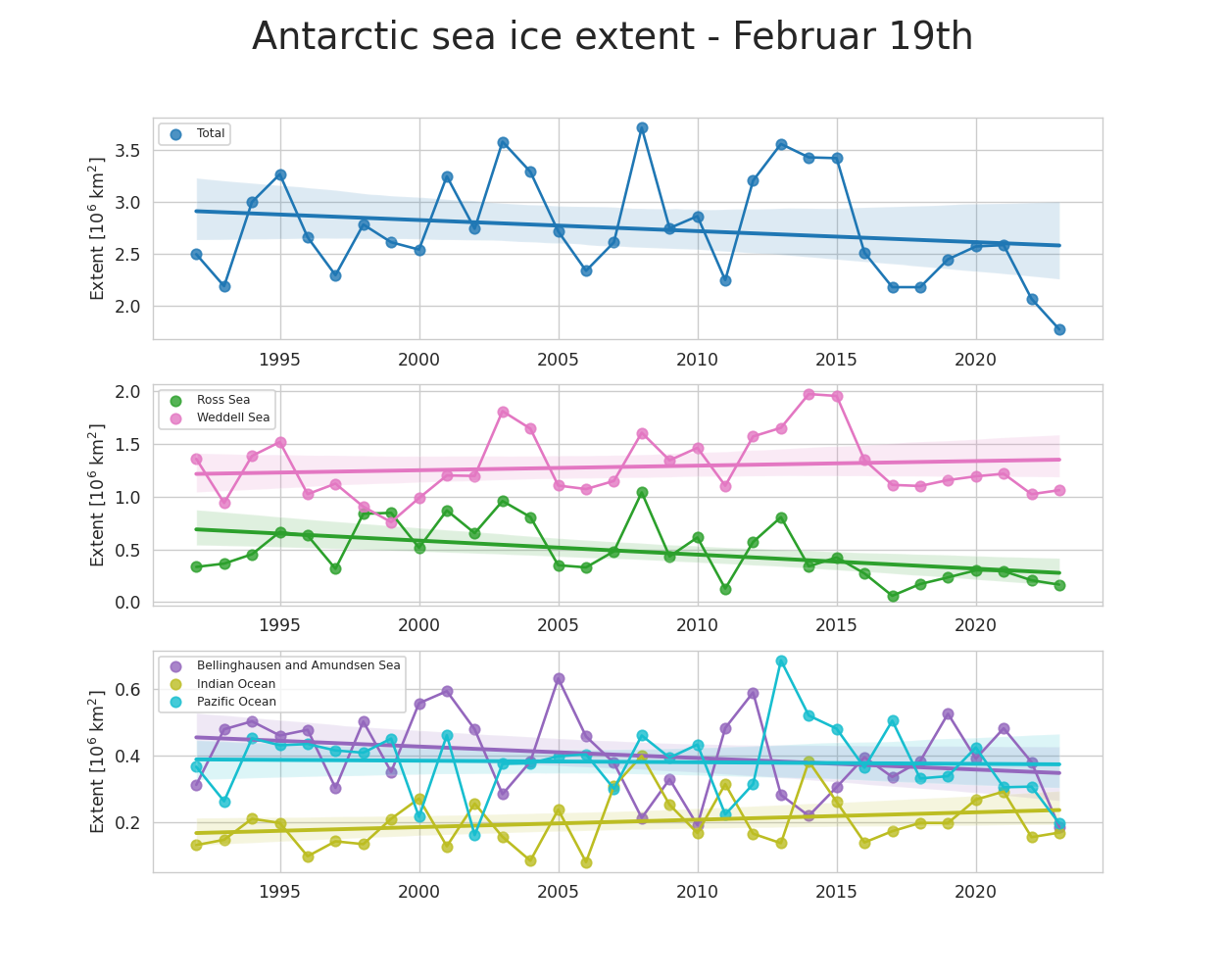
However, as many others have also pointed out, although the overall trend was increasing up to 2016, that increase largely came from one basin, the Weddell Sea, which in contrast to the Ross Sea, Bellingshausen Sea and Amundsen Sea sectors*, was increasing it’s area covered by sea ice. Now all sectors have seen a decrease.

Figure posted by Lars Kaleschke on mastodon (#FF) showing how the Antarctic sea ice trend looks when broken down into basins

There are good reasons to be cautious interpreting these changes. Antarctica is a big place. There is a lot of climate variability and some of the patterns we know are pushing will affect different parts of the continent in opposite directions.

I tried to get this across in the clip below. Let me know if you think I succeeded…

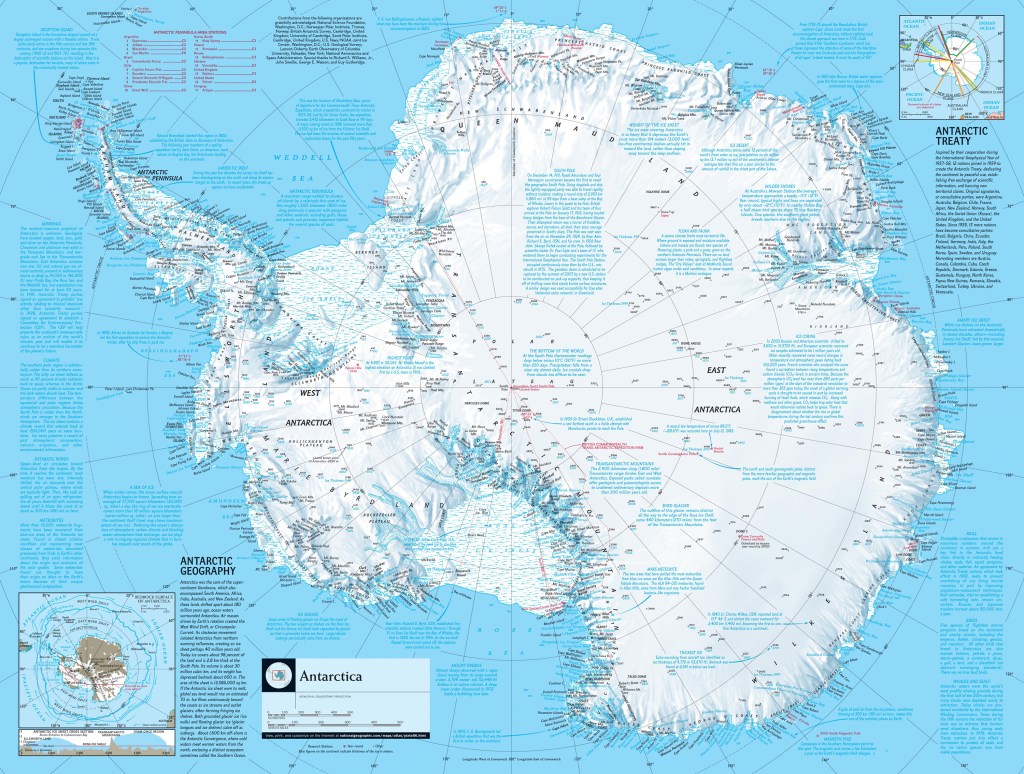
*Yes I know it’s confusing. Maybe this National Geographic Map helps?

Out and about in Leeds..

I’ve been on holiday this last week and I’m combining the trip to the UK with a visit to colleagues and collaborators at the University of Leeds. I’ve also been nabbed while I’m in Leeds to give a wider interest talk at the Royal Meteorological Society Yorkshire branch in Leeds.

I’ll be discussing ice sheets, their contribution to sea level rise and how the future is looking. There may also be some nice photos from our fieldwork in Northern Greenland for those who like dogs, icebergs and snow…

If you’re in Leeds and fancy joining you’re most welcome to register and attend at this link.

In general, I’m trying to reduce my travel this year, last year, with all the rolled over meetings from the COVID times was disruptively busy with work travel, it makes it challenging to actually get the work done. So I think combining work and holidays and rolling up meetings into a block is the way forward.

Although I very much appreciate the opportunity to present online at various meetings, I’m less convinced about hybrid meetings where the purpose is mostly scientific discussions, that is something that works much better either all online or all in person in my opinion, but I think they work well when the aim is to present new and ongoing work (like EGU).

For those who are interested but can’t attend I will see if the talk tomorrow will be recorded and can be uploaded somewhere. Here’s the abstract:

Frozen Threats: Understanding the Role of Ice Sheets in Sea Level Rise

In this talk, we will delve into the world’s ice sheets and explore their importance in the climate system. Ice sheets are the largest stores of freshwater on the planet, their size and location means they influence our climate but their interactions with the atmosphere and ocean are complex. As the world warms, they will inevitable have an impact on sea level. Adapting to sea level rise will be one of our civilisations biggest and longest challenges, so understanding ice sheets is now of critical importance. They are also beautiful and fascinating environments in their own right. In this talk I will discuss some of the scientific challenges, but also show how far we have come in understanding ice sheets and glaciers.

The Inughuit cliffs near Qaanaaq in Northern Greenland rising up above the sea ice. In the far distance a dog-sled is a small black speck.

A door closes, another opens…

It’s time to say goodbye to Twitter..

I posted towards the end of last year about my early explorations of the fediverse (the federated universe – seriously it’s awesome check it out) of apps and websites that can talk to each other but cover a vast range outside of the walled gardens of the corporate controlled internet. Like many people who were (probably far too) intensely online, the changes at Twitter were forcing me away from that platform, which I had been on for a decade. And on which I had more than 10,000 followers

After a few weeks I was completely enraptured by the community on mastodon, far more independently minded, creative and yes, that awful tech bro cliche, disruptive. It was, as is also now fast becoming a bit of cliche, like going back to 2011 Twitter.

On mastodon, as of February 2023 I now have 3600 followers and follow about 2000 accounts. I get far far more interesting interaction and discussion than on my old twitter account with three times as many followers. I’m not the only one noticing this. To be clear it’s taken some “work” to get there. Finding new accounts, dealing with a less than intuitive UX and working out what is of general interest has taken some time. If htis post makes you curious, I recommend the feditips page as a good starting point.

I’m now a fully signed up active member of the fediverse with a pixelfed account (think instagram before the annoying tiktok immitation and with a lot fewer “influencers”), 2 mastodon accounts (probably soon to be amalgamated to one tbh) and some tentative explorations of friendica (a bit like facebook when it still seemd like a cool way to keep in touch with friends and family abroad, jury is still out on this one tbh, I’m trying to keep it for personal friends and family only).

Blogging also seems to have come back into my purview. And it’s fun, thinking about writing and science in quite a different way to the one imposed by the 280 character limit (some of us remember when it was 140).

A few months down the line and while activity on mastodon has subsided since the first waves in 2022, the hard core who are still here are REALLY cool. I feel refreshed and revitalised after checking the stream in a way I have not experienced for a long time on twitter.

It’s also made me reflect on the way I had used social media in the past (probably far too much time spent there if I’m honest with myself). I had accumulated a lot of followers and could quite happily spend hours browsing the algorithmic feed, but especially recently, a lot of that browsing was like snacking on cookies, it was time that would have been more fufilling going in depth on a project or enjoying my leisure time without thjat SoMe filter. At some point twitter helped to find good stuff too, but even before the Musk takeover and mass departures it wass getting harder and harder to find genuinely interesting stuff amid the flood of witty oneliners and outrage driven algorithmically pushed tweets.

After the takeover there has been poisonous floodtide of misinformation and anti-science drivel, not to mention anti-semitism, racism and general bigotry. The climate denial that has arisen since Elon Musk bought the platform wasn’t even this bad during climategate. I have no idea why it has got this awful again recently. I assume the same state actors and misinformation manipulators and their bot armies. Either way, even though I missed some accounts and friends, I no longer want to be supporting a billionaire’s hobby project. SO in the best social democratic tradition, I’m withdrawing my (free) labour.

I moved over towards the end of last year and while I kept an eye on the birdsite, I didn’t feel the need to engage there anymore. I was cross-posting exclusively from Mastodon to Twitter until the crossposter service was ended at the end of January. The end of the open API this week is probably the final end for me. I may post links to my blog for a little while longer, but probably that’s just prolonging the inevitable.

So now it’s time to take stock. I will hold on to my account, though probably locked to new followers, I may drop in from time to time but I don’t plan to engage over there at all. I have downloaded my archive (while I still could) and started deleting my tweets. As of today there is a year’s worth left. I’ll probably scrap that at some point too.

So, do I miss it? Yes, a bit. More than I missed the swamp of facebook when I left there in 2016. But not as much as I thought I would. Possibly because the discovery of the fediverse is leading me to becoming a far more active netizen again, rather than a passive consumer of snack food. I do miss some accounts and friends who have not moved over, though I hope they will one day.

And the ever wise Danish genre and Grundtvig expert Sune Auken expressed it pretty well in one of his daily reminders: “I know why I left, and I know what I lost, but I’m not going back and I don’t miss the experience of twitter even as I miss excellent friends”

And where from here? Well the cool thing about the fediverse is we are in control, we get to decide (at least to some limited extent) what it should look like in the future. It is not a corporate walled garden, we get to work on and improve it and make it after our own image. The same was once true to some extent of twitter and in fact many of it’s best features were user-driven originally.

More to the point, this whole sorry saga has made me realise two things:
I don’t want to build stuff on someone else’s platform anymore.

I need to be much more mindful of the way I use social media and the internet. I have too many responsibilities to family, friends and work to fritter away a mindless hour on social media snack food. But there is nonetheless value and entertainment in creating and sharing:

The bottom line of this general thinking is that a simple, carefully curated, minimalist digital life is not a rejection of technology or a reactionary act of skepticism; it is, by contrast, an embrace of the immense value these new tools can offer…if we’re willing to do the hard work of figuring out how to best leverage them on behalf of the things we truly care about.

Cal Newport, Digital Minimalism

Politics, history, science and the continuation by other means

War is not merely a political act, but also a real political instrument, a continuation of political commerce, a carrying out of the same by other means. All beyond this which is strictly peculiar to War relates merely to the peculiar nature of the means which it uses. 

Carl von Clausewitz, On War

I have lots of thoughts about this really great Timothy Snyder piece on the US 2016 elections, (not least, I wonder what it means for how we understand Brexit too?)

But most of all I’m reminded of Gary Kasparov’s declaration that the point of modern propaganda is not to make you believe something but it’s to make you believe nothing. (I paraphrase slightly). Much of the piece is about how the Russian propaganda operation as been so successful at engendering doubt about Ukraine and the state of relations between Russia and Ukraine.

I sometimes feel the invasion of Ukraine has really been a wake-up call for many of us because it’s just so undeniable. An actual event happening to real people that we know with a pretty clear narrative. The genius of Russian influence operations has always been to muddy the waters sufficiently that it was a little hard to trust anything that anyone said or wrote.

In this sense I’ve also found Timothy Snyder’s series on the making of modern Ukraine (which I’ve been listening to over the last few weeks) brilliant and helpful and interesting. The subject is fascinating, but it also because it becomes clear listening to a historian that, yes there can be different ways to interpret events, but the events themselves are real and we have a duty to try to learn the facts before judging them.

This is of course exactly how scientists should think, that we have to establish good observational data before trying to interpret it. We also need, inevitably to consider what are the uncertainties and likely range within that data. What is missing? What can’t we know? What is the most likely interpretation based on the things we can observe? How reliable are our measurements?

One of my favourite teachers at school who really helped to develop the way I think was very clear on how to do this. And he was not a scientist, he was a historian.

Ultimately, I was more interested in understanding the physical world and went on to study glaciers, ice sheets and the climate system at the poles. However, as I’ve been focusing more on sea level rise and how on earth we adapt to a changing climate it’s quite clear that going back to the social sciences will be important to understand human behaviour. And the murky way other actors seek to influence us as we adapt to climate change is also going to be important to understand. There has been undue influence from a “Merchants of Doubt” perspective for sure for many years when it comes to the causes of climate change and the effects. This is very clear in the mess of climate denial that the new Lord of Twitter has unleashed, it’s a little bit like returning to 2009.

But here we are in 2023 and there are apparently serious politicians having hissy fits over the idea that a significant source of indoor air pollution should maybe be replaced with a far more efficient alternative (yes I’m talking about replacing gas stoves with electric induction), imagine how climate adaptation can be weaponised just as for example COVID vaccination was as part of the culture wars?


Anyway, this is a bit incoherent maybe. But it’s a great piece for clarifying what we know now and maybe for working out what comes next in terms of Russian interference in democratic institutions. And from a climate scientist perspective it’s also another reason to try to avoid (if we can), becoming just another cultural battleground. This is also key: it’s not always about money, sometimes people really are being manipulated for other reasons:

“When people act in the interest of a foreign power, it is sometimes for money, it is sometimes because the foreign power knows something about them, it is sometimes for ideals, and it is sometimes for no conscious motive at all — what one thinks of as one’s own motives have been curated, manipulated, and directed.  It seems quite possible — I raise it as a hypothesis that reasonable people would consider — that some mixture of these factors was at work at FBI New York in 2016.”

Well worth reading the whole thing.
https://snyder.substack.com/p/the-specter-of-2016