I’m lifting my head from the semi-organised chaos that is my office, my home office, our family basement and the office workshop to write a quick post. This might be for reasons of despairing procrastination.
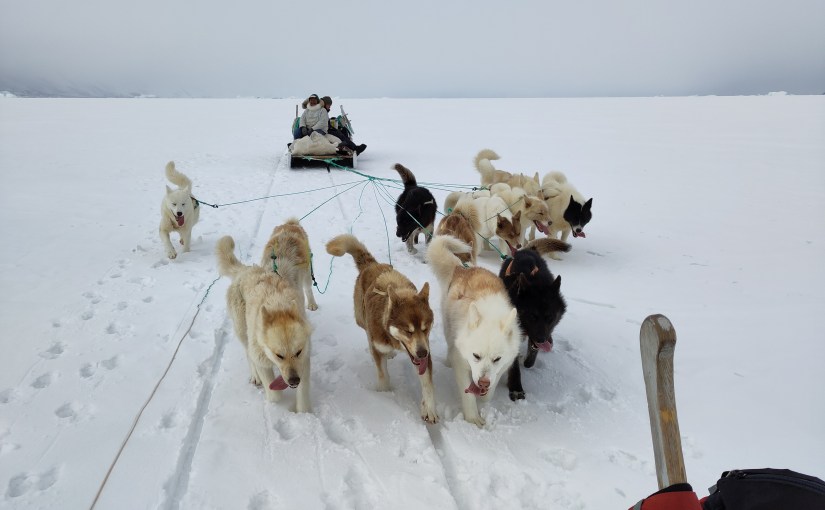
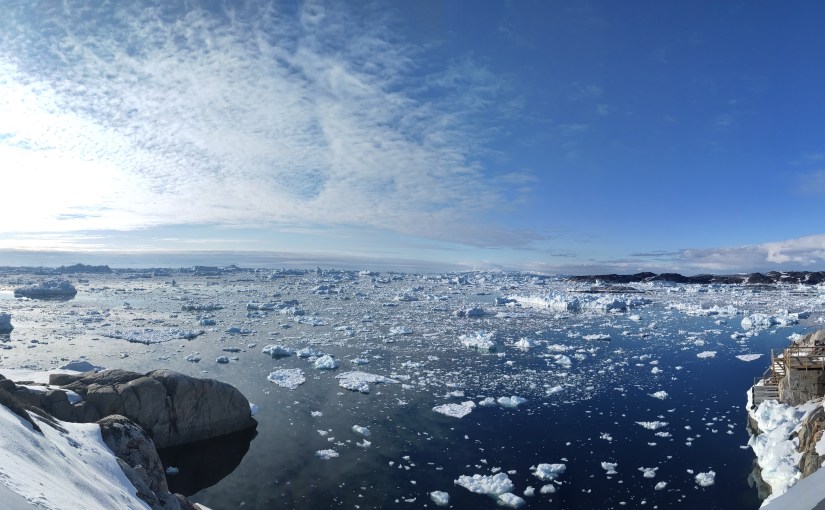
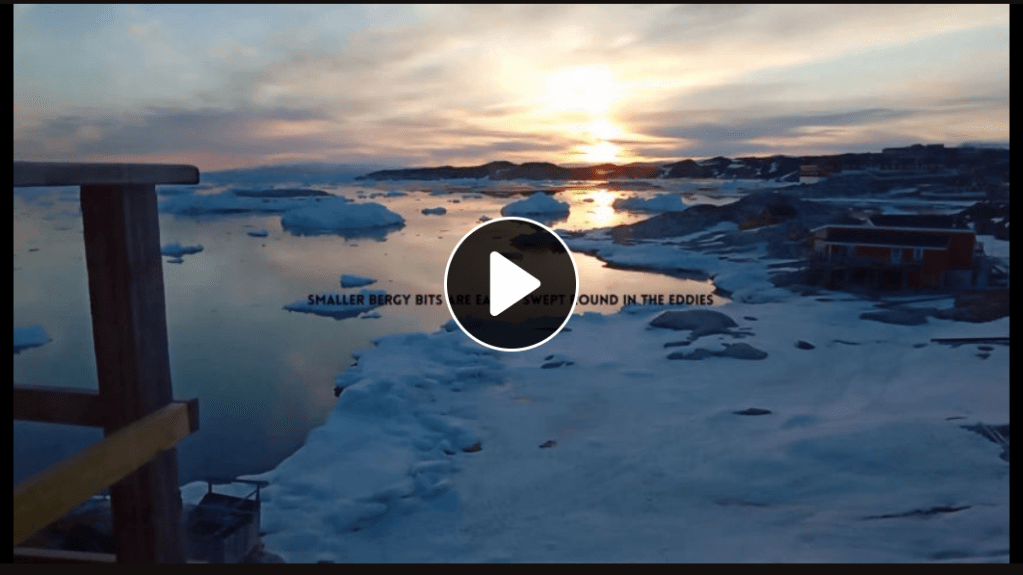
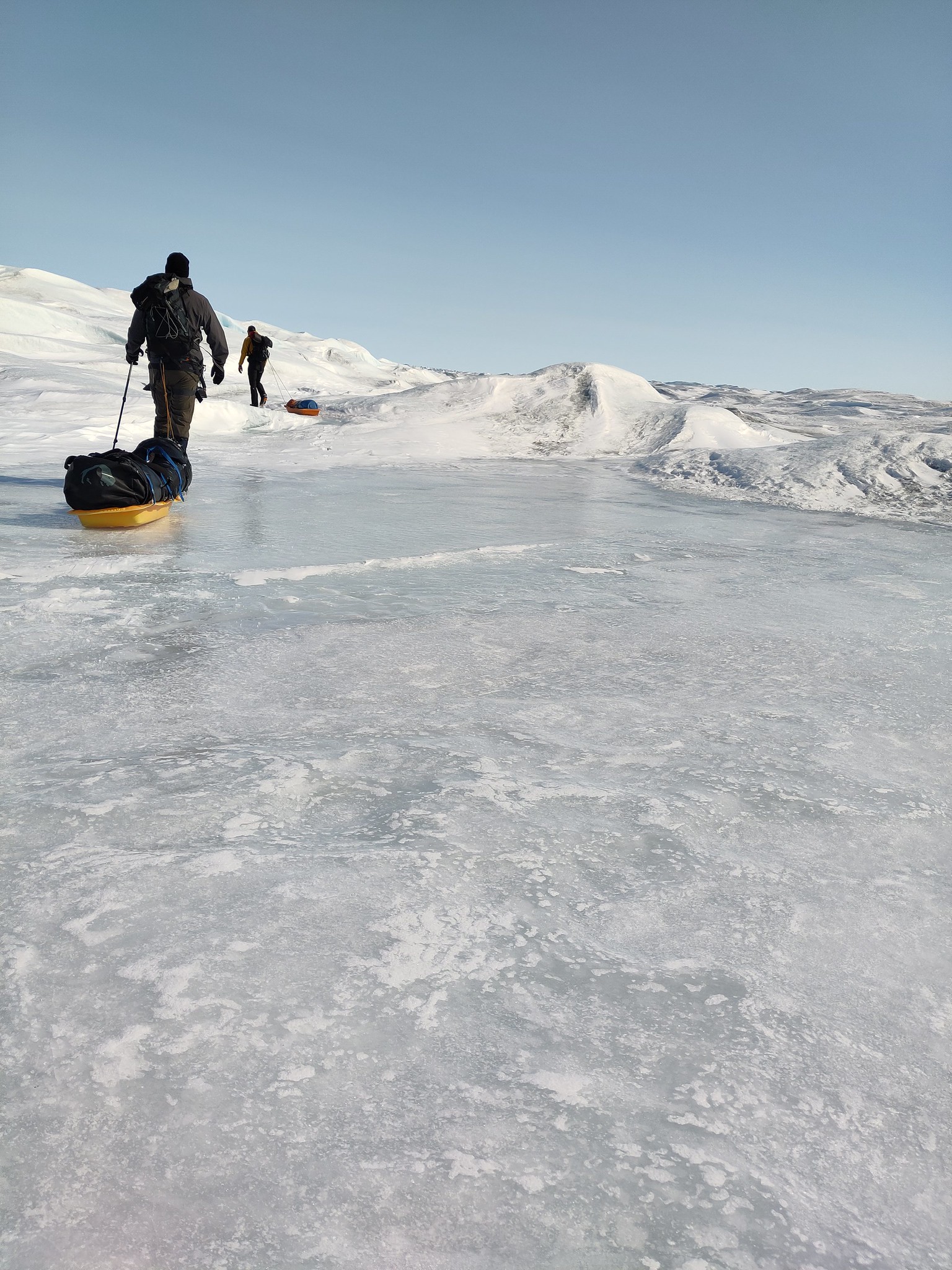
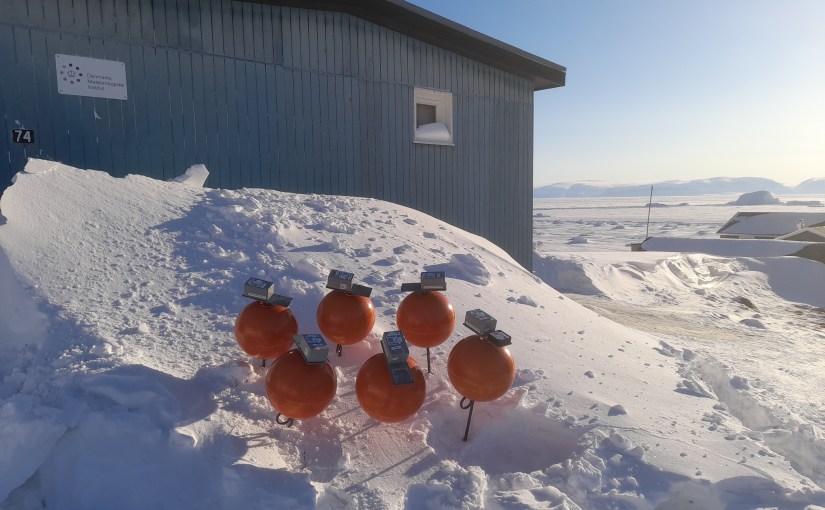
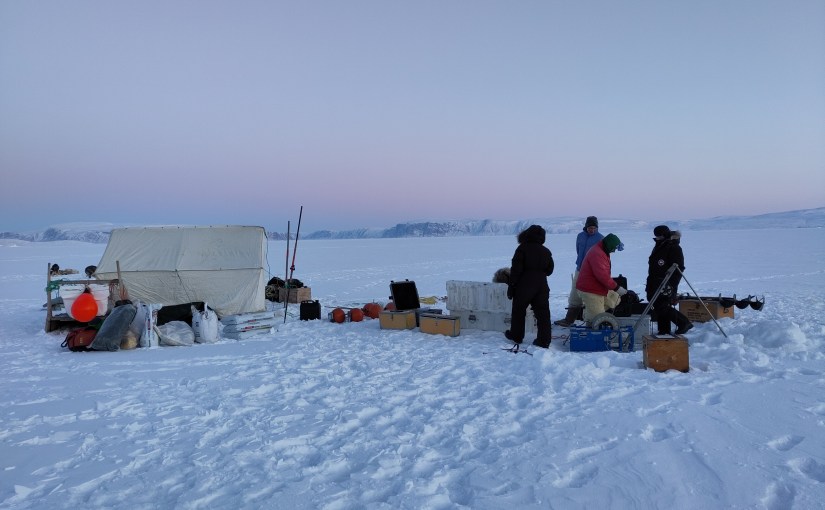
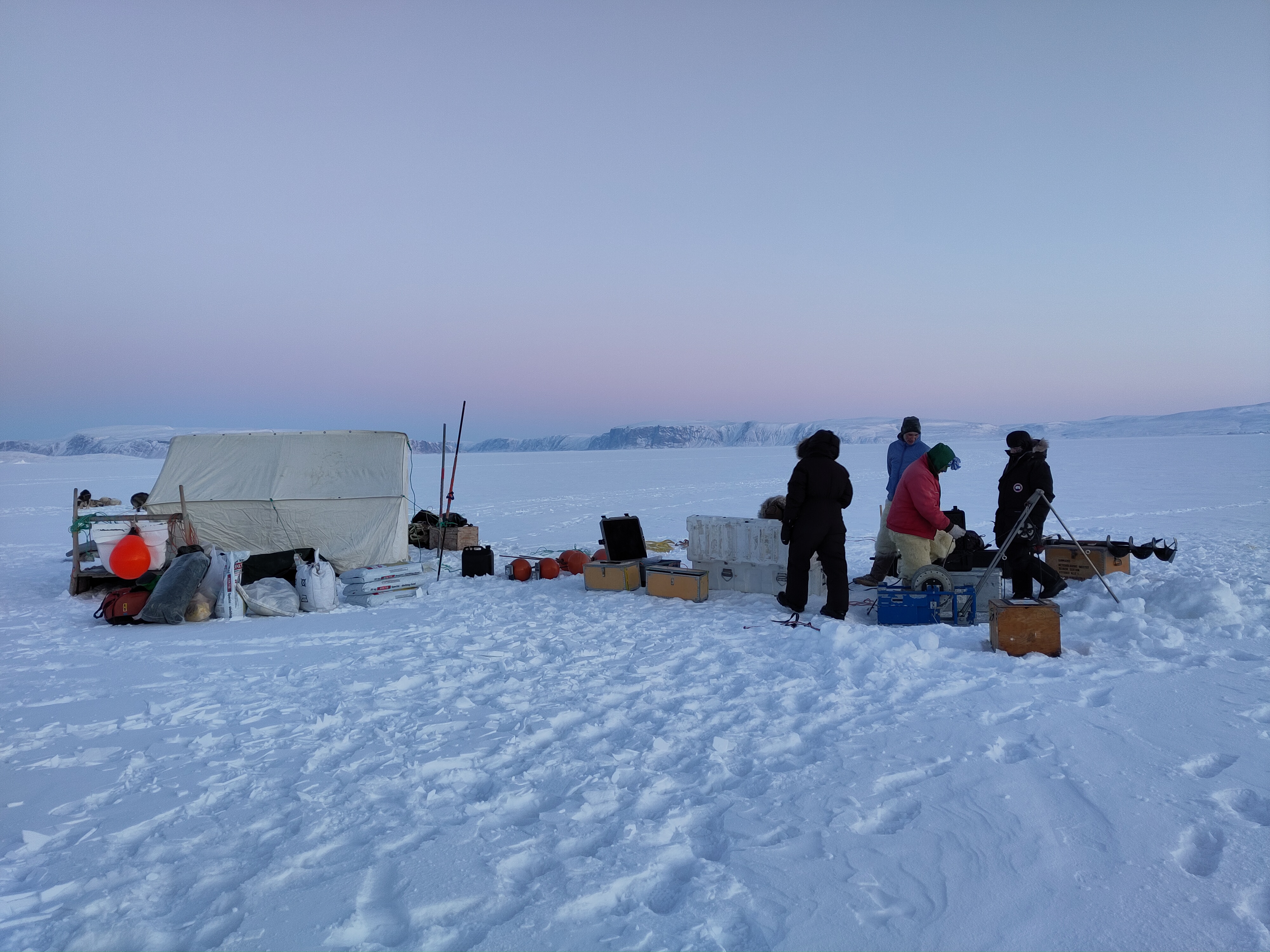
The reason for the chaos is that fieldwork season has come round again and on Friday I and my DMI colleague Steffen will be off to Northern Greenland once again. I’ll try to post a few photos to pixelfed (and perhaps even Instagram, though I swore off Meta products after the Brexit fiasco).
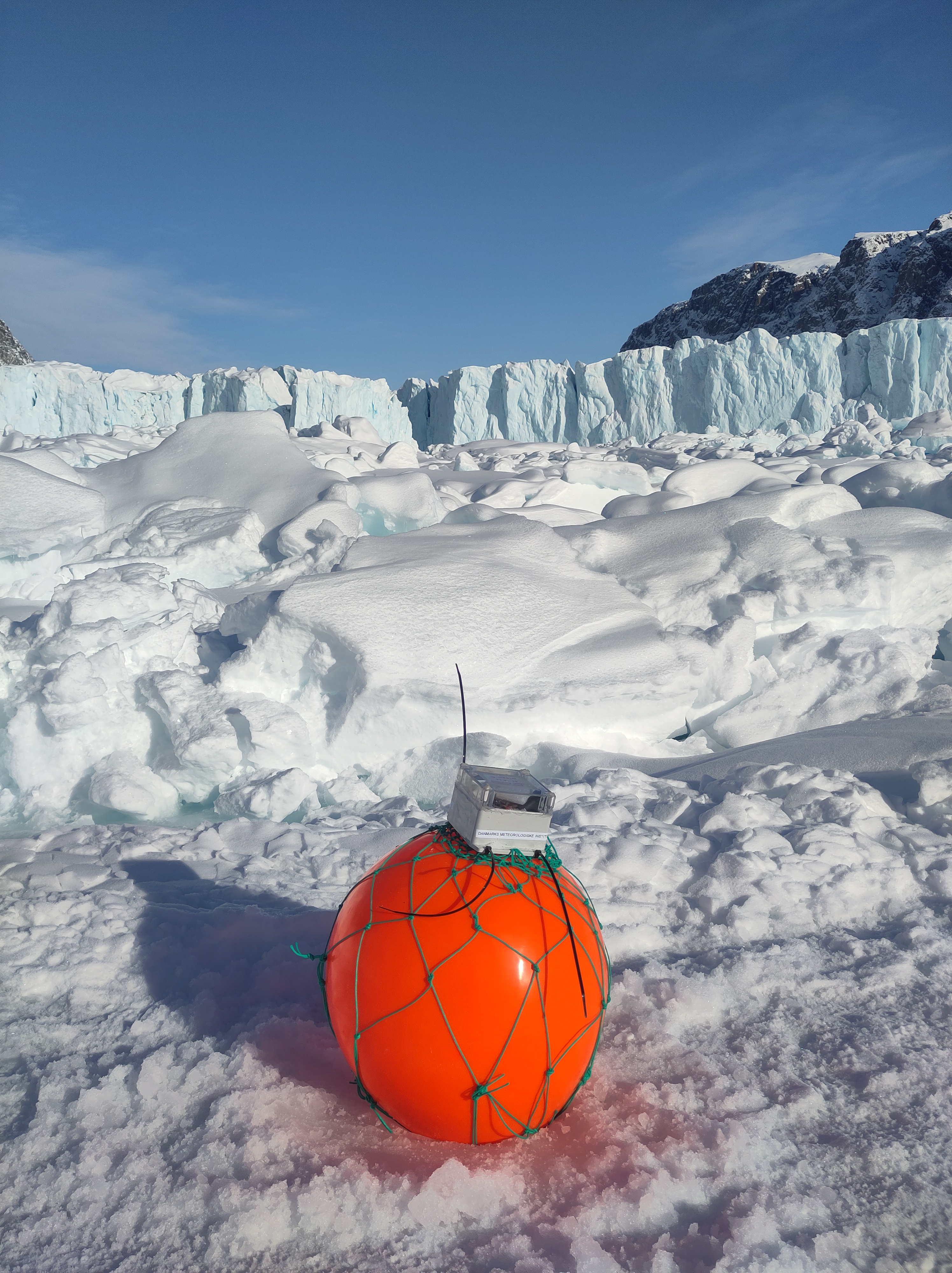
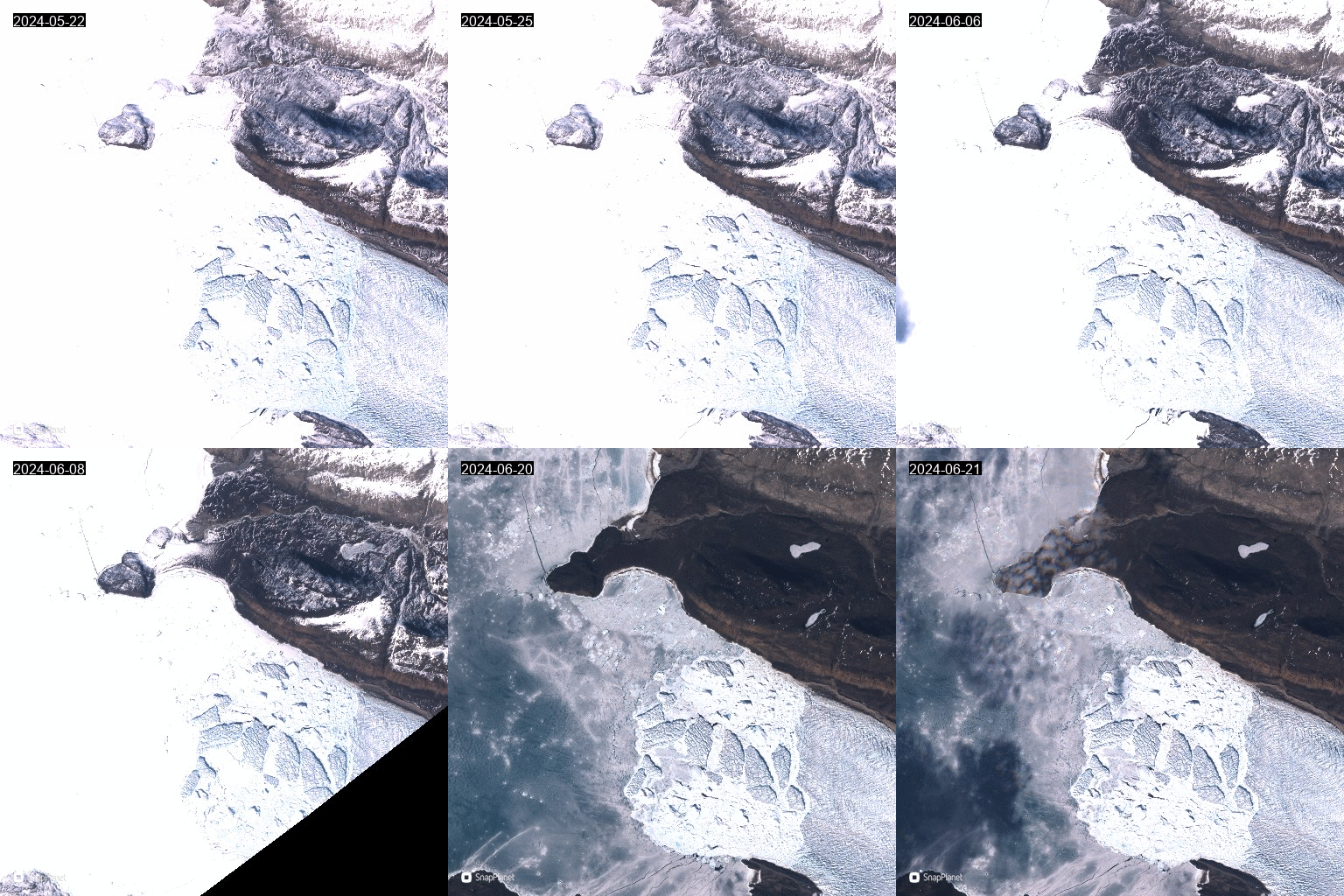
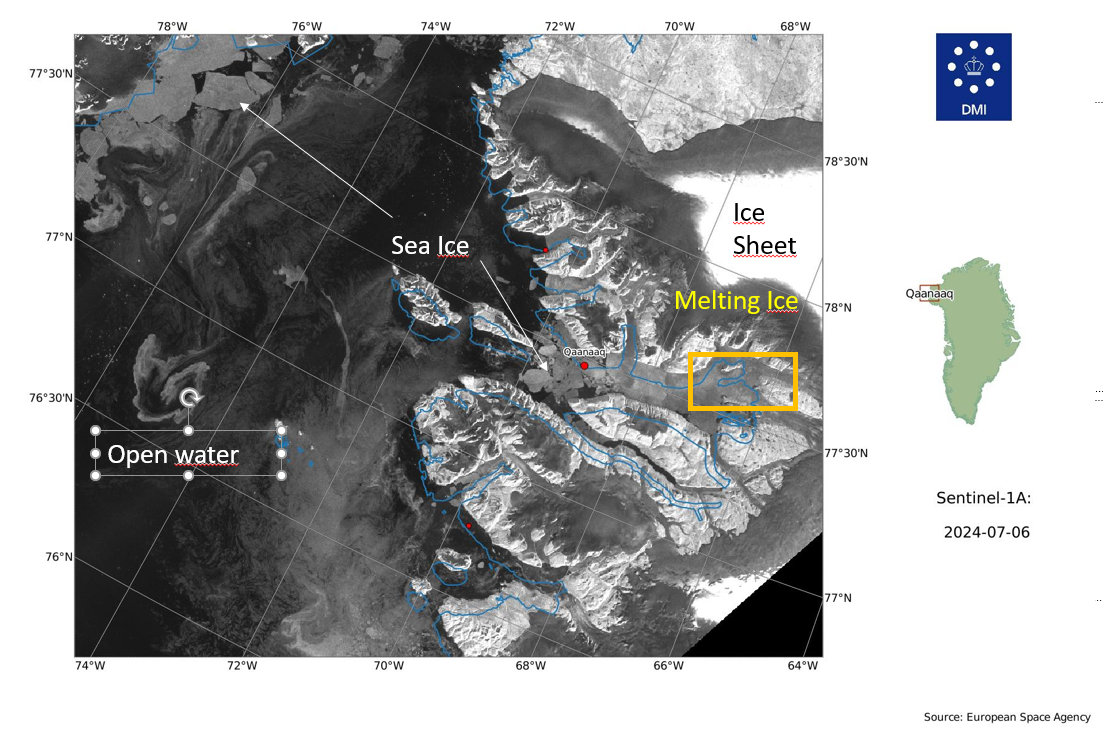
This year my focus is again on the melange zone and we’ll be placing our instruments out to record the break-up of the fast ice. I also hope to get time to establish a new snow measurement programme – which I partly piloted last year. However, we will only be 2 scientists instead of the team of 4 this year, so this may have to wait until the second fieldwork period we have planned in early June (when the sea ice starts to break up). We are fortunate indeed that the local hunters, who still live a semi-subsistence lifestyle, are both incredibly competent and helpful and willing and eager to help when we go out on fieldwork.
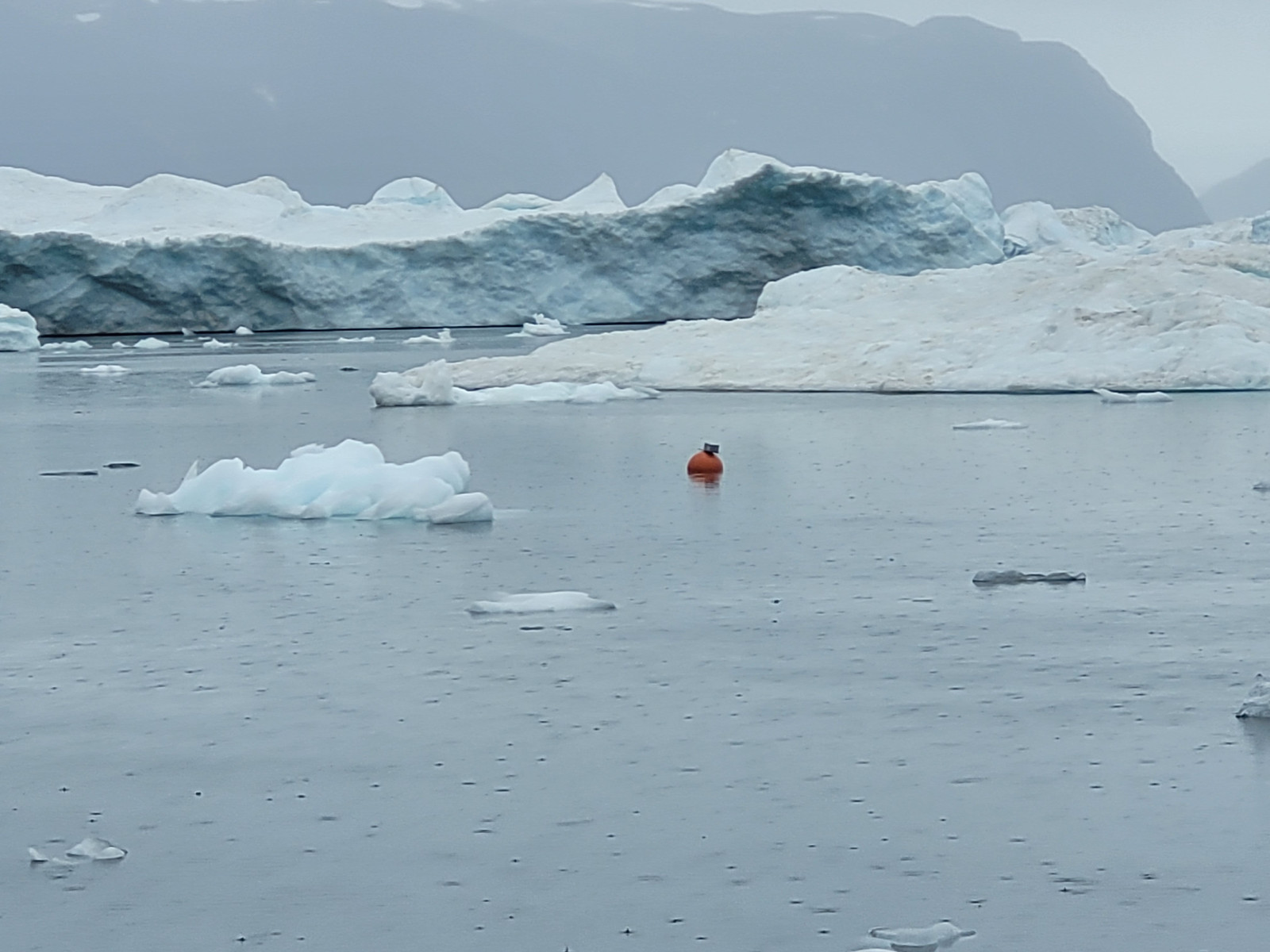
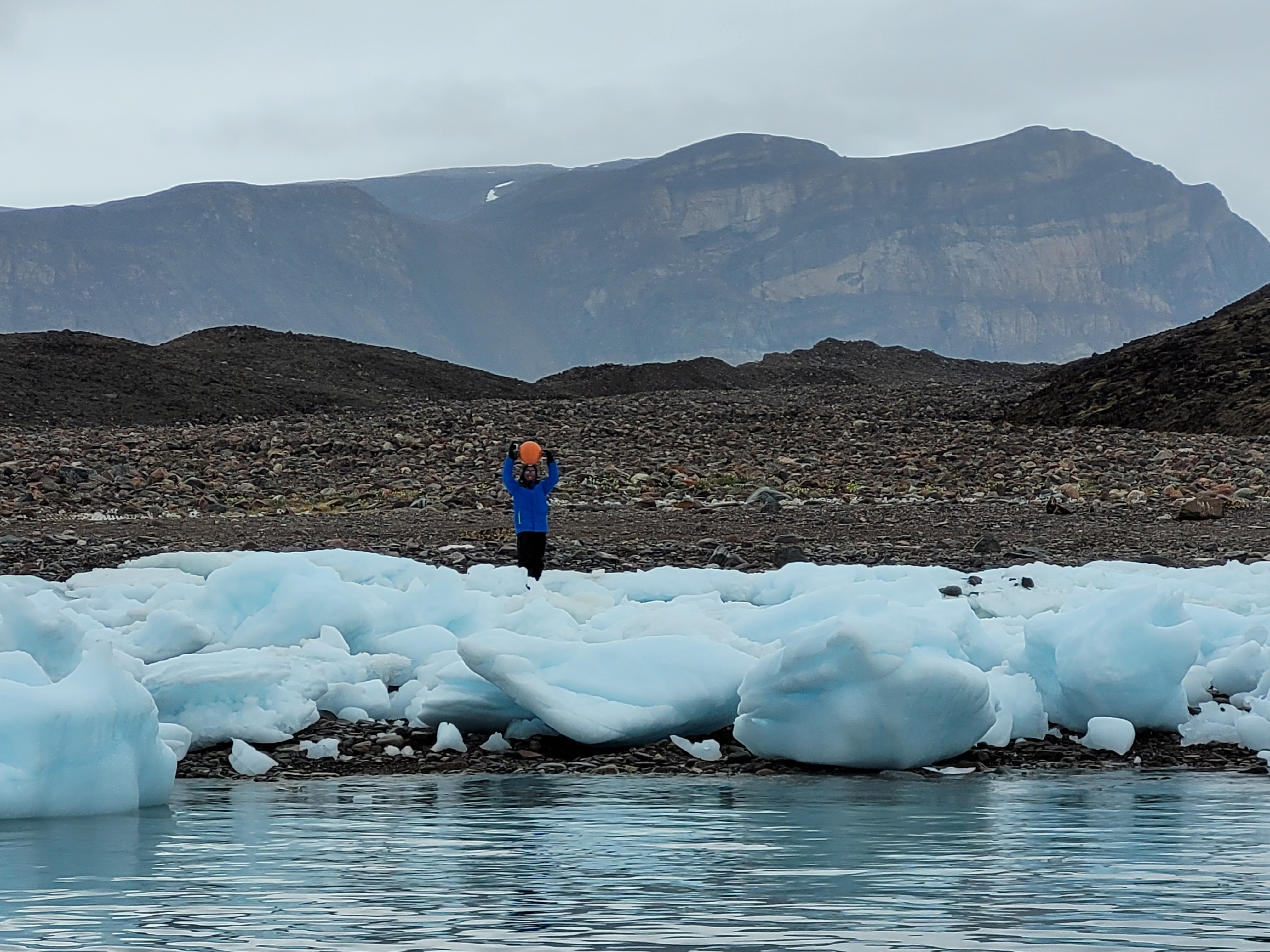
Last year was a test of concept, and noone was more astonished than I was that the final set up not only survived the ice break up and floated safely down the fjord, we also managed to retrieve them and I hope they are waiting patiently in Qaanaaq so I can reprogramme and redeploy this year.
I wrote this piece on our work last year, promising a whole load of posts I didn’t end up having time to write. Sadly even my lego scientists never got an update. So instead of promising a whole lot of new posts, let me know what you’d like to see and read about either in the comments here or on my mastodon feed, and I’ll try to make some time to answer one or two of them while we go.
The area we travel to is going through very rapid changes now – not just climatic and environmental, but, perhaps even higher impact, social and cultural. I am privileged to be abel to witness it and we try hard to leave as little impact as possible.
At this stage it’s hard to imagine I’ll ever be ready to leave, but the clock is ticking down..
I’ve explained several times in the course of media comments that, when it comes to the sea level rise that you experience, it really matters where the water comes from. This point still seems to cause confusion so I’ve written a super fast post on it.
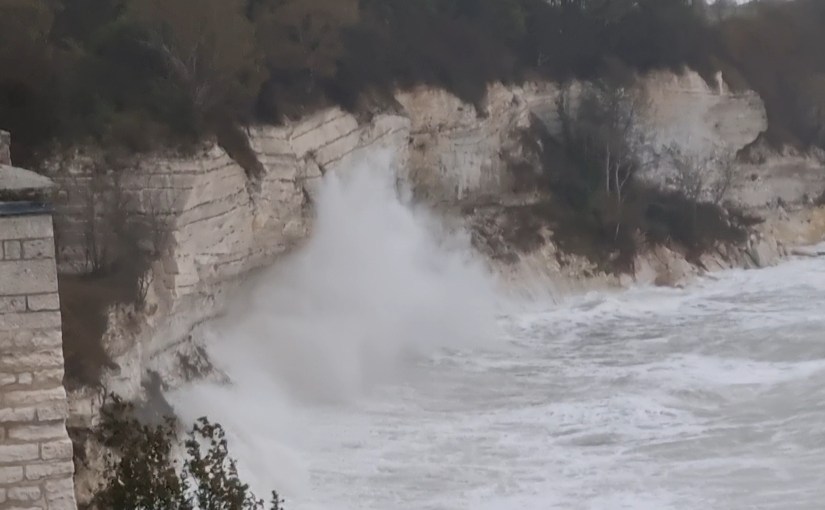
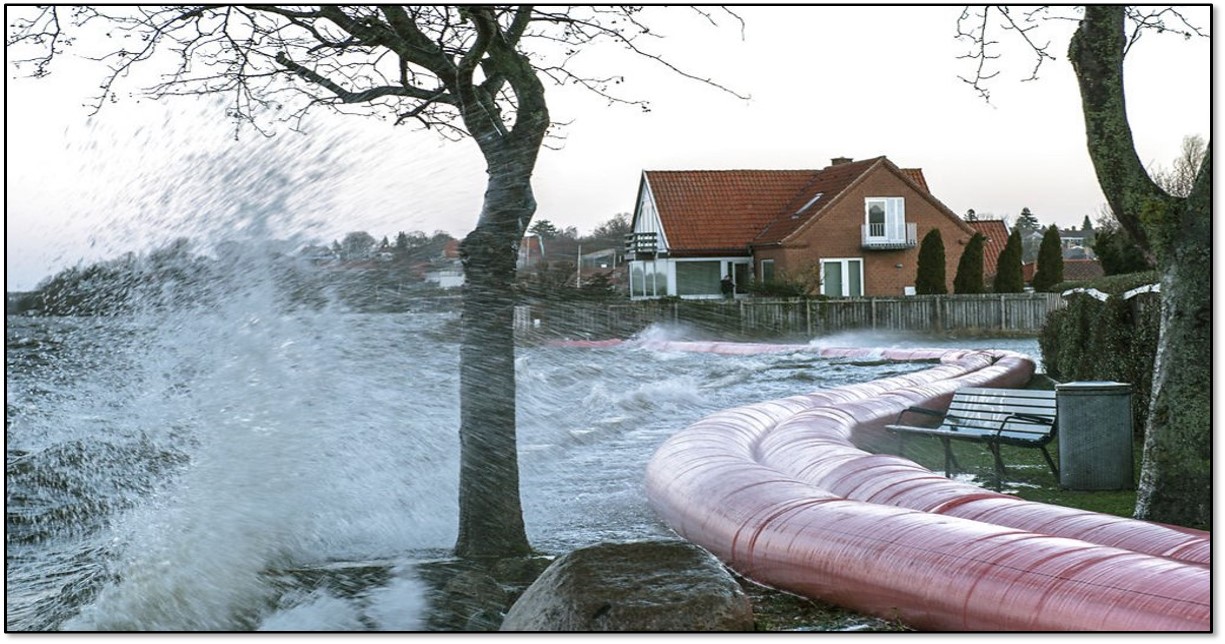
Waves from the Storm Surge that hit Denmark in October 2023 credit: Sebastian Pelt
We very often talk about a metre or two of sea level rise by the end of the century, but in general that refers to global average sea level. And much like a global mean temperature rise doesn’t tell you very much about the kind of temperature changes you will experience in your location due to weather or climate, global mean sea level is also not very informative when talking about preparing your local community for sea level rise. There are other local factors that are important, (see below), but here I’m going to mostly focus on gravity.
Imagine that sea level is more or less stable around the earth (which it was, more or less, before the start of the twentieth century). Just like the moon causes tides because its gravity exerts a pull on the oceans, the ice sheets are large masses and their gravity also attracts ocean water, so the average sea level is higher closer to Greenland and to Antarctica. But there is only a finite volume of water in the oceans, so a higher sea level close to the ice sheets means lower sea levels further away in the tropics for example.
As the ice sheet melts and gets smaller, its gravitational pull becomes smaller so the average height of the sea around Greenland and Antarctica is lower than it was before, but the water gets redistributed around the earth until it is in equilibrium with the gravitational pull of the ice sheets again. The sea level in other places is therefore much higher than it would have been without that gravitational effect.
And in general, the further away from an ice mass you are, the more these gravitational processes affect your local sea level change. In Northern Europe, it often surprises people (also here in Denmark) to learn that while Greenland has a small influence on our local sea level, it’s not very much because we live relatively close to it, however the loss of ice from Antarctica is much more important in affecting our local sea level rise.
Currently, most of the ice contributing to sea level is from the small glaciers around the world, and here too there is an effect. The melt of Alaska and the Andes are more important to our sea level than the Alps or Norwegian glaciers because we are far from the American glaciers but close to the European ones.
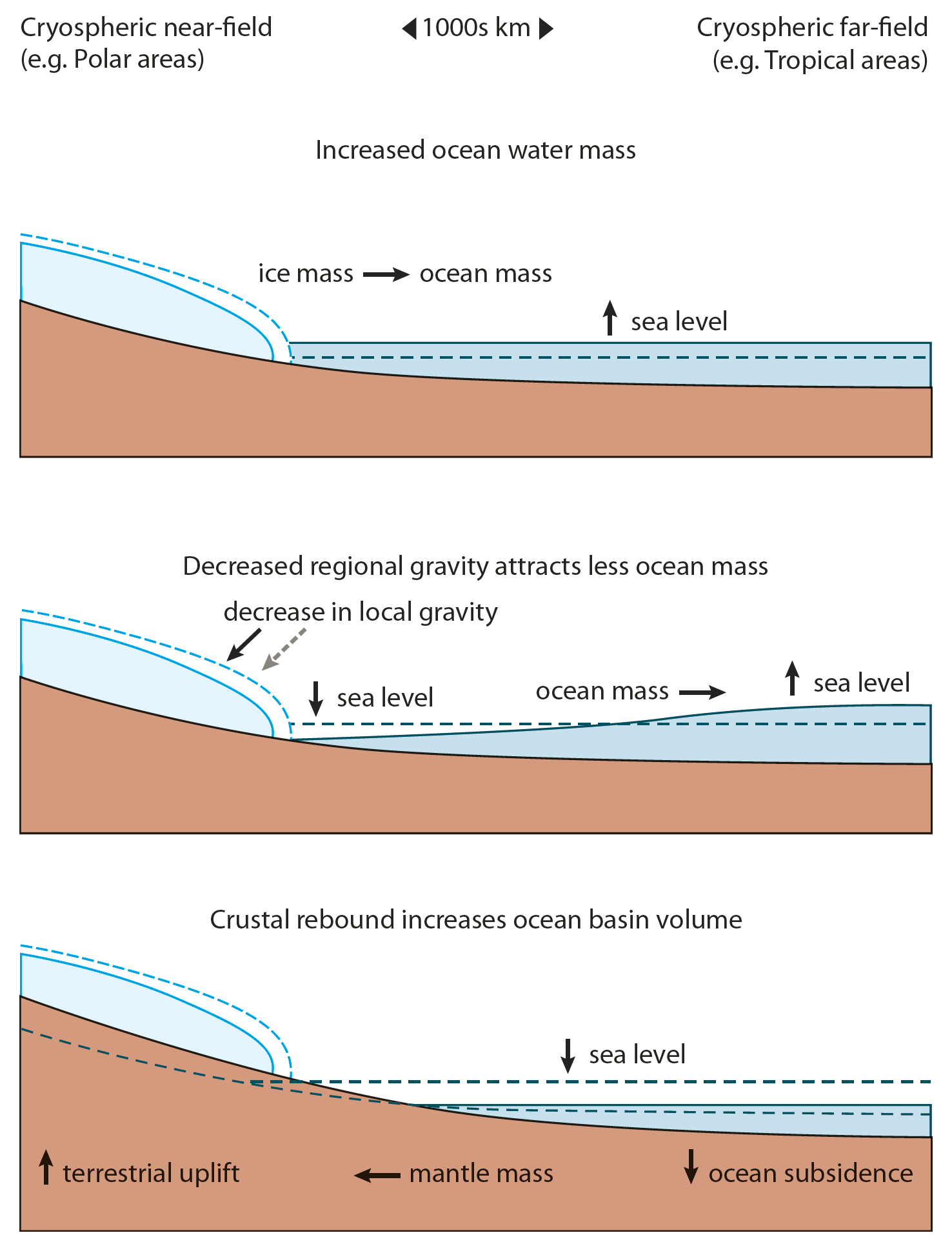
This figure below illustrates the processes:
Processes important for local sea level include changes in land height as ice melts but also the redistribution of water as the gravitational attraction of the ice sheets is reduced. The schematic representation is from the Arctic assessment SWIPA report Figure 9.1 from SWIPA 2017
This is partly why the EU funded PROTECT project on cryosphere contributions to sea level rise, which I am currently working on, has an emphasis on the science to policymakers pipeline. We describe the whole project in this Frontiers paper, which includes a graphic explaining what affects your local sea level.
As you can see, it very much depends on what time and spatial scale you’re looking at, with the two ice sheets affecting sea level on the longest time scales.
Figure 1 from Durand et al., 2021 Illustration of the processes that contribute to sea level change with respect to their temporal and spatial scales. These cover local and short term effects like storm surges, waves and tides to global and long-term changes due to the melting of ice sheets.
In the course of the project some of the partners have produced this excellent policy briefing, which should really be compulsory for anyone interested in coastal developments over the next decades to centuries. The most important points are worth highlighting here:
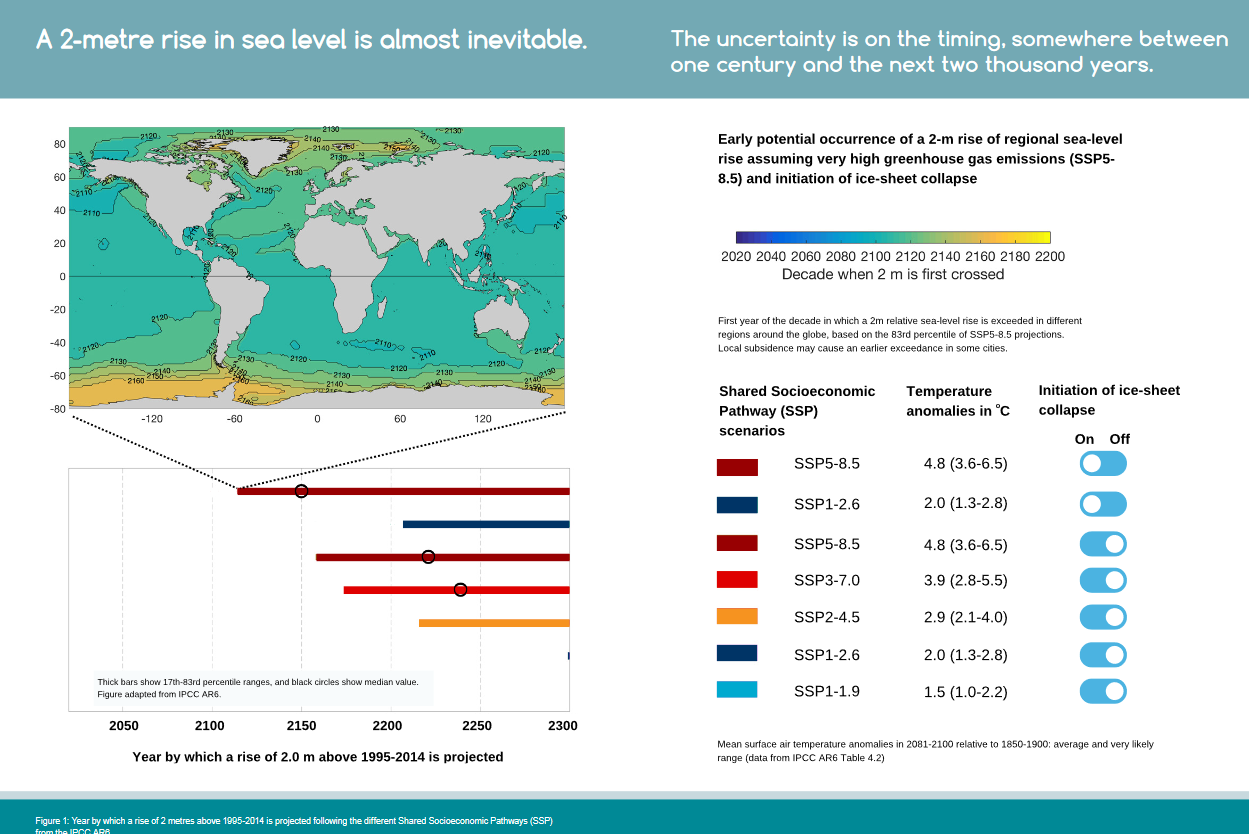
We expect that 2m of global mean sea level rise is more or less baked in, it will be very difficult to avoid this, even with dramatic reductions in greenhouse gas emissions. But the timescale, as in when that figure will be reached, could be anything from the next hundred years to the next thousand.
Figure from PROTECT policy briefing showing how the time when average global sea level reaches 2m is strongly dependend on emissions pathway – but also that different parts of the world will reach 2m of sea level rise at very different times, with the tropics and low latitudes in general getting there first.
What the map shows is that the timing at which any individual place on earth reaches 2 m is strongly dependent on where on earth it is. In general lower latitudes close to the equator will get to 2m before higher latitudes, and while there are ocean circulation and other processes that are important here – to a large extent your local sea level is controlled by how close to the ice sheets you are and how quickly those ice sheets will lose their ice.
There are other processes that are important – especially locally, including how much the land you are on is rising or sinking, as well as changes in ocean and atmosphere circulation. I may write about these a bit more later.
Feel free to comment or ask questions in the comments below or you can catch me on mastodon:
Hands-up who is looking for a new and very cool job in ice sheet and climate modelling and developing new machine learning tools?
REMINDER: 4 days left to apply for this PhD position with me at DMI looking at Antarctic Ice Sheet mass budget processes and developing new Machine Learning models and processes.
UPDATE 2: The PhD position on Antarctica is now live here. Deadline for Applications 18th February!
UPDATE: It’s not technically a PRECISE job, but if you’re a student in Copenhagen and are looking for a part-time study job (Note that this is a specific limited hours job-type for students in higher education in Dnmark) , DMI have got 2 positions open right now, at least one of which will be dedicated to very related work – namely working out how well climate and ice sheet models work when compared with satellite data. It’s part of a European Space Agency funded project that I and my ace colleague Shuting Yang, PI on the new TipESM project, are running. Apply. Apply. Apply…
This is a quick post to announce that our recruitment drive is now open. We’re split across three institutes. We are two in Copenhagen, ourselves at DMI and the Niels Bohr Institute at the University of Copenhagen, and then the University of Northumbria in Newcastle, UK.
The PI at the Niels Bohr Institute is the supremely talented Professor Christine Hvidberg, aided by material scientist and head of the institute, Joachim Mathiesen. I am leading for DMI, and the Northumbria work is led by Professor Hilmar Gudmundsson. We are also very fortunate to have the talents of Aslak Grindsted, Helle Schmidt, Nicolas Rathmann and Nicolaj Hansen already on board.
The project is already very cohesive between institutes, we’ve been working together for some time already and know each other well.
We have a good budget for travel and exchanges between groups, workshops, symposia, summer schools and the like, but perhaps more importantly, all the positions are focused at the very cutting edge (apologies for the cliche) of climate and ice sheet modelling. We are developing not just existing models and new ways to parameterise physical processes, but we also want to focus on machine learning to incorporate new processes, speed-up the production of projections for sea level rise, not forgetting an active interface with the primary stakeholders who will need to use the outcomes of the project to prepare society for the coming changes.
There’s also a healthy fieldwork component (particularly in Greenland, I don’t rule out Antarctica either), and if you’re that way inclined, some ice core isotope work too. So, if you’re looking for a new direction, feel free to give me a shout. I’m happy to talk further.
Links to all the openings, will be updated as they come out, these are currently open and have deadlines at the end of January:
The International Cryosphere Climate Initiative has put together a new petition for scientists to sign. I’m a little sceptical that this kind of “clicktivism” makes much difference, but there are many many lobbyists from polluting industries at the COP28 and rather fewer scientists. And how else to draw attention to what is one of the most visible and urgent effects of climate change?
The petition is aimed at:
” all cryosphere scientists globally; as well as those working on emissions pathways: and those in the social sciences with research on adaptation, loss and damage and health impacts. This includes research and field associates, as well as doctoral students — because you are the future, and will be dealing with the impacts of climate change in the global cryosphere throughout your lives, as well as your professional careers.”
ICCI
The list of signatories so far already includes many rather senior scientists, so take this as a challenge to add your signature if you work in the cryosphere/climate space. It takes only a minute to sign and there are many familiar names on the list.
I’m not sure how else to emphasise the urgency of real action at COP 28.
As a coincidence though, and as I posted on mastodon the image below appears in Momentum, a plug-in on my web browser with a new photo every day. Today’s is this beautiful image of the Marmolada glacier in Italy by Vicentiu Solomon.
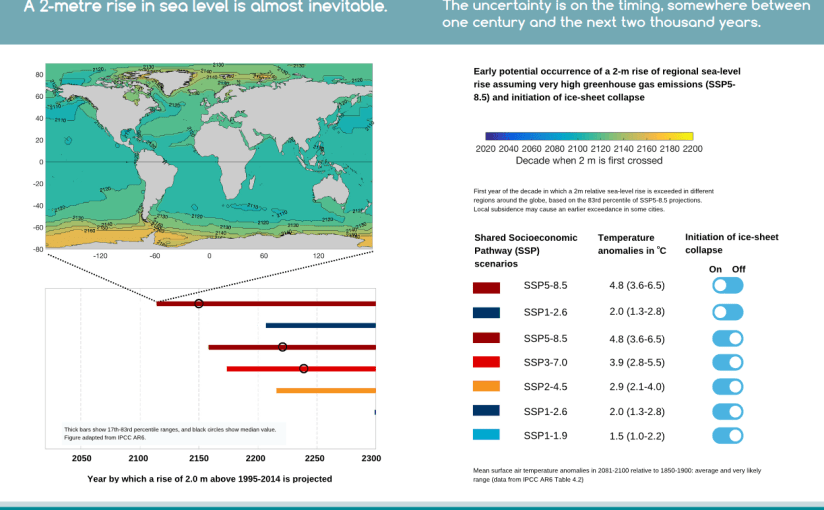
It’s a gorgeous but very sad picture – this is one of the faster disappearing #glaciers in the world and to hear more about the consequences of cryosphere loss, take a look at the policy brief produced by the PROTECT project on the sea level rise contributions from glaciers and ice sheets. It also contains this eye opening graphic:
A 2 metre rise in sea level is almost inevitable. The uncertainty is on the timing which is somewhere between one century and the next 2 thousand years, depending on where you are in the world, but, more importantly given COP28, how fast fossil fuels are phased out. You can download the whole thing here.
The Danish online popular science magazine is currently running a series on tipping points in the Earth system with a series of interviews with different scientists. They asked me to comment on the extraordinary low sea ice in Antarctica this year. You can read the original on their site here. But I thought it might be interesting for others to read in English the piece which is a pretty fair reflection of my thinking. So I’m experimenting a little with DeepL machine translation which I consider much more reliable that google’s competitor. I have not edited anything in the below! I have been promising a piece on West Antarctica for a while – which I’m still working on, but hopefully this is interestign to read to be going on with!
A sudden and surprising loss of sea ice in Antarctica could be a sign that we are approaching something critical that we need to prepare for, warns an ice researcher from DMI. The climate seems to be changing before our eyes.
In Antarctica, there has been a sudden, violent and in many ways unexplained lack of sea ice, which normally melts in the summer and re-forms in the winter.
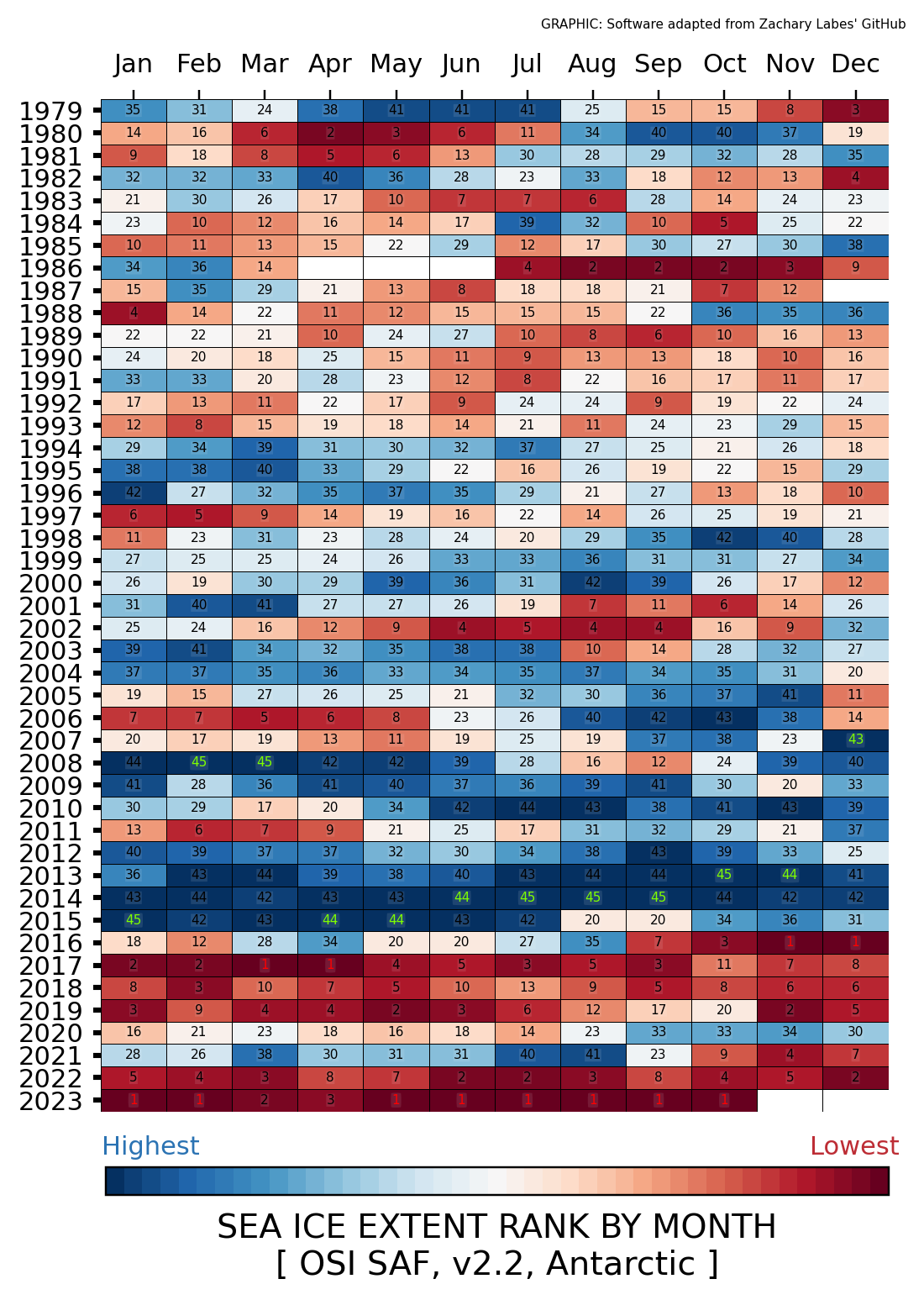
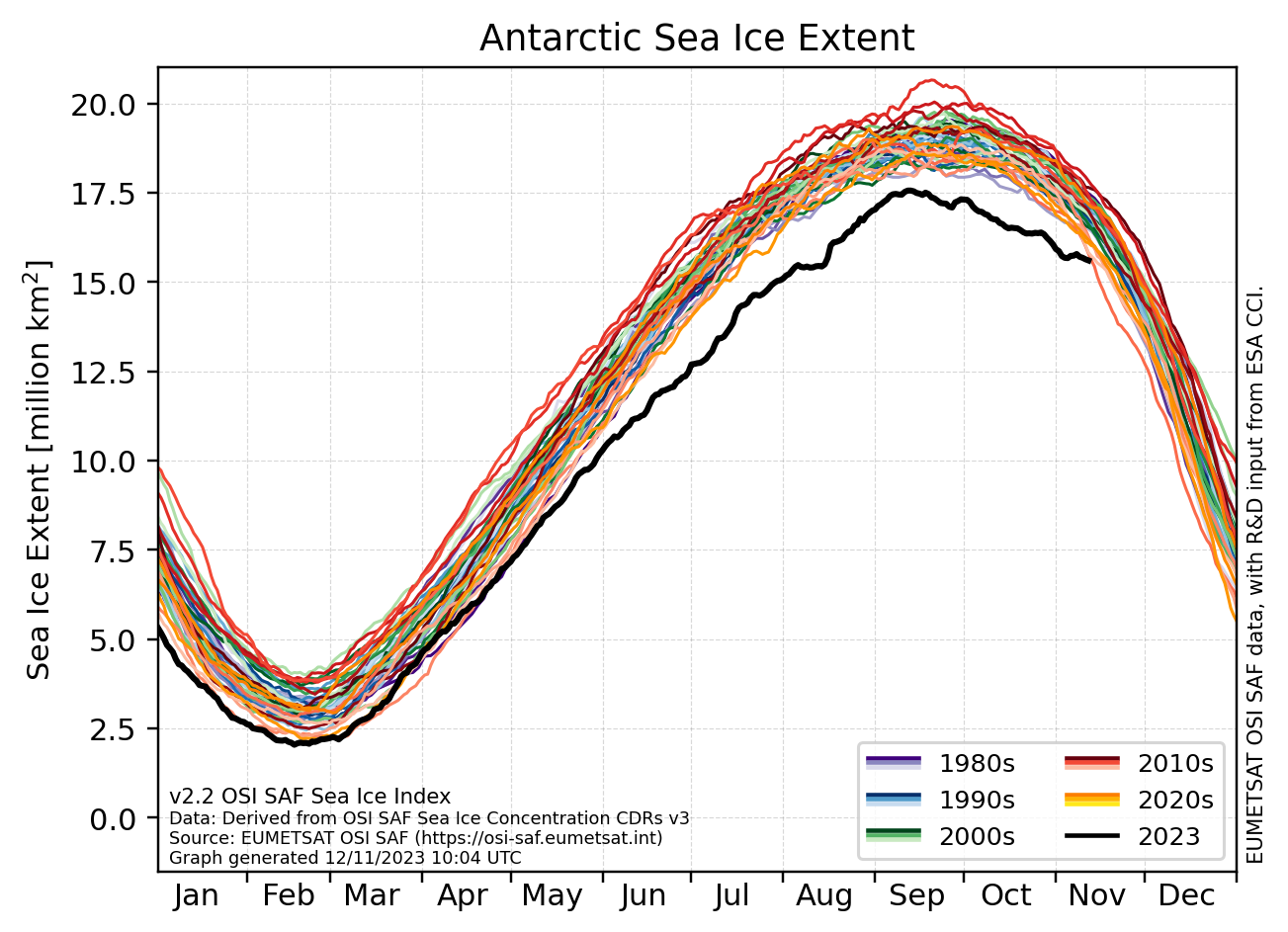
Monthly sea ice extent ranked by month also processed by OSI SAF. 2022 and 2023 are both extremely low.
Since then, some of what was lost has been recovered, but when the sea ice peaked in September 2023, 1.75 million square kilometres of sea ice was still missing. This is equivalent to about 40 times the area of Denmark.
“The melting sea ice in Antarctica is not unexpected in itself, because we have long predicted that it would disappear due to global warming,” Ruth Mottram, senior climate researcher and glaciologist at the Danish Meteorological Institute (DMI) tells Videnskab.dk.
The climate seems to be changing before our eyes.
2023 has seen record high temperatures both on land and in the sea, which you can read more about in the article ‘Is the climate running out of control like in ‘The Day After Tomorrow’?
“But to suddenly have a very, very large disappearance like that is a big surprise. We can’t explain why it happened, and our models can’t recreate it either,” she says, but adds that over time, the models are getting closer to reality.
Disturbances in the Earth’s system are probably connected
Videnskab.dk has in a series asked five leading Danish scientists to assess the state of the climate from their chair – in this article Ruth Mottram.
The OCEAN:ICE project The researchers in OCEAN:ICE, led by Ruth Mottram as principal investigator, will take measurements below the ocean surface. This will provide more knowledge about the temperatures in the ocean around Antarctica. They will also calculate how fast the ice is melting in Antarctica due to ocean processes and warming in the air. They will also investigate what the lack of sea ice means for the rest of the Antarctic system. Ruth Mottram cites as examples: How does it affect ecosystems? For example, many animals feed on the small crustacean krill, whose life is affected by sea ice. Will more waves now reach the Antarctic ice sheet and perhaps lead to more icebergs and more melting? Will glaciers and icebergs become more sensitive to heat? Or, on the contrary, will less sea ice trigger more snow over the continent, which could even stabilise the glaciers? More specifically, researchers will focus their efforts on seven areas, which you can read more about on the OCEAN:ICE website.
In the project, researchers will, among other things, take measurements under the sea surface in Antarctica to gain more knowledge about how the ocean and ice interact.
Is melting sea ice linked to warm water in the Atlantic?
In the North Atlantic, sea surface temperatures in some places have been as much as five degrees above normal.
To an outsider, it seems obvious that this could have something to do with melting sea ice.
However, according to Ruth Mottram, the two factors are not necessarily directly related. Sea ice in Antarctica melts from below. Therefore, the temperature at the bottom of the sea is far more important than the temperature at the surface.
“But if there’s one thing I’ve learnt over the past 15 years working at DMI, it’s how interconnected the whole world is. So I think we’re seeing some disturbances throughout the Earth system that are unlikely to be completely independent of each other,” she says to Videnskab.dk.
Ocean Professor Katherine Richardson made the same point earlier in the series. You can read about it in the article ‘Professor: The oceans are warming much faster than expected’.
Lack of knowledge and observations
Ruth Mottram emphasises that far more observations from Antarctica are needed before we can say anything definite about the causes of the rapidly shrinking sea ice, but: “It could indicate that the Antarctic sea ice has a critical tipping point like the Arctic, where for a number of years we see a slow decline year by year, and then suddenly it drops to a new stability where it is very low compared to before.””But we don’t know, because there are parts of the system that we don’t understand and that we haven’t observed yet,” explains Ruth Mottram.
Possible reasons why sea ice is disappearing
Ruth Mottram talks a lot with international colleagues about why the sea ice is currently experiencing a significant decline.
She explains that there are different theories, for example that warmer water from below is coming into contact with the sea ice and melting it from below, and that warmer air may be feeding in from above.
In Antarctica, the direction and strength of the wind has a big impact on the state of the ice (click here for a scientist’s timelapse of how Antarctic weather changes rapidly).
Perhaps the sea ice has been hit by “a very unfortunate event”, where it is both being hit by warm water from below and being affected by weaker winds from changing directions, which is holding back the recovery of sea ice.
Again, more research is needed.
Melting ice also contributes to sea level rise, and the Earth is actually designed so that melting in Antarctica hits the northern hemisphere much harder than melting in Greenland. So, bad news for the ice in Antarctica is bad news for Denmark.
Even more bad news is on the horizon.
The natural weather phenomenon El Niño looks set to get really strong over the next few months. A so-called Super-El Niño will likely only make the world’s oceans even warmer.
“We know that the ocean is going to be really, really important in the future in terms of how fast the Antarctic ice is melting and what that will mean for sea level rise,” says Ruth Mottram. We can’t just wish the world would look different
The climate scientist does not fear huge increases or a violent change in climate overnight, as depicted in the 2004 disaster film ‘The Day After Tomorrow’. She points out that even abrupt shifts in the Earth’s past climate have occurred over decades or centuries, not a few months or years. Still, Ruth Mottram thinks it makes sense to start talking a little more openly about how we tackle severe sea level rise – which on a smaller scale can still be sudden – and large-scale climate change.
The Antarctic ice sheet is the largest on the planet
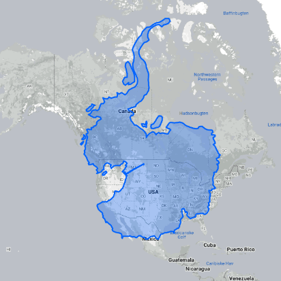
Figure made on http://www.thetruesize.com showing how Antarctica is roughly 1.5 times the size of the USA.
The Antarctic ice sheet contains around 30 million cubic kilometres of ice. This means that around 90 per cent of all fresh water on Earth is frozen in Antarctica.
If all the ice sheet in Antarctica melts, the world’s oceans will rise by around 60 metres. Even if we stay within the framework of the Paris Agreement, we risk that melting Antarctic ice from Antarctica will cause sea levels to rise by 2.5 metres.
Ruth Mottram notes that the more we exceed the limits of the Paris Agreement, the faster sea levels rise – and slower if we act quickly and stay close to the set limits of preferably 1.5 and maximum 2 degrees of temperature rise compared to the 1800s.
“The Earth’s climate system may be shifting towards a new equilibrium, which could result in a different world than we have grown up with,” continues Ruth Mottram.
“It is already affecting us and will do so increasingly in the future. That doesn’t mean it will be a total disaster, but we will probably get to the point where we have to adjust our lifestyles and societies.”
“It won’t necessarily be simple or easy to do so, but we can’t just wish for the world to be different than it is,” says Ruth Mottram.
“We are in the process of allowing future generations to accept that large areas of land will become uninhabitable because the water level rises too much,” he says. ‘Bipolar’ researcher: Keep an eye on Greenland too
In the short term, Ruth Mottram is interested in finding out what the consequences of El Niño will be and how Antarctica will change over the next few years.
But she also has her sights set on Greenland.
“Because there have been so many weather events elsewhere, it has gone a bit unnoticed that we’ve had a really high melt season in Greenland this year.
“It can give us the opportunity to see very concretely how weather and climate are connected. That’s why the next few years will be really interesting in Greenland,” says Ruth Mottram, who has also conducted research in the Arctic for many years.
The next article in Videnskab.dk’s series on the state of the climate will focus on Greenland.
UPDATE THE MORNING AFTER (21/10/2023): water levels are now falling rapidly to normal and the worst of the gales are past, so it’s time for the clean-up and to take stock of what worked and where it went wrong. It’s quite clear that we had a hundred year storm flood event in many regions, though the official body that determines this has not yet announced it. Their judgement is important as it will trigger emergency financial help with the cost of the clean-up.
In most places the dikes, sandbags and barriers mostly worked to keep water out, but in a few places they could not deal with the water and temporary dikes (filled pvc tubes of water km long in some cases) actually burst under the pressure, emergency sluice gates and pumps could also not withstand the pressure in one or two places.
Trains and ferries were delayed or cancelled and a large ship broke free from the quayside at Frederikshavn and is still to be shepherded back into place.
Public broadcaster DR has a good overview of the worst affected places here.
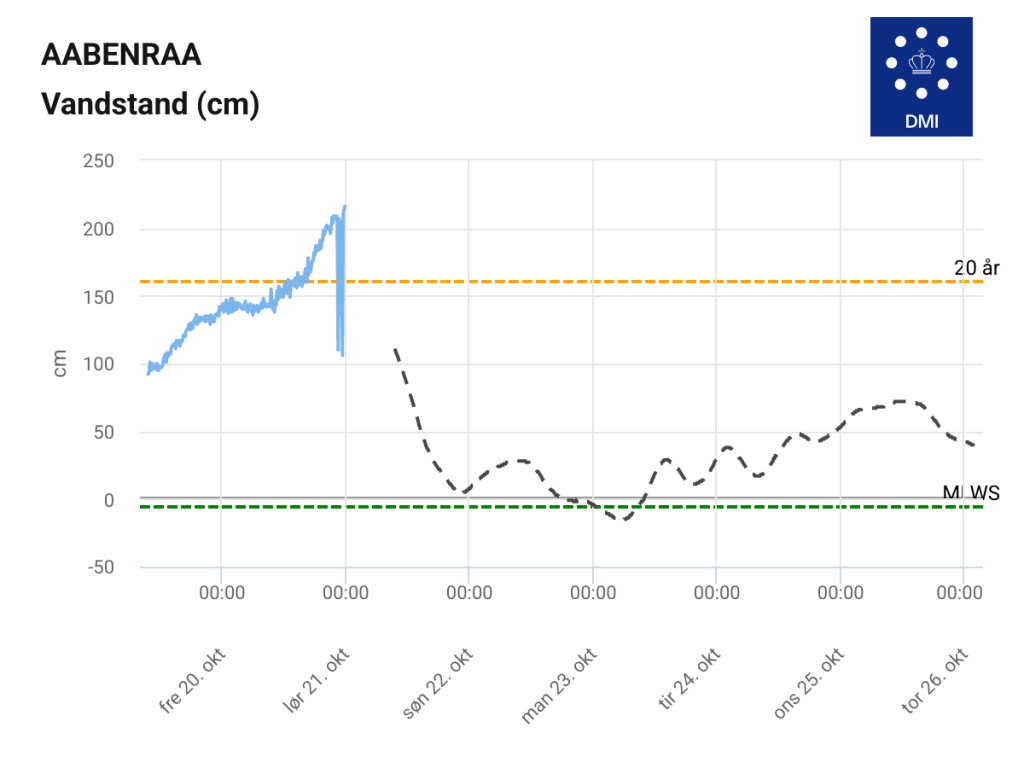
Water levels reached well over 2m in multiple places around the Danish coast and in some places, water measurements actually failed during the storm..
In other places, measurements show clearly that the waters are pretty rapidly declining. So. A foretaste of the future perhaps? We will expect to see more of these “100 year flood” events happening, not because we will have more storms necessarily but because of the background sea level rising. It has already risen 20cm since 1900, 10cm of that was since 1991, the last few years global mean sea level has risen around 4 – 4.5 mm per year. The smart thing to do is to learn from this flood to prepare better for the next one.
But we as a society also to assess how we handle it when a “hundred year” flood happens every other year…
-Fin-
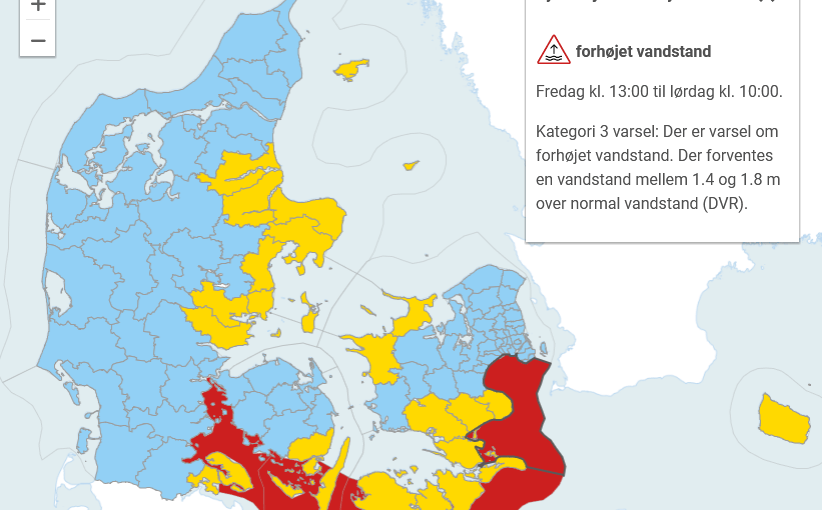
Like much of northern Europe we have been battening down the hatches, almost literally, against storm Babet in Denmark this week. DMI have issued a rare red weather warning for southern Denmark, including the area I often go kayaking in.
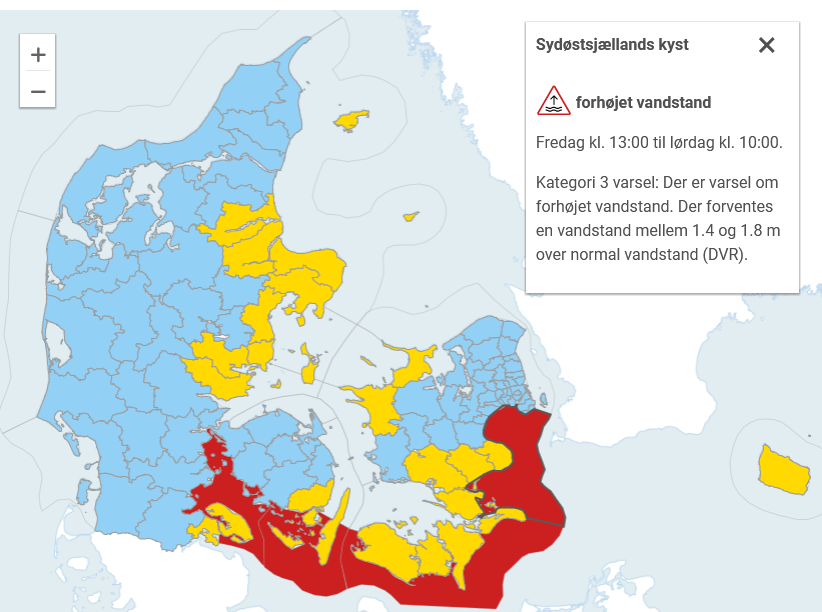
Weather warning issued by DMI 20th October 2023 There are three levels, blue signifies the lowest, yellow is medium and the highest is red, which is rather rarely issued. The boxed text applies to the red zome around southern Denmark and states it relates to a water level of between 1.4 and 1.8m above the usual.
I should probably start by saying that this storm is not caused by climate change, though of course in a warming atmosphere, it is likely to have been intensified by it, and the higher the sea level rises on average, the more destructive a storm surge becomes, and the more frequent the return period!
Neither are storm surges unknown in Denmark -there is a whole interesting history to be written there, not least because the great storm of 1872 brought a huge storm surge to eastern Denmark and probably led directly to the founding of my employer, the Danish Meterological Institute. My brilliant DMI colleague Martin Stendel persuasively argues that the current storm surge event is very similar to the 1872 event in fact, suggesting that maybe we have learnt something in the last 150 years…
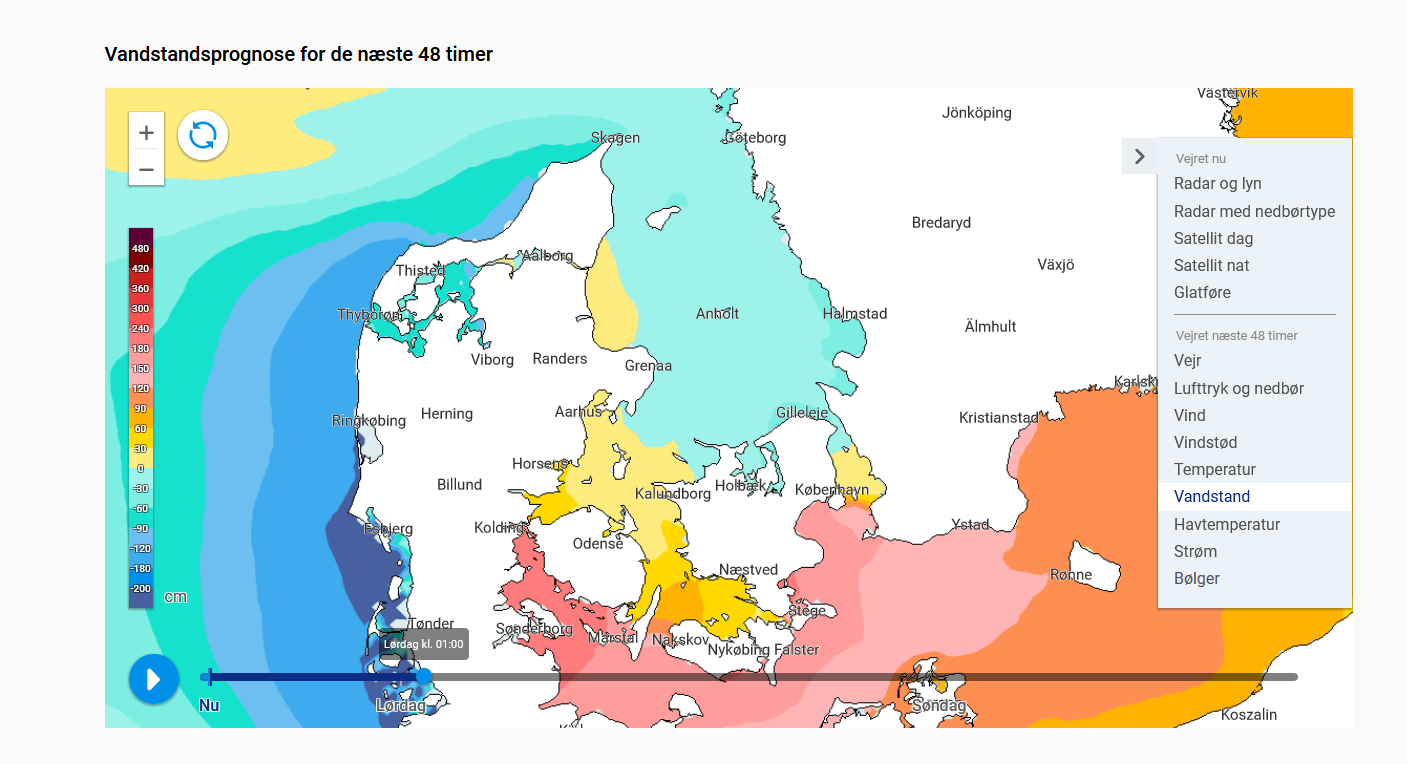
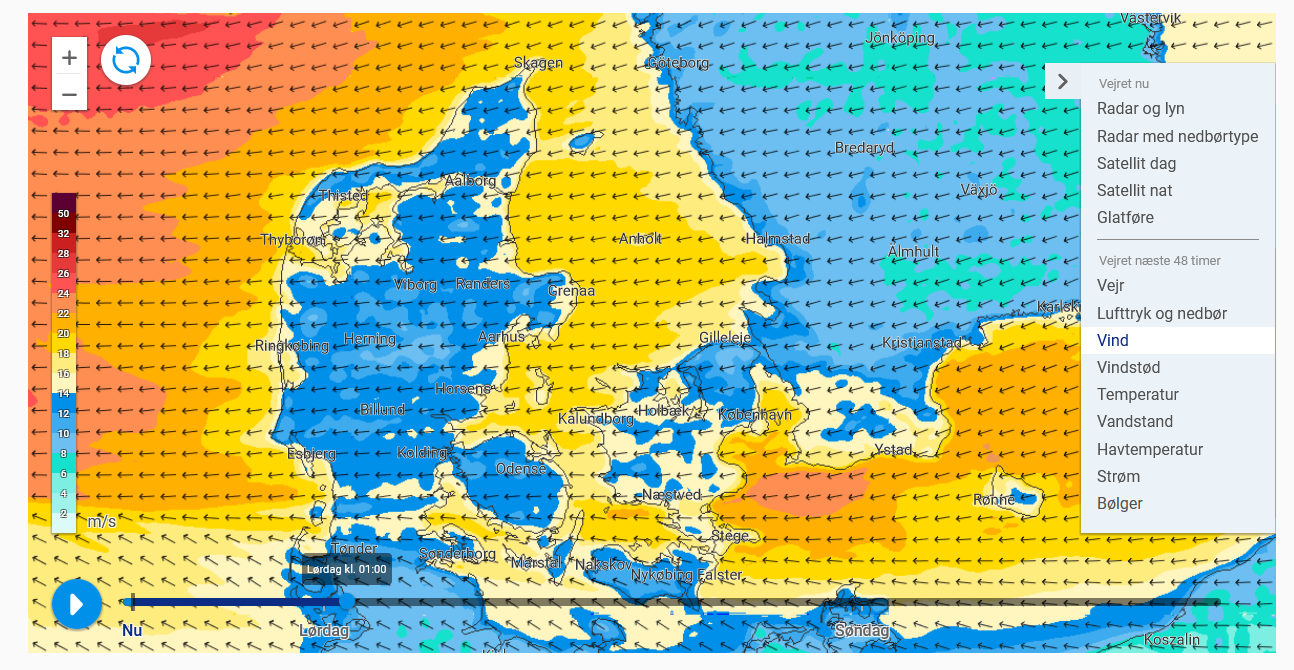
However, back to today: the peak water is expected tonight, and the reason why storm surges affect southern and eastern Denmark differently to western Denmark is pretty clear in the prognosis shown below for water height (top produced by my brilliant colleagues in the storm surge forecasting section naturally) and winds (bottom, produced by my other brilliant colleagues in numerical weather prediction):
Basically, the strong westerly winds associated with the storm pushed a large amount of water from the North Sea through the Kattegat and past the Danish islands into the Baltic Sea over the last few days. Imagine the Baltic is a bath tub, if you push the water one way it will then flow back again when you stop pushing. Which is exactly what it is now doing, but now, it is also pushed by strong winds from the east as shown in the forecast shown above. These water is being driven even higher against the coasts of the southern and eastern danish islands.
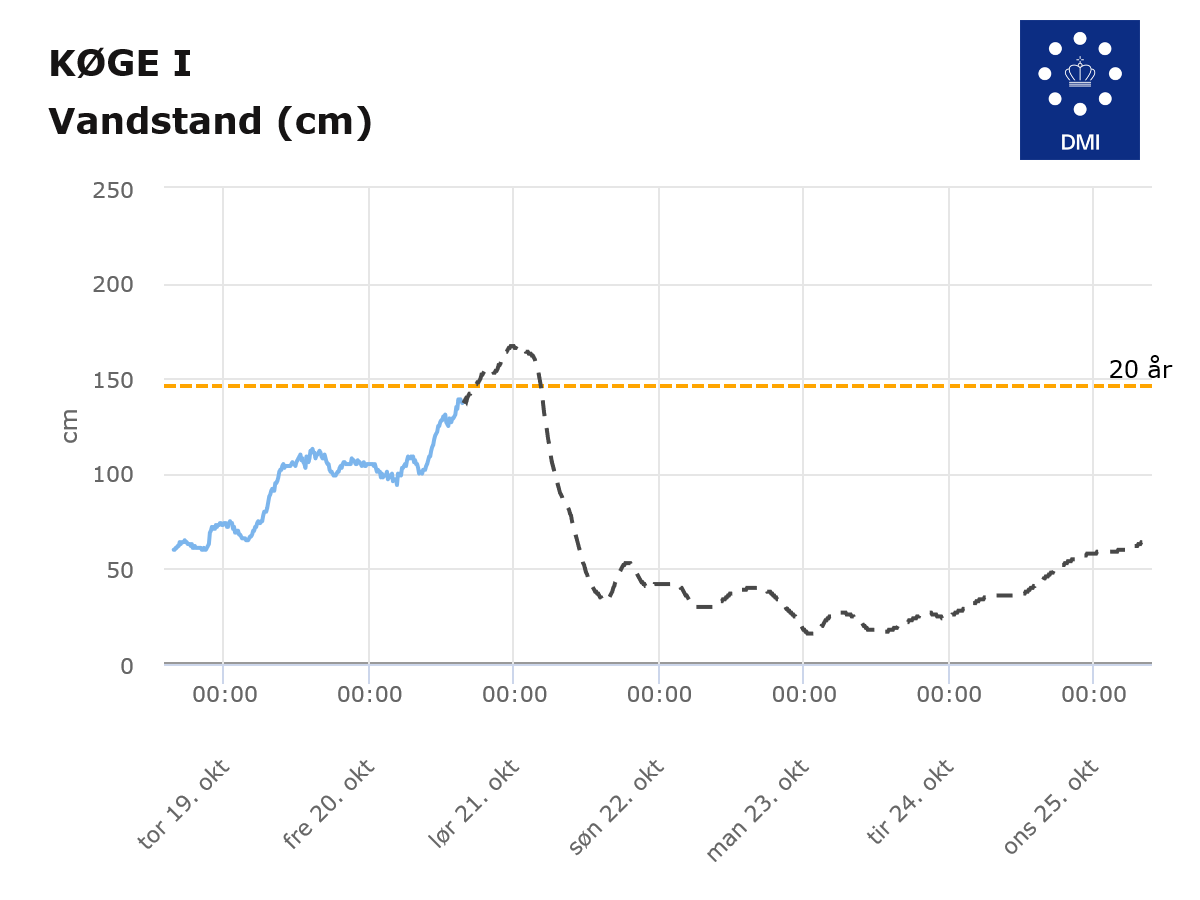
These kind of storm surges are sometimes known as silent storm surges by my colleagues in the forecasting department because they often occur after the full fury of the storm has passed. I wrote about one tangentially in 2017. This time, adding to the chaos, are those gale force easterly winds, forecast to be 20 – 23 m/s, or gale force 9 on the Beaufort Scale if you prefer old money, which will certainly bring big waves that are even more problematic to deal with that a slowly rising sea, AND torrential rain. So while the charts on dmi.dk which allow us to follow the rising seas (see below for a screengrab of a tide gauge in an area I know fairly well from the sea side), water companies, coastal defences and municipalities also need to prepare for large amounts of rain, that rivers and streams will struggle to evacuate.
Water height forecast for Køge a town in Eastern Sjælland not far from Copenhagen. The yellow line indicates the 20 year return period for this height. Blue line shows measurements and dashed black lines show the forecast from the DMI ocean model. You can find more observations here.
In Køge the local utilities company is asking people to avoid running washing machines, dishwashers and to avoid flushing toilets over night where possible to avoid overwhelming sewage works when the storm and the rain is at the maximum.
This brings me to the main lessons that I think we can learn from this weather (perhaps super-charged by climate) event.
Firstly, it’s the value of preparedness, and learning from past events. There will certainly be damage from this event, thanks to previous events, we have a system of dykes and other defence measures in place to minimse that damage and we know where the biggest impacts are likely to be.
Secondly, the miracle, or quiet revolution if you will, of weather and storm forecasting means we can prepare for these events days before they happen, allowing the deployment of temporary barrages, evacuations and the stopping of electricity and other services before they become a problem.
This is even more important for the 3rd lesson, that weather emergencies rarely happen alone – it’s the compound nature of these events that makes them challenging – not just rising seas but also winds and heavy rain. And local conditions matter – water levels in western Denmark are frequently higher, the region is much more tidally influenced than the eastern Danish waters. This is basically another way of saying that risk is about hazard and vulnerability.
Finally, there are the behavioural measures that mean people can mitigate the worst impacts by changing how they behave when disaster strikes. Of course, this stuff doesn’t happen by itself. It requires the slightly dull but worthy services to be in place, for different agencies to communicate with each other and for a bit of financial head room so far-sighted agencies can invest in measures “just in case”. We are fortunate indeed that municipalities have a legal obligation to prepare for climate change and that local utilities are mostly locally owned on a cooporative like basis – rather than having to be profit-making enterprises for large shareholders..
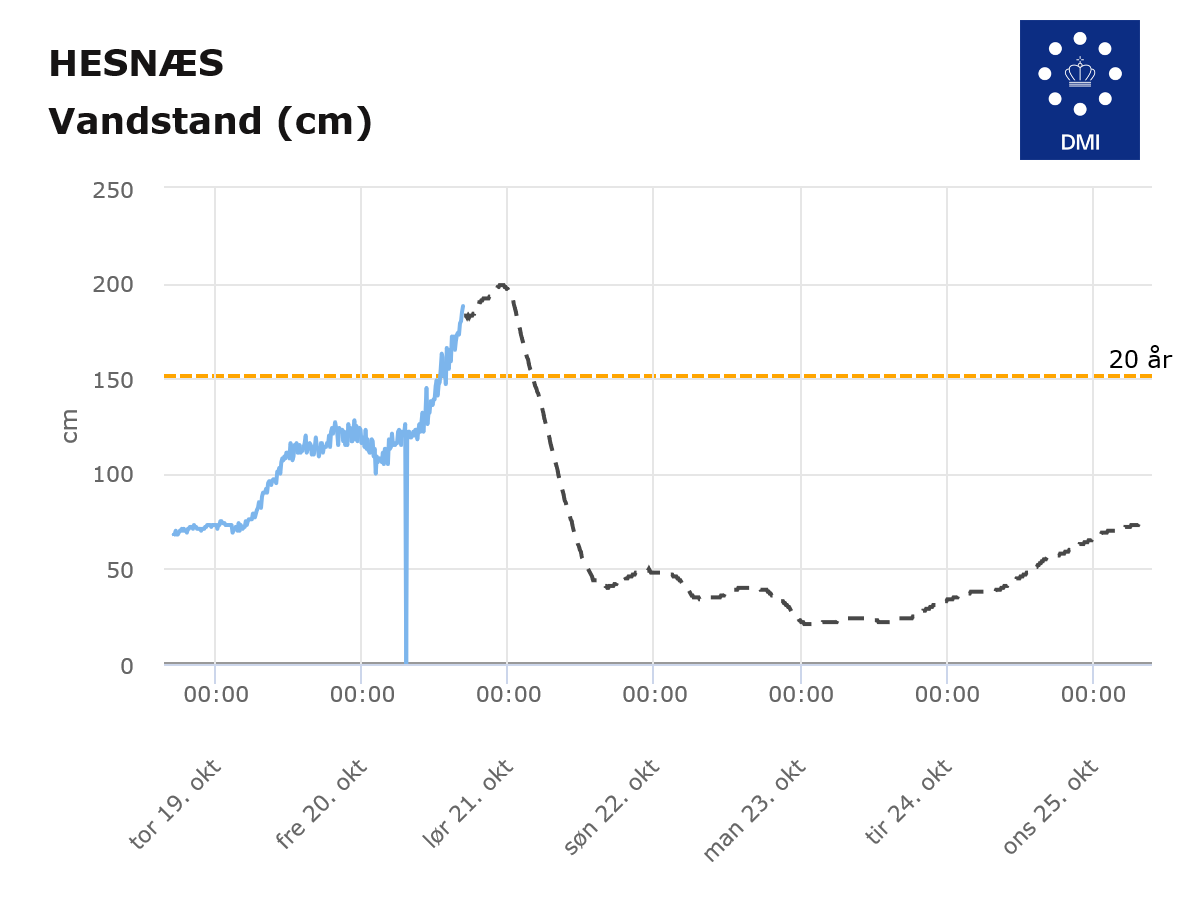
This piece is already too long, but there is one more aspect to consider. The harbour at Hesnæe Havn has just recorded a 100 year event, that is a storm surge like this would be expected to occur once ever hundred years, in this case the water is now 188cm. The previous record of 170cm was set in 2017. We need to prepare for rising seas and the economic costs they will bring. The sea will slowly eat away at Denmark’s coasts, but the frequency of storm surges is going to change – 20cm of sea level rise can turn a 100 year return event into a 20 year return event and a 20 year return event into an ever year event.
Screenshot of the observations of sea level from Hesnæs
We need to start having the conversation NOW about how we’re going to handle that disruption to our coastlines and towns.
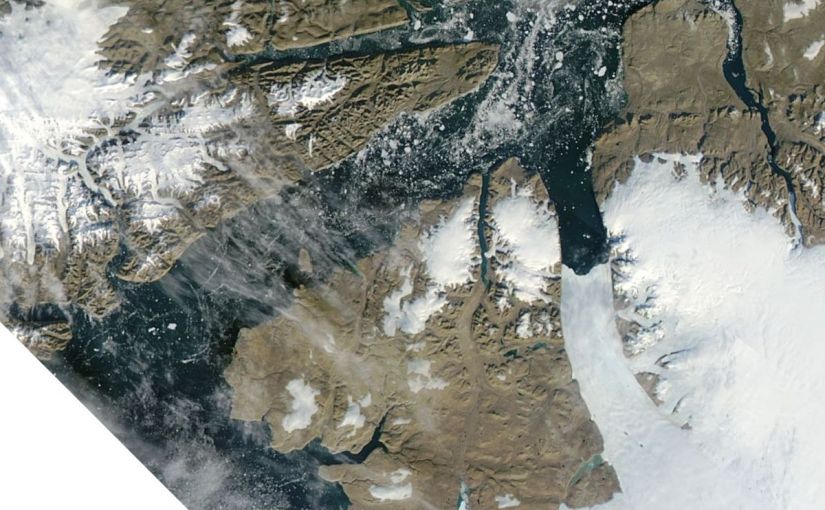
This is a lightly edited and expanded post in response to a Reuters fact checking query. I gather one of the usual suspects (in the place formerly known as the birdsite) has been spreading misinformation and confusion about the magestic Petermann Glacier in Northern Greenland. So here’s a few thoughts. The TL;DR is in the title, but if you want to know why it’s not growing, how we know it’s not growing and what it means, read on…
But, that’s not why it is a glacier of choice for a section of the climate (denier) community. It behaves very much like any ice shelf; that is, it calves a large iceberg, but as the glacier is still flowing from areas of accumulation to areas where melt and calving balance it, so the front continues moving forward to roughly it’s previous position, before calving another large iceberg. This is a well understood cylce but it also means that if you cherry pick your starting and ending dates you can indeed show that the front is “advancing”. However, this is not the same as the glacier “growing”. Let’s take a look.
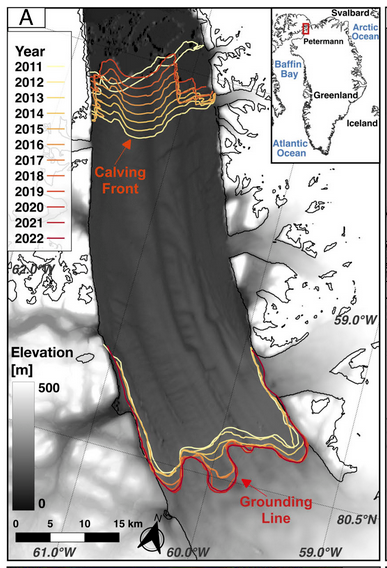
It is one of the only remaining ice shelves in Greenland – all of the others have collapsed and not regrown and there is good reason to suspect Petermann is also on the same trajectory. I had a student a few years ago who showed the ice shelf itself is thinning, and that it was unlikely to remain stable for long. We never managed to publish it, though a publication from Eric Rignot’s group that came out earlier this year largely shows the same things we found. The cycle of calving and advance is quite clear in their Figure 1a, as is the retreat of the grounding line – the point at which the glacier starts to float. This is significant because as the glacier gets thinner, the grounding line will likely retreat inland.
Figure from Caraci et al., 2023 showing the slow advance of the calving front in recent years and the retreat of the ground ing line at the same time.
So does NASA Worldview imagery show that Petermann glacier has been growing at roughly 3 metres per day for the past 11 years? (As intimated by a number of accounts on the internet.)
No it does not.
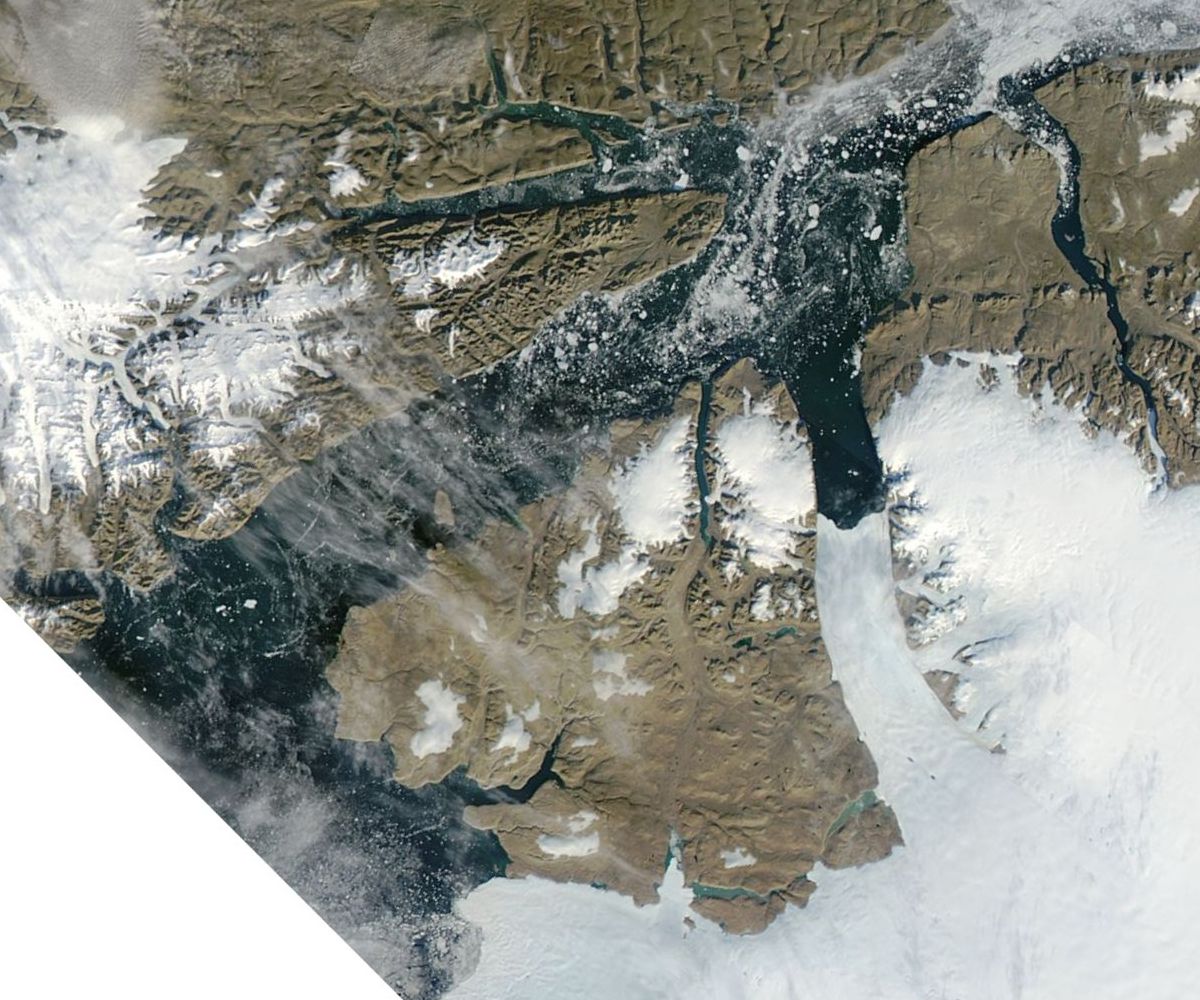
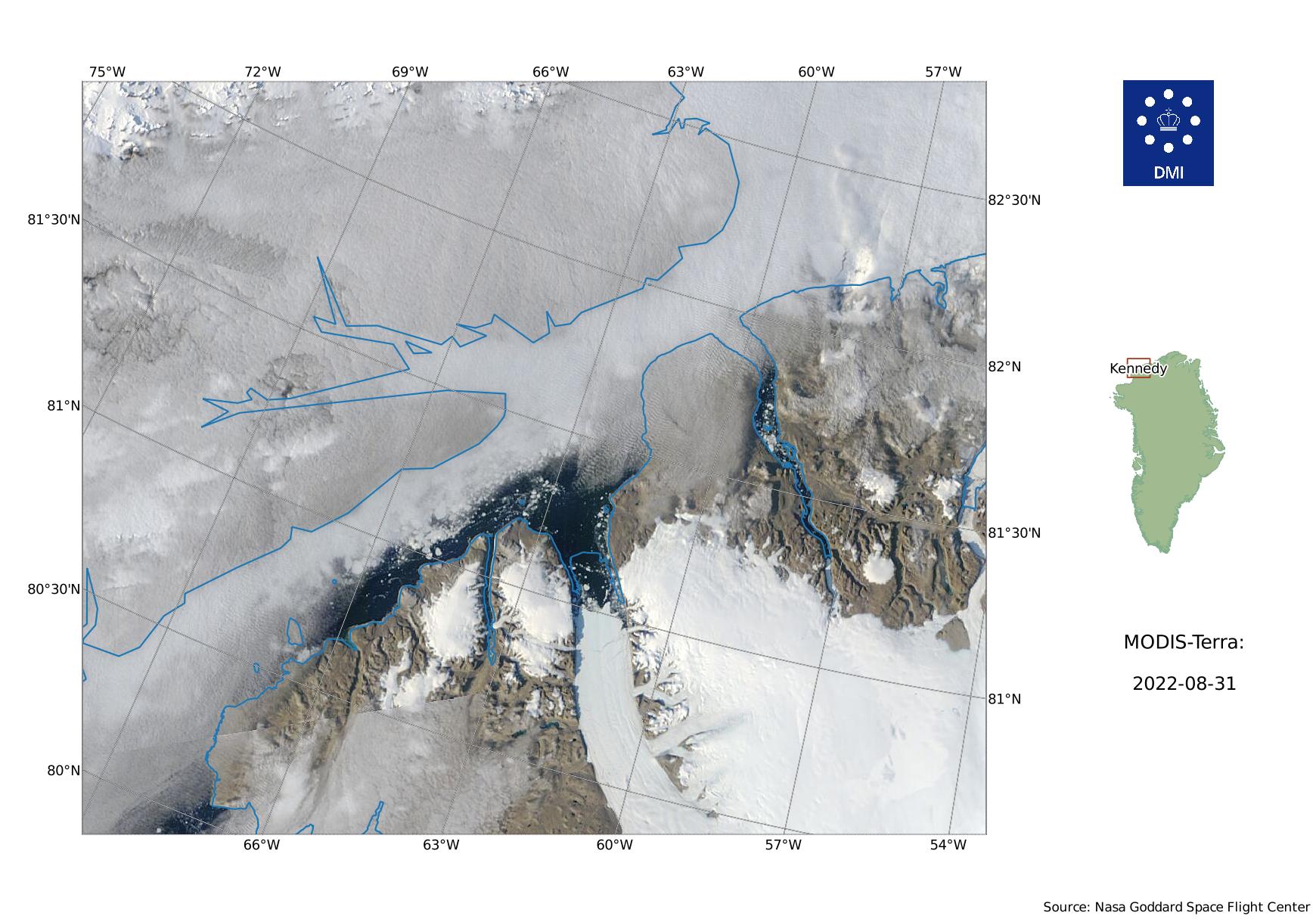
You can play a semantic trick here though. Satellite imagery shows that the front of the glacier has been moving forward for the past 11 years (note that it doesn’t move much in winter, it’s mostly a summer feature after the sea ice has broken up). Compare these two images which I grabbed from DMI’s satellite picture archive around the coast of Greenland, in it the glacier terminus does appear to be ahead in 2022 compared to 2012.
Two MODIS satellite images, TERRA taken 31st August 2012 top and AQUA taken 31st August 2022 bottom. The end of the glacier is closer to the end of the fjord in 2022 than in 2012, but that is due to a large calving event that occurred just prior to these images.
But the choice of 2012 is a trick as a large calving event occurred on the 16th July 2012, after a previous large one in 2010, so the glacier was more or less at it’s minimum in recent years if you choose 2012 as a starting position.
Here is that large iceberg, so big it’s called an ice island, detaching from the front of Petermann glacier on the 18th July 2012 as captured by NASA’s TERRA MODIS satellite.
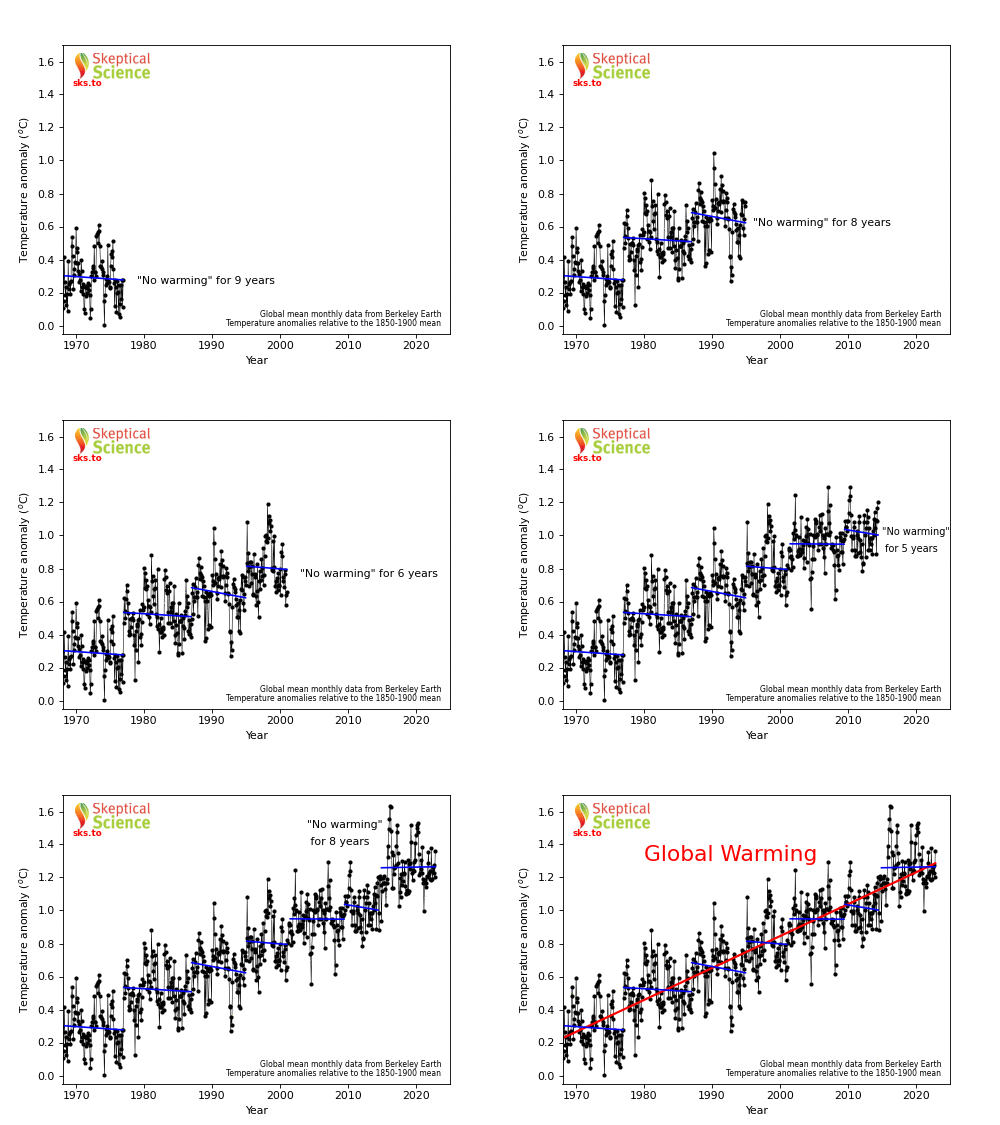
This is of course the difference between noise and signal and a similar trick to choosing to start your temperature curve in 2016 for example, right after a big El Nino event.
The skeptical Science global warming escalator – a neat graphic that you can read more about here
After the glacier calves a large iceberg the glacier behind continues to push ice out through the channel. The ice still flows and the front eventually moves back to roughly the same position it was in before the calving. However that does not mean the glacier is “growing”.
A glacier only grows if it gains more glacier ice each year than it loses.
Glaciers lose ice in 3 ways: they melt at the surface and this runs off the glacier; they can calve icebergs off – at a glacier like Petermann, this may only happen every few years; or, they can be melted from underneath by warm ocean water.
If these three mass budget terms added together are bigger than the amount of snow falling each year then the glacier will shrink. If more snow falls than is lost by these three processes, then the glacier is growing.
At Petermann glacier all three ways to lose ice are happening. We have seen the calving, the surface melt and runoff is clearly visible in the satellite image below and the thinning of the glacier (ocean melt as well as stretching as the ice flows) has been measured by satellites and radar measurements.
Petermann Glacier this summer, the blue shows surface melt ponds with surface streams forming distinctive meanders over the surface. These drain through surface cracks, that have progressively formed over several years as the ice shelf has thinned.
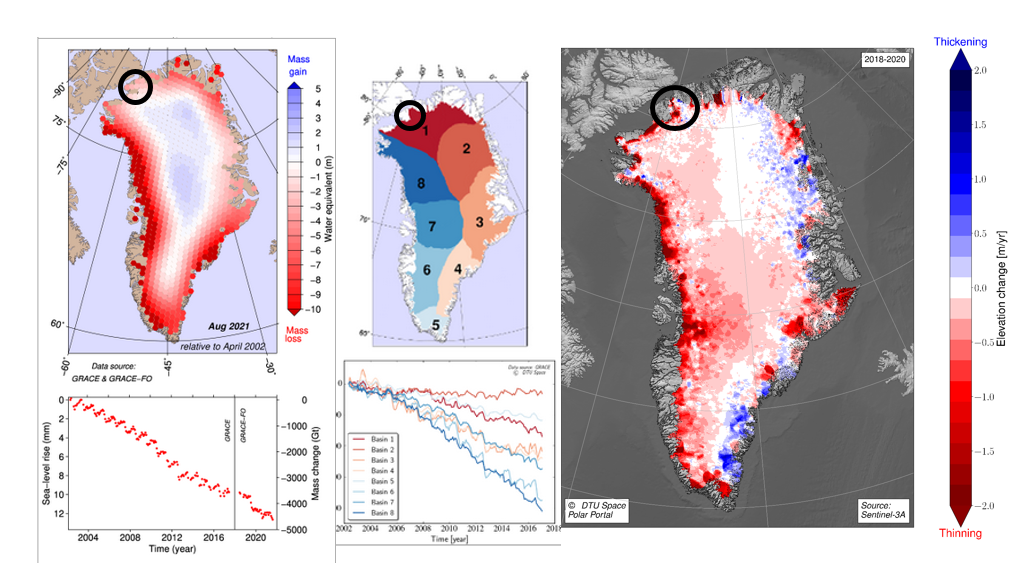
We can therefore check how much this net ice change budget is by using GRACE satellite data. GRACE measures change in mass by gravimetry and the data, processed by DTU Space colleagues, is displayed on our polar portal website here: http://polarportal.dk/en/greenland/mass-and-height-change/
And it shows that this region of Greenland has lost ice every single year since 2002 when the satellite was launched.
This is not a surprise, a paper by Jeremie Mouginet et al. all the way back in 2019 estimated that Petermann glacier alone had lost 56 Gt of ice for the period 1972 to 2017. Most of this ice has been lost since the late 1990s. Their estimate agrees well with results presented in Mankoff et al., 2021, who update their dataset each week and show that there is pretty steady net ice loss from Petermann from both calving and surface melt that continues to the present day.
Three screenshots from the polar portal showing full mass change from all processes: I have circled the location of Petermann Glacier, note the red colour indicates net ice loss from all processes. Left is from the GRACE gravity satellite, the centre and right show surface elevation change, measured by radar satellites. Note that virtually the entire ice sheet is getting thinner, except in some areas with higher snowfall. The Petermann glacier is close to the maximum rate measured of 2m of surface lowering (mostly surface melt) between 2018 and 2020 alone.
So the Petermann Glacier is not growing, even if the front is advancing. But the satellite pictures of the glacier do tell us something about the local conditions of the glacier. Petermann glacier is in a long narrow fjord in a region where there is a lot of sea ice. This is probably why the ice shelf has survived so long when many other similar ice shelves have collapsed and disappeared over the last 30 years or so. 50 years ago there were a lot more ice shelves in Greenland and across the whole of the Arctic. Most of them have now gone.
The figure below (from Hill et al., 2018 https://tc.copernicus.org/articles/12/3243/2018/) shows all the places where there used to be floating ice tongues, only Petermann, Ryder glacier (which is significantly shorter now than it was in the 1990s) and 79 North remain in Northern Greenland with some floating bits of Storstrømmen also technically still counting as shelves in the east.
From Hill et al., 2018 Study region of northern Greenland. Green circles show the location of each of 18 northern Greenland study outlet glaciers. Average glacier velocities (m a−1) are shown between 1993 and 2015 derived from the multi-year mosaic dataset (Joughin et al., 2010). Black outlines show glacier drainage catchments. Symbols represents the state of the glacier terminus. Stars show glaciers which currently have floating ice tongues, circles represent glaciers which lost their ice tongues *[see footnote] (during 1995 to 2015), squares denote glaciers which have some previous literature record of a floating ice tongue, and triangles are glaciers which are grounded at their termini and have been throughout the study record.
Given the thinning that has been recorded at the Petermann Shelf, it’s probably only a matter of time before this magestic glacier also loses its shelf. And there are two ways that might go. It might follow the path of Sermeq Kujalleq, previously known as Jakobshavn Isbræ. The fairly dramatic collapse of which over a few months in 2002 was a massive wake-up call to the glaciology community that things can change very fast indeed and they may not be reversible.
Series of Landsat images from June 2001 to June 2003 showing the large retreat of Sermeq Kujalleq (Jakobshavn Isbræ)
Or it may retreat in a more low-key way, like the relatively nearby glacier C.H. Ostenfeld where the ice shelf indeed was more ice tongue like* and slowly fragmented and washed out the fjord over several years.
Series of Landsat pictures from 1999 (top), 2002 (middle) and 2005 (bottom) showing remaining icebergs floating away. The stripes are unfortunately due to a well-known sensor problem in Landsat7C. H. Ostenfeld glacier this year from Sentinel 2 imagery. The ice shelf/tongue has not reformed.
It’s not very easy to say which path Petermann will take, it may even take a hybrid between the two, with first slow disintegration like Ostenfeld, with a more rapid collapse like Sermeq Kujalleq as the grounding line approaches.
Time will, unfortunately, almost certainly tell.
And now back to the day job..
*An ice shelf and an ice tongue are similar but not quite the same, I would call Petermann an ice shelf whereas C H Ostenfeld was rather tongue like by the time it collapsed, though the others in nrthern Greenland are and were definitely more shelf like. See for example this spectacular image of the Erebus ice tongue in Antarctica. Glacier tongues still exist in Antarctica but with the loss of Ostenfeld, they are now non-existent in Greenland.
By Jesse Allen, NASA Earth Observatory, using data provided courstesy of NASA/GSFC/METI/ERSDAC/JAROS, and the U.S./Japan ASTER Science Team. – [1], Public Domain, https://commons.wikimedia.org/w/index.php?curid=795403
We are expanding quite rapidly at DMI currently – part of a strategic plan to ensure that we are primed for a generational shift at DMI, but also reflecting some of the themes I touched on yesterday – an expansion into climate services and the development of new machine learning based models and advanced statistical techniques for weather and climaet applications. Note also that the remote sensing part of NCKF
UPDATE: A new position advert has been added:
0) Climate Scientist with Focus on Decadal Climate Prediction
Our sister units also have some interesting postings out that would also crossover with the work we do in our section on the climate of Denmark and Greenland.
4) Remote sensing and/or machine learning specialist for automated sea ice classification from satellite data – building on the very successful project ASIP
We are expanding quite rapidly at DMI currently – part of a strategic plan to ensure that we are primed for a generational shift at DMI, but also reflecting some of the themes I touched on yesterday – an expansion into climate services and the development of new machine learning based models and advanced statistical techniques for weather and climaet applications. Note also that the remote sensing part of NCKF
UPDATE: A new position advert has been added:
0) Climate Scientist with Focus on Decadal Climate Prediction
Our sister units also have some interesting postings out that would also crossover with the work we do in our section on the climate of Denmark and Greenland.
4) Remote sensing and/or machine learning specialist for automated sea ice classification from satellite data – building on the very successful project ASIP
Climate adaptation will also most likely (going by previous history), be unevenly spread and probably not focussed on those feeling the biggest impacts, but those most able to pay for it.
This is something I’ve been pondering for a while, and I’m not really sure how to grasp it, but perhaps more and better work with the social scientists is necessary?
I was struck yesterday by this related snippet from the IPCC AR6 WGII report, posted by David Ho (and I gather courtesy Eric Rostrom), pointing out that heatwave impacts will be unevenly distributed between high and low income people.
At the same time, I also read an interesting piece in the Danish newspaper this weekend suggesting that heatwave exposure is a new marker of class, even in Europe. With the working class toiling in fields, roads, kitchens and on building sites, while the higher educated white collar professionals both able to take advantage of air conditioning and to afford time off in cooler places. This is not a new argument. But it is yet another argument for unions and robust government regulation to try to limit heatwave morbidity and mortality where this is possible. Trades unions may not be able to solve all problems, but they can definitely help when it comes to working conditions!
On a similar note, but outside Europe, the Economist has an unexpectedly excellent piece on how meteorology can help to mitigate weather and climate driven disasters . The whole piece is worth a read as it very much aligns with developments I can see at DMI. They point out for example the great possibilities offered by AI methods in weather forecasting, and how they can be applied to climate models (something I hope to start working on this year), as well as the dangers that AI could be used to undermine the robust national infrastructure that machine learning models are in fact built on.
However, the most important point is that so often, the main challenge is getting extreme weather warnings and other important information out to people affected.
“24 hours’ notice of a destructive weather event could cut damage by 30%, and that a $800m investment in early-warning systems for developing countries could prevent annual losses of $3bn-16bn.”
No breakthroughs are required to put this right, just some modest investment, detailed planning, focused discussion and enough political determination to overcome the inevitable institutional barriers. It is not an effort in the Promethean tradition of MANIAC’s [sic – an early pioneering weather supercomputer] begetters; it will neither set the world on fire nor model the ways in which it is already smouldering. But it should save thousands of lives and millions of livelihoods.
And this is probably generally true of the way we should think about climate change adaptation in the near and short term: how to leverage the best possible information to help make decisions and nudge behaviour to remove people from harm.