We are expanding quite rapidly at DMI currently – part of a strategic plan to ensure that we are primed for a generational shift at DMI, but also reflecting some of the themes I touched on yesterday – an expansion into climate services and the development of new machine learning based models and advanced statistical techniques for weather and climaet applications. Note also that the remote sensing part of NCKF
UPDATE: A new position advert has been added:
0) Climate Scientist with Focus on Decadal Climate Prediction
Our sister units also have some interesting postings out that would also crossover with the work we do in our section on the climate of Denmark and Greenland.
4) Remote sensing and/or machine learning specialist for automated sea ice classification from satellite data – building on the very successful project ASIP
We are expanding quite rapidly at DMI currently – part of a strategic plan to ensure that we are primed for a generational shift at DMI, but also reflecting some of the themes I touched on yesterday – an expansion into climate services and the development of new machine learning based models and advanced statistical techniques for weather and climaet applications. Note also that the remote sensing part of NCKF
UPDATE: A new position advert has been added:
0) Climate Scientist with Focus on Decadal Climate Prediction
Our sister units also have some interesting postings out that would also crossover with the work we do in our section on the climate of Denmark and Greenland.
4) Remote sensing and/or machine learning specialist for automated sea ice classification from satellite data – building on the very successful project ASIP
Climate adaptation will also most likely (going by previous history), be unevenly spread and probably not focussed on those feeling the biggest impacts, but those most able to pay for it.
This is something I’ve been pondering for a while, and I’m not really sure how to grasp it, but perhaps more and better work with the social scientists is necessary?
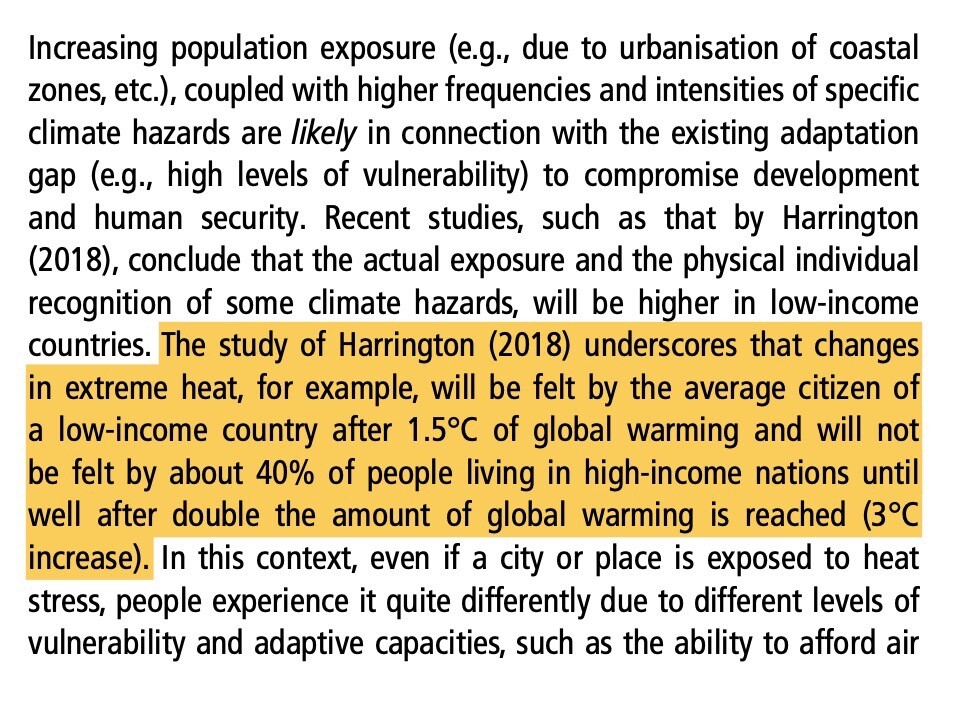
I was struck yesterday by this related snippet from the IPCC AR6 WGII report, posted by David Ho (and I gather courtesy Eric Rostrom), pointing out that heatwave impacts will be unevenly distributed between high and low income people.
At the same time, I also read an interesting piece in the Danish newspaper this weekend suggesting that heatwave exposure is a new marker of class, even in Europe. With the working class toiling in fields, roads, kitchens and on building sites, while the higher educated white collar professionals both able to take advantage of air conditioning and to afford time off in cooler places. This is not a new argument. But it is yet another argument for unions and robust government regulation to try to limit heatwave morbidity and mortality where this is possible. Trades unions may not be able to solve all problems, but they can definitely help when it comes to working conditions!
On a similar note, but outside Europe, the Economist has an unexpectedly excellent piece on how meteorology can help to mitigate weather and climate driven disasters . The whole piece is worth a read as it very much aligns with developments I can see at DMI. They point out for example the great possibilities offered by AI methods in weather forecasting, and how they can be applied to climate models (something I hope to start working on this year), as well as the dangers that AI could be used to undermine the robust national infrastructure that machine learning models are in fact built on.
However, the most important point is that so often, the main challenge is getting extreme weather warnings and other important information out to people affected.
“24 hours’ notice of a destructive weather event could cut damage by 30%, and that a $800m investment in early-warning systems for developing countries could prevent annual losses of $3bn-16bn.”
No breakthroughs are required to put this right, just some modest investment, detailed planning, focused discussion and enough political determination to overcome the inevitable institutional barriers. It is not an effort in the Promethean tradition of MANIAC’s [sic – an early pioneering weather supercomputer] begetters; it will neither set the world on fire nor model the ways in which it is already smouldering. But it should save thousands of lives and millions of livelihoods.
And this is probably generally true of the way we should think about climate change adaptation in the near and short term: how to leverage the best possible information to help make decisions and nudge behaviour to remove people from harm.
I was talking to some friends today about climate change – in the light of the latest #AMOC paper, suggesting a tipping point. I’m far from an expert on AMOC so if you’re here for that I suggest this comprehensive piece on real climate from Stefan Rahmstorf.
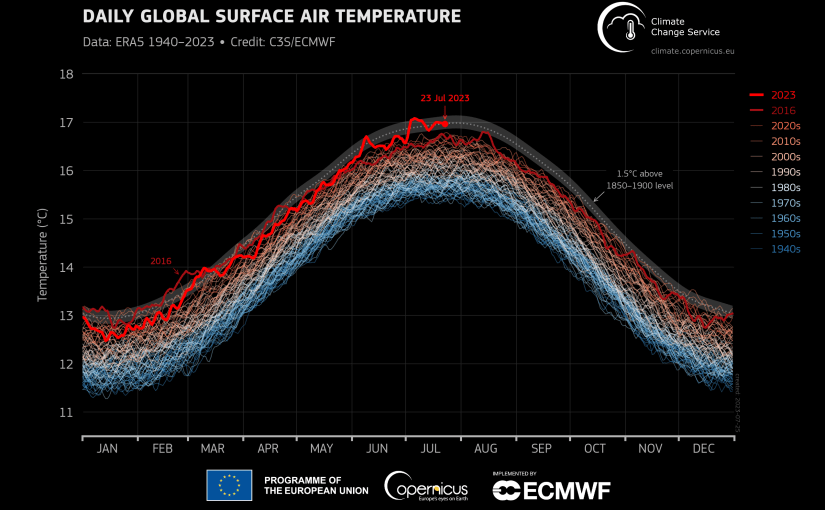
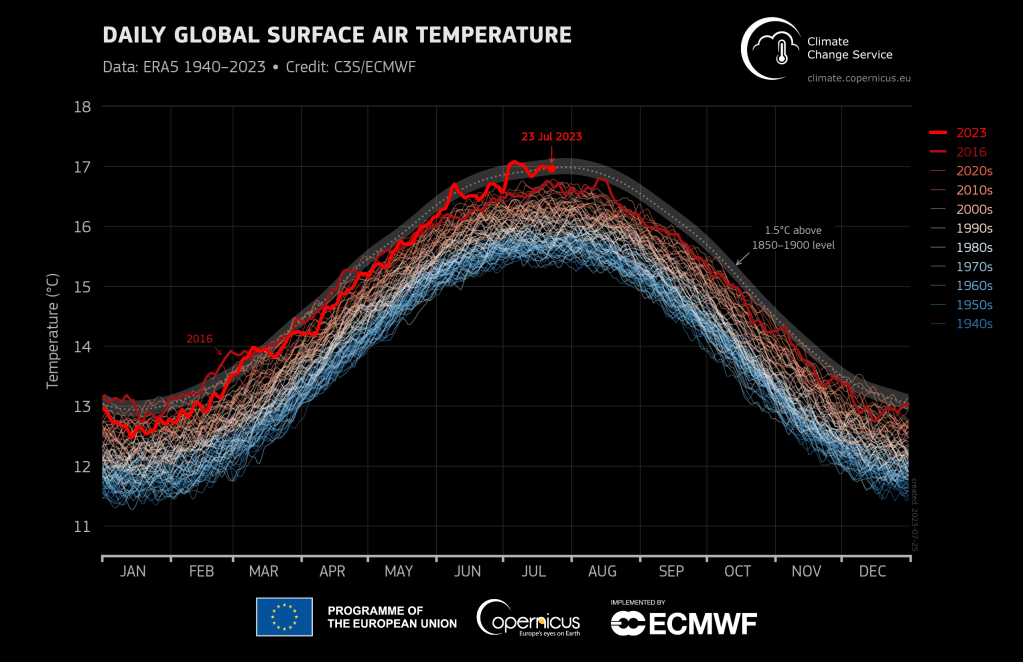
It’s been hot, in short and even if July has been cooler and rainy in Denmark, May and June were hot and record dry..
And it’s fair to say that, as when I’m asked why, or similar questions by journalists, there is an almost overwhelming temptation to say “we told you so”. I think that’s what Antonio Guttieres is getting at here too.
There’s of global boiling is upon us. Apparently. It certainly felt like it on my summer holiday this year…
However, that’s not what I was mostly musing on. Given the apocalyptic heatwaves, strange patterns of warming in the ocean and the Antarctic sea ice loss, it feels a little like end of days.
However, in the long-term (and I do mean really long-term – on the century to millennia scale), we’re facing something more existential. We’re going to lose a lot of Danish land to sea level rise. Exactly how much will largely be determined over the next 20 to 50 years as there’s a pretty clear relationship between greenhouse gases and melting ice.
But we do have time to prepare for it- and most importantly to have some grown up conversations about our priorities as a society. This is going to require a good bit more social and behavioural science. In the medium term, we will need to prepare for ever more storm surges, but adaptation to coastal flooding also falls into the engineering category.
Of course, these local to regional risks still need dealing with and that is largely why my employer has created the awesome Danish climate atlas – to give accurate but also useful climate information to those who need to plan for the future. I suspect an ever greater part of my job will be focused on producing usable projections and climate service information. This is certainly also something we will focus on in the PRECISE project. Being able to make useful sea level rise projections is about more than identifying if an ice sheet is stable* or not, it’s also about how quickly, how likely and how much it is likely to retreat. As we have also focused on at a regional level in the PROTECT project
So that’s ice sheets and sea level. The tl;dr is, we know they’re melting, we still don’t know by how much and how fast they’ll ultimately melt but we still have time to deal with it, at least in wealthy well educated societies like Denmark,.
There is a whole nother discussion to be had about the global south and less equal societies which I don’t feel confident enough to discuss here.
And then there is some evidence that multiple heatwaves could occur concurrently, threatening food production in compound events across several key regions. Perhaps working out how to make the global food chain less vulnerable to disruption at key points should be more of a focus than it is?
And that’s after the latest banditry from Russia, destroying perfectly good foodstocks and the means to distribute them, has given us a clear wake-up call on the interdependence of human society.
(Anders Puck Nielsen a military commentator has an interesting take on that from a strategic point of view here: https://youtu.be/fvPcPZP-6os which is very interesting for Ukraine watchers)
If I were a wise and concerned government I think I’d be thinking about how exactly we’re going to be feeding our population over the next 5-20 years. Where will be able to produce like Spain and Italy today? Or will diets have to change? How do we persuade people to eat more healthily and ensure that food is equitably spread through society?
This is of course also a part of the job of the other working groups, 2 and 3 of the IPCC – and it’s possibly not just an accident or indeed good lobbying that the new IPCC chair, Jim Skea, is a former WG3 coordinator. Perhaps the IPCC also sees that we have now moved into a new world.
So, these are just some of the things I’m thinking about as I prepare to go back to the office after the summer break next week.
As I observed on Mastodon after the IUGG meeting, and online with this excellent heatmap article. Climate science is entering a new phase. It’s the end of the beginning and it’s time to prepare.
*On the subject of ice sheet stability, Jeremy Bassis has an excellent thread on what this does and does not mean over on Mastodon. Worth checking out
Today the European Council is debating (behind closed doors), the proposed Nature Restoration Law – there has been heavy lobbying by several EU countries to water down the provisions. I believe this is a mistake and last week I and almost three and a half thousand other scientists signed a petition saying so.
It has now been reopened for signatures. Please do sign if you feel strongly about it. It’s worth a read anyway as the organisers (probably being scientists!) have written out what the agreement means in admirable clarity:
Rough land which has been allowed to turn into a wildflower haven in Copenhagen
I am a climate scientist who has become increasingly interested in and concerned about biodiversity. I have had a deep love and sense of wonder about nature since I was a kid – and probably my interest in glaciers and weather and climate have in in part grown out of that. I’m not a biodiversity expert, but I am acutely aware of the impact climate change is already having on the biosphere. It is at a fundamental level very hard to separate climate from biodiversity and probably unwise to try.
In the past I’ve considered it was a scientist’s duty to advise impartially and therefore to be politically completely inactive, I have regretfully come to the conclusion that actually, maybe we as a community do need to push a little more firmly in the direction our science is actually pointing us. Perhaps it is in fact irresponsible not to be involved?
As the great atmospheric chemist and Nobel Laureate Sherwood Rowland once said (in 1986!):
“After all, what’s the use of having developed a science well enough to make predictions, if in the end all we’re willing to do is stand around and wait for them to come true?”
The petition I linked to above has been organised by german scientists, experts in ecology and biodiversity. They emphasise:
“Being proactive is thus important. We would therefore appreciate if you found your way of communicating this letter in your surroundings, and help delivering the science to whoever may be interested in it. The purpose is not to lobby but rather to support, to offer help, maybe even mediate where possible.”
We’re scientists and we’re also public servants.
Use us to help guide policy. If scientists are ringing alarm bells, then somewhere there is a fire…
Yellow flag iris around a wildlife rich garden pond.
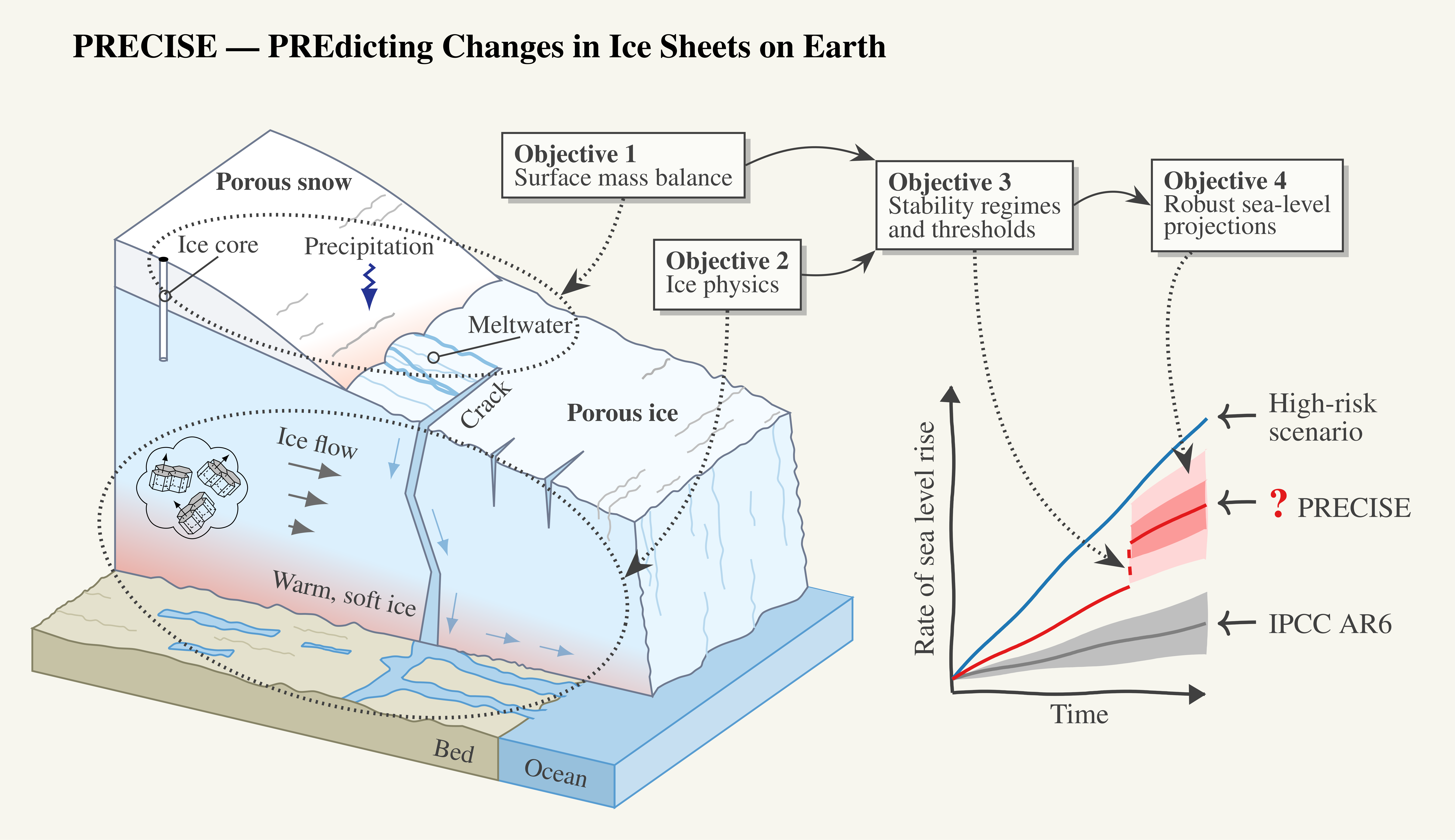
The project is led by Professor Christine Hvidberg at the Niels Bohr Institute and there is a really nice interview with her on their website about our plans that’s worth a read. I’m co-PI and lead on surface mass balance processes and coupled climate models within the project so I thought it might be worth giving a quick overview of what we hope to achieve.
TL;DR? We will be improving estimates of and assessing the uncertainties in sea level rise projections from the two big ice sheets in Greenland and Antarctica.
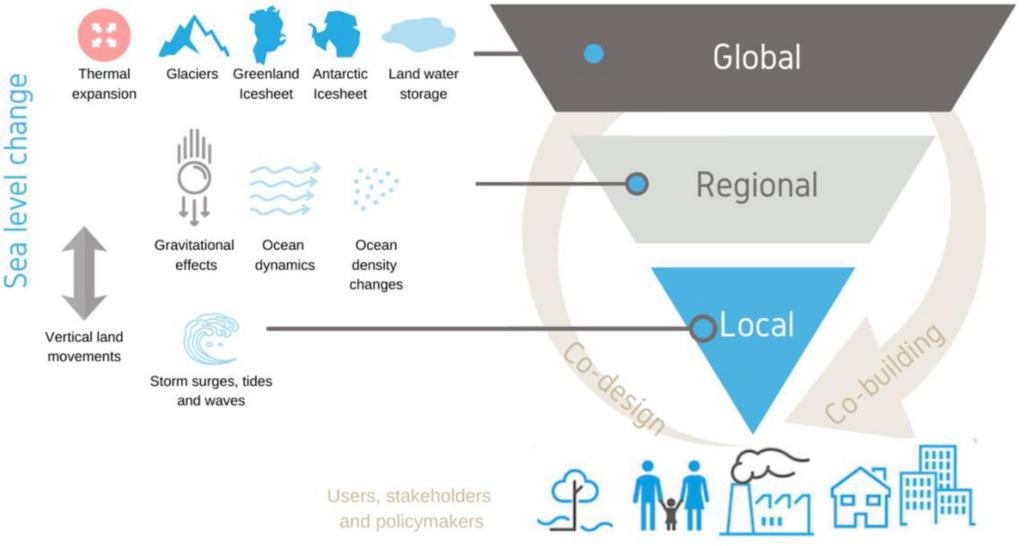
Every science proposal has a graphic like this somewhere showing how the whole project hangs together. This is ours…
Slightly longer version: we’re using new approaches from materials science to incorporate “new” physics in ice sheet models. We’re also integrating in-situ observations and satellite data into our model frameworks and using these to train machine-learning tools. My work package will emulate our physics based numerical climate models to expand the ensemble and generate a statistical approach for assessing ice sheet stability as well as investigating important feedbacks between different elements of the earth system. Finally, we (or rather my colleague Christian Rodehacke and his postdoc) will run our coupled climate – ice sheet model (EC-EARTH-PISM), including these advances, to generate new sea level rise projections.
The outputs from all these experiments will be communicated and developed in collaboration with the Danish Klima Atlas (Climate Atlas) to ensure we are focused on the right kind of data and time periods for use by stakeholders and local populations when it comes to adaptation planning.
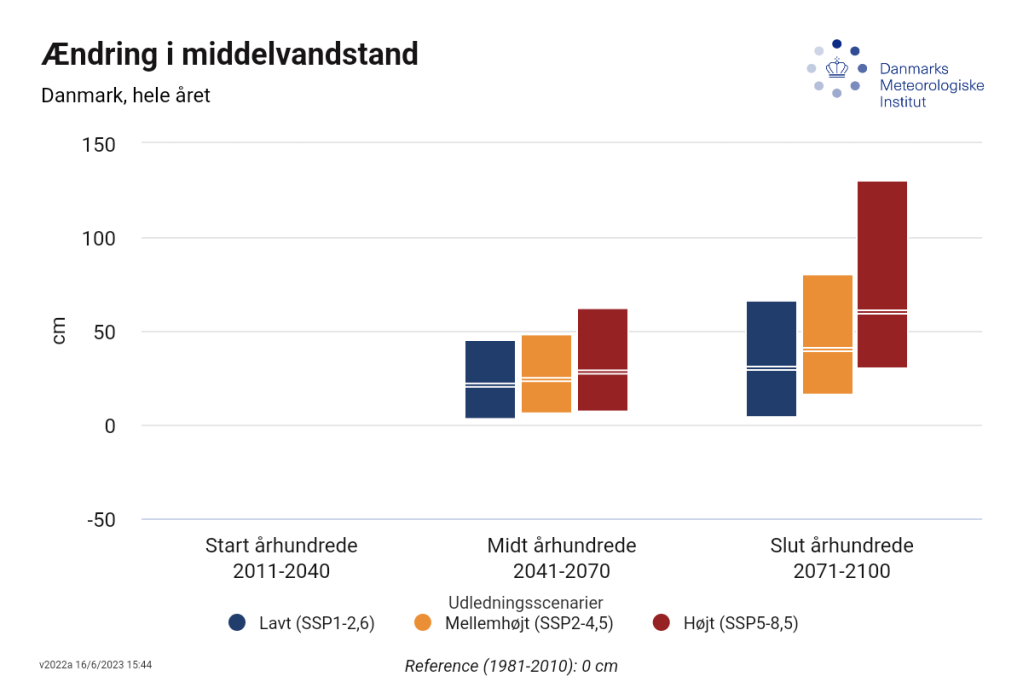
Current projections of change in average sea level around Denmark from the klima atlas
So why this project?
One of the most iconic images to come out of the last IPCC 6th asessment report (at least in my little corner of the climate science universe) is this one on sea level rise projections out to 2100.
Much of climate science has, at least to some extent been “solved”. At least in the sense that we understand the mechanisms and processes quite well and the remaining uncertainty is to some extent tinkering around the edges, often bound up with uncertainty on scenario, or related to impacts – there’s still quite large uncertainty on what will happen to the Amazon rainforest at different levels of emissions for example. However, sea level rise is really an exception to this. It’s very difficult to be sure that some very unpleasant surprises are really implausible.
The IPCC for example, concluded that sea level rise of 15 metres or more by 2300 can’t be ruled out, even if it seems rather unlikely. And this poses a pretty large problem to planners, politicians, stakeholders and providers of coastal services. Working out how far and how fast we expect the sea to rise is really our challenge.
But there is also a risk of abrupt and extreme sea level rise that could come round the corner to surprise us. However, it’s hard to know how likely this is or even how to evaluate that risk.
Where PRECISE differs is that we have the flexibility within this project to develop new and innovative techniques that we’re not quite sure will work: especially the development of machine learning tools.
The EU science budget is a brilliant thing, but risky research is difficult to get through, the Move Nordisk challenge centres allow us to try really new and, yes, risky techniques. Though climate is a new topic for them, so we’re very much test bunnies in this new phase of funding science for them.
So what are we going to be doing practically?
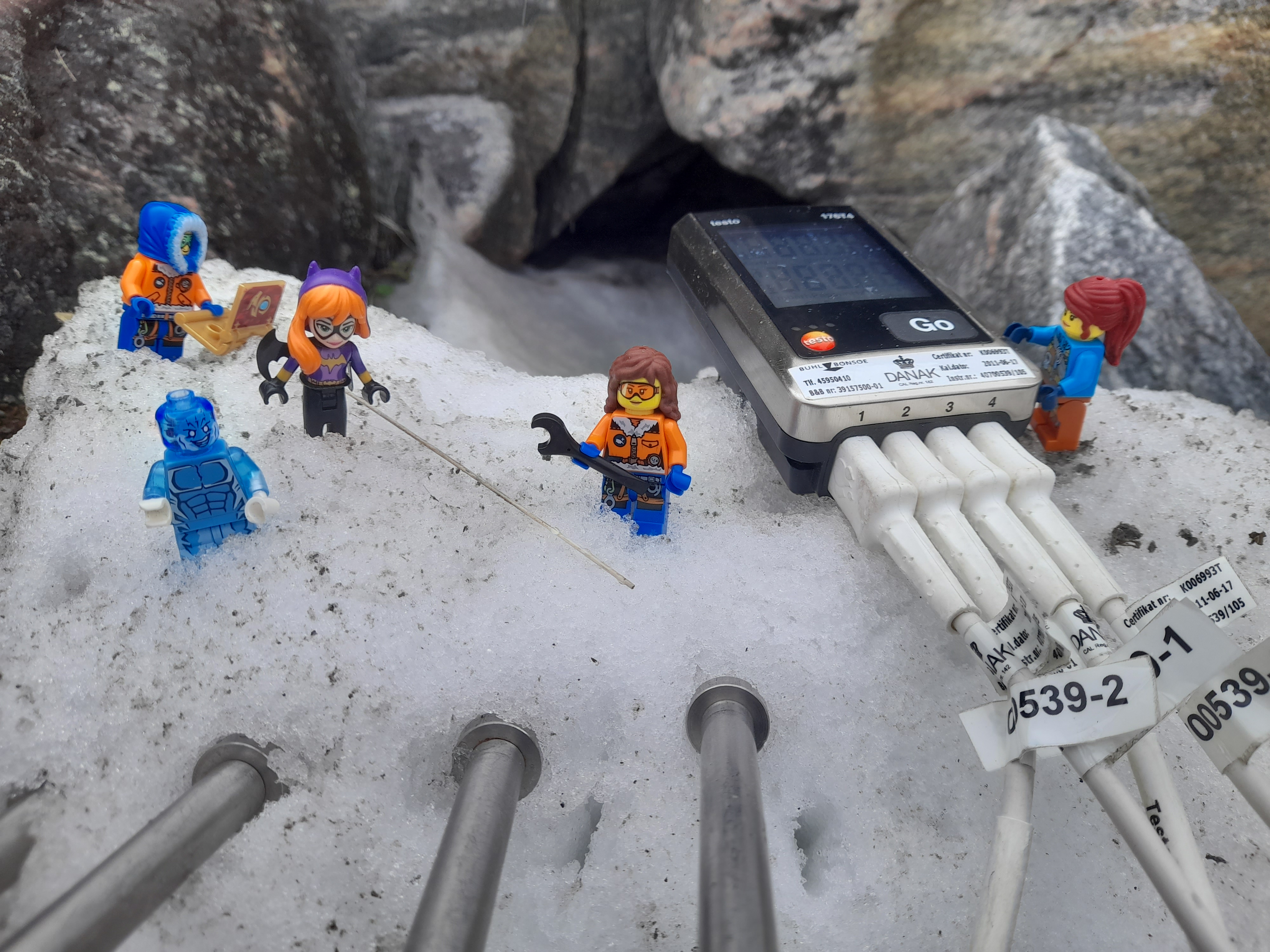
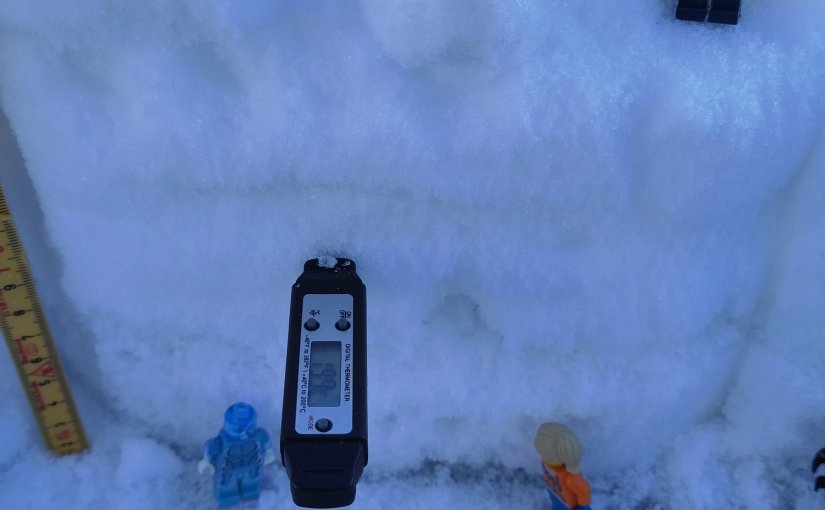
Measuring snow pack properties in Greenland, with the help of the Lego scientists..
Our partners at NBI include Joachim Mathiesen, Helle Astrid Kjær, Aslak Grinsted and Nicholas Rathmann. They will be focusing on assembling field data from both ice sheets, and developing new physical solutions for ice sheet models based on solutions from materials science. They will be looking at phase field approaches for ice flow, at new solutions for calving and ice fracture and integrating these into ice dynamical models. NBI will also be doing fieldwork to collect new surface mass budget (SMB) data from the ice sheets.
A new ice fracture appears, how to understand and model these is a key part of the NBI contribution in PRECISE project.
The SMB part of the work is part that I’m especially involved in. Not just in modelling SMB with our climate and weather models as we do on the polar portal but also in getting a much better understanding on the uncertainty in these models associated with precipitation (which is much higher than that associated with e.g. temperature, especially when it is snowfall). So new observations with a high time resolution will be key for improving our current snowpack models.
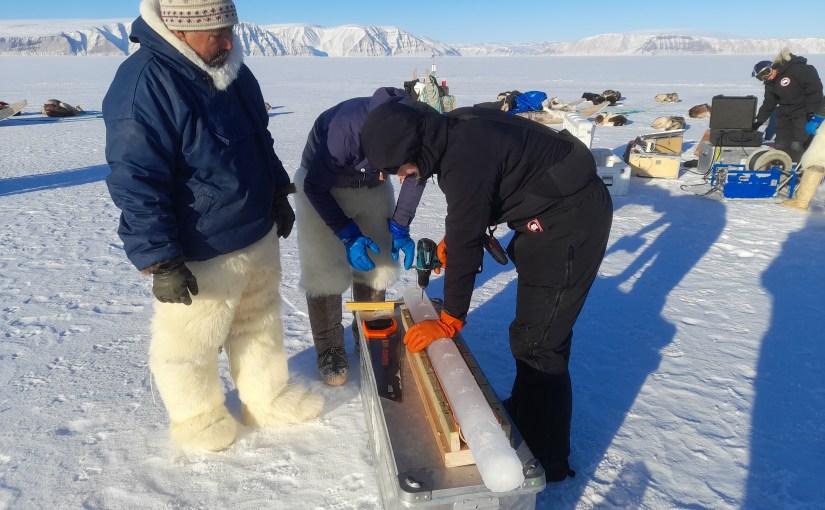
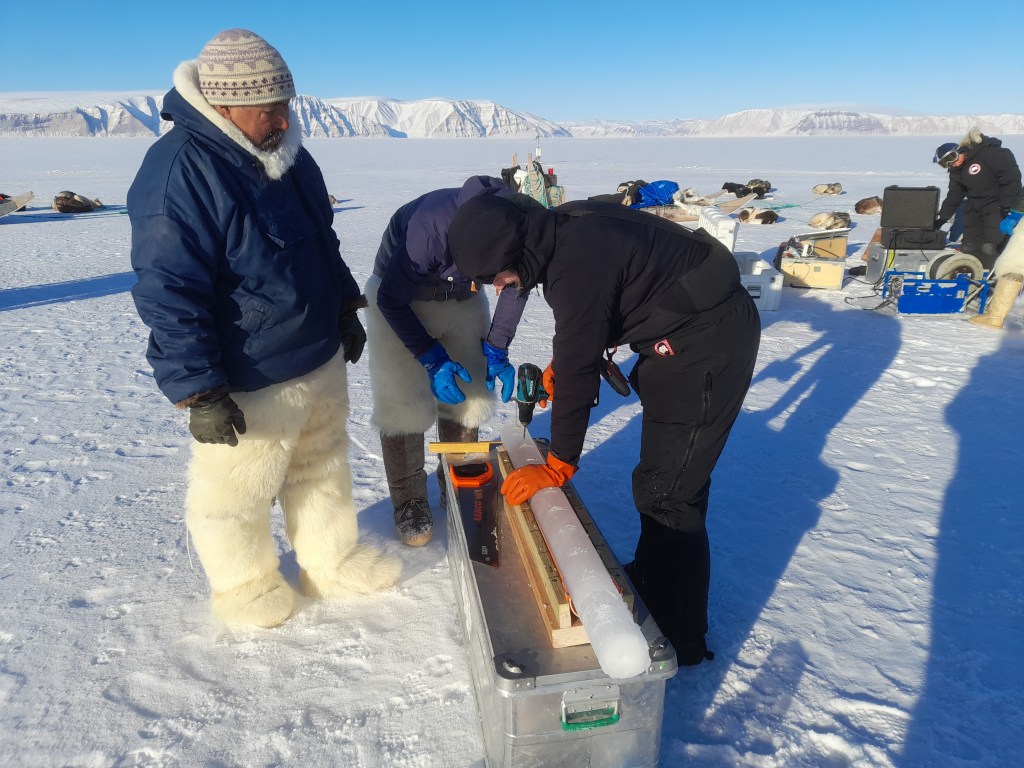
A shallow ice core, in this case sea ice, but part of the fieldwork will focus on taking more of these samples and doing isotope analysis on situ to get high quality data on snowfall accumulation
We will also be working on bringing regional climate emulators into use over both ice sheets to see how varying starting conditions will vary the outcomes. We know that on a chaotic system like weather starting conditions are key and emulators allow us to do many many more experiments than with our physics based numerical codes alone. It’s pretty cutting edge stuff right now but I know several groups are working on this – including this fantastic paper that recently came out of the Delft/Leuven group, which really shows what is possible
Our other collaborator, Hilmar Gudmundsson at University Northumbria Newcastle will be working on implementing these processes in ice sheet models and examining how plausible instability in ice sheet simulations is using ensembles of multiple model simulations. They will also be using and developing their ice shelf emulator to look at basal melting and investigating the potential instabilities in Antarctic ice shelves that could lead to abrupt sea level rise.
The project will receive 42 million Danish kroner in total (about 5 million euros) of which 8 million dkk will fund work at DMI, work to be carried out by 2 postdocs and a PhD student (so if this sounds like something you’d be interested in working on do get in touch) over the next 6 years from September. In fact most of the funding we have received will go directly to early career scientists, there is nothing in the budget for us seniors! Naturally this has some disadvantages, but given the rapidly aging population within Europe and European science, I see it as a positive and we have lots of cool summer schools, bootcamps and other networking activities planned that will hopefully reach out beyond PRECISE to the rest of the ice sheet – climate community.
Yesterday, I attended a mini conference on power to X and the potential to generate green synthetic fuels in Greenland.
Power to X became a big thing in Denmark a few years ago and the government is keen to promote it. Danish company Topsoe are currently building a green fuel facility in Herning and they have a nice explainer on their website of the concept.
In Greenland the fuels could be anything from hydrogen to methanol (though I learnt methanol is least likely as it requires a CO2 source that Greenland doesn’t have, ammonia seems the most plausible initially).
It was an interesting meeting, lots of different companies, institutions and the Greenlandic MP Aaja Chemnitz as well as academics were in the room. The emphasis was very much on the social and economic aspects of power to X, but as the title implied: Greenland has the potential to be the “world’s largest energy island.” From a local point of view, Greenland has very high per capita emissions and is heavily dependent on energy imports for transport, though a majority of electricity, at least in the south west, is already hydropower.
Many other smaller and more remote communities however are dependent on diesel generators for heating and power as well as for shipping, fishing and flying between communities.* Transitioning away from these fuels will be challenging but the potential for much larger developments is clear.
Head of development at NunaGreen (the recently rebranded and reoriented NunaOil), Rasmus Wendt, emphasised just how cheap and in theory at least, abundant, Greenland hydropower is. Probably some of the cheapest electricity in the world is generated by Greenlandic dams already operating or planned. And indeed the potential is massive. As the ice sheet melts, enormous amounts of water are produced more or less endlessly in Greenland. It will take at least a thousand years to melt the whole ice sheet, even under a high emissions scenario. We’re not going to run out of water soon.
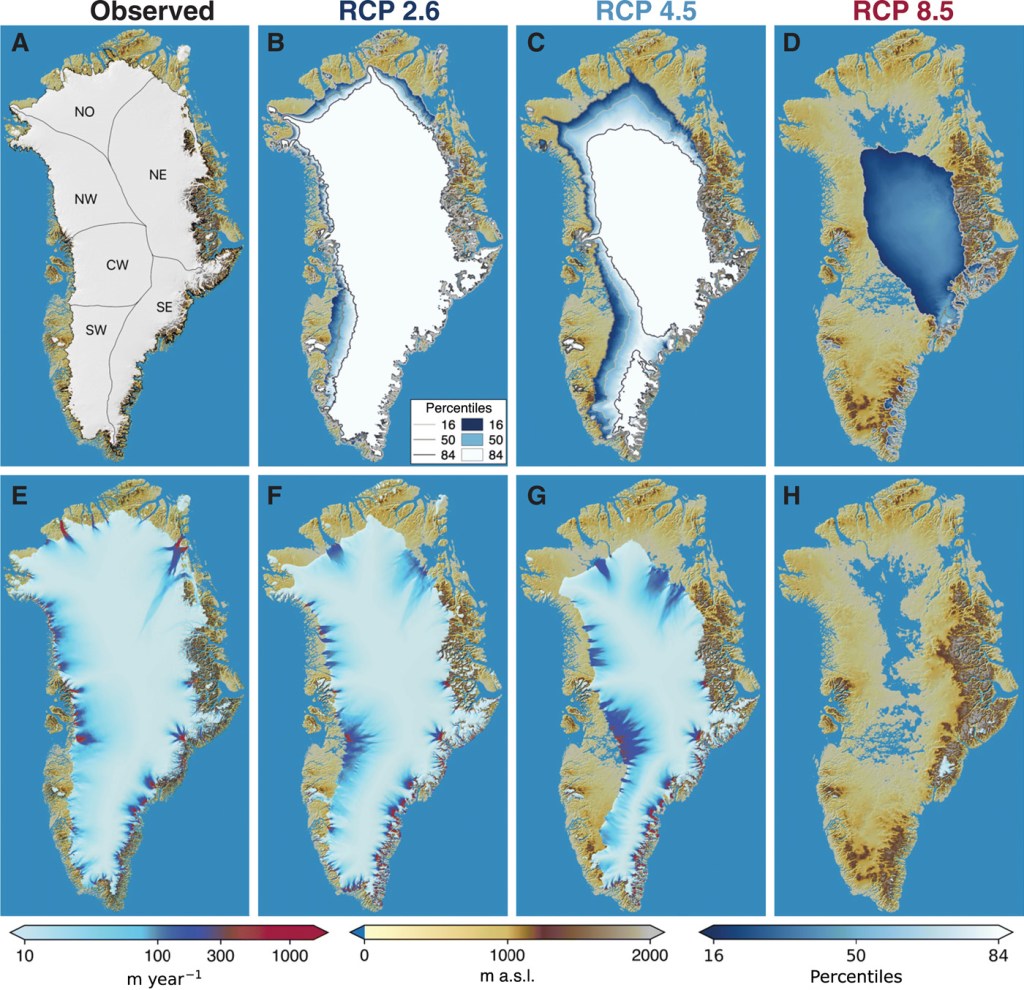
Figure 2 from Aschwanden et al., 2019. Observed 2008 state and simulations of the Greenland Ice Sheet at year 3000. (A) Observed 2008 ice extent (53). (B to D) Likelihood (percentiles) of ice cover as percentage of the ensemble simulations with nonzero ice thickness. Likelihoods less than the 16th percentile are masked. (E) Multiyear composite of observed surface speeds (61). (F to H) Surface speeds from the control simulation. Basin names shown in (A) in clockwise order are southwest (SW), central-west (CW), northwest (NW), north (NO), northeast (NE), and southeast (SE). RCP 2.6 (B and F), RCP 4.5 (C and G), and RCP 8.5 (D and H). Topography in meters above sea level (m a.s.l.) [(A) to (H)].
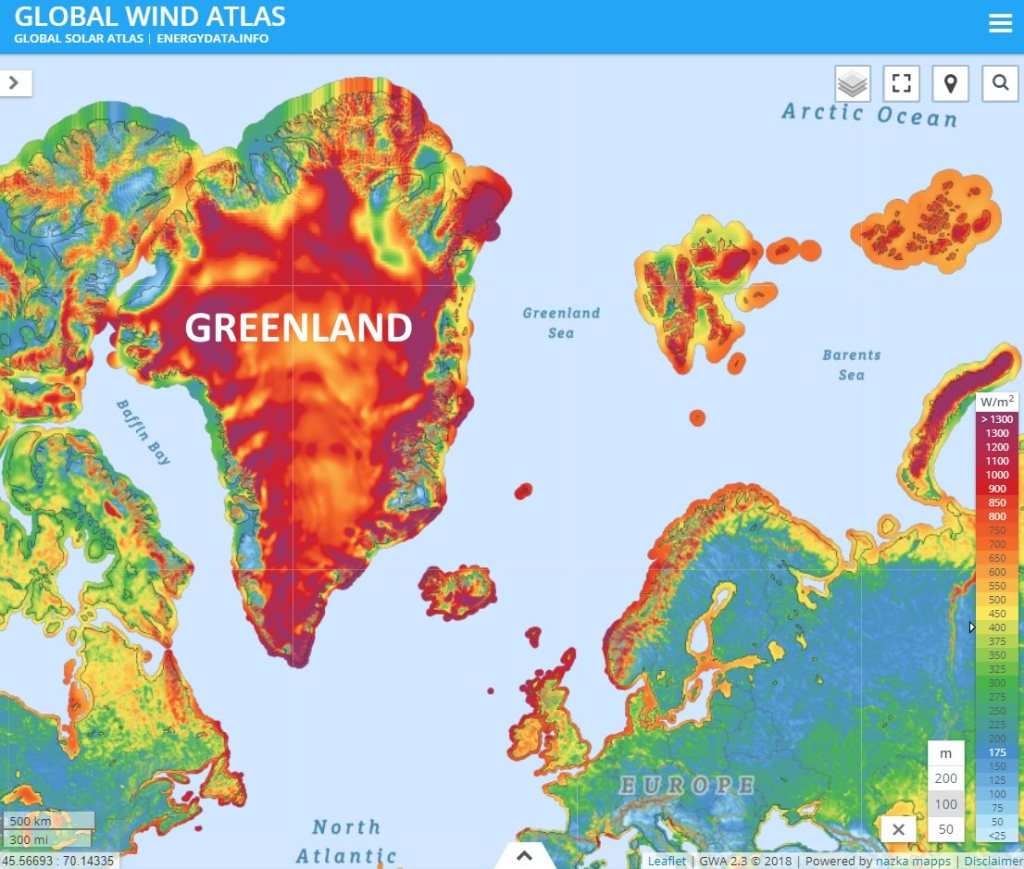
Wind energy too is extremely underdeveloped but potentially huge in Greenland. The problem is of course, all that potential energy is a long way from the end users as this screenshot from the global wind atlas, shared by energy scenario planner Brian Vad Mathiessen shows well.
Screenshot from the global wind atlas showing wind energy potential in Greenland and the north Atlantic margin of Europe
By sheer coincidence, this morning I stumbled over this article in the Dutch newspaper NRC on mastodon about the large green hydrogen facility currently under construction by Shell in Rotterdam.
It’s a really interesting read – (if you don’t speak Dutch try DeepL translation) and I was struck by many of the same issues being raised there as in the Greenland meeting: lack of trained staff, uncertain commercial environment, cost and competitiveness with other energy sources. Unlike in Greenland, energy in the Netherlands for producing synthetic fuels is scarce, but the market for using the energy is huge and nearby, and given the EU’s ambitions to produce and, crucially, import large amounts of hydrogen fuel by 2030, it seems like many of the important stars are aligning. Importing ammonia to Rotterdam for cracking back into hydrogen seems like it could actually be a viable future for Greenlandic generated fuels in Greenland he medium to long term.
We at DMI are shortly starting a project within the National Centre for Climate Research framework looking at exactly the potential to generate renewable energy from a climate and weather angle. But what I took away from yesterday’s meeting is that while the physical potential in Greenland really is HUGE, the regulatory environment – and probably the local population – is supportive, the economic certainty is not quite there yet.
It felt a bit like being in a bunch of young seabirds clustered on the edge of the cliff, none quite daring to take the flight, in spite of the undoubted rewards. And indeed, this seems the situation in the Netherlands too. I was especially struck by this quote in the NRC piece:
“Another problem is that many parties are just waiting for each other to take the first step so that they themselves dare to go. Producers, for instance, invest only sparingly because they are not sure whether there will soon be customers, and customers in turn hesitate because they are not sure whether the producers will deliver. The classic chicken-and-egg story.” (Translated with DeepL)
Chris Hensen, NRC, 17thnMay 2023 “De Europese waterstofambities zijn groot, maar bedrijven zijn nog altijd afwachtend”
Perhaps the diving in of Shell, a company that can afford to risk investing a billion Euros in a new facility in Rotterdam, is what the development of Power to X needs?
BP, Air liquide and Uniper already have plans to build follow on plants in Rotterdam. Once one of the birds have taken flight, others will surely follow.
Thanks to Aalborg University,and especially my Danish Arctic Research Forum colleague Carina Ren for an interesting and inspiring meeting.
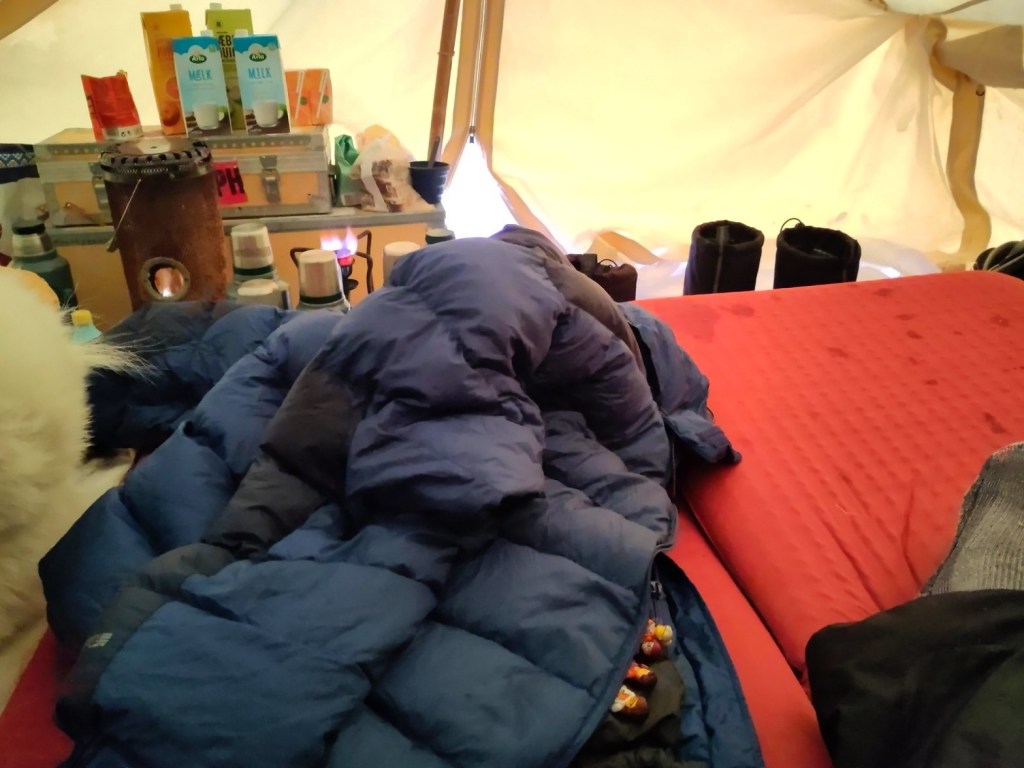
*(As an aside, I was reflecting while on fieldwork just how difficult removing fossil fuels from scientific work in Greenland will be. We rely on petrol generators to power equipment and oil stoves to warm tents. What if we could develop an easy to operate “tabletop” (or even just room sized) electrolysis system to generate clean fuels from e.g. wind energy, that we could burn instead of paraffin and/petrol? I’d invest in that and it would be a quick win for Greenland science.)
Inside of the tent during fieldwork, note the primus stove, running on petrol, for melting ice for water and food and the paraffin powered oven to keep the inside warm and dry while camping.
My employer DMI, and specifically my team at the National Centre for Climate Research are recruiting.
Not an earth-shattering revelation perhaps but these are premium research jobs, and this is probably a once in a generation opportunity in Denmark.
Let me explain. They are full time and permanent positions, working right at the cutting edge of both basic climate research, and importantly, climate services. You can see the full adverts at the links below:
DMI scientists collaborating with local hunters in the field in Greenland
I call these positions once in a generation positions because these kind of positions just don’t come up very often. Part of the reason these are now available is related to the generation change* that is coming to DMI. Right now we are fortunate also to have a number of large EU funded projects as well as danish funding for our Climate Atlas and new hydrology department which is giving us the opportunity to plan for the long term.
Sea level rise is an existential threat for Denmark, at least in the long term and we are putting a great deal of effort not just into the science of melting ice, tipping points and so forth to try and assess the potential risks, but also into planning climate adaptation and mitigation in the short and medium term.
The new positions related to climate and ice sheets and sea level rise will have some flexibility with them in terms of how the jobs evolve and research directions. There will certainly be opportunities for whoever is hired to steer in their own direction and initiate their own research programmes within the broad frame of the topics. I can certainly also only praise the management for the generally supportive and research positive encouragement.
I’d like to help cast the net wide and deep to get as strong a pool of candidates as possible, so please do feel free to get in touch with me either here or via the usual email, and other social media feeds if I can help at all. And if you have good students, postdocs or others, please do share.
We will be holding some “open house” events where you can come in person to visit DMI or sign on in a virtual event to hear more about the positions, about DMI and what it’s like to work in Denmark. Again get in touch to hear more about those.
*”Generations skift” in Danish – I have not looked at the statistics but I suspect many public institutes, including weather and climate services are greying. There was an expansion during the 80s and 90s as numerical techniques became more widespread and integrated into weather prediction and by extension climate – many of the staff employed then are getting close to retirement. In my view DMI is wise to start trying to replace these staff now so there will be continuity and knowledge exchange before it becomes a problem.
In the before times I would usually spend this week walking around a world class city humming an old 80’s hit (- don’t ask me why it was so durable in my head, probably something to do with being an impressionable age at a time when access to pop music meant half an hour on a Thursday evening).
Anyway, it is the time for EGU… Sadly I will not be wandering the streets of the ever beautiful (and most livable) capital of Austria this year. I have to get some actual work done, but I’m following the #EGU23 on mastodon and hoping to catch a few highlights on the sides. I do have a poster, which will be capably presented by PolarRES PI Priscilla Mooney and my DMI Colleague Abraham Torres on Thursday.
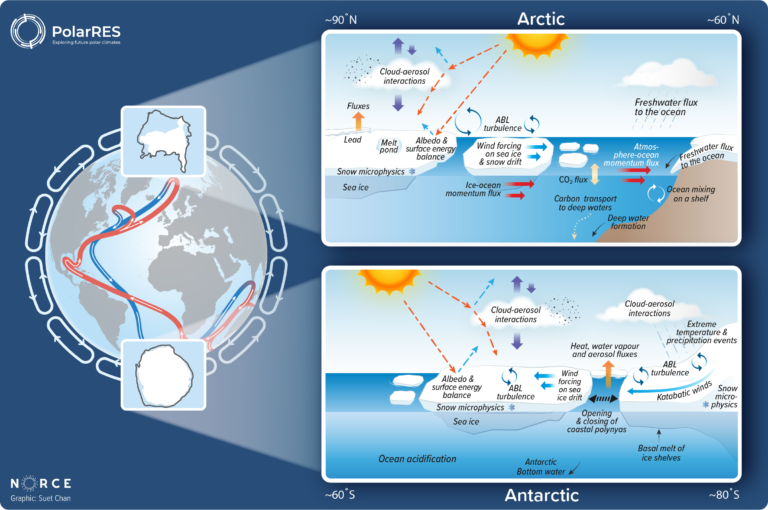
The topic is our PolarRES project – an ambitious Horizon 2020 effort to produce a large ensemble of regional climate simulations over both poles. These are state-of-the-art regional climate models run at unprecedented high spatial resolution and all data will be made open access and free via the CORDEX project.
I will also put it here later – feel free to comment here or ask questions on mastodon or get in touch by email if it sounds exciting.
Other posters and talks I’ve contributed to from PolarRES are
Kristiina Verro’s talk on HCLIM_Arome results from the Antarctic peninsula:
Verro, K., van de Berg, W. J., Orr, A., Landgren, O., and van Ulft, B.: New non-hydrostatic polar regional climate model HCLIM-AROME: analysis of the föhn event on 27 January 2011 over the Larsen C Ice Shelf, Antarctic Peninsula, EGU General Assembly 2023, Vienna, Austria, 24–28 Apr 2023, EGU23-13864, https://doi.org/10.5194/egusphere-egu23-13864, 2023.
Abraham Torres joined our group last year and is primarily working on PolarRES also. He will show some of our preliminary HCLIM results for both the Arctic and the Antarctic
Torres-Alavez, A., Landgren, O., Boberg, F., Christensen, O. B., Mottram, R., Olesen, M., Van Ulft, B., Verro, K., and Batrak, Y.: Assessing Performance of a new High Resolution polar regional climate model with remote sensing and in-situ observations: HCLIM in the Arctic and Antarctica, EGU General Assembly 2023, Vienna, Austria, 24–28 Apr 2023, EGU23-14090, https://doi.org/10.5194/egusphere-egu23-14090, 2023
Quentin Glaude is a collaborator from Liege in the Horizon 2020 PROTECT project on sea level rise contributions from the cryosphere . Baptiste Vandecrux, a former PhD student with me here and now working at GEUS is also presenting some work based on the same models as Quentin, with a comparison to the PROMICE observation statons on the Greealnd ice sheet. It’s very cool application of machine learning and the results are very interesting.
Glaude, Q., Noel, B., Olesen, M., Boberg, F., van den Broeke, M., Mottram, R., and Fettweis, X.: The Divergent Futures of Greenland Surface Mass Balance Estimates from Different Regional Climate Models, EGU General Assembly 2023, Vienna, Austria, 24–28 Apr 2023, EGU23-7920, https://doi.org/10.5194/egusphere-egu23-7920, 2023
Vandecrux, B., Fausto, R. S., Box, J. E., Covi, F., Hock, R., Rennermalm, A., Heilig, A., Abermann, J., Van As, D., Løkkegaard, A., Fettweis, X., Smeets, P. C. J. P., Kuipers Munneke, P., Van Den Broeke, M., Brils, M., Langen, P. L., Mottram, R., and Ahlstrøm, A. P.: Historical snow and ice temperature compilation documents the recent warming of the Greenland ice sheet, EGU General Assembly 2023, Vienna, Austria, 24–28 Apr 2023, EGU23-9080, https://doi.org/10.5194/egusphere-egu23-9080, 2023.
Nicolaj Hansen (who finished his PhD with me and Sebastian Simonsen at DTU Space last year) has just submitted a beauty of a paper which he will talk about – also partof PROTECT.
Hansen, N., Sørensen, L. S., Spada, G., Melini, D., Forsberg, R., Mottram, R., and Simonsen, S. B.: ICESat-2 Ice Sheet Mass balance: Going below the surface, EGU General Assembly 2023, Vienna, Austria, 24–28 Apr 2023, EGU23-12349, https://doi.org/10.5194/egusphere-egu23-12349, 2023
Mathias Larsen is a current Phd student with me and is presenting a poster on the CARRA dataset and an application in surface mass balance modelling. This work falls under the danish National center for klima forskning
Larsen, M., H. Mottram, R., and L. Langen, P.: CARRA-driven simulation of Greenland Ice Sheet surface mass balance at 2.5 km resolution, EGU General Assembly 2023, Vienna, Austria, 24–28 Apr 2023, EGU23-5852, https://doi.org/10.5194/egusphere-egu23-5852, 2023
Last year I co-organised a bootcamp for early career researchers on Arctic processes in the CMIP6 models. It was super fun and would not have been possible without the support offered by Anne Fouilloux, Tina Odaka and colleagues from the Pangeo project. Their poster is super interesting and if you’re interested in optimising the use of big climate data, go and check it out!
Fouilloux, A., Marasco, P. L., Odaka, T., Mottram, R., Zieger, P., Schulz, M., Coca-Castro, A., Iaquinta, J., and Eynard Bontemps, G.: Pangeo framework for training: experience with FOSS4G, the CLIVAR bootcamp and the eScience course, EGU General Assembly 2023, Vienna, Austria, 24–28 Apr 2023, EGU23-8756, https://doi.org/10.5194/egusphere-egu23-8756, 2023.
Excitingly, at least 3 of the projects at the bootcamp will also be presented at EGU this year. So, lots to be getting on with, for now, here’s a link to Ultravox’s finest…
Back in Denmark after 2 weeks in Greenland. Always a bit strange to come back, not just that transition from Arctic cold to European Spring but the sheer abundance of the fertile mid-latitudes, colours, plants, trees, the sheer number of people.
Not to mention that expedition frame of mind, where you are really focused on accomplishing a given set of often quite complex tasks (almost) without distraction. It is the ultimate deep work task, and naturally readjusting to family life, not to mention the tsunami of work tasks left on hold is… difficult.
The town was formerly a summer hunting spot, but after Thule was decided on, the community was moved to Qaanaaq year round. It has an association with the famous Danish explorer Knud Rasmussen, whose old house is a museum (allegedly. I’ve never actually had time to visit it..)
This year we again visited the glaciers at the head of the Inglefield Fjord – expanding a new research programme we piloted last year. We also did a lot of work on the sea ice – not just Steffen Olsen‘s ocean programme, but a new NCKF research programme looking at biological productivity and carbon cycling in the fjord, led by Anna Pedersen, a DMI PhD student also at the University of Southern Denmark. I and another colleagues also did a lot of work on snow processes that is something of a pilot programme for a processes project we’d like to establish next year that will also involve (hopefully) our weather forecasting colleagues and perhaps also the GEUS PROMICE programme.
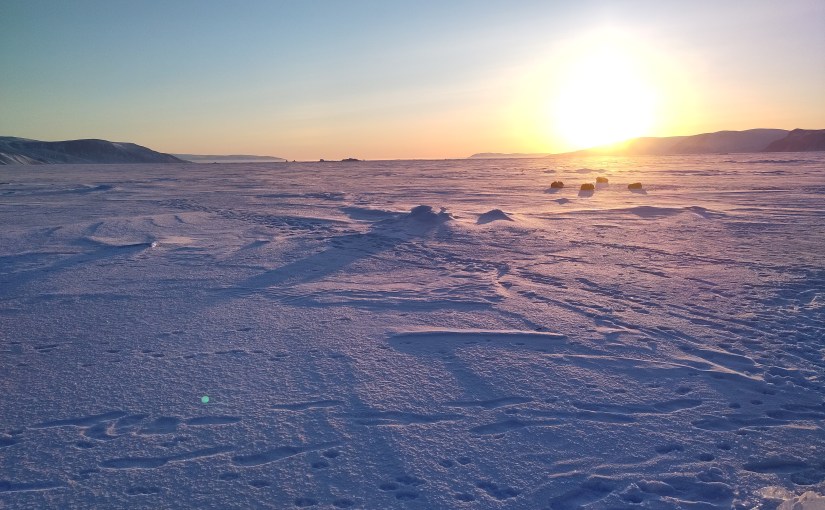
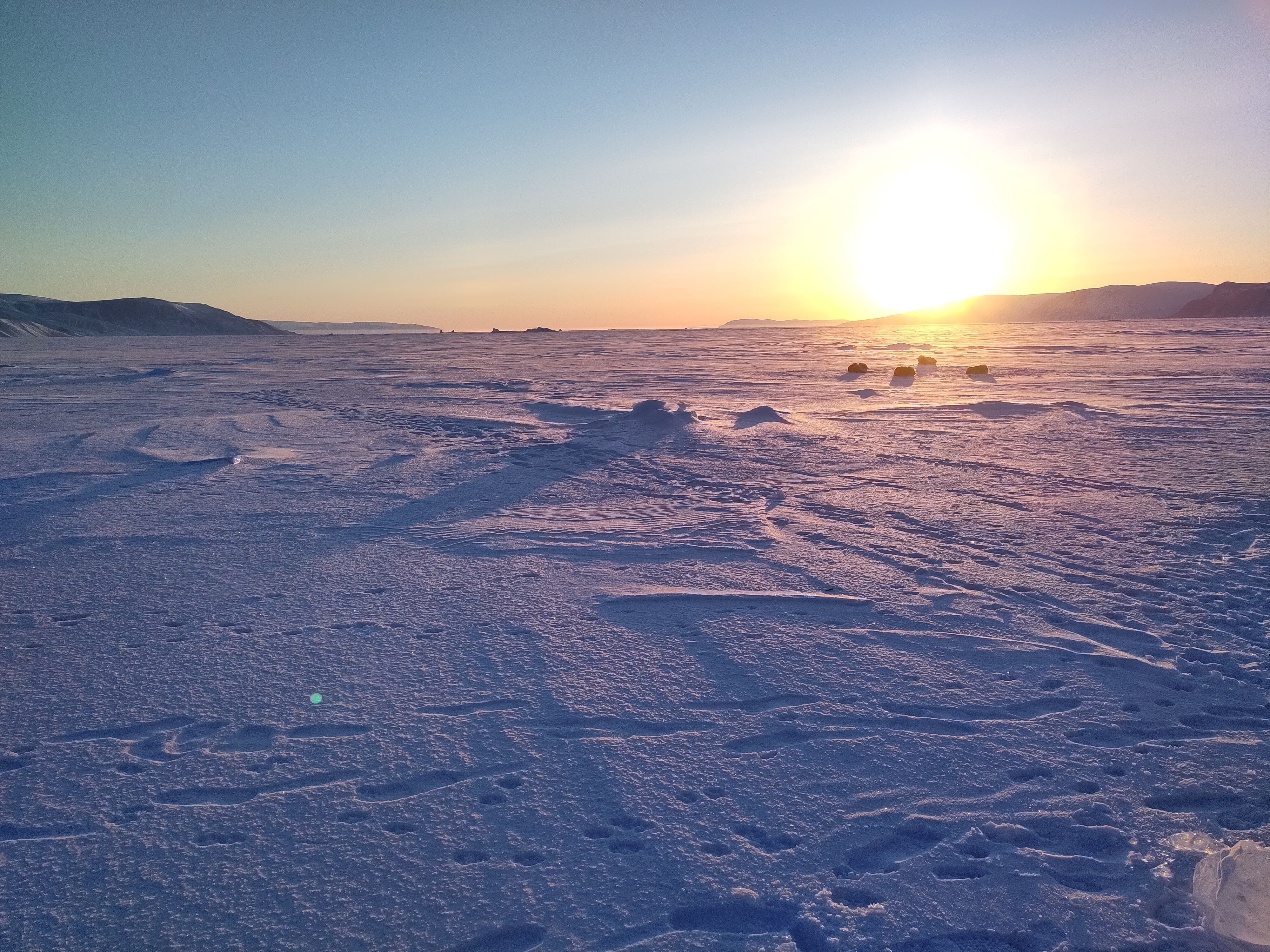
All of this work involved 6 days of travelling over and camping on the sea ice, plus an additional day trip. We were lucky with the weather, although it was *extremely* cold, around -25 to -28C most days, and dipping well below -30C at night (though being after the equinox it was never truly pitch dark). However, in general there was little wind, no fresh snow (which can really slow the dogs down as they struggle to pull through deep soft snow) and the sun shone every day. This meant we basically managed to achieve the full planned programme – including our extra-optimistic goals – which almost never happens in fieldwork.
I intend to write a whole series of posts based on what we have been doing scientifically and technically as well as some general observations. There have been various hints already in my preferred social network. The whole trip was super inspiring, it’s always valuable to get out and observe the real world when you’re trying to model it, understand it and make projections of sea level rise.
I also promised to make another Lego scientists series and took quite a few photos in between times to do so. However, the research programme was packed, so I had no time at all to make the comic during fieldwork, that will have to wait a few weeks.
Expect my pixelfed account to host gratuitous numbers of dog pictures. And ice pictures. And unexpectedly clear blue skies. For now it’s time to unpack, get the washing machine going and spend some time with my family.
As ever, thanks to my amazing colleagues Steffen Malskær Olsen, Andrea Gierisch and Anna Pedersen for an incredible trip and to DMI station manager in Qaanaaq Aksel Ascanius without whom most of this work would be impossible.
Special thanks to our friends in Qaanaaq, the local hunters, whose unfailing energies and knowledge are absolutely essential to these scientific projects. We literally could not do this without them and of course their dogs.
I must also credit DMI and the Danish Government for funding via the National Center for Klima Forskning and thanks also to Horizon Europe projects PROTECT on sea level rise and PolarRES for additional inspiration and funding and to my colleagues at the Horizon Europe/NERC project OCEAN:ICE for indulging my two weeks away. All three projects will benefit from the insights gained in this fieldwork.

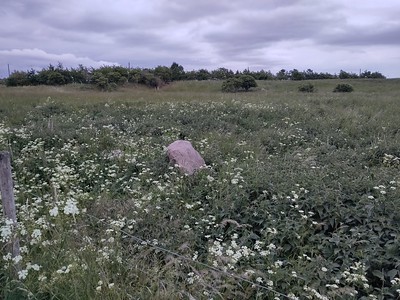




 Sterna Paradisaea