PROTECT: The Sea Level Rise Question

There is currently some discussion in the Danish media about sea level rise hazards and the risk of rapid changes that may or may not be on the horizon. Some of the discussion is about IPCC estimates. That’s a little unfortunate and in fact a bit unfair as the IPCC report has not been updated since 2021, nor was it intended to have been. In the mean time there has been a lot of additional science to clear up some of the ambiguities and questions left from the last report.

I’ve been working quite a bit on the cryosphere part of the sea level question of late, so thought I’d share some insights from the latest research into the debate at this point. And I have a pretty specific viewpoint here, because I’ve been working with the datasets, models, climate outputs etc that will likely go into the next IPCC report as part of a couple of EU funded projects. As part of that, we have prepared a policy briefing that will be presented to the European Parliament in June this year, but it’s already online now and will no doubt cross your socials later this week. I’m going to put in some highlights into this post too.

Now, I want to be really clear that everything I say in this post can be backed up with peer reviewed science, most of which has been published in the last 2 to 3 years. Let’s start with the summary:.:

  • The sea is rising. And the rate of rise is currently accelerating.
  • The sea will continue to rise long into the future. The rate of that sea level rise is largely in our society’s hands, given that it is strongly related to greenhouse gas emissions.
  • We have already committed to at least 2m of sea level rise by 2300.
  • By the end of 2100 most small glaciers and ice caps will be gone, mountain glaciers will contribute 20-24% of total sea-level rise under varying emission scenarios.
  • Antarctic and Greenland ice sheet mass loss will contribute significantly to sea-level rise for centuries, even under low emissions scenarios
  • Abrupt sea level rise on the order of metres in a few decades is not credible given new understanding of key ice fracture and iceberg calving processes.
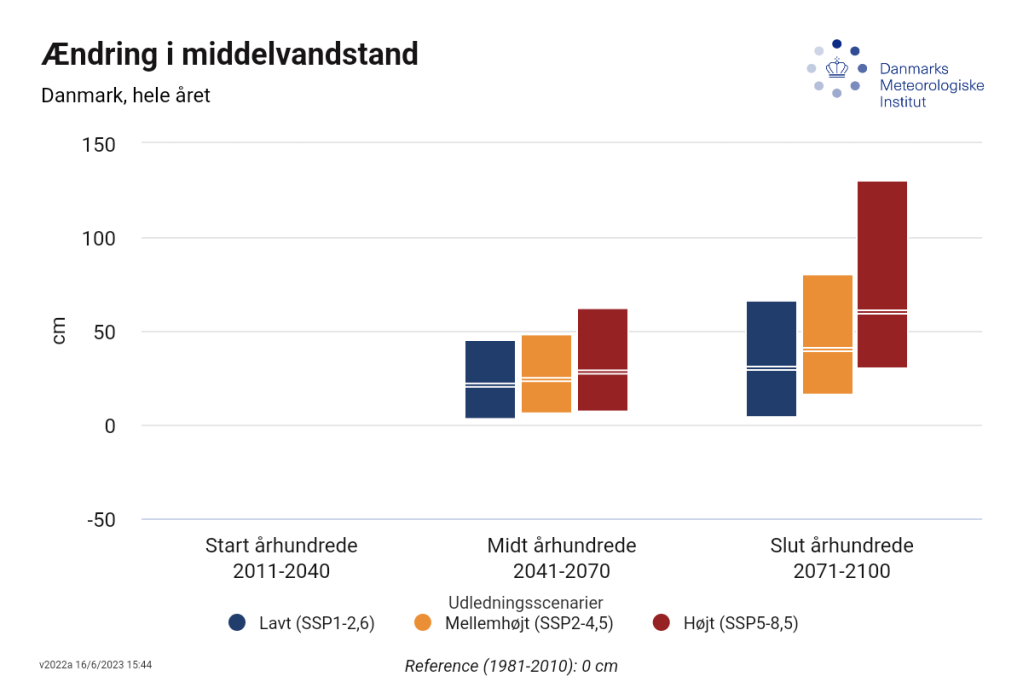
  • By the end of this century we expect on the order of a half to one metre of sea level rise around Denmark, depending on emissions pathway. (If you want to get really specific: the low-likelihood high impact sea level rise scenario corresponds to about 0.9 m (on average), or at the 83rd percentile, about 1.6 m of sea level rise).
  • Your local sea level rise is not the same as the global average and some areas, primarily those at lower latitudes will experience higher total sea level rise and earlier than in regions at higher latitudes.
  • We have created a local sea level rise tool. You should still check your local coastal services provider, they will certainly have something tailor made for your local coastline (or they *should*!), but for something more updated than the IPCC, with latest SLR data, this is the one to check.

Sea level rise now is ~5mm per year averaged over the last 5 years, 10 years ago it was about 3 mm per year). Much of that sea level rise comes from melting ice, particularly the small glaciers and ice caps that are melting very fast indeed right now. Even under lower levels of emissions, those losses will increase. There won’t be many left by the end of this century.

Greenland is the largest single contributor and adds just less than a millimetre of sea level rise per year, with Antarctica contributing around a third of Greenland, primarily from the Amundsen Sea sector. The remaining sea level rise comes from thermal expansion of the oceans. Our work shows very clearly that the emissions pathway we follow as a human society will determine the ultimate sea level rise, but also how fast that will be achieved. The less we burn, the lower and slower the rise. But even under a low-end Paris scenario, we expect around 1 metre of sea level by 2300.

The long tail of sea level rise will come from Antarctica, where the ocean is accelerating melt of, in particular, West Antarctica. However, our recent work and that of other ice sheet groups shows that the risk of multi-metre sea level rise within a few decades is unrealistic. Again, to be very clear: We can’t rule out multiple metres of sea level rise, but it will happen on a timescale of centuries rather than years. High emissions pathways make multiple metres of sea level rise more likely. In fact, our results show that even under low emissions pathways, we may still be committed to losing some parts of especially West Antarctica, but it will still take a long-time for the Antarctic ice sheet to disintegrate. We have time to prepare our coastlines.

Greenland is losing ice much faster than Antarctica, and here atmospheric processes and firn and snow are more important than the ocean and these are also where the læarge uncertainties are. As I’ve written about before, that protective layer of compressed snow and ice will determine how quickly Greenland melts, as it is lost, the ice sheet will accelerate it’s contribution to sea level. This is a process that is included in our estimates.

There’s so much more I could write, but that’s supposed to be the high level summary. Feel free to shoot me questions in the comment feeds. I’ll do my best to answer them.

Five years ago, a small group of European scientists got together to do something really ambitious: work out how quickly and how far the sea will rise, both locally and on average worldwide, from the melting of glaciers and ice sheets. The PROTECT project was the first EU funded project in 10 years to really grapple with the state-of-the-art in ice sheet and glacier melt and the implications for sea level rise and to really seek to understand what is the problem, what are the uncertainties, what can we do about it.

We were and are a group of climate scientists, glaciologists, remote sensors, ice sheet modellers, atmospheric and ocean physicists, professors, statisticians, students, coastal adaptation specialists, social scientists and geodesists, stakeholders and policymakers. We’ve produced more than 155 scientific papers in the last 5 years (with more on the way) and now our findings are summarised in our new policy briefing for the European Parliament.

It’s been a formative, exhilarating and occasionally tough experience doing big science in the Horizon 2020 framework, but we’ve genuinely made some big steps forward, including new estimates of rates of ice sheet and glacier loss, a better understanding of some key processes, particularly calving and the influence of the ocean on the loss of ice shelves. More importantly for human societies, by integrating the social scientists into the project, we have had a very clear focus on how to consider sea level rise, not just as a scientific ice sheet process problem, but also how to integrate the findings into usable and workable information. In Denmark, we will start to use these inputs already in updating the Danish Climate Atlas. If you are elsewhere in the world, you may want to check out our sea level rise tool, that shows how the emissions pathway we follow, will affect your local sea level rise.

Our final recommendations?

  1. Accelerate emission reductions to follow the lower emission scenario to limit
    cryosphere loss and associated sea-level rise
  2. Enhance monitoring of glaciers and ice sheets to refine models and predictions
  3. Support the long-term development of ice sheet models, their integration into
    climate models, and the coupling of glacier models with hydrological models, while
    promoting education and training to build expertise in these areas
  4. Invest in flexible and localized coastal management that incorporates
    uncertainty and long-term projections
  5. Foster international collaboration to share knowledge, resources, and strategies
    for mitigating and adapting to global impacts

Looking backwards…
This is the first in a two-parter. At this time of year, posts making bold statements about what happened last year and what we plan to do this year start to become prominent. The last few years I have spent a few hours in the first week of January reviewing what worked, what was fun and what was cool, what was awful and what definitely was a waste of time. I’m not honestly sure that any of this is of interest to anyone except me, so read on, but you have been warned..

2024: Themes of this year: Greenland, Machine Learning, people, and big data…
I visited the world’s largest island 3 times this year – a rather unprecedented number of times for me, with fieldwork in April (it was very cold and there was a lot of snow) to continue a soon to be submitted for publication set of observations in the melange zone and then to establish a new snow observation site.

View from Qaanaaq at evening in early April 2024.

In late May and early June, after a slightly longer than expected stop in Ilulissat, we made it to bring in the instruments before the sea ice break-up and happily my new snow observations seem to be working. Now I just need to do set-up the data processing chain, which will be 2025’s paying myself first.

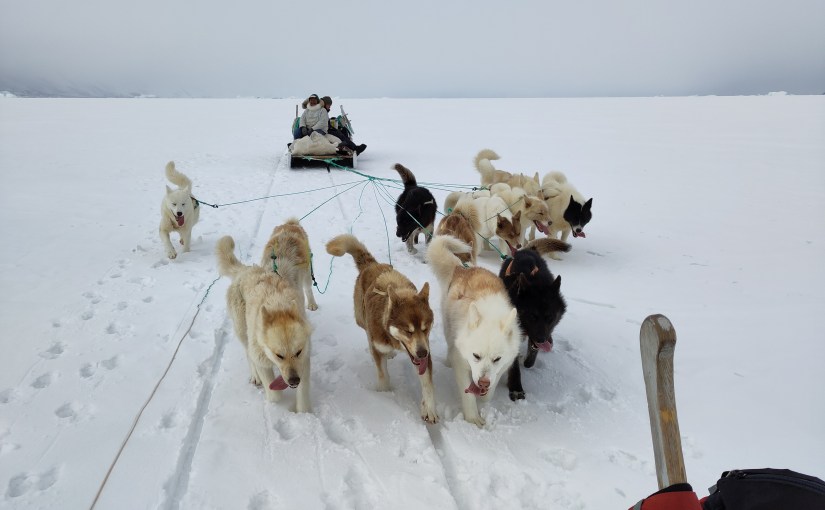
Working with scientists from the Greenland natural resources institute and local hunters on the sea ice.

The final trip was in October for a workshop with scientists in Greenland about climate change impacts in Greenland, the subpolar gyre and AMOC for the UN Ocean decade. It was a memorable meeting for the sheer range and quality of science presented as well as for being stranded in Nuuk by a broken aeroplane in quite ridiculously beautiful weather (I mostly stayed in my hotel room to write the aforementioned paper, sadly. In 2025 I will work on my priorities) .

Apart from fieldwork I have really tried hard on publications this year. I have (like many scientists I suspect), far more data sitting around on hard drives than I have published. It’s a waste and it’s also fun to work on actual data instead of endless emails. This is something I intend to continue focusing on the next few years as well. There is gold in them thar computers…

We had a couple of writing retreats were very successful. These I plan to continue also and the PRECISE project grant is happily flexible enough to do this. I probably achieve as much in terms of data processing and paper writing in 3 focused days as I would in 3 months in the office. It paid off too. I managed to co-author 8 papers published this year (including my first 1st-author paper in ages – a workshop report, but nevertheless it counts.). Some of these are still preprints, so will change, and there are a couple more that have been submitted but are not yet available as preprints. I will submit two more papers in the next 3 weeks as well (1 first author), so January 2025 is going to be the 13th month of 2024 in my mind.

Bootcamps have been a theme the last 3 years, I organised the first in 2022 and so far there have been 4 publications from that first effort. There was another this year in June, ( I have attended them in 2023 and 2024 but was not organising) where we really got going on a project for ESA that I have had my eye on for a while – I hope the publication from that will be ready in the Spring this coming year.

Machine Learning: This was the year I really got machine learning. I’ve been following a graduate course online, and learning from my colleagues and students about implementations. I understand a lot more about the architecture and how to in practice apply neural networks and other techniques like random forests now. This is not before time, as we intend to implement these to contribute to CMIP7 and the next IPCC report. We still have a lot of work to do, but the foundation is laid. And it’s been fun to learn something that, if not exactly new, is a new application of something. In fact the biggest barrier has really been learning new terminology. We have also been fortunate that Eumetsat and the ECMWF have been very helpful in providing us with ML-optimised computer resources to test much of these new models out on. We’re actually running out of resources a bit though, so it’s time to start investigating Lumi, Leonardo and the new Danish centre Gefion to see what we can get out of these.

People: This year our research group has grown with another 2 PhD students, and at the end of the year we also employed a new post-doc. I think it’s large enough now. I’m very aware that if I don’t do my job properly, then not only the research but the people will suffer, so developing people management skills is really important. In any case it’s extremely stimulating to work with such talented young people and I’m really excited to see where the science will take us, given the skills in the team. I hope I have been good enough at managing such a large and young team, but I have my doubts. A focus for 2025 for sure.

Data: This has been the year of big data, not necessarily just for ML purposes but also in the PolarRES project the production and management of an enormous set of future climate projections at very high resolution. More on this anon. Suffice to say, it has taken a lot of my time and mental energy and it’s probably not the most exciting thing to talk about, but we now have 800 Tb of climate simulation data to dig into. I suspect that rewards of this will be coming for years. There has also been a lot of digging into satellite datasets and the bringing together of the two has been very rewarding already. It’s a rich seam, to continue the metaphor, that will be producing scientific gold for many years.

Projects: we have gone in the final year of two projects, PROTECT and PolarRES, both of which will finally end in 2025. We also arrived at the half way point of OCEAN:ICE. So rather than being a year of starts, it has been a year where we have started to prepare for endings – actually this is a fun part of many projects where a lot of the grunt work is out the way and we can start to see what we have actually found out. It can also be a slog of confusing data, writing and editing papers and dealing with h co-author comments. I’ve definitely been in that process this year, hopefully with some of the outputs to come next year…

Proposals: I started 2024 writing a proposal. Colleagues were in 3 different consortia for the same call, alas ours didn’t get funded, but 2 of the others did and will start this year. That is a good result for DMI and our group. I wrote another proposal in the Autumn and contributed to a 4th and finally at the end of the year I heard that both will *likely* be funded (but are currently embargoed and in negotiation, so no more will be said now). It sometimes feels that spending so much time and energy on proposal writing is putting the cart before the horse, but in fact I find proposal writing something akin to brainstorming. It’s essential of course to ensure we can continue to do the science we want, but it can also help us to clarify our ideas and make sure we’re not on the wrong track. It’s also a good way to keep track of what the funders are actually wanting to know and to help us focus on policy relevance.

There was also an incredible number of meetings, reports, milestones and deliverables, but you probably don’t want to hear about that…

Also missing from this summary is personal life, and, well that is not for sharing publically, but suffice to say, I learnt about raising teenagers, I also had some very good times with friends and family, to all of whom I immensely grateful for being a part of my voyages around the sun.

Anyway, reading all that back, I’m not surprised I ended the year exhausted! I am not planning on quite such a slog in future. I should probably pace myself a bit more this year, the plans for which will be the subject of next week’s post.

Small differences that make a really big difference.

I’m a co-author on a new paper that has just come out in GRL. It’s based on simulations we did with our collaborators in the PROTECT project on sea level contributions from the cryosphere.  What Glaude et al shows is that, to quote the first of the 3 key points:

“With identical forcing, Greenland Ice Sheet surface mass balance from 3 regional climate models shows a two-fold difference by 2100”

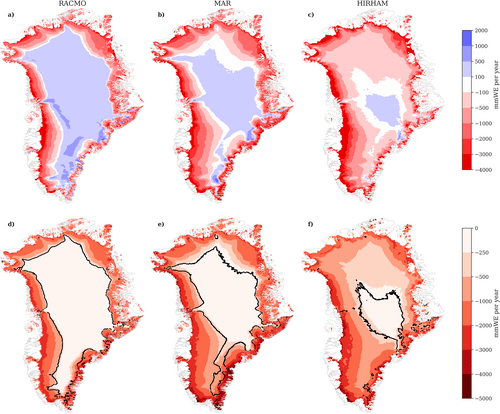
In perhaps more familiar terms, if you run 3 regional climate models (that is a climate model run only over a small part of the world, in this case Greenland) with identical data feeding in from the same global climate model around the edges, you will get 3 quite different futures. Below you can see how the 3 different models think the ice sheet will look on average between 2080 and 2100. The model on the right, HIRHAM5 is our old and now retired RCM. It has a much smaller accumulation area left by the end of the century than the other two, which have much more intense melt going on in the margins.

Greenland Ice Sheet annual surface mass balance (a, b, c, 2080–2099 average) and annual surface mass balance anomaly (d, e, f, 2080–2099 average relative to 1980–1999) [mm WE/yr]. From left to right, RACMO (a and d), MAR (b and e), and HIRHAM (c and f). The equilibrium line (SMB = 0) is displayed as a solid black line in (d-f). Glaude et al., 2024, GRL.

In fact, by the end of the century, although the maps above seem to show HIRHAM having much more melt, there is in fact more runoff from the MAR model, because of this intense melt.

Spatially aggregated annual GrIS SMB anomalies (a), total precipitation (PP, b), and runoff (RU, c) [Gt/yr]. The solid lines represent the anomalies using a 5-year moving average, while the transparent lines display the unfiltered model output.

The surface mass balance (SMB) at the present day is in fact positive. This often surprises people, but SMB as the name suggests, only describes surface processes. Ice sheets can (and do) also lose a lot of ice by calving and subglacial and submarine melt. As SMB should balance everything if a glacier is to remain stable or even grow, present day SMB is usually 300 to 400 GT positive at the end of each year, and even so the Greenland ice sheet loses, net around 270Gt per year.

Our work here shows that, at least under this pathway, not only does SMB become net negative in itself by the middle of this century, there are significant differences in SMB projections between the estimates of how negative it will be, between the three RCMs. The global model we used, CESM2 under the high-end SSP5-8.5 scenario, is famously a warm scenario, but our estimated end of the century SMBs are extraordinary : (−964, −1735, and −1698 Gt per year, respectively, for 2080–2099). As I’ve discussed previously, one gigatonne is a cubic kilometre of water, 360Gt is roughly 1mm global mean sea level rise. (Though note your local sea level rise is *definitely* not the same as global average!) Even the lowest estimate here the  is giving around 3 mm of global average sea level rise from surface melt and runoff *alone* by the end of this century each year. That’s pretty close to the modern day observed sea level rise from all sources.

And this is in spite of the fact that at the present day, the 3 models are rather similar in their estimates of SMB. The Devil is as usual in the details.

We attribute these startling divergences in the end of the century results to small differences in 1) the way melt water is generated, due to the albedo scheme (that is how the ice sheet surface reflects incoming energy); 2) but also due to the cloud parameters that control long-wave radiation at the surface, which again can promote or suppress melting. (We really need to know how much liquid water or ice there are in clouds, as this paper also emphasises in Antarctica); and 3) mainly down to the way liquid water that percolates down from the surface is handled in the snow pack. That is, how much air there is in the snowpack, how warm the snow is and how much refreezing can occur to buffer that melt.

The problem is that all of these processes happen at very small scales, from the mm (snow grains and air content), to the micron scale (cloud microphysics). That means that even in high (~5km) resolution regional models, we need to use parameterisations (approximations that generalise small scale processes over larger spatial and/or time scales). Small differences between these parameterisations add up over many decades.  Essentially,  much like the famous butterfly flapping its wings in Panama and causing a hurricane in Florida, the way mixed phase clouds produce a mix of water vapour and ice over an ice surface might ultimately determine how fast Miami will sink beneath the waves.

More data would certainly help to refine these parameterisations. The main scheme to work out how much liquid can percolate into snow was originally based on work by the US Army engineers in the 1970s. More field data with different types of snow would surely help refine these. Satellite data will be massively helpful, if we can smoothe out some wrinkles in how clouds (there they are again) affect surface reflectivity.

These 3 different types of processes also interact with each other in quite complex ways and ultimately affect how much runoff is generated as well as the size of the runoff zone in each model. So integration of many different types of observations is crucial.

“Different runoff projections stem from substantial discrepancies in projected ablation zone expansion, and reciprocally” as we put it in Glaude et al., 2024.

The timing and magnitude of the expansion of the runoff zone is quite different between the models, but all of them show a very consistent increase in melt and runoff over the next 80 years.

It’s probably also important to understand a couple of key points:

Firstly we ran a very high emissions pathway: SSP5-85 is probably not representative of the path we will follow in emissions (at least I hope not), but in this study we wanted to address the spread on different model estimates. And this is a way to get a good check on the sensitivity.

Secondly, the ice sheet mask and topography in these runs is kept fixed all the way through the century. This means we do not account for any elevation feedbacks (as the ice sheet gets lower because of melt, a larger area becomes vulnerable to melt because it’s lower and thus warmer), but we also don’t account for ice that has basically melted away no longer contributing to calculated runoff later in the century. Ice sheet dynamics are also not factored in.

Finally, we ran different resolution models, and that can have an impact particularly on precipitation and is one of the reasons why the new models we developed and have run in PolarRES (and which are now being analysed), have used a much more consistent set-up.

The 3 models we used, MAR, RACMO and HIRHAM have all been used in many different studies over both Greenland and Antarctica, but we haven’t really done a systematic comparison of future projections before. I think this work shows we need to get better at doing this to capture the uncertainty in the spread, especially when you consider that we’re now looking at using these models as training datasets for AI applications: training on each one of these models would give quite different results long-term. We need to think about how to both improve numerical models and capture that spread better. But ultimately, it’s how fast we can reduce greenhouse gas emissions and bend the carbon dioxide curve down that will determine how much of Greenland we will lose, and how quickly.

All data and model output from these simulations is available to download on our servers (we’re transitioning to a new one download.dmi.dk, not everything has been moved there yet). We also of course have data over land points and the surrounding seas, and we’ve run many more global climate models through the regional system to get high resolution (5km!) climate data also looking at different emissions pathways, if you’re interested in looking at, analysing or using any of this data – get in touch!

My warmest thanks to Quentin Glaude who led this analysis and special thanks to our colleagues in the Netherlands, France and Belgium for running these models and contributing to the paper analysis. Clearly, we have much work to do to get better at this ahead of CMIP7.

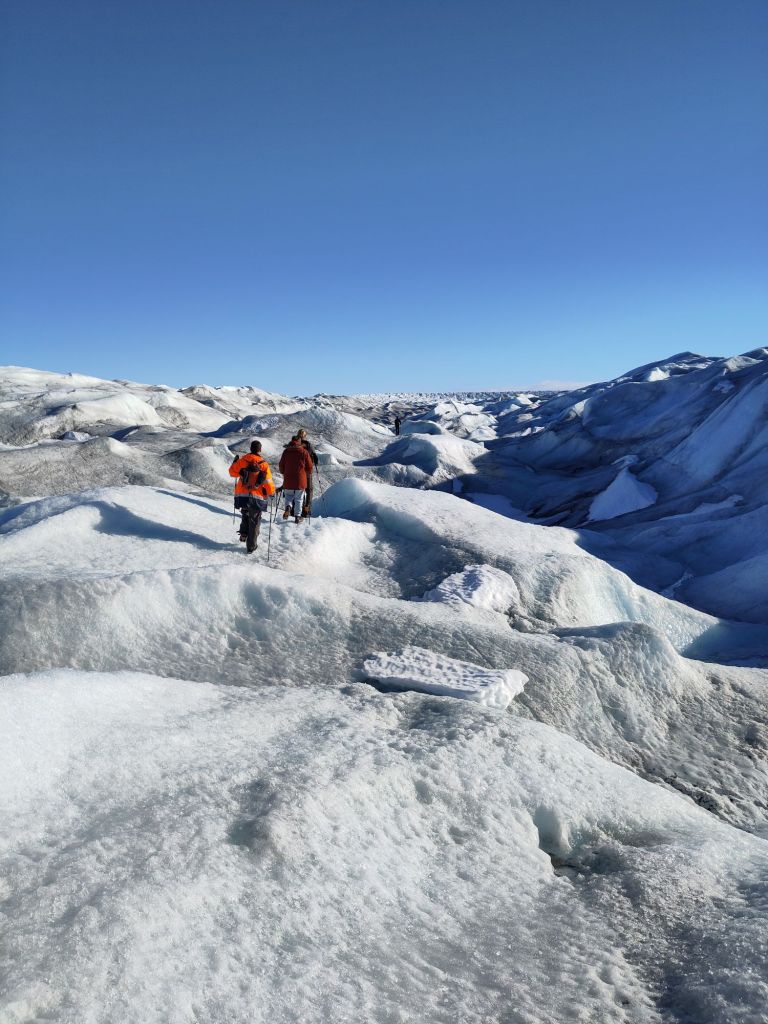
Group field trip the Greenland ice sheet: it’s important to see what you’re modelling actually looks like….

Breaking up is hard to do…

Way back in the mists of time, that is, early April, I and colleagues deployed some instruments on the sea ice in front of a number of glaciers in Northern Greenland, which I wrote a little bit about here.

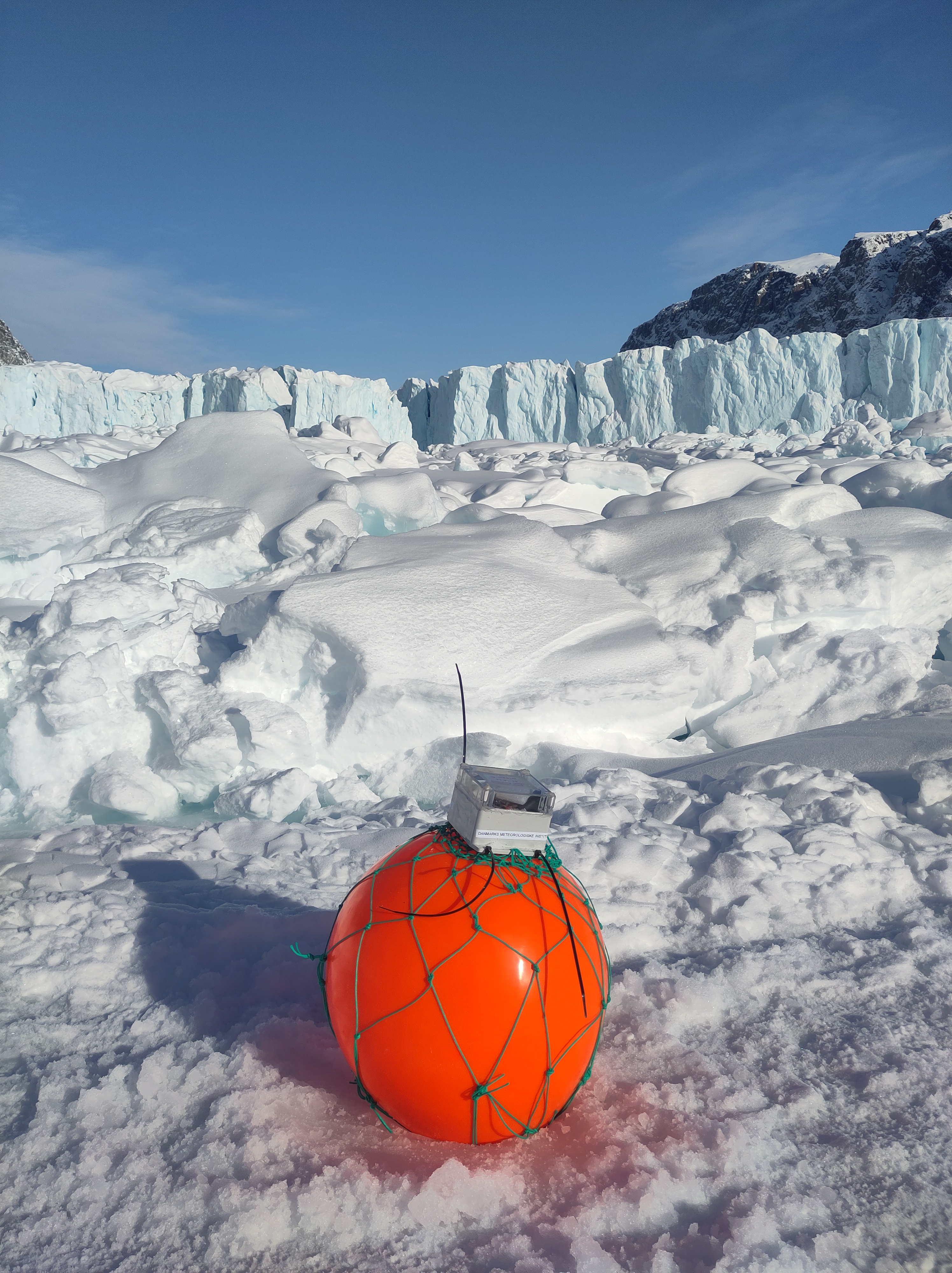
Trusted global GPS tracker buoy
Open met buoy

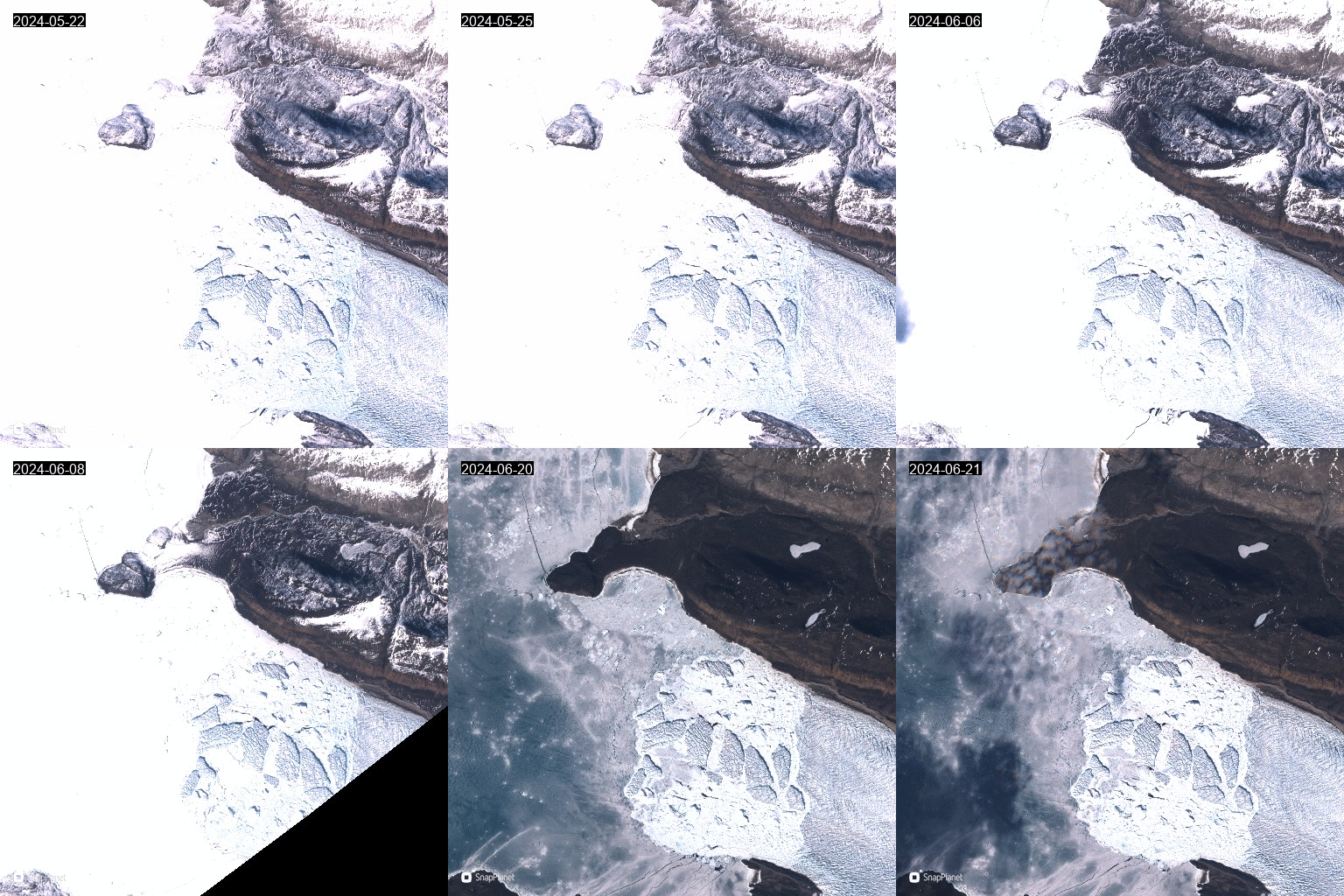
Since then I’ve mostly been letting them get on with reporting their data back and occasionally checking on the satellite imagery to see how it’s looking in their surroundings.

It was about -30C and very cold when I left them out, so it’s sometimes quite hard to visualise just how much things will change over only a few months and to remember that at some point, they’ll need collecting

After a fairly melty start (yes, that is actually a technical term) to July, particularly in the northern part of the ice sheet (which you can see on the polarportal, see also below right) it’s time to start anticipating their collection.

We have a lot of advantages when it comes to coordinating this kind of project now, compared to the bad old days when imagery and communication were both scarce and expensive

For starters, there is Sentinel Hub’s EO browser, a course in which should be a requirement for every earth science adjacent subject in my opinion. EO Browser produces superb pre-processed imagery for free, such as this one, from the European Space Agency’s Sentinel-2 satellite yesterday

As you can see, the sea ice is still there but fracturing and patches of open water (in blue green) are now becoming visible.

Sentinel 2 satellite image processed on EO browser showing sea ice and ice bergs in front of Tracy and Farquhar glaciers.

If you’re out and about and only have your phone, there is also the excellent snapplanet.io app on your smartphone, with which you can create instagram ready snapshots of the planet or even animated gifs, with high resolution imagery a link away…

Now that’s what I call a fun social media* application…

Animated gif of satellite images showing the front of Heilprin glacier with icebergs and landfast sea ice.

Anyway, back to the break up. Every year, the sea ice forms in the fjord from October/November onwards, by December it’s often thick enough to travel on and then from April it starts to thin and melt and by late June large cracks are starting to form, allowing the surface meltwater to drain through. For a look at what happens if you get a large amount of melt from, say, a foehn wind, before the cracks start to open up, see this iconic photo taken by my colleague Steffen Olsen in 2019.

An extremely rare event, that nevertheless went viral

The other advantage we have working in this fjord is our collaboration with the local hunters and fishers. In winter they use dog sleds for hunting and accessing fishing sites, and to take us and our equipment out on to the ice. In summer, they are primarily using boats for fishing, hunting narwhal and, hopefully, collecting our equipment! Our brilliant DMI colleague Aksel who lives and works in the local settlement is also a huge help in assisting with communication and generally being able to get hold of things and people when asked.

Winter travel

We offer a reward for each buoy that is found and brought back to our base in Qaanaaq, so many of them in fact make their own way home. But we also work with our friends on a kind of remote treasure hunt, challenge Anneka style, with someone at home watching their positions come in via the satellite transmissions and sending updated information via sms to an iridium phone to the hunters on the boat…

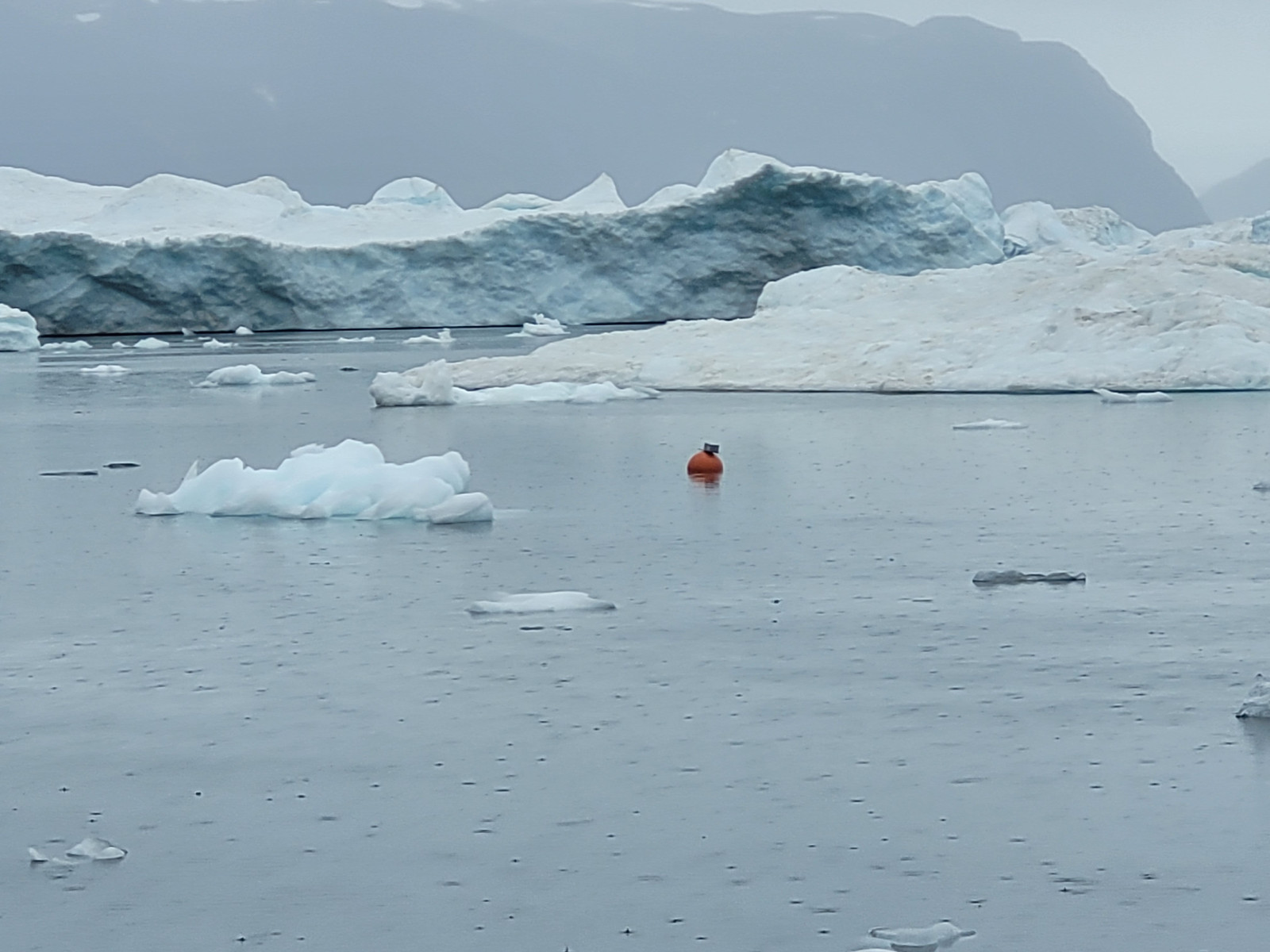
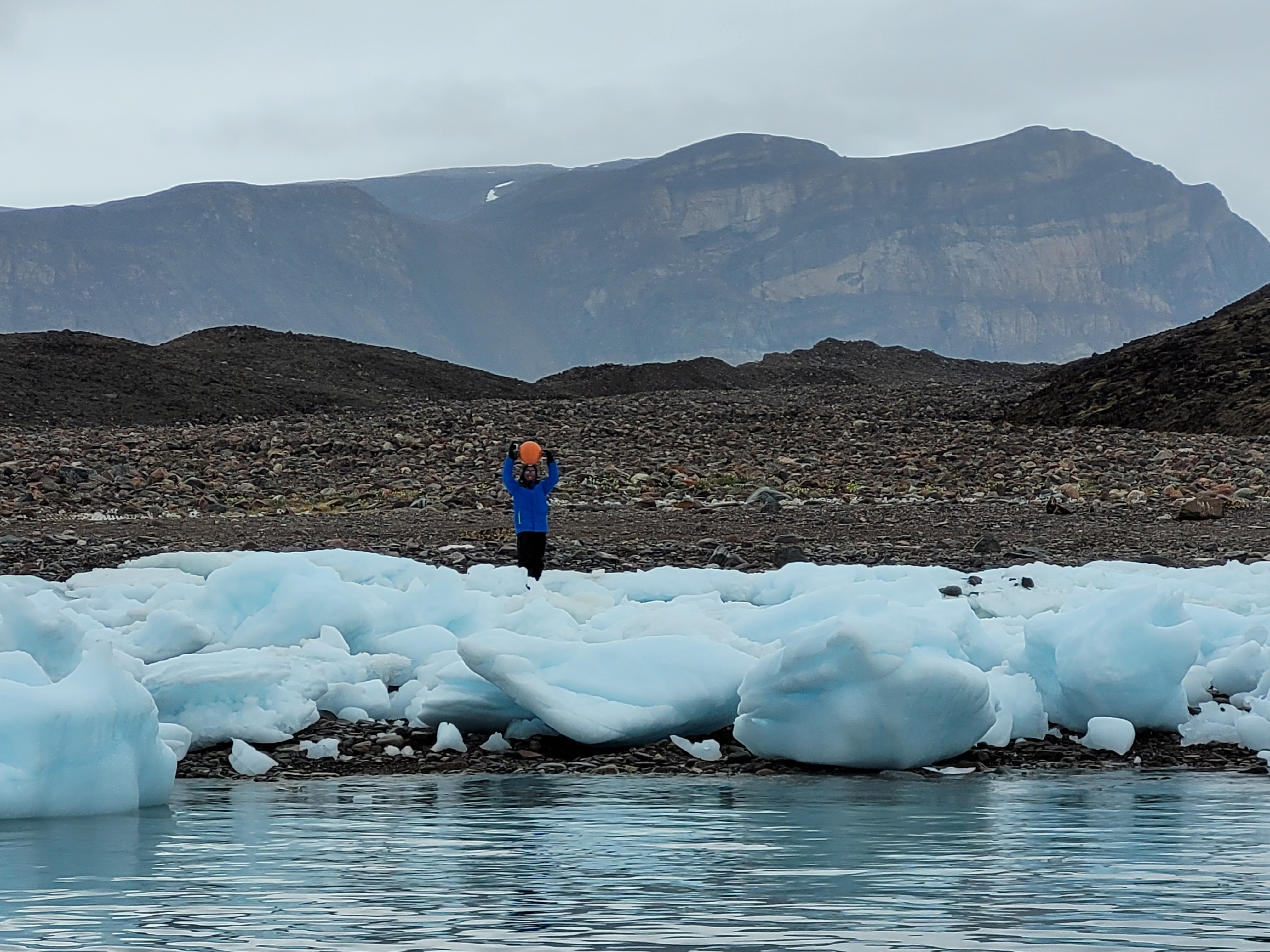
I’m told it’s tremendous fun, with sharp eyes required, as even a bright orange plastic globe can be challenging to spot.

A floating trusted buoy in 2022.

I’ve never participated in this treasure hunt myself sadly, on land we generally see something like a spaghetti of arrows and spots via the Trusted global web api:

GPS positions from a trusted buoy.

We then have to try and superimpose these movements on the latest satellite images to work out if the buoy is floating or not, and then check to see if there is sufficient open water for a collection. Naturally working with local knowledge for this part is also absolutely vital.

One of our buoys is found…

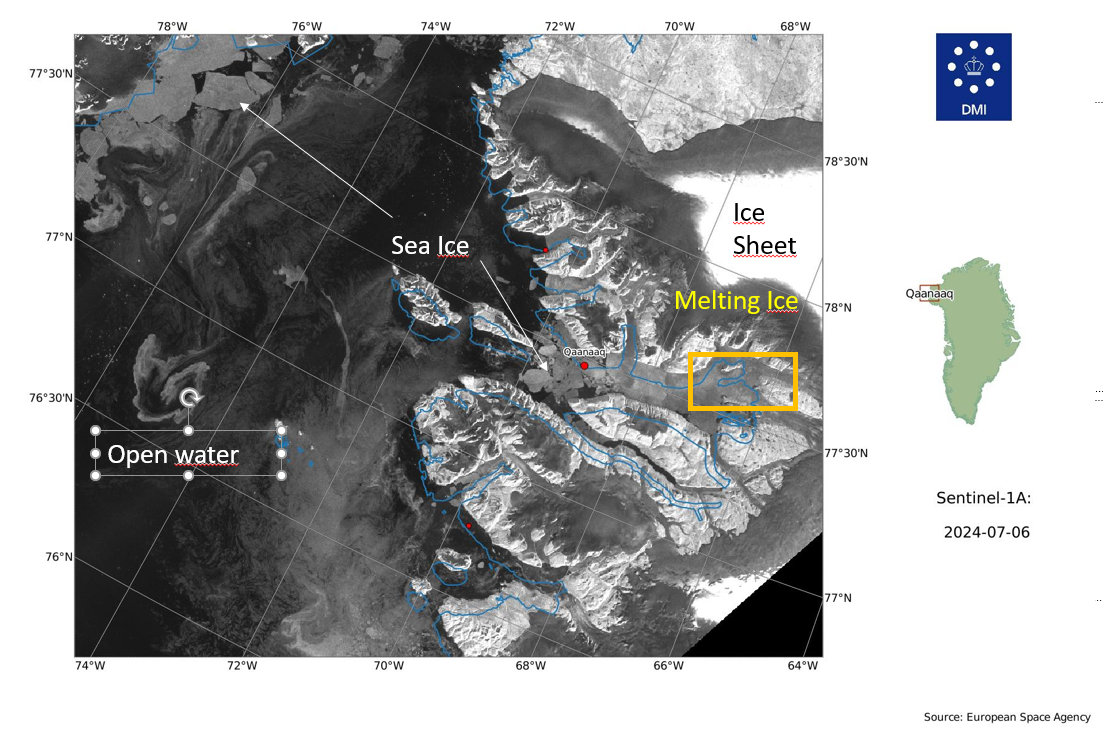
The latest satellite images look like the ice has already broken up into large flakes close to Qaanaaq. I’ve annotated the Sentinel-1 image below as it is from a radar satellite that can see through clouds and the images can be a bit confusing if you’re not used to looking at them.

The scale of the massive melt on the ice sheet from the last few days is clearly visible in the dark grey rim on the glaciers. The open sea water is black and the sea ice shows up as geometric greys. This one is downloaded from the automatic archive my colleagues at DMI maintain around the whole coast of Greenland. It can be a handy quick check too.

Annotated satellite image of Kangerlussuaq/Inglefield Bredning (Gulf of Inglefield) fjord. The orange box shows where our study glaciers are located.

So, although the ice is starting to break up it’s at the tricky stage where it’s far from navigable by dog sled and certainly too difficult for boats, so it’s not quite the time to send out hunting parties for GNSS buoys.

It also means that when I go on holiday next week, I will not be quite leaving all this behind. I and my colleague in this project will be monitoring the movements of the buoys and the satellite pictures, as well as relying on our friends in the local community to let us know how the ice is looking and if they can get out to rescue our brave little sensors.

In the mean time I have plenty of data to start analysing and writing up. As ever massive thanks to the people of Qaanaaq and my cool colleagues for putting up with me and our GPS buoys. We hope to submit our first paper pretty soon..

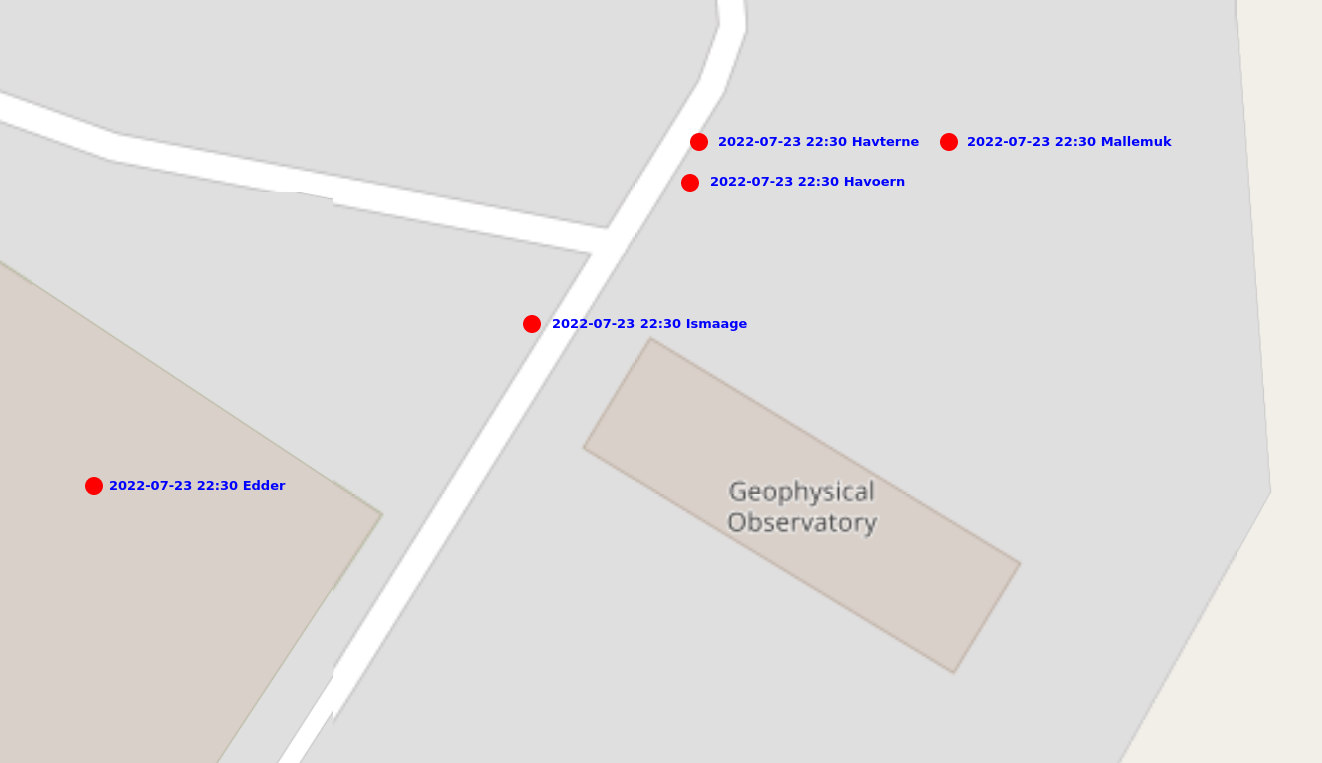
Hopefully I’ll soon be able to look at a map like this one to see where they are (note that the precision on these buoy positions isn’t great, probabaly because they were thenbeing stored in a metal container).

*Yes, I’m probably a nerd. I’m a lot of fun** at parties too though.

**For a given value of “fun”.

Icebergs of Ilulissat

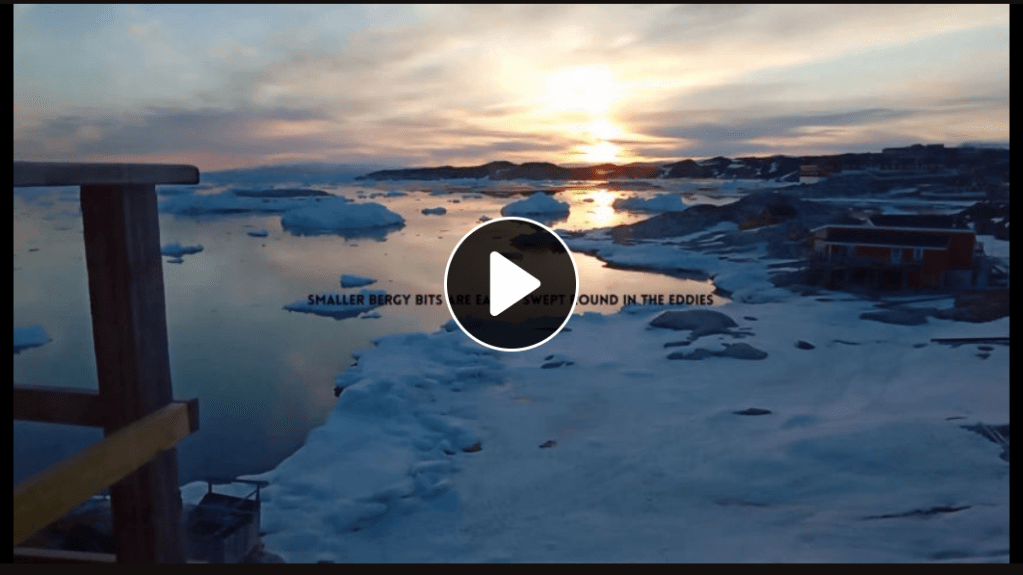
Icebergs in Ilulissat drift around the bay, sometimes fast, sometimes slow, sometimes they don’t move at all. They are drenched in the beautiful but sometimes stark light of the polar day. It’s scientifically interesting to watch them and speculate on their past trajectory and their likely future. It’s also extremely beautiful.

I’m once more on my way north to Qaanaaq, but this time I’ve been lucky enough to be able to enjoy some days off in Ilulissat. It’s an astonishing beautiful place, famous for the icebergs that come pouring out of the Ilulissat ice fjord just round the corner.

Normally, we’re only in town for one night as we have to switch planes to get to our field sites and this requires an overnight stay so it has been brilliant to be able to use a little holiday here.

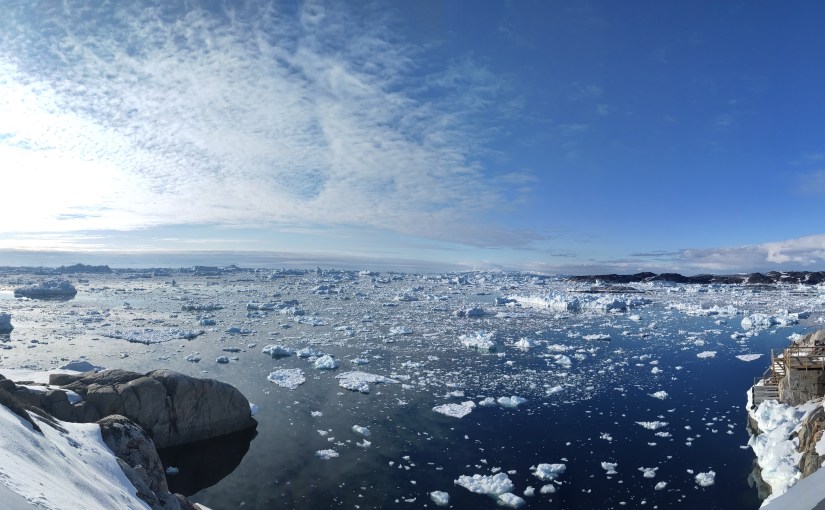
Panorama over the bay in Ilulissat on a sunny evening

I have been using the time to work on some papers and try to clear some of the back log of reports and emails, but there has at least been some time for a couple of hikes in the back country nearby. I could post several hundred photos of icebergs and other magnificent views, but I was struck by the movement of icebergs in the bay outside my window while I was working yesterday.

Sometimes the big bergs seemed to move more, sometimes they seem stuck. I wanted to check this so I set up a time lapse on my tablet in the window of the guest house I’m staying in overnight (bearing in mind it’s the Polar Day so doesn’t actually get dark). I think it actually ran out of power before covering the full six hours I set it up for, so I’m now trying a full day. However, it was enough to show my perception was basically right and I have come to the conclusion the changing movement is related to the tides.

You can see the full almost a minute long film at my peertube account below.

This is also a bit of an excuse to play around with video editing a little, in this case I’m trying out canva, and to advertise my peertube account @icesheets_climate on TILvids.com.

As I’ve alluded to before, I’m trying out the non-corporate social media fediverse and it’s actually quite fun, though the videos are a bit time-consuming so I’m not quite sure how regularly I will manage to post these on my channel, but the clue is in the name on what most of them are about I guess…

Another iceberg near Ilulissat, this time one we visited by boat…

But I have gratuitously many photos on my pixelfed account and no doubt more to come. I’m also planning some icebreaker shorts describing different elements of the environment that I’m working on. We’ll have to see how much time I have to actually get those finished, they typically take a while!

Of course, these are not just pretty pictures – I have a professional interest in icebergs – my PhD was about ice fracture and applying models of crevasse formation to describe a new parameterisation of calving. One of the projects I’m working on in northern Greenland, (funded by the danish state through the National Centre for Climate Research, NCKF) is also focused on calving processes, and specifically the role of ice melange in the system. In fact, one of the papers I’ve been working on this week analyses those iceberg related datasets. It’s immensely valuable and rare that I have the opportunity to be able to focus on the process in the field at the same time as writing the paper.

I have 2 more days in Ilulissat, so no doubt there will be more walks around town and more iceberg photos, but I have sent the iceberg paper back to my co-authors now, so it’s time to focus on a new paper – and the climate of the polar regions in the future.

The Greenland ice sheet

Local sea level rise: A question of gravity

I’ve explained several times in the course of media comments that, when it comes to the sea level rise that you experience, it really matters where the water comes from. This point still seems to cause confusion so I’ve written a super fast post on it.

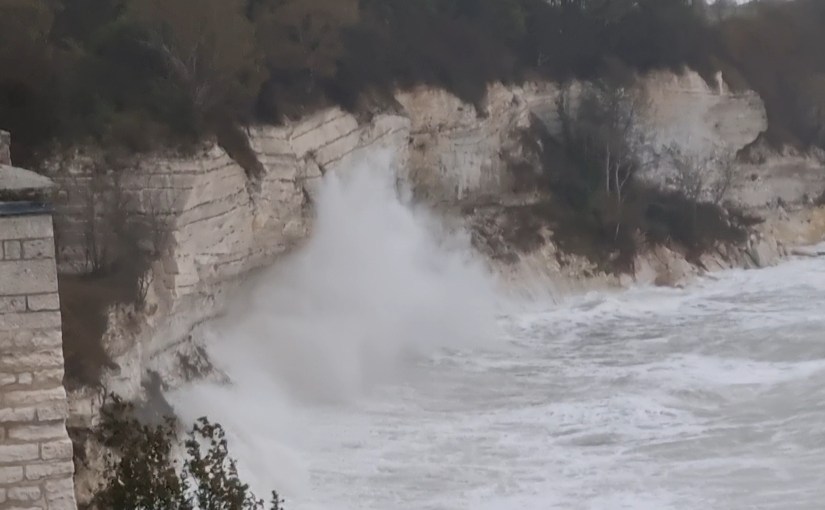
Waves from the Storm Surge that hit Denmark in October 2023 credit: Sebastian Pelt

We very often talk about a metre or two of sea level rise by the end of the century, but in general that refers to global average sea level. And much like a global mean temperature rise doesn’t tell you very much about the kind of temperature changes you will experience in your location due to weather or climate, global mean sea level is also not very informative when talking about preparing your local community for sea level rise. There are other local factors that are important, (see below), but here I’m going to mostly focus on gravity.

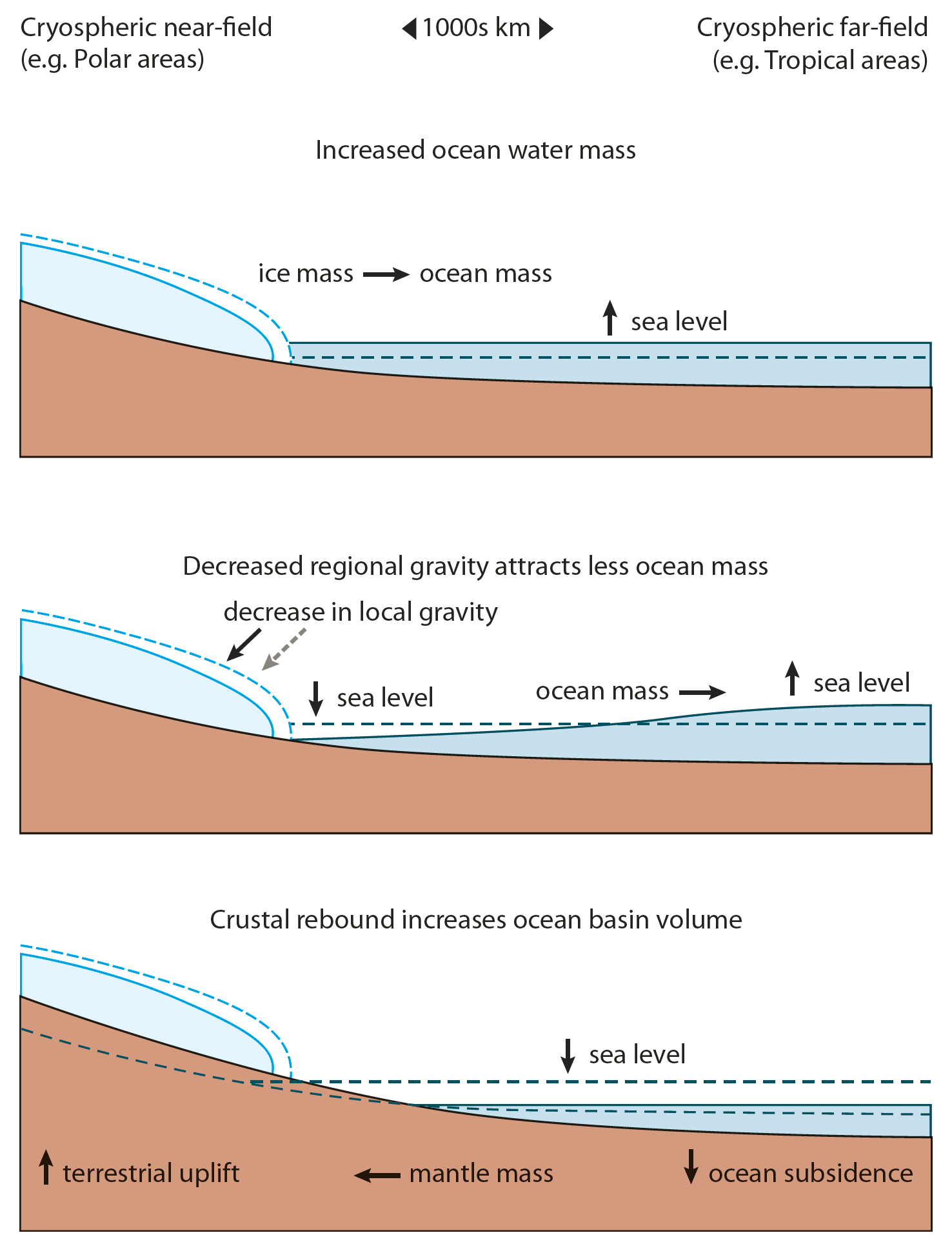
Imagine that sea level is more or less stable around the earth (which it was, more or less, before the start of the twentieth century). Just like the moon causes tides because its gravity exerts a pull on the oceans, the ice sheets are large masses and their gravity also attracts ocean water, so the average sea level is higher closer to Greenland and to Antarctica. But there is only a finite volume of water in the oceans, so a higher sea level close to the ice sheets means lower sea levels further away in the tropics for example.

As the ice sheet melts and gets smaller, its gravitational pull becomes smaller so the average height of the sea around Greenland and Antarctica is lower than it was before, but the water gets redistributed around the earth until it is in equilibrium with the gravitational pull of the ice sheets again. The sea level in other places is therefore much higher than it would have been without that gravitational effect.

And in general, the further away from an ice mass you are, the more these gravitational processes affect your local sea level change. In Northern Europe, it often surprises people (also here in Denmark) to learn that while Greenland has a small influence on our local sea level, it’s not very much because we live relatively close to it, however the loss of ice from Antarctica is much more important in affecting our local sea level rise.

Currently, most of the ice contributing to sea level is from the small glaciers around the world, and here too there is an effect. The melt of Alaska and the Andes are more important to our sea level than the Alps or Norwegian glaciers because we are far from the American glaciers but close to the European ones.

This figure below illustrates the processes:

Processes important for local sea level include changes in land height as ice melts but also the redistribution of water as the gravitational attraction of the ice sheets is reduced. The schematic representation is from the Arctic assessment SWIPA report Figure 9.1 from SWIPA 2017

This is partly why the EU funded PROTECT project on cryosphere contributions to sea level rise, which I am currently working on, has an emphasis on the science to policymakers pipeline. We describe the whole project in this Frontiers paper, which includes a graphic explaining what affects your local sea level.

As you can see, it very much depends on what time and spatial scale you’re looking at, with the two ice sheets affecting sea level on the longest time scales.

Figure 1 from Durand et al., 2021 Illustration of the processes that contribute to sea level change with respect to their temporal and spatial scales. These cover local and short term effects like storm surges, waves and tides to global and long-term changes due to the melting of ice sheets.

In the course of the project some of the partners have produced this excellent policy briefing, which should really be compulsory for anyone interested in coastal developments over the next decades to centuries. The most important points are worth highlighting here:

We expect that 2m of global mean sea level rise is more or less baked in, it will be very difficult to avoid this, even with dramatic reductions in greenhouse gas emissions. But the timescale, as in when that figure will be reached, could be anything from the next hundred years to the next thousand.

Figure from PROTECT policy briefing showing how the time when average global sea level reaches 2m is strongly dependend on emissions pathway – but also that different parts of the world will reach 2m of sea level rise at very different times, with the tropics and low latitudes in general getting there first.

What the map shows is that the timing at which any individual place on earth reaches 2 m is strongly dependent on where on earth it is. In general lower latitudes close to the equator will get to 2m before higher latitudes, and while there are ocean circulation and other processes that are important here – to a large extent your local sea level is controlled by how close to the ice sheets you are and how quickly those ice sheets will lose their ice.

There are other processes that are important – especially locally, including how much the land you are on is rising or sinking, as well as changes in ocean and atmosphere circulation. I may write about these a bit more later.

Feel free to comment or ask questions in the comments below or you can catch me on mastodon:

Celebration time: PRECISE

Quick update: our project website is now live where updates will be posted as we go…

The news is now officially out: I’m really delighted to announce the funding of our large project, PRECISE, by the Novo Nordisk Foundation.

The project is led by Professor Christine Hvidberg at the Niels Bohr Institute and there is a really nice interview with her on their website about our plans that’s worth a read. I’m co-PI and lead on surface mass balance processes and coupled climate models within the project so I thought it might be worth giving a quick overview of what we hope to achieve.

TL;DR? We will be improving estimates of and assessing the uncertainties in sea level rise projections from the two big ice sheets in Greenland and Antarctica.

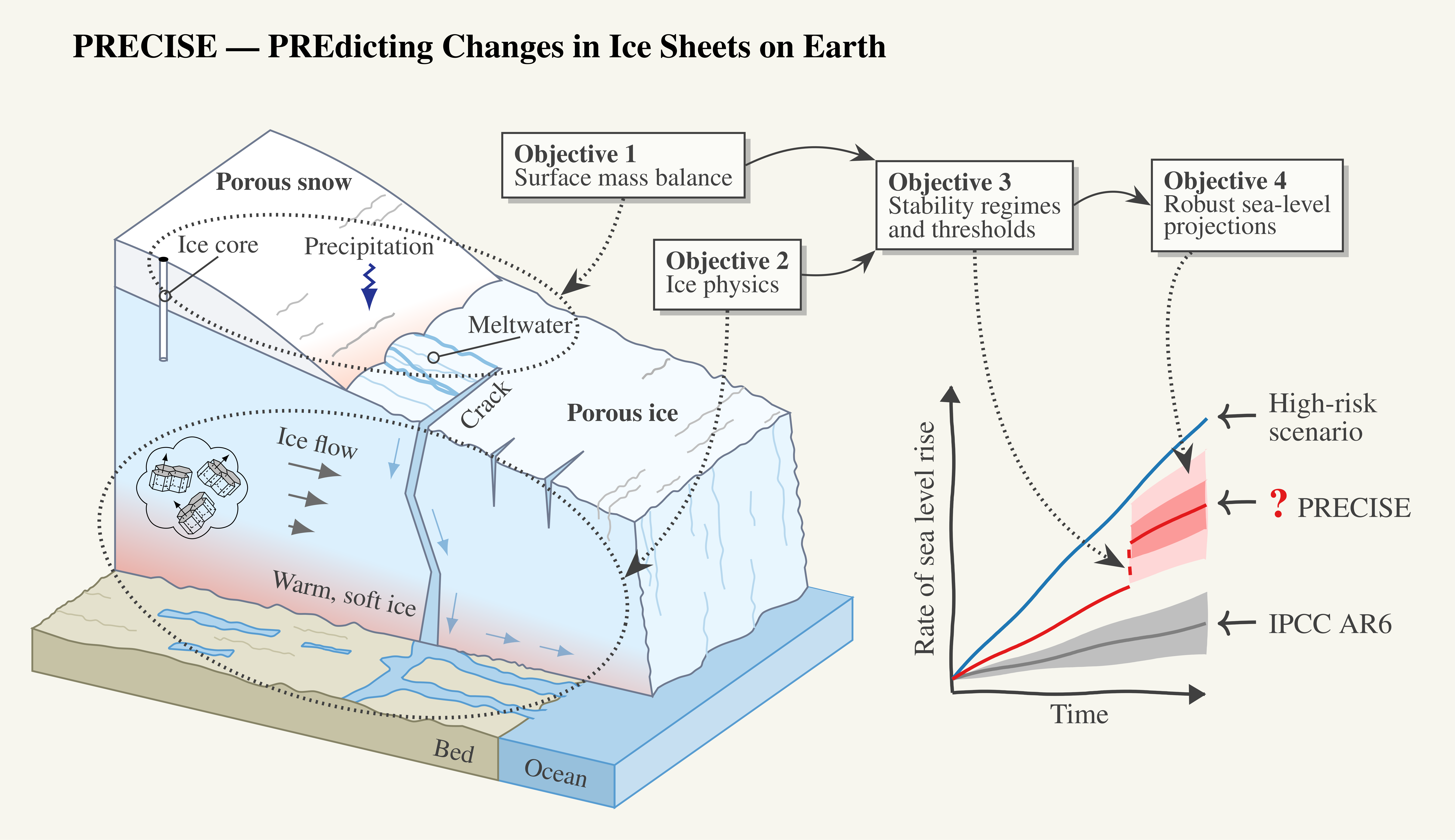
Every science proposal has a graphic like this somewhere showing how the whole project hangs together.
This is ours…

Slightly longer version: we’re using new approaches from materials science to incorporate “new” physics in ice sheet models. We’re also integrating in-situ observations and satellite data into our model frameworks and using these to train machine-learning tools. My work package will emulate our physics based numerical climate models to expand the ensemble and generate a statistical approach for assessing ice sheet stability as well as investigating important feedbacks between different elements of the earth system. Finally, we (or rather my colleague Christian Rodehacke and his postdoc) will run our coupled climate – ice sheet model (EC-EARTH-PISM), including these advances, to generate new sea level rise projections.

The outputs from all these experiments will be communicated and developed in collaboration with the Danish Klima Atlas (Climate Atlas) to ensure we are focused on the right kind of data and time periods for use by stakeholders and local populations when it comes to adaptation planning.

Current projections of change in average sea level around Denmark from the klima atlas

So why this project?

One of the most iconic images to come out of the last IPCC 6th asessment report (at least in my little corner of the climate science universe) is this one on sea level rise projections out to 2100.

Much of climate science has, at least to some extent been “solved”. At least in the sense that we understand the mechanisms and processes quite well and the remaining uncertainty is to some extent tinkering around the edges, often bound up with uncertainty on scenario, or related to impacts – there’s still quite large uncertainty on what will happen to the Amazon rainforest at different levels of emissions for example. However, sea level rise is really an exception to this. It’s very difficult to be sure that some very unpleasant surprises are really implausible.

We’re reasonably certain that global mean sea level will rise by at least 2 metres and around a metre by the end of this century with further sea level rise likely to continue perhaps for centuries.

The IPCC for example, concluded that sea level rise of 15 metres or more by 2300 can’t be ruled out, even if it seems rather unlikely. And this poses a pretty large problem to planners, politicians, stakeholders and providers of coastal services. Working out how far and how fast we expect the sea to rise is really our challenge.

But there is also a risk of abrupt and extreme sea level rise that could come round the corner to surprise us. However, it’s hard to know how likely this is or even how to evaluate that risk.

This has become something of a theme for me in the last few years. I have been working on the Horizon 2020 project PROTECT which very much focuses on the cryosphere and sea level rise, and I’m coordinating Horizon Europe’s OCEAN:ICE which focuses much more on the influence and feedbacks between Antarctic ice sheet and ocean.

Where PRECISE differs is that we have the flexibility within this project to develop new and innovative techniques that we’re not quite sure will work: especially the development of machine learning tools.

The EU science budget is a brilliant thing, but risky research is difficult to get through, the Move Nordisk challenge centres allow us to try really new and, yes, risky techniques. Though climate is a new topic for them, so we’re very much test bunnies in this new phase of funding science for them.

So what are we going to be doing practically?

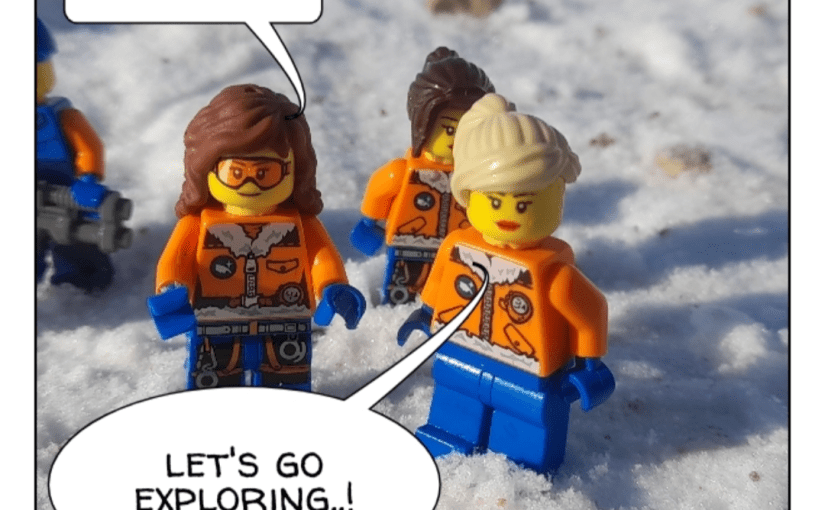
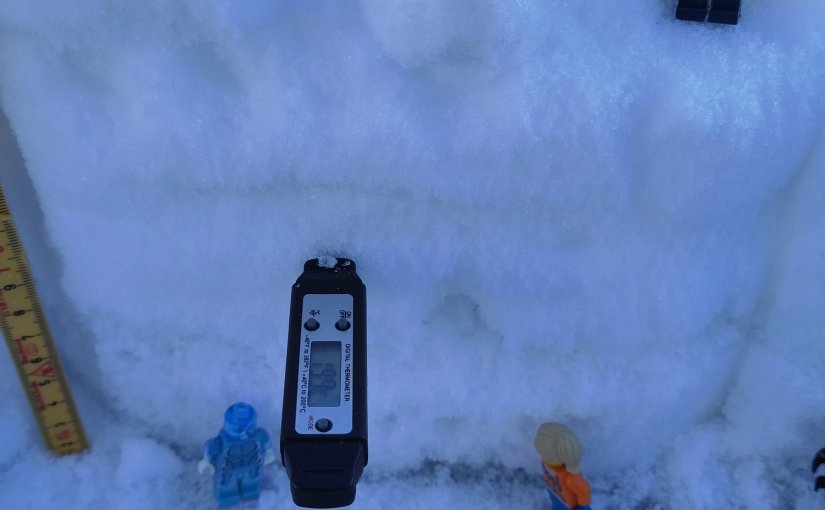
Measuring snow pack properties in Greenland, with the help of the Lego scientists..

Our partners at NBI include Joachim Mathiesen, Helle Astrid Kjær, Aslak Grinsted and Nicholas Rathmann. They will be focusing on assembling field data from both ice sheets, and developing new physical solutions for ice sheet models based on solutions from materials science. They will be looking at phase field approaches for ice flow, at new solutions for calving and ice fracture and integrating these into ice dynamical models. NBI will also be doing fieldwork to collect new surface mass budget (SMB) data from the ice sheets.

A new ice fracture appears, how to understand and model these is a key part of the NBI contribution in PRECISE project.

The SMB part of the work is part that I’m especially involved in. Not just in modelling SMB with our climate and weather models as we do on the polar portal but also in getting a much better understanding on the uncertainty in these models associated with precipitation (which is much higher than that associated with e.g. temperature, especially when it is snowfall). So new observations with a high time resolution will be key for improving our current snowpack models.

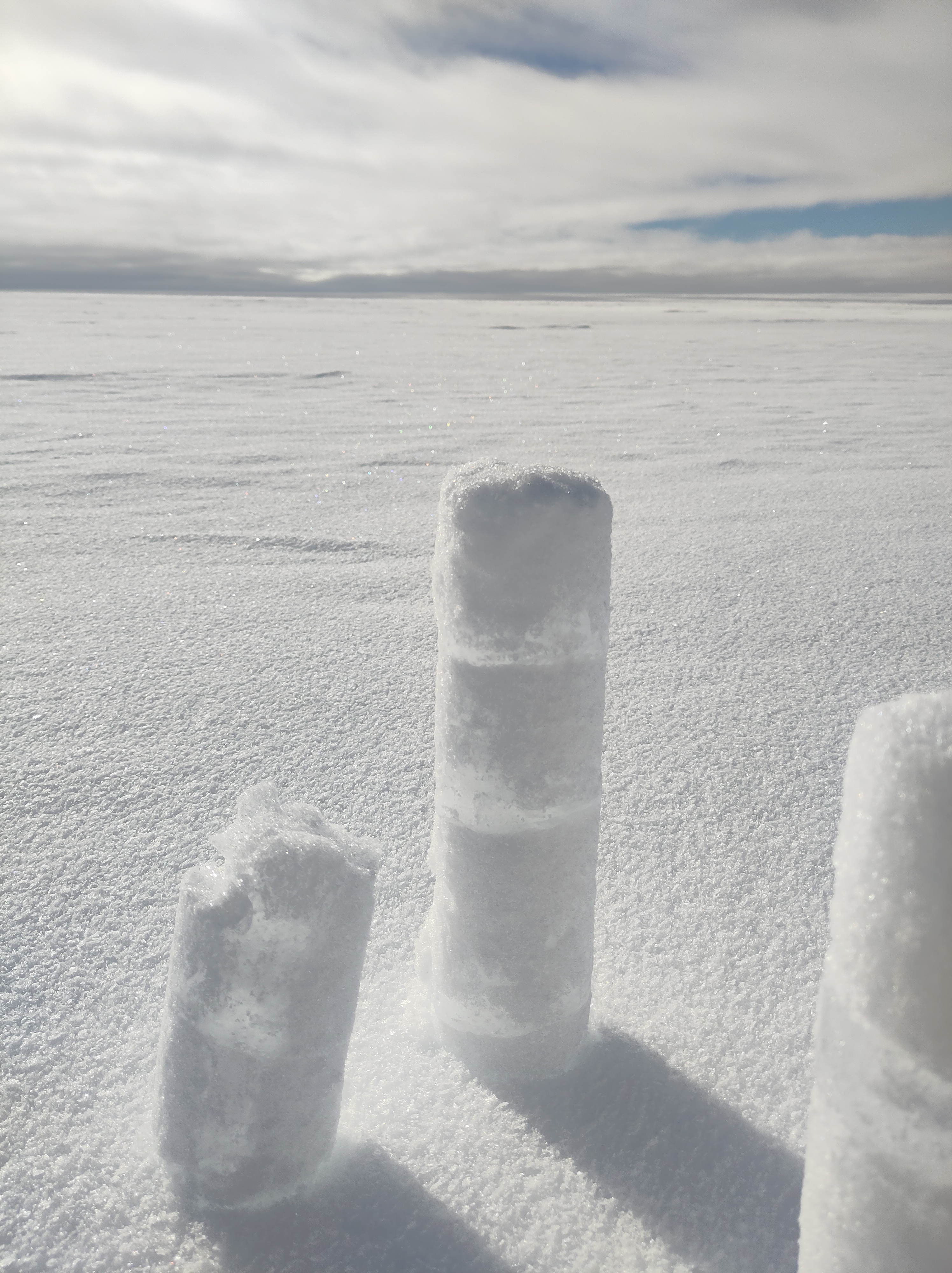
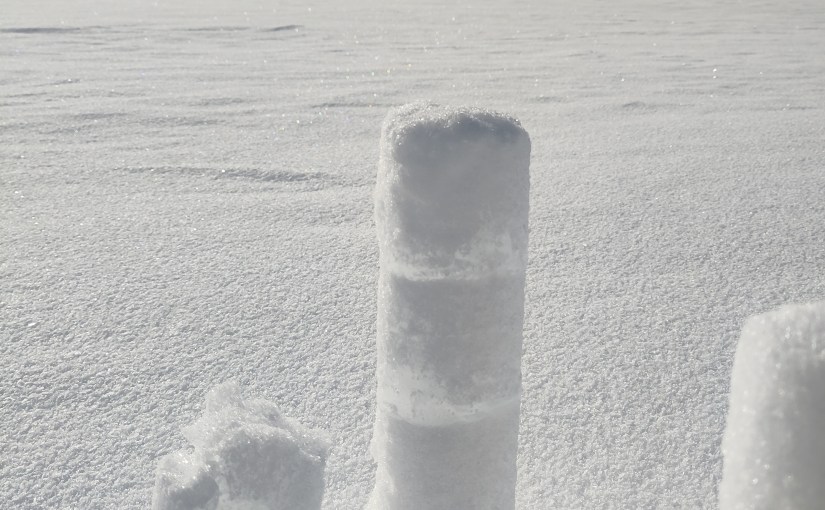
A shallow ice core, in this case sea ice, but part of the fieldwork will focus on taking more of these samples and doing isotope analysis on situ to get high quality data on snowfall accumulation

We will also be working on bringing regional climate emulators into use over both ice sheets to see how varying starting conditions will vary the outcomes. We know that on a chaotic system like weather starting conditions are key and emulators allow us to do many many more experiments than with our physics based numerical codes alone. It’s pretty cutting edge stuff right now but I know several groups are working on this – including this fantastic paper that recently came out of the Delft/Leuven group, which really shows what is possible

Our other collaborator, Hilmar Gudmundsson at University Northumbria Newcastle will be working on implementing these processes in ice sheet models and examining how plausible instability in ice sheet simulations is using ensembles of multiple model simulations. They will also be using and developing their ice shelf emulator to look at basal melting and investigating the potential instabilities in Antarctic ice shelves that could lead to abrupt sea level rise.

Finally, bringing it all together, our EC-Earth-PISM model will be deployed to do coupled climate and ice sheet simulations to see how the two ice sheets influence each other. This work will mostly be supervised by my DMI colleague Christian Rodehacke.

The project will receive 42 million Danish kroner in total (about 5 million euros) of which 8 million dkk will fund work at DMI, work to be carried out by 2 postdocs and a PhD student (so if this sounds like something you’d be interested in working on do get in touch) over the next 6 years from September. In fact most of the funding we have received will go directly to early career scientists, there is nothing in the budget for us seniors! Naturally this has some disadvantages, but given the rapidly aging population within Europe and European science, I see it as a positive and we have lots of cool summer schools, bootcamps and other networking activities planned that will hopefully reach out beyond PRECISE to the rest of the ice sheet – climate community.

So watch this space…

Q is for Qaanaaq

Back in Denmark after 2 weeks in Greenland. Always a bit strange to come back, not just that transition from Arctic cold to European Spring but the sheer abundance of the fertile mid-latitudes, colours, plants, trees, the sheer number of people.

Not to mention that expedition frame of mind, where you are really focused on accomplishing a given set of often quite complex tasks (almost) without distraction. It is the ultimate deep work task, and naturally readjusting to family life, not to mention the tsunami of work tasks left on hold is… difficult.

This particular deep fieldwork has been carried out in Qaanaaq, Northern Greenland, as I’ve written about before. The community of about 600 people (and maybe a 1000 dogs), was established in the 1950s when the US established the Thule air base. It is almost the most northern settlement in Greenland – and certainly the largest. The small village of Siorapaluk is about 45km (or 6 hours by dog sled) further away.

The town was formerly a summer hunting spot, but after Thule was decided on, the community was moved to Qaanaaq year round. It has an association with the famous Danish explorer Knud Rasmussen, whose old house is a museum (allegedly. I’ve never actually had time to visit it..)

DMI established a geomagnetic observatory there in the 1950s and today its part of the Comprehensive Test Ban Treaty Organisation network that DMI operates on behalf of the Danish government from what we now call the DMI geophysical facility. There is transnational access to this via the INTERACT network.

This year we again visited the glaciers at the head of the Inglefield Fjord – expanding a new research programme we piloted last year. We also did a lot of work on the sea ice – not just Steffen Olsen‘s ocean programme, but a new NCKF research programme looking at biological productivity and carbon cycling in the fjord, led by Anna Pedersen, a DMI PhD student also at the University of Southern Denmark. I and another colleagues also did a lot of work on snow processes that is something of a pilot programme for a processes project we’d like to establish next year that will also involve (hopefully) our weather forecasting colleagues and perhaps also the GEUS PROMICE programme.

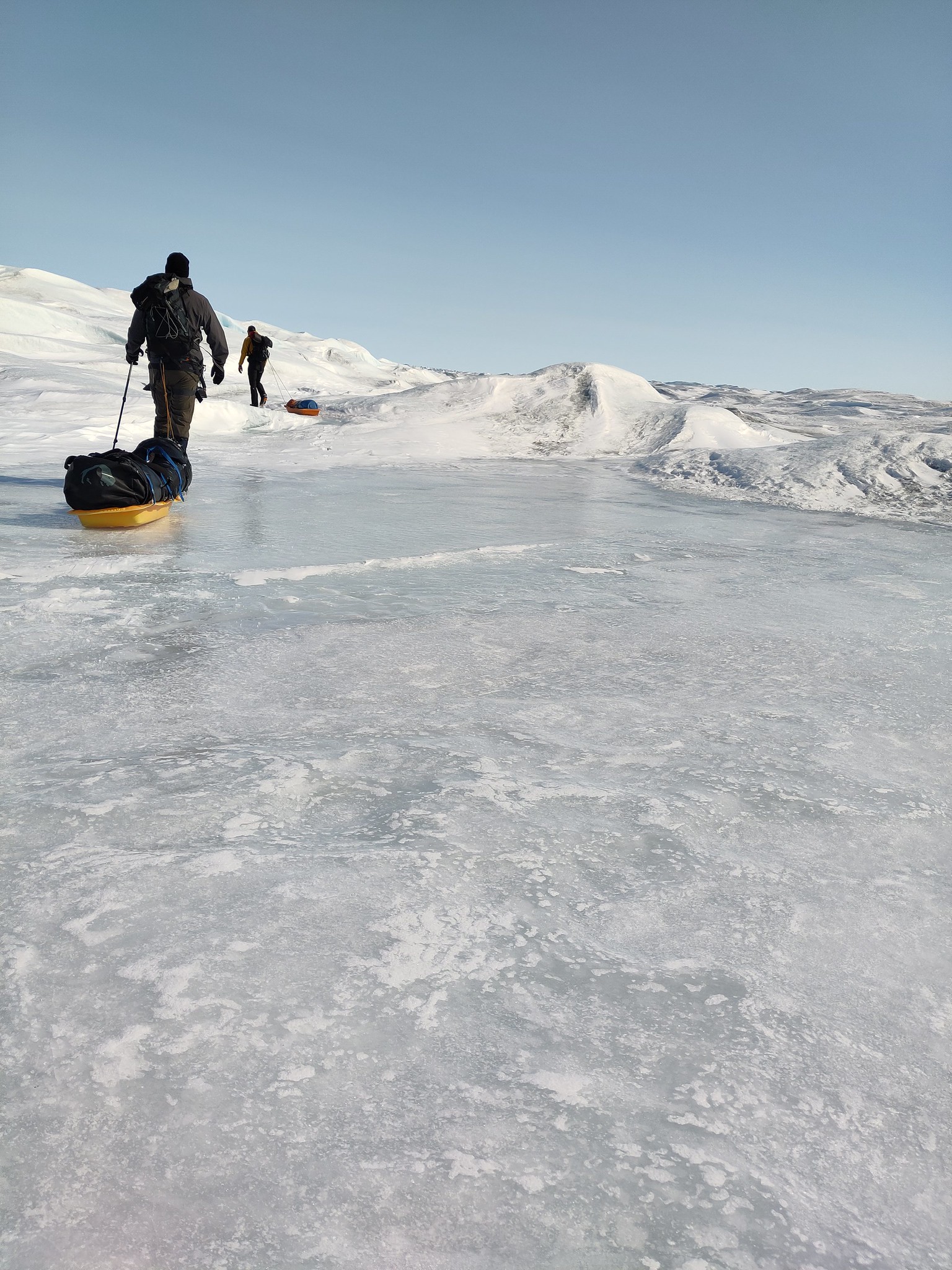
All of this work involved 6 days of travelling over and camping on the sea ice, plus an additional day trip. We were lucky with the weather, although it was *extremely* cold, around -25 to -28C most days, and dipping well below -30C at night (though being after the equinox it was never truly pitch dark). However, in general there was little wind, no fresh snow (which can really slow the dogs down as they struggle to pull through deep soft snow) and the sun shone every day. This meant we basically managed to achieve the full planned programme – including our extra-optimistic goals – which almost never happens in fieldwork.

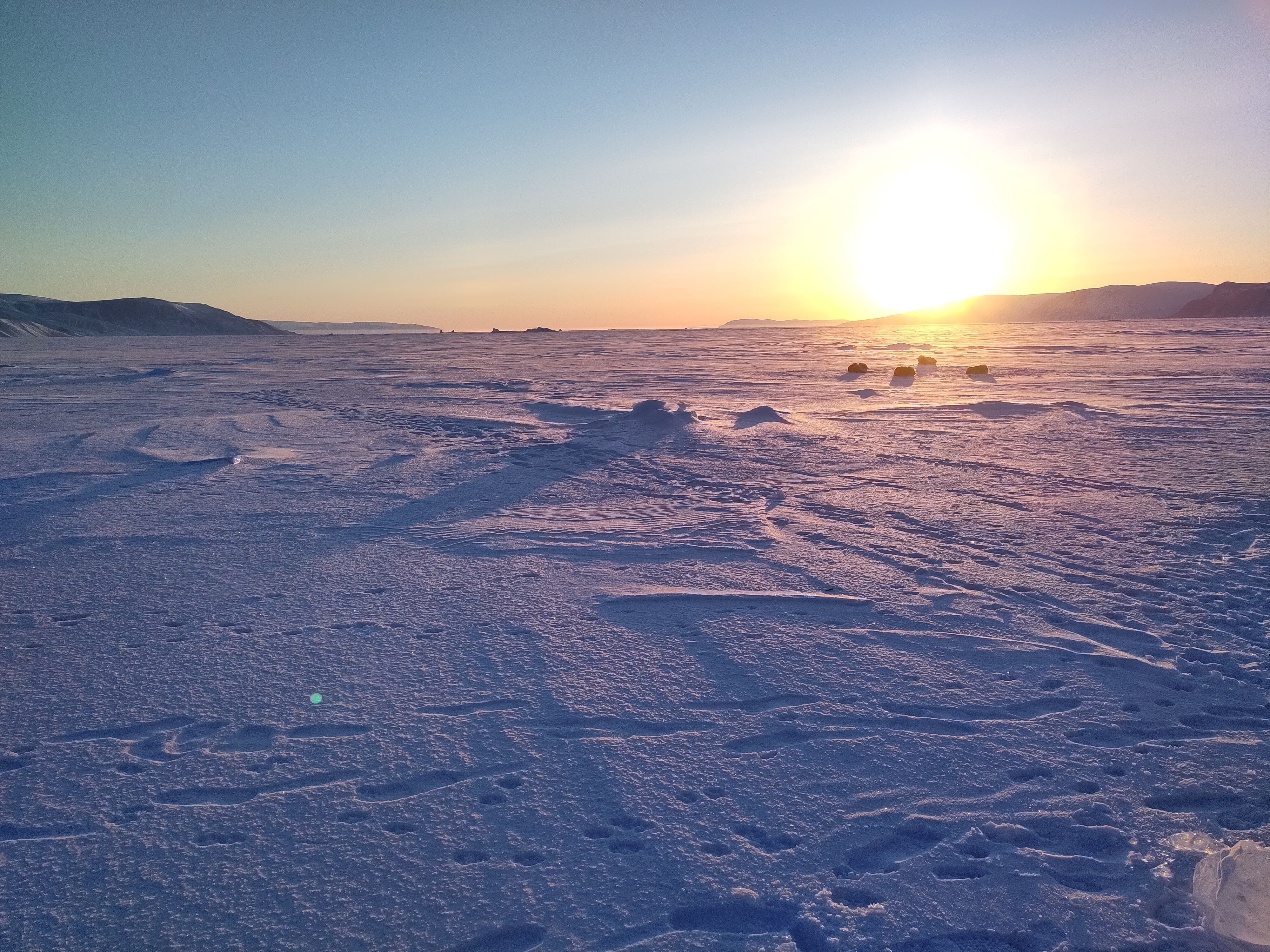
Camping on the sea ice at sunset. Northern Greenland
This work by Ruth Mottram is licensed under a Creative Commons Attribution-NonCommercial-ShareAlike 4.0 International License.

I intend to write a whole series of posts based on what we have been doing scientifically and technically as well as some general observations. There have been various hints already in my preferred social network. The whole trip was super inspiring, it’s always valuable to get out and observe the real world when you’re trying to model it, understand it and make projections of sea level rise.

I also promised to make another Lego scientists series and took quite a few photos in between times to do so. However, the research programme was packed, so I had no time at all to make the comic during fieldwork, that will have to wait a few weeks.

Expect my pixelfed account to host gratuitous numbers of dog pictures. And ice pictures. And unexpectedly clear blue skies. For now it’s time to unpack, get the washing machine going and spend some time with my family.

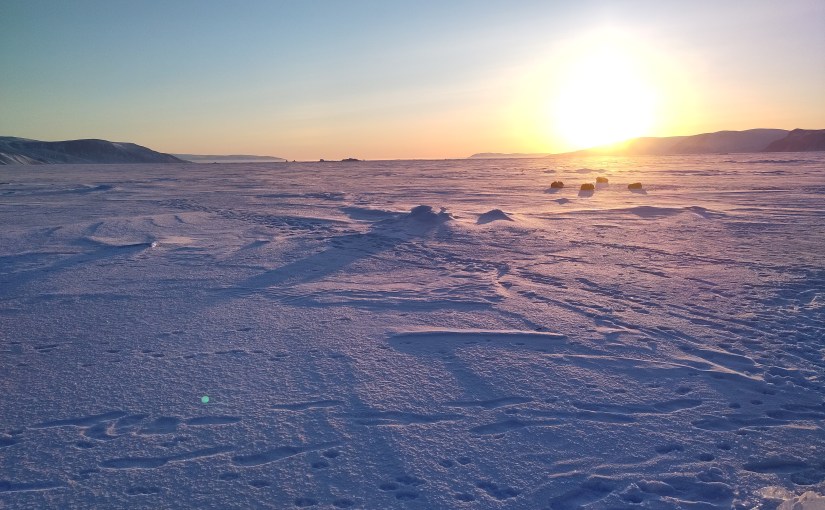
Sunset over sea ice near Qaanaaq, North West Greenland
This work by Ruth Mottram is licensed under a Creative Commons Attribution-NonCommercial-ShareAlike 4.0 International License.

As ever, thanks to my amazing colleagues Steffen Malskær Olsen, Andrea Gierisch and Anna Pedersen for an incredible trip and to DMI station manager in Qaanaaq Aksel Ascanius without whom most of this work would be impossible.

Special thanks to our friends in Qaanaaq, the local hunters, whose unfailing energies and knowledge are absolutely essential to these scientific projects. We literally could not do this without them and of course their dogs.

I must also credit DMI and the Danish Government for funding via the National Center for Klima Forskning and thanks also to Horizon Europe projects PROTECT on sea level rise and PolarRES for additional inspiration and funding and to my colleagues at the Horizon Europe/NERC project OCEAN:ICE for indulging my two weeks away. All three projects will benefit from the insights gained in this fieldwork.

The further adventures of batgirl…

I wrote this series of comics to amuse and inform my kids while I was on fieldwork a few years ago. It turned out to be quite a success and my kids classes both read the Danish versions at their school.

Last year I started https://icemangoeshome.wordpress.com/more-arctic-adventures/ the further adventures of batgirl on the ice with her new friends the Lego scientists and a couple of stowaways.. but last year’s season was extremely busy and I never managed to finish it.

I asked yesterday on mastodon if I should do another this year, and the only feedback I got was I should try to finish the one I started last year. So maybe that’s what I’ll try to do. It’s always challenging fitting around field tasks though so no promises.

This is just a quick post from the airport: you’ve been warned, bat girls and her friends are on their way back with a new season!

A New Arctic Adventure

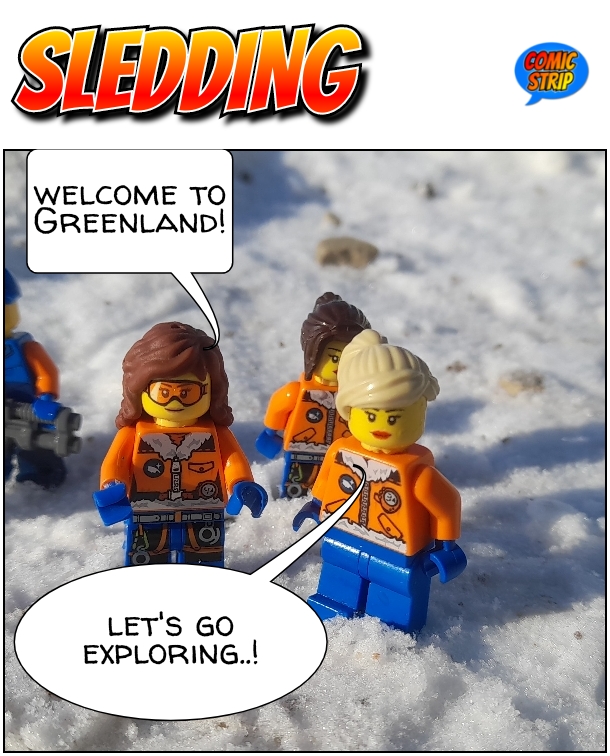
Lego figures in the snow

Signs of Spring

Currently, I’m very busy getting ready with colleagues to travel to Greenland next week. We have an extremely full programme of fieldwork activities covering oceanography, biology, sea ice, snow and glacier processes as part of our NCKF work. More on these no doubt in a future post…

Yesterday, one of my ace DMI colleagues (without whom most of the work we plan would definitely not happen) shared the first optical satellite image of the area this year – taken by ESA’s Sentinel 2 (a truly astonishing source of free imagery and everone should know about it). Because the area is very far north, it has been in the Polar night until now so we have been reliant on the ESA Sentinel 1 imagery based on radar.

First Sentinel-2 optical satellite image of the year downloaded from Sentinel Hub’s EO Browser today. Processing with Sentinel Hubs optimised natural colour filter has introduced some artefacts, notable the brigh white patches which probably represent areas of shadow due to the low solar angle. The area is blanketed in thin cloud and only parts of the glaciers, sea ice and icebergs are clearly visibe.

It’s a wonderful thing to see the first satellite image of Spring, akin to other signs like the first cuckoo (in the UK), the first peewit egg (in the Netherlands), and the timing of the cherry blossom in Kyoto.

The first lapwing (peewit) egg of the year was traditionally presented to the Dutch monarch – these days, given the

There was recently a very illuminating thread on phenology on mastodon in reply to a query by Pauline von Hellerman where the Diagram Monkey John Kennedy pointed out the existence of the Pan European Phenology network – not something I was aware of before (though I’d suspected it’s existence) – and who have all sorts of interesting data.

Where biology is clearly showing us earlier springs due to climate change, the date of the first optical image is unlikely to change any time soon due to climate change.

A newer updated version of the Economist’s cherry blossom flowering date plot provided by Datagraver after I posted the old one. See: https://mastodon.social/@Datagraver/110021046678442071

Nor are species assemblages (it’s not quite certain that it’s the same variety of cherry blossom for the whole 1200 year period), or biodiversity losses (the cuckoo is down 65% since the early 1980s alone in the UK, and heaven knows it was not particularly common then) likely to affect it. Not to mention human behaviour changes, the lapwing has gone from being a common agricultural bird to near threatened over the same period, which probably also affects the reliability of that data.

Of course, quite a bit of what you might call bulk phenology can be done by satellite too now…

Copernicus land dataset showing biological activity in Europe basedon satellite data available here

As for Qaanaaq, there is not much in the way of biological phenology, but a compilation and analysis of data on sea ice cover and thickness over the last 60 years would probably be as instructive. Do get in touch if you’re interested in doing this as a student project…