Back at Basen*

LISA is alive! Kind of. We had a really good field test of the system in this, our first week in Antarctica (though thank goodness for satellite wifi connection** to the rest of the world so LISA’s genius creator Helle Kjær could assist in troubleshooting). It was a bit of a struggle and I would say we came out partial winners, with a much deeper understanding of how the box is actually put together and more importantly some really interesting data (yay!) that Clement is busy processing already – I’m very excited to see how it turns out as it will help to direct our following field sorties.

This is the first field deployment of LISA in Antarctica, and even if she didn’t give up all the secrets of the snow, it’s still an achievement worth celebrating that we got half of it, and an interesting half too.

We chose a coring site around 60km from Wasa, so it was a long slow snow-scooter tour up Plogbreen (the plough glacier – named after our neighbouring nunatak Plogen, the plough) and on to the flat plateau of Ritscher Flya at about 1000m elevation.

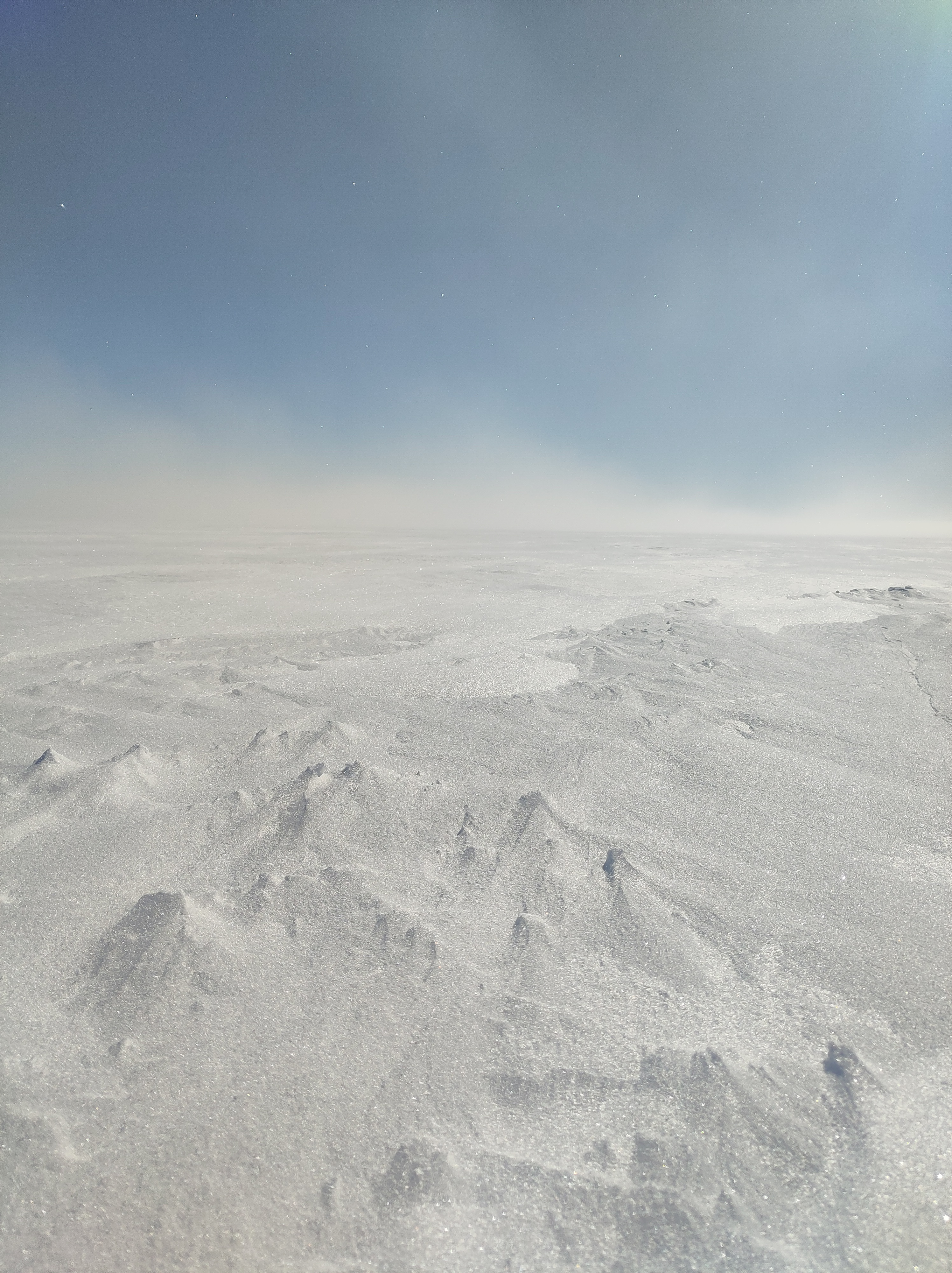
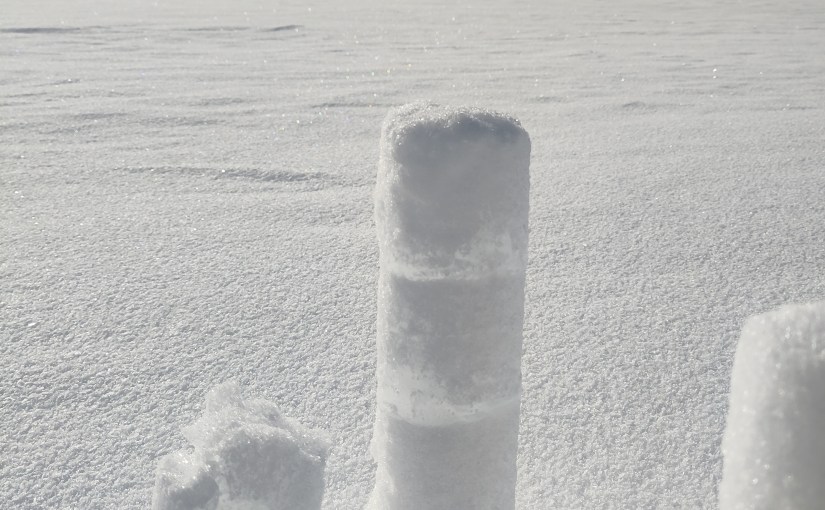
Wind sculpts snow into ridges called sastrugi. We had quite a bit of fresh snow at this site while we were there. Sometimes it’s hard to work out where the snow surface actually is.

It was a pretty wind and snowy site, in a katabatic wind zone (thankfully not too strong on this trip), which was intentional, as one of the aims of our study is the effects of strong winds on snow accumulation. As preparing to leave took most of the day (especially doing the chemistry mixes for LISA), we headed up in the afternoon and then stayed out overnight in these fantastic little cabins on skis.

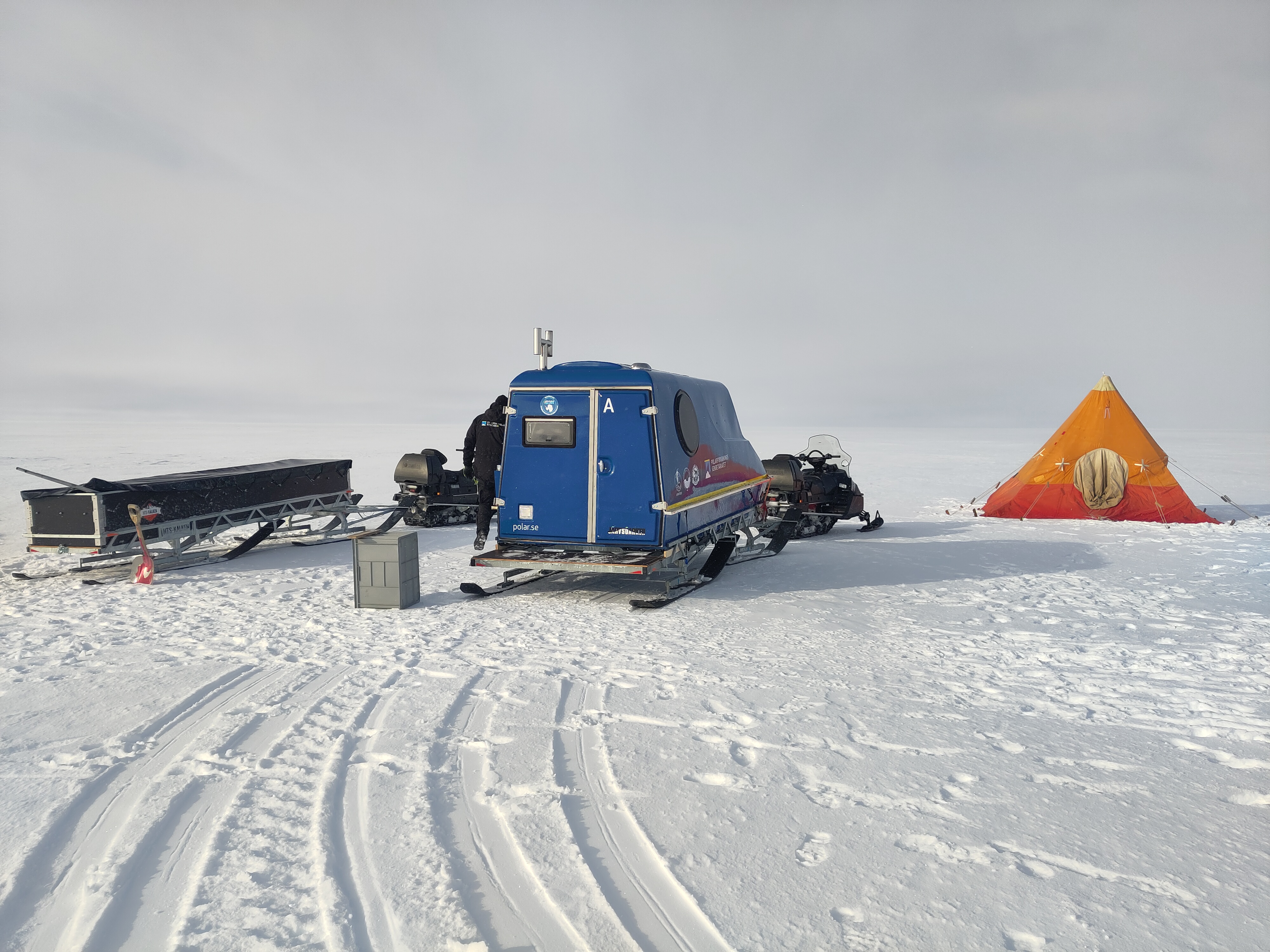
Our field camp: sledge full of equipment, the blue cabin on a sledge (an ark) is one of our living quarters and the pyramid shaped, orange Scott tent is our bathroom.

The Polar Research institute in Sweden calls them arks and they are really a very nice solution to the problem of cold and wind and trying to work in quite extreme conditions. Pulled by a snow-scooter and with a stove inside for melting snow and heating, they’re really very cosy to sleep in and it makes a big difference to be able to warm up when for example you’ve been sitting in a snow pit at -15C with a hefty wind chill on top and are covered in spin drift snow (as me how I know).

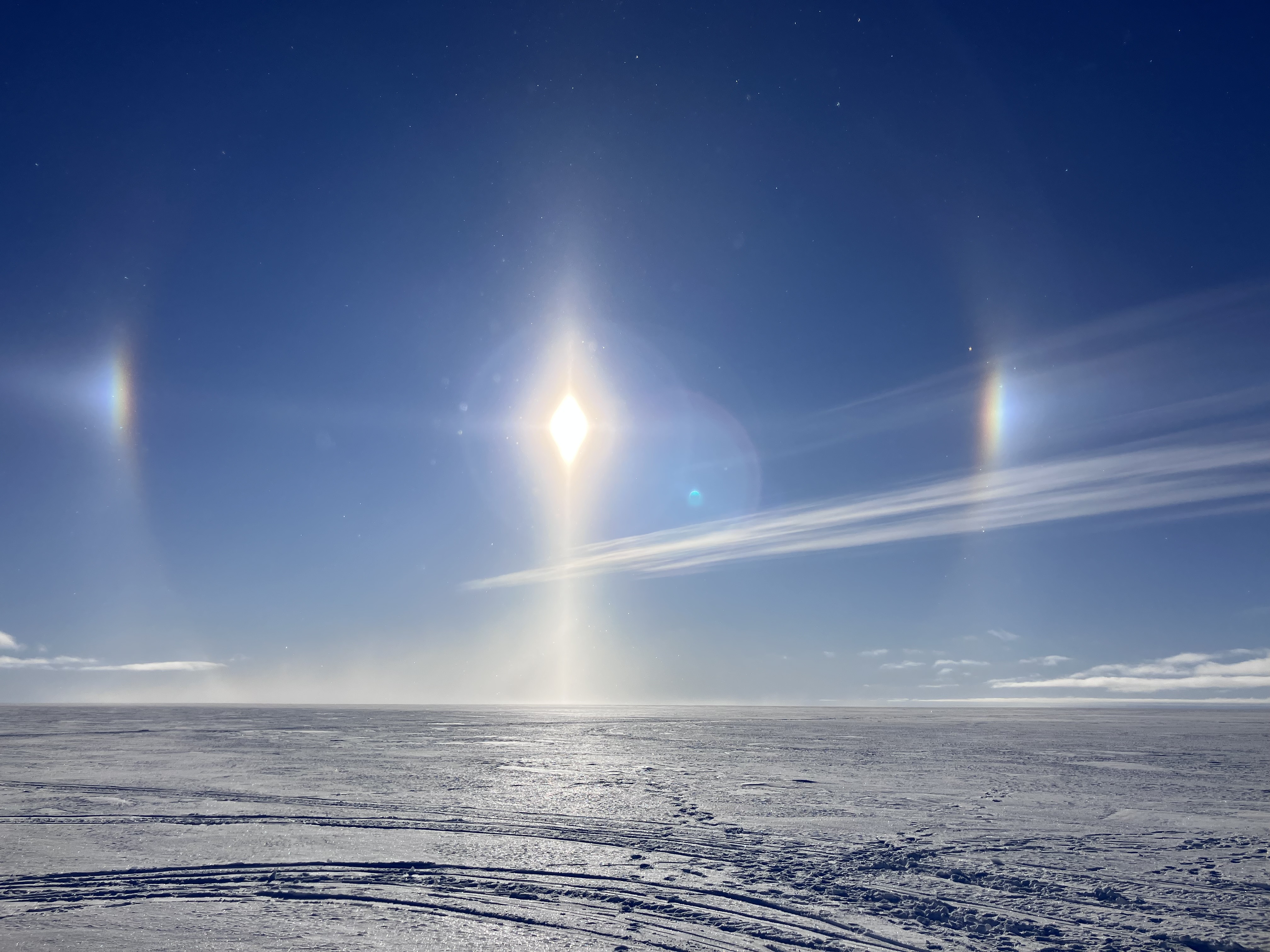
We were greeted by this beautiful halo around the sun upon waking, with sun dogs on either side, caused by the ice crystals in the sky. In fact we nick-named the site diamond dust because of the clear sky precipitation on the first morning.

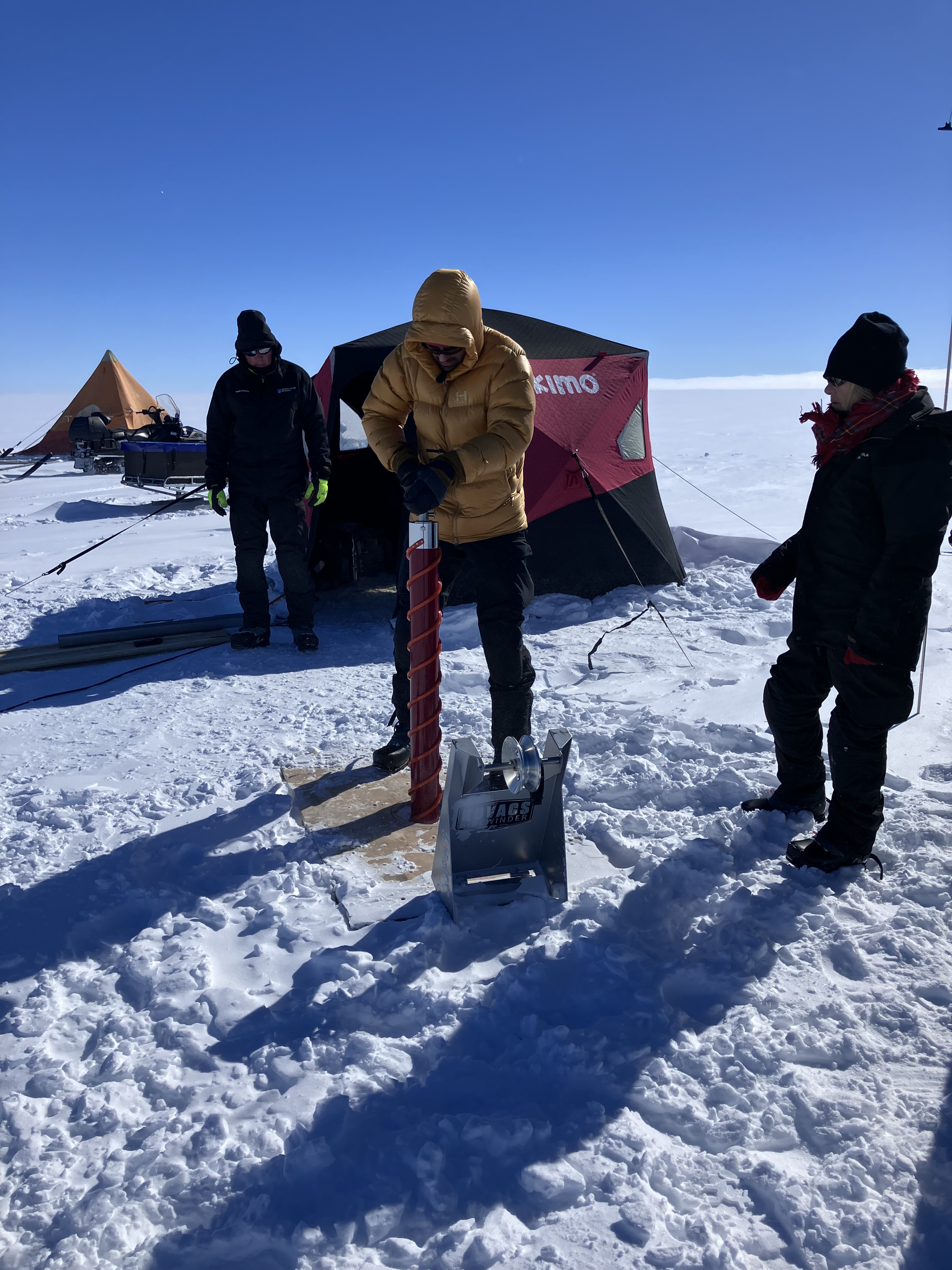
We soon got into a good rhythm with Henrik driving the coring, Clement logging and Ninis and myself assisting with the cores.

Starting the first core, (l to r the rest of the field team, Henrik, Clement and Ninis)

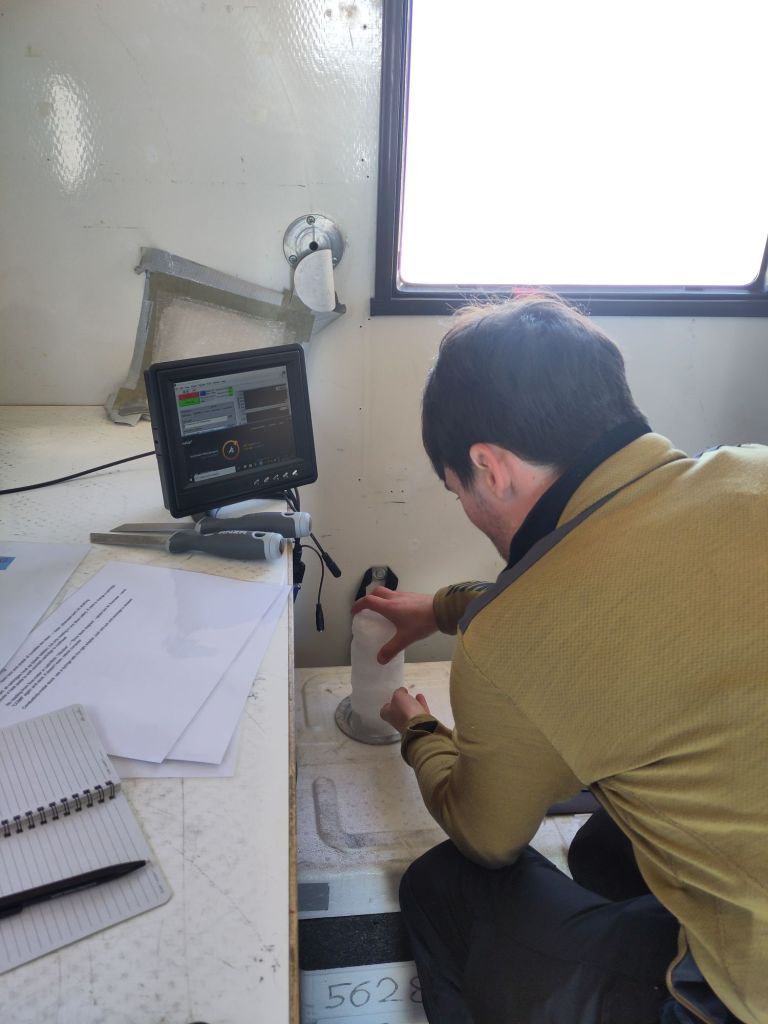
And then it was time to get LISA going and a very long and slightly frustrating day followed. Thankfully, by bedtime and having reconstructed quite a lot of the inner tubing of the box, we got LISA ready for work the next day.

The LISA box with melting ice core on top and computer recording the data as it appears. The pop-up fishing tent was essential for working at this site in the cold winds. Without wind chill it was around -10C outside, preventing ice crystals from forming in the chemistry lines and reagents is also a concern, but the arks also simplify things.

I dug a snow pit – always one of my favourite activities, it’s good to get your hands in the snow and really feel what is going on, and we identified some really intriguing layers. Lots more work to be done there to work out what is going on.

As added entertainment, Ninis was interviewed live from the top of the ice sheet by Swedish TV live from the fieldcamp (check out God Morgon Sverige on TV4, 23rd December if you’re interested). However, after 2 nights out it was time to pack up and head back, 3 cores worth of data richer, for a shower, laundry and a Christmas Eve day off.

On Christmas eve daytime it was my turn with a brief 2 minutes to explain our project on Danish TV2 news (at 12.15 CET in case you have an account and would like to see me looking wind swept). Juleaften, Christmas Eve, is the big day of celebration in the Nordic countries, so we took an almost day off, doing some washing, cleaning the living modules and enjoying plenty of good food courtesy of the Swedish chef Raymond who prepared a Christmas dinner feast later, perfect after a long Christmas hike over the nunatak.

Field Photos

Given the current state of the US administration I think it’s worth thinking about what services we use, to become less dependent on US tech and social media companies. Therefore, I’m sharing photos over on pixelfed while we’re out here, in case you want to see more field photos, though sharing is a bit intermittent as it depends on the internet link and due to the expense of the data, we’re trying not to use too much.

I am also posting over on blue sky, though there is much that makes me uneasy about that platform, so I will keep posting on the fediscience server on mastodon too (and indeed the quality of interaction is often better there strangely, given I feel that the platform is smaller than blue sky).

*The Swedish research station Wasa is located on a nunatak in Antarctica called Basen (it’s pronounced Baasen, like the sound a sheep makes in english)

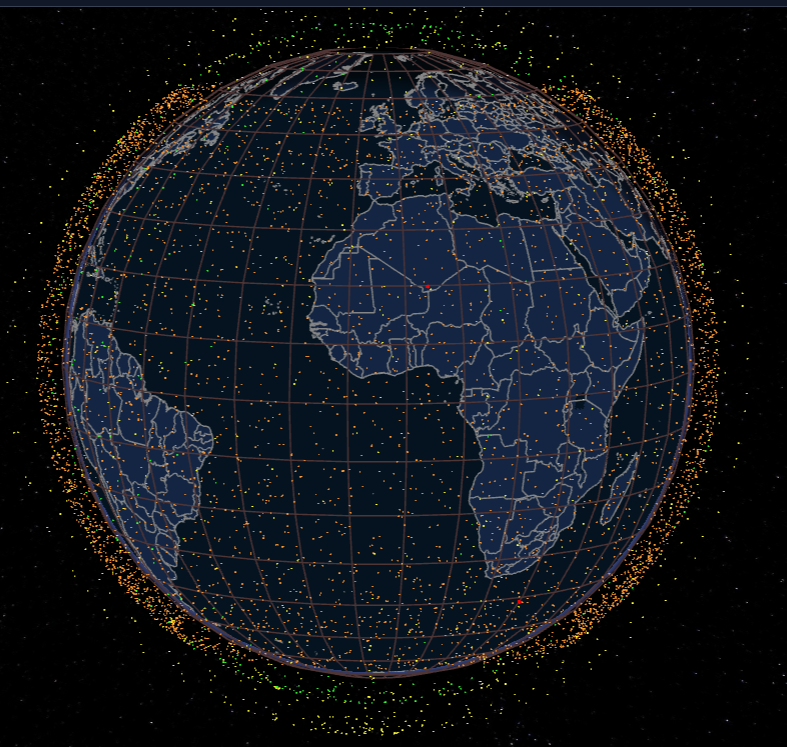
**Yes we are on starlink. It’s incredibly impressive performance wise, but I’d rather not be supporting the nazi man-child, the sooner Eutel Oneweb makes an alternative for users like us, the better, though preferably without this polluting a footprint in low earth orbit. In fact if any EUTEL folks are reading this, I’d be delighted to test out a lightweight system for polar field scientists for you 🙂

Screenshot from satellitemap.space showing the position of the tens of thousands of starlink satellites currently orbiting earth. Check out their visualiser to see other satellites!

Settling in..

It’s been a good start to the field season, incredible competent logistics, great field equipment, super helpful colleagues and incredible food by the station cook. For the first time ever I suspect I’ll be putting on weight in the field. But everything also takes a lot longer in Antarctica so little in the way of actual scientific results to report yet. Nevertheless we’ve some tantalising hints of some interesting processes and we’ve been settling in to the expedition frame of mind.

We had a very good flight from Oslo, a small delay in Prague notwithstanding, very friendly cabin crew and 3 seats each to lie across meant a relatively good sleep and a decent amount of work finalised on route.

Clouds over Namibia’s Etosha National Park. We basically crossed a third of the world to get here. A carbon debt I’ll be paying for years…
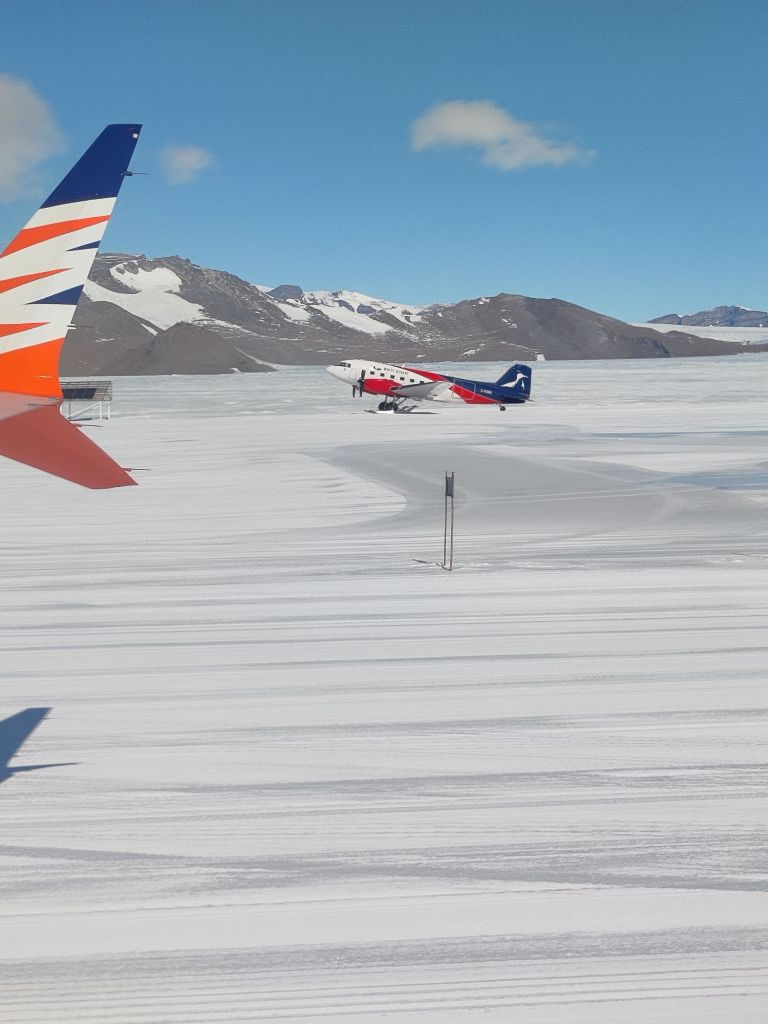
Similarly, in Cape Town, mostly spent in a hotel room finishing off reports, except for dinner and an occasional walk. And then a very smooth and easy 5 hour flight first to Troll, to be met by welcoming Norwegian colleagues and a vintage Basler (a DC3 airframe dating back to 1944, but with new engines – I’ve seen it in Greenland before – it still works!), that took us more or less directly to Wasa, where our Swedish colleagues met us on the glacier runway. And what a welcome! Everyone has been extremely helpful and very friendly.

The “vintage” Basler, an unpressurized aircraft. Very fun to fly in and beautiful views..

Operating in Antarctica is a bit like working in Greenland and also not at all like Greenland. In both places you have to be pretty flexible, self reliant and able to work in difficult conditions and across broad teams. It’s just much more extreme in terms of isolation, logistics, costs and everything else here in Antarctica.

The nunataks of Dronning Maud Land: it’s a big and very beautiful place

We are extremely fortunate to be so well- supported by such a great crew and it is important to me that we repay that investment with some excellent science results.

So far though, we’ve been laying the groundwork, getting our safety training done, testing some new coring equipment, unpacking and testing the LISA box and learning how to use the arks (a kind of plastic shell on skis that we will use for camping in while out of the station) and preparing for what I believe is sometimes called “deep field” (perhaps a touch melodramatic for what is basically camping).

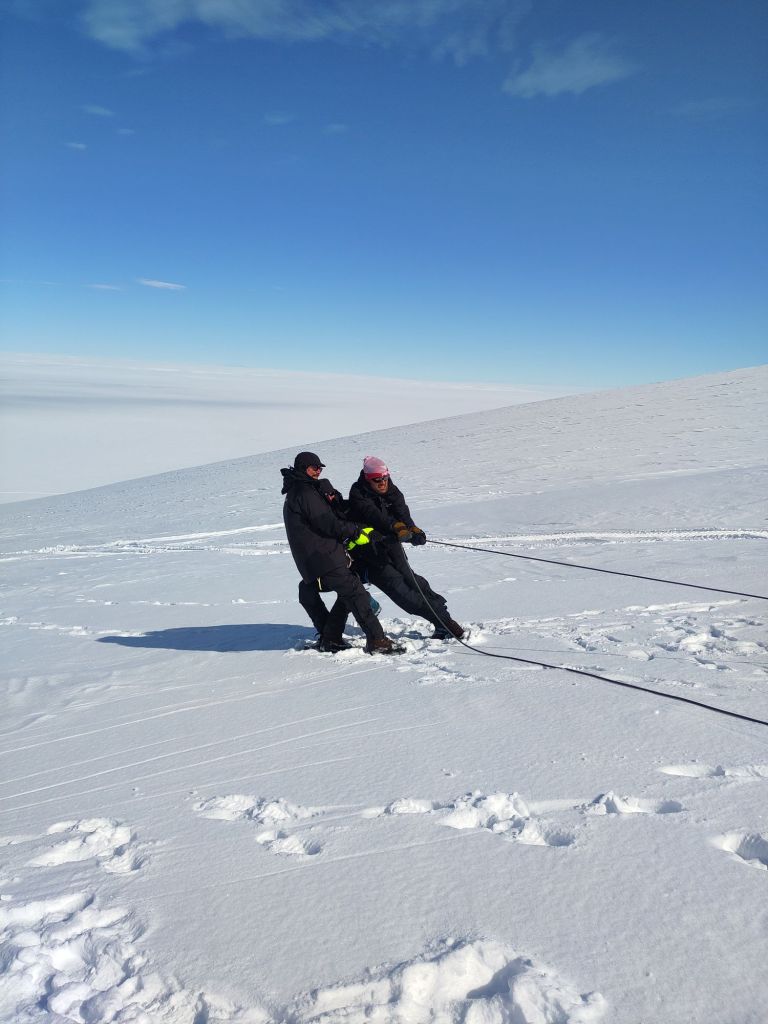
Safety training: testing a snow anchor for crevasse rescue purposes

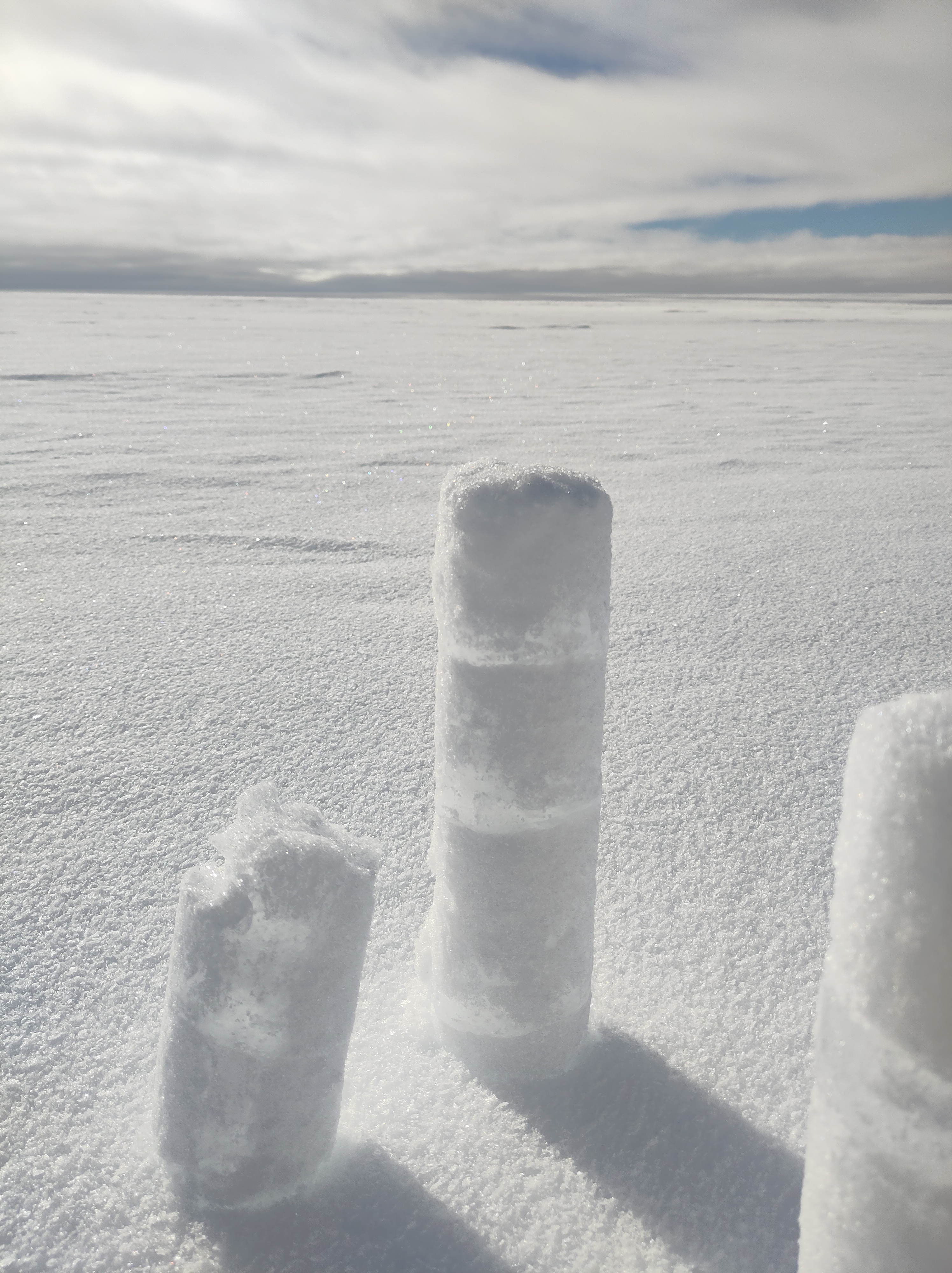
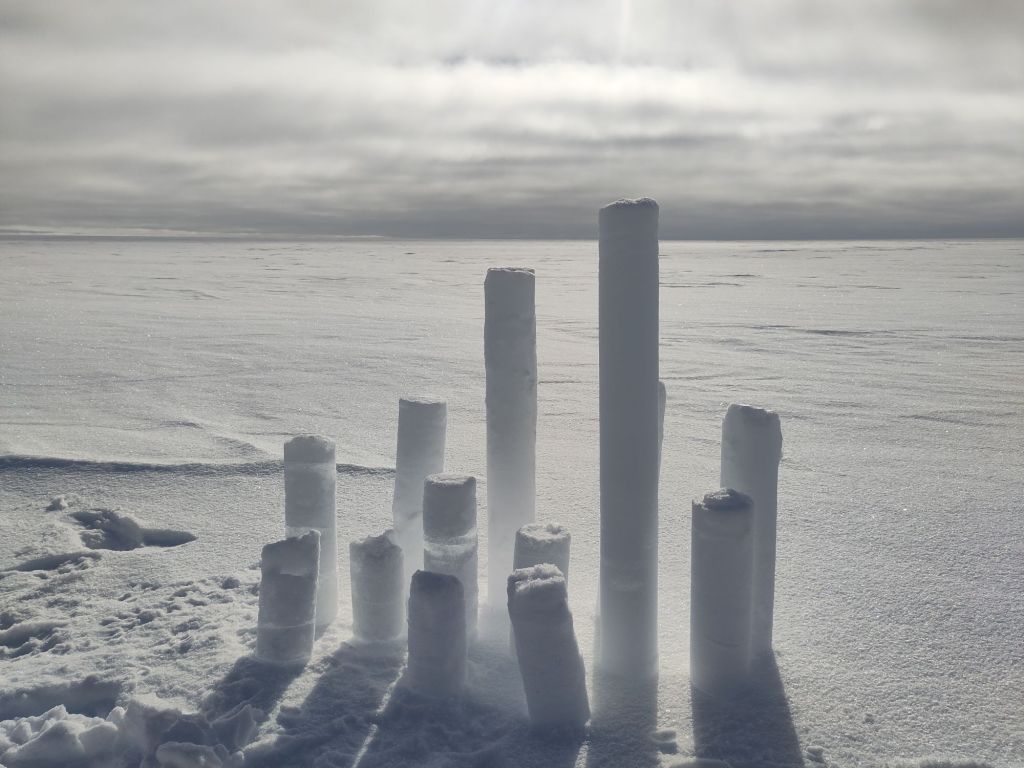
We’ve also tested some new drilling equipment, finding some very interesting firn features in the process, including several thick ice lenses in a region we didn’t expect.

Stacked firn cores on the glacier.

There have been a few anxious moments around our old friend LISA. She is a complex machine with many pieces that can go wrong but finally at 9.30 this evening Clément managed to get her working. In a tiny “lab” but one with a great view. A huge relief all round (and hopefully field operation will be more straightforward now we’ve had some practice).

  Tomorrow will be mostly packing up and preparation for a few days away, so Christmas Eve will likely find us camping out on a glacier somewhere working away. Weather permitting of course. So far we’ve been pretty lucky with that and we need to make the most of it while it lasts.

So that was a quick field update, it’s been pretty busy and a bit weird to think I’ve only been here 3 days so far. I’ve already slipped into field mode and slightly lost track of time.

The next update will probably be after Christmas, but I’m posting pictures as we go along to my pixelfed account. There are also some nice entries on the official iQ2300 expedition blog.

Meeting LISA

LISA: the Lightweight In Situ Analysis box is one of a kind; built by our friends at PICE in the Niels Bohr Institute. Later this year we’re taking LISA to Antarctica for the first time ever, to analyse shallow snow and firn cores directly in the field.

This is part of our contribution to the EPIC iQ2300 – a project led by Prof. Arjen Stroeven in Stockholm and organised by the Swedish Polar Research Secretariat.

iQ2300 is a huge project, and we are just a small part of it: the aim is to understand Dronning Maud Land’s evolution from the Holocene and out to 2300. Expect to hear a lot more about this effort in coming months…
Map of Antarctica, I lifted from polar.se : LISA will be visiting the Swedish Wasa station in DML – the top bit on this map – with us


Now back to our humble friend.

We hope LISA will help us understand how much snow falls in Dronning Maud Land, how much it varies from year to year and what is the influence of sea ice and far field atmospheric processes on the rate of snowfall. Snowfall is exceptionally difficult to measure and one of our biggest uncertainties in working out Antarctic mass budget and the response of Antarctica to a changing climate (spoiler alert: we might have a paper coming out about this shortly)…

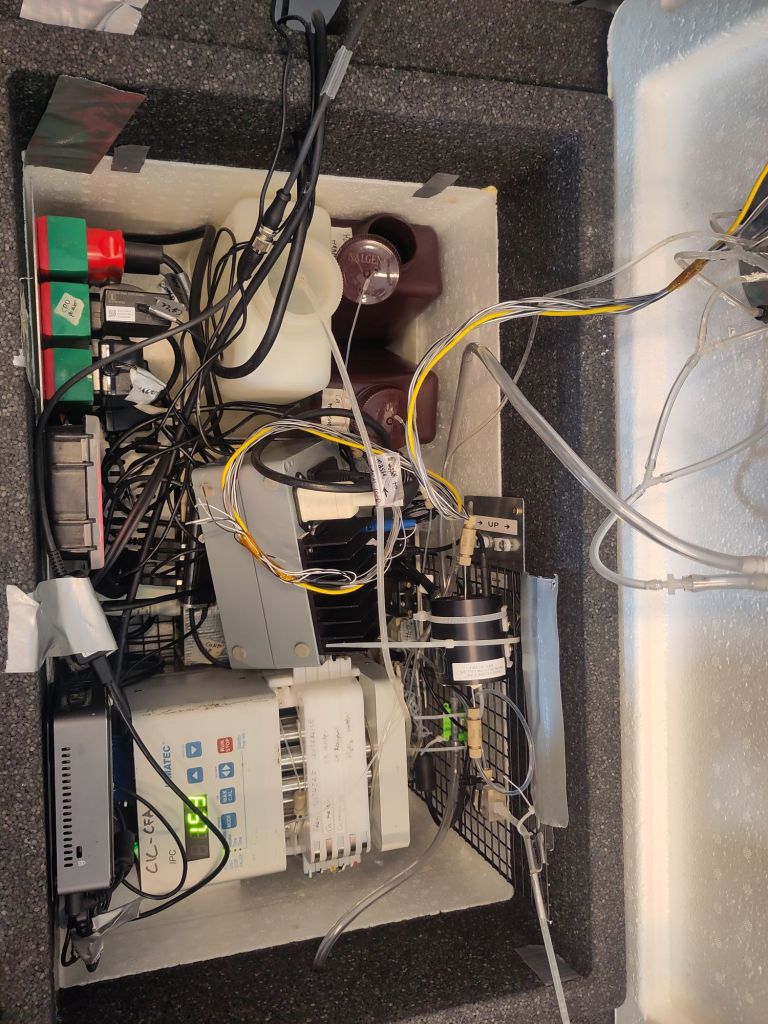
Meet LISA: a view inside the Magic Box..


Although LISA has been used in Greenland before, this is quite an experimental deployment, which means potentially really a lot of valuable scientific results. We would ultimately liek to build an Antarctic specific box, but that will have to wait to see if the results of this deployment are as good as we hope. (And some funding – if you are a billionaire with a spare couple of hundred thousand Euros, we’re always interested in talking).

The box itself is conceptually simple but in practice a little complex with a multiplicity of tubes, connectors and spare parts. This means it’s easy to fix if it breaks down, but also we need to understand how it works first.

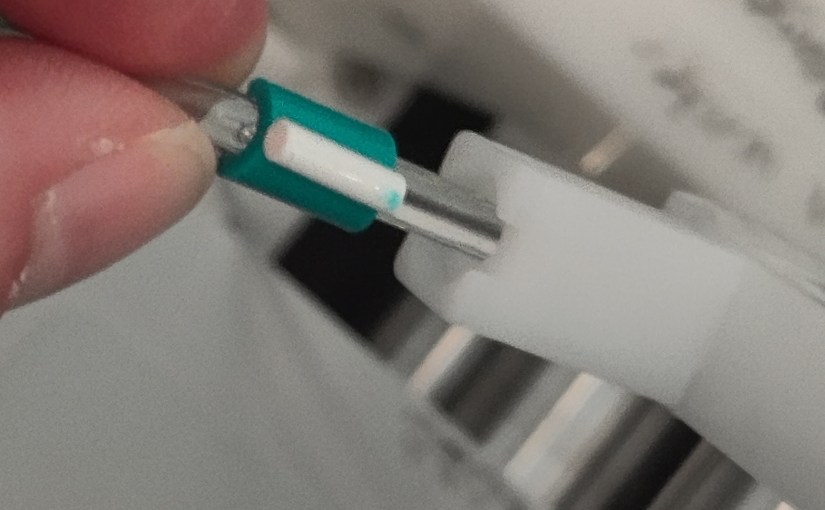
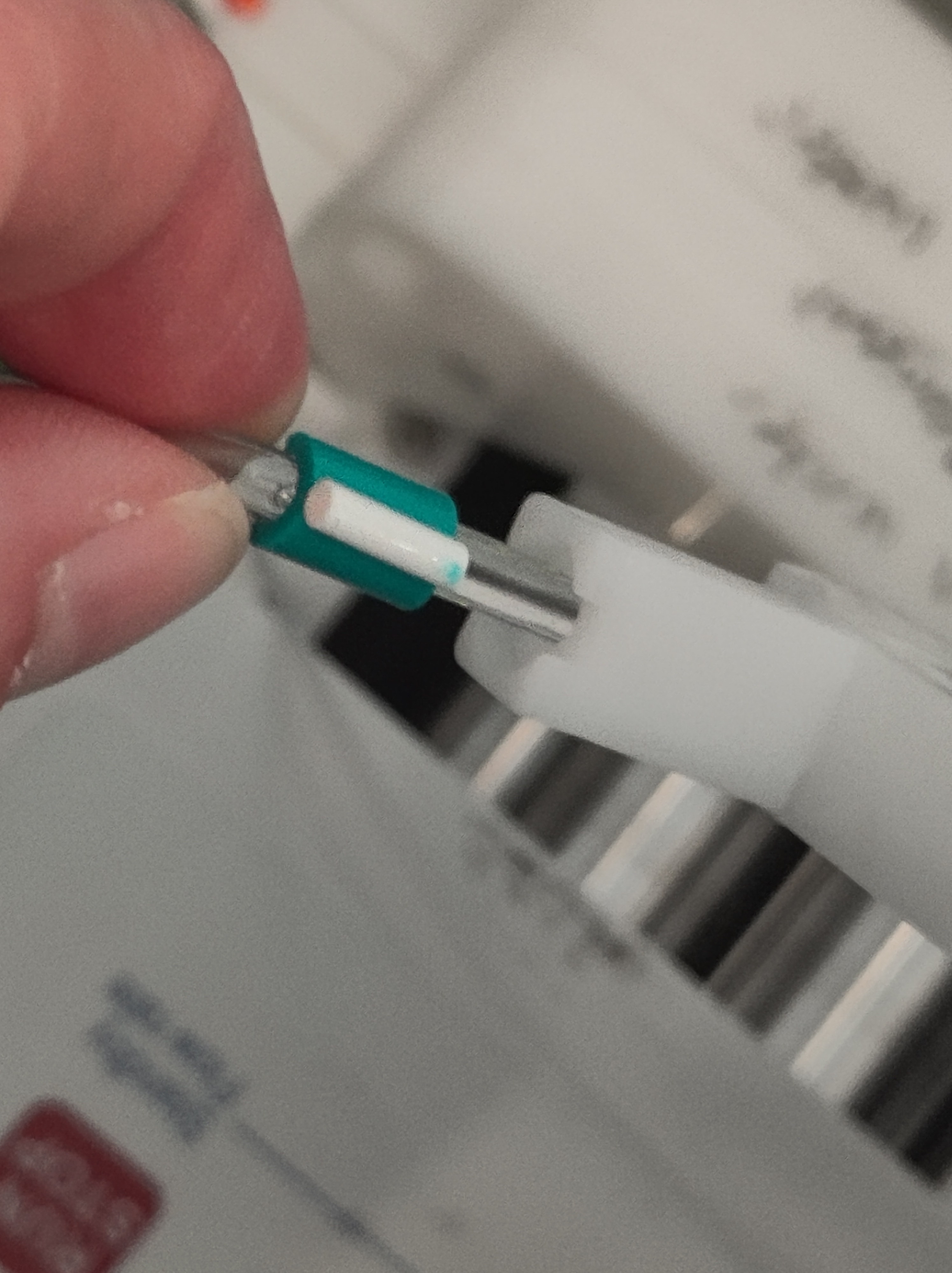
Some parts of LISA are quite fiddly…


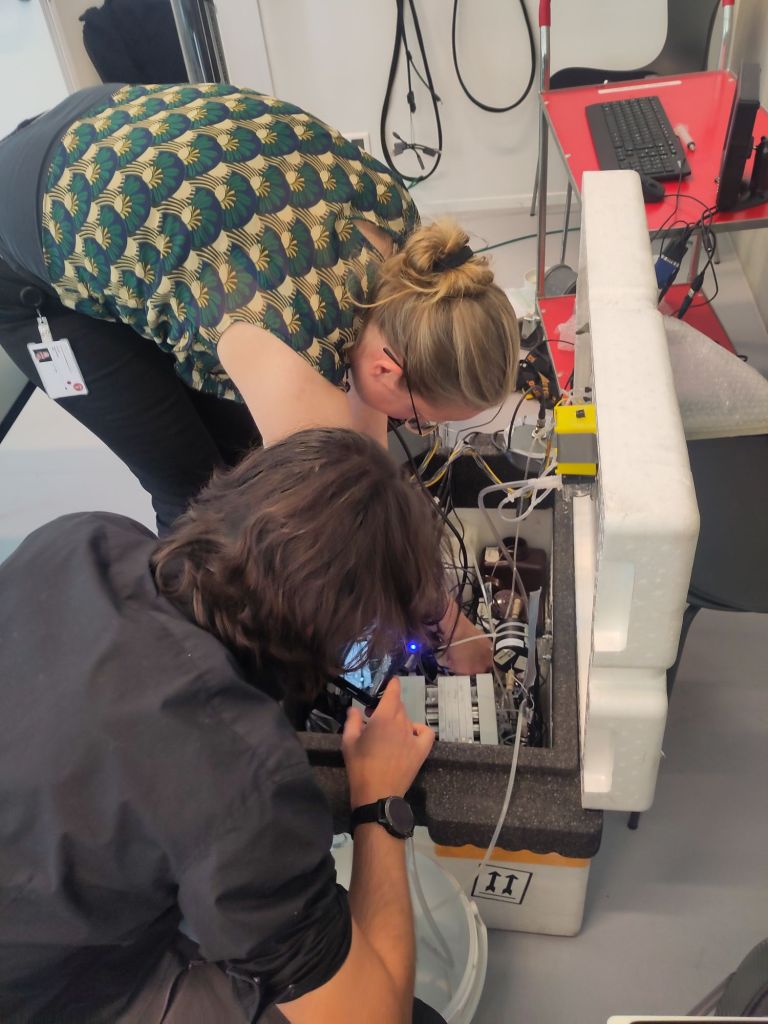
Today, the awesome and exceptionally generous Associate Professor Helle Kjær took myself, Stockholm Uni Prof Ninis Rosqvist and our PhD colleague from the Novo Nordisk funded PRECISE project, Clément Cherblanc through the use of the box.

Helle showing Clément the workings inside LISA

There’s a lot to remember and a lot to check but we’re reasonably hopeful we’ll get good results. The aim is to understand both the interannual variability on decadal timescales and the spatial gradients in snowfall accumulation. It’s a huge task, so it’s probably fortunate that we have 6 weeks or so (depending on the weather always!) to try and get it deployed at anumber of different sites which will hopefully allow us to do this.

It’s a big change to my normal fieldwork activities, but also a logical extension of them. And highly complementary to the climate and SMB modelling we are developing.

Nonetheless, ithere’s a lot of new stuff and I have in the past weeks learnt a great deal about transporting very small amounts of mildly hazardous chemicals on airlines, how to deal with customs and pack fragile instruments in large boxes.

Much more to come on this project, so stay tuned…

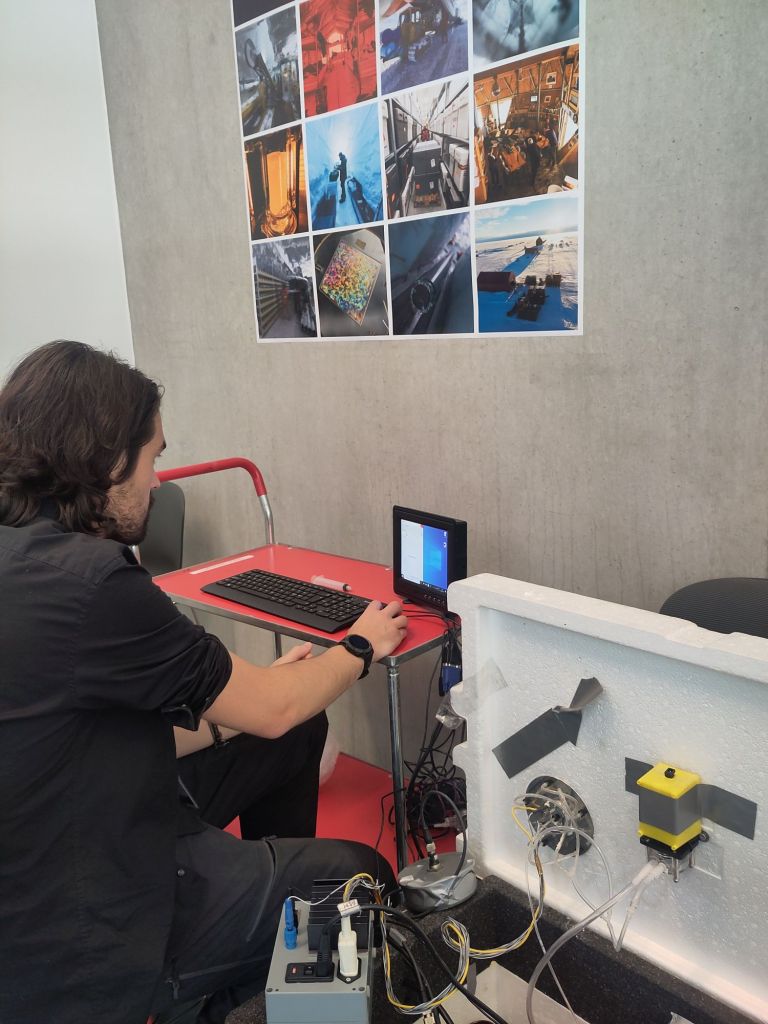
Clement getting stuck into using the software that measures different properties in the cores.

PROTECT: The Sea Level Rise Question

There is currently some discussion in the Danish media about sea level rise hazards and the risk of rapid changes that may or may not be on the horizon. Some of the discussion is about IPCC estimates. That’s a little unfortunate and in fact a bit unfair as the IPCC report has not been updated since 2021, nor was it intended to have been. In the mean time there has been a lot of additional science to clear up some of the ambiguities and questions left from the last report.

I’ve been working quite a bit on the cryosphere part of the sea level question of late, so thought I’d share some insights from the latest research into the debate at this point. And I have a pretty specific viewpoint here, because I’ve been working with the datasets, models, climate outputs etc that will likely go into the next IPCC report as part of a couple of EU funded projects. As part of that, we have prepared a policy briefing that will be presented to the European Parliament in June this year, but it’s already online now and will no doubt cross your socials later this week. I’m going to put in some highlights into this post too.

Now, I want to be really clear that everything I say in this post can be backed up with peer reviewed science, most of which has been published in the last 2 to 3 years. Let’s start with the summary:.:

  • The sea is rising. And the rate of rise is currently accelerating.
  • The sea will continue to rise long into the future. The rate of that sea level rise is largely in our society’s hands, given that it is strongly related to greenhouse gas emissions.
  • We have already committed to at least 2m of sea level rise by 2300.
  • By the end of 2100 most small glaciers and ice caps will be gone, mountain glaciers will contribute 20-24% of total sea-level rise under varying emission scenarios.
  • Antarctic and Greenland ice sheet mass loss will contribute significantly to sea-level rise for centuries, even under low emissions scenarios
  • Abrupt sea level rise on the order of metres in a few decades is not credible given new understanding of key ice fracture and iceberg calving processes.
  • By the end of this century we expect on the order of a half to one metre of sea level rise around Denmark, depending on emissions pathway. (If you want to get really specific: the low-likelihood high impact sea level rise scenario corresponds to about 0.9 m (on average), or at the 83rd percentile, about 1.6 m of sea level rise).
  • Your local sea level rise is not the same as the global average and some areas, primarily those at lower latitudes will experience higher total sea level rise and earlier than in regions at higher latitudes.
  • We have created a local sea level rise tool. You should still check your local coastal services provider, they will certainly have something tailor made for your local coastline (or they *should*!), but for something more updated than the IPCC, with latest SLR data, this is the one to check.

Sea level rise now is ~5mm per year averaged over the last 5 years, 10 years ago it was about 3 mm per year). Much of that sea level rise comes from melting ice, particularly the small glaciers and ice caps that are melting very fast indeed right now. Even under lower levels of emissions, those losses will increase. There won’t be many left by the end of this century.

Greenland is the largest single contributor and adds just less than a millimetre of sea level rise per year, with Antarctica contributing around a third of Greenland, primarily from the Amundsen Sea sector. The remaining sea level rise comes from thermal expansion of the oceans. Our work shows very clearly that the emissions pathway we follow as a human society will determine the ultimate sea level rise, but also how fast that will be achieved. The less we burn, the lower and slower the rise. But even under a low-end Paris scenario, we expect around 1 metre of sea level by 2300.

The long tail of sea level rise will come from Antarctica, where the ocean is accelerating melt of, in particular, West Antarctica. However, our recent work and that of other ice sheet groups shows that the risk of multi-metre sea level rise within a few decades is unrealistic. Again, to be very clear: We can’t rule out multiple metres of sea level rise, but it will happen on a timescale of centuries rather than years. High emissions pathways make multiple metres of sea level rise more likely. In fact, our results show that even under low emissions pathways, we may still be committed to losing some parts of especially West Antarctica, but it will still take a long-time for the Antarctic ice sheet to disintegrate. We have time to prepare our coastlines.

Greenland is losing ice much faster than Antarctica, and here atmospheric processes and firn and snow are more important than the ocean and these are also where the læarge uncertainties are. As I’ve written about before, that protective layer of compressed snow and ice will determine how quickly Greenland melts, as it is lost, the ice sheet will accelerate it’s contribution to sea level. This is a process that is included in our estimates.

There’s so much more I could write, but that’s supposed to be the high level summary. Feel free to shoot me questions in the comment feeds. I’ll do my best to answer them.

Five years ago, a small group of European scientists got together to do something really ambitious: work out how quickly and how far the sea will rise, both locally and on average worldwide, from the melting of glaciers and ice sheets. The PROTECT project was the first EU funded project in 10 years to really grapple with the state-of-the-art in ice sheet and glacier melt and the implications for sea level rise and to really seek to understand what is the problem, what are the uncertainties, what can we do about it.

We were and are a group of climate scientists, glaciologists, remote sensors, ice sheet modellers, atmospheric and ocean physicists, professors, statisticians, students, coastal adaptation specialists, social scientists and geodesists, stakeholders and policymakers. We’ve produced more than 155 scientific papers in the last 5 years (with more on the way) and now our findings are summarised in our new policy briefing for the European Parliament.

It’s been a formative, exhilarating and occasionally tough experience doing big science in the Horizon 2020 framework, but we’ve genuinely made some big steps forward, including new estimates of rates of ice sheet and glacier loss, a better understanding of some key processes, particularly calving and the influence of the ocean on the loss of ice shelves. More importantly for human societies, by integrating the social scientists into the project, we have had a very clear focus on how to consider sea level rise, not just as a scientific ice sheet process problem, but also how to integrate the findings into usable and workable information. In Denmark, we will start to use these inputs already in updating the Danish Climate Atlas. If you are elsewhere in the world, you may want to check out our sea level rise tool, that shows how the emissions pathway we follow, will affect your local sea level rise.

Our final recommendations?

  1. Accelerate emission reductions to follow the lower emission scenario to limit
    cryosphere loss and associated sea-level rise
  2. Enhance monitoring of glaciers and ice sheets to refine models and predictions
  3. Support the long-term development of ice sheet models, their integration into
    climate models, and the coupling of glacier models with hydrological models, while
    promoting education and training to build expertise in these areas
  4. Invest in flexible and localized coastal management that incorporates
    uncertainty and long-term projections
  5. Foster international collaboration to share knowledge, resources, and strategies
    for mitigating and adapting to global impacts

Local sea level rise: A question of gravity

I’ve explained several times in the course of media comments that, when it comes to the sea level rise that you experience, it really matters where the water comes from. This point still seems to cause confusion so I’ve written a super fast post on it.

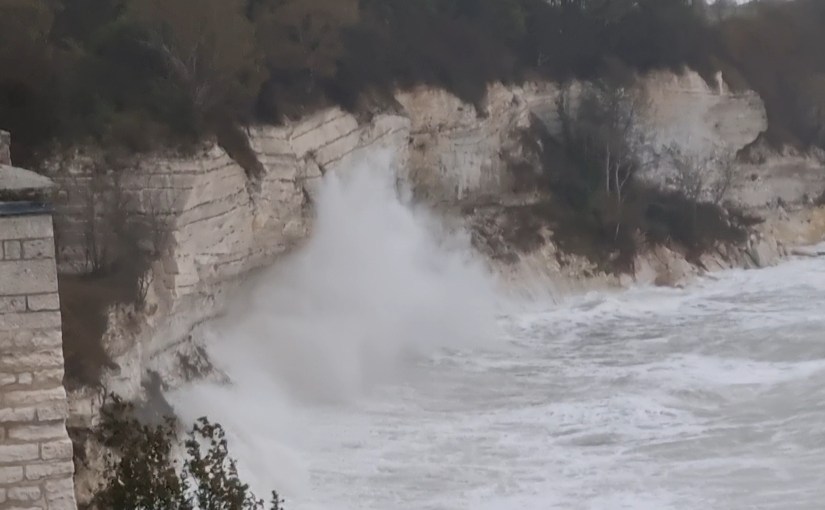
Waves from the Storm Surge that hit Denmark in October 2023 credit: Sebastian Pelt

We very often talk about a metre or two of sea level rise by the end of the century, but in general that refers to global average sea level. And much like a global mean temperature rise doesn’t tell you very much about the kind of temperature changes you will experience in your location due to weather or climate, global mean sea level is also not very informative when talking about preparing your local community for sea level rise. There are other local factors that are important, (see below), but here I’m going to mostly focus on gravity.

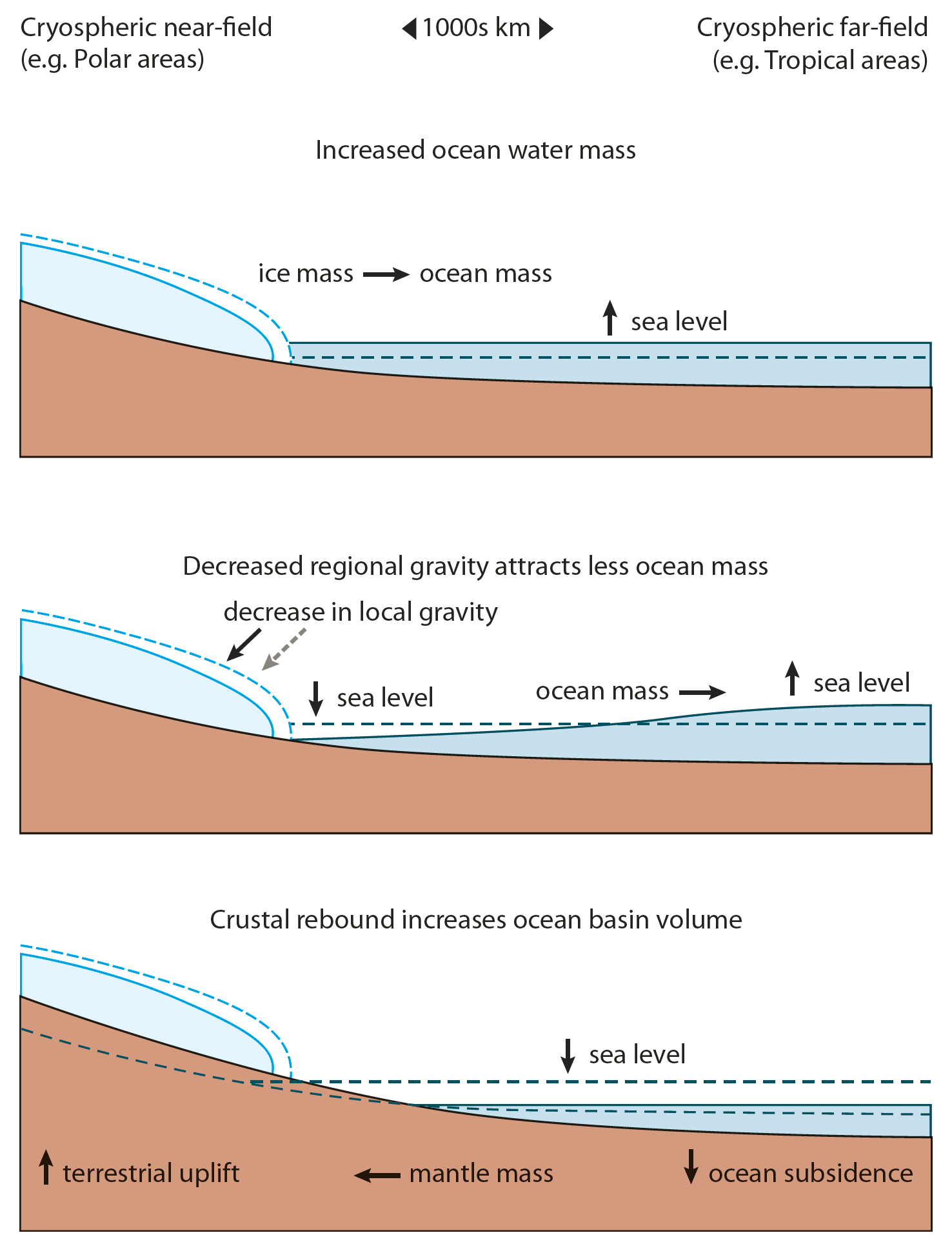
Imagine that sea level is more or less stable around the earth (which it was, more or less, before the start of the twentieth century). Just like the moon causes tides because its gravity exerts a pull on the oceans, the ice sheets are large masses and their gravity also attracts ocean water, so the average sea level is higher closer to Greenland and to Antarctica. But there is only a finite volume of water in the oceans, so a higher sea level close to the ice sheets means lower sea levels further away in the tropics for example.

As the ice sheet melts and gets smaller, its gravitational pull becomes smaller so the average height of the sea around Greenland and Antarctica is lower than it was before, but the water gets redistributed around the earth until it is in equilibrium with the gravitational pull of the ice sheets again. The sea level in other places is therefore much higher than it would have been without that gravitational effect.

And in general, the further away from an ice mass you are, the more these gravitational processes affect your local sea level change. In Northern Europe, it often surprises people (also here in Denmark) to learn that while Greenland has a small influence on our local sea level, it’s not very much because we live relatively close to it, however the loss of ice from Antarctica is much more important in affecting our local sea level rise.

Currently, most of the ice contributing to sea level is from the small glaciers around the world, and here too there is an effect. The melt of Alaska and the Andes are more important to our sea level than the Alps or Norwegian glaciers because we are far from the American glaciers but close to the European ones.

This figure below illustrates the processes:

Processes important for local sea level include changes in land height as ice melts but also the redistribution of water as the gravitational attraction of the ice sheets is reduced. The schematic representation is from the Arctic assessment SWIPA report Figure 9.1 from SWIPA 2017

This is partly why the EU funded PROTECT project on cryosphere contributions to sea level rise, which I am currently working on, has an emphasis on the science to policymakers pipeline. We describe the whole project in this Frontiers paper, which includes a graphic explaining what affects your local sea level.

As you can see, it very much depends on what time and spatial scale you’re looking at, with the two ice sheets affecting sea level on the longest time scales.

Figure 1 from Durand et al., 2021 Illustration of the processes that contribute to sea level change with respect to their temporal and spatial scales. These cover local and short term effects like storm surges, waves and tides to global and long-term changes due to the melting of ice sheets.

In the course of the project some of the partners have produced this excellent policy briefing, which should really be compulsory for anyone interested in coastal developments over the next decades to centuries. The most important points are worth highlighting here:

We expect that 2m of global mean sea level rise is more or less baked in, it will be very difficult to avoid this, even with dramatic reductions in greenhouse gas emissions. But the timescale, as in when that figure will be reached, could be anything from the next hundred years to the next thousand.

Figure from PROTECT policy briefing showing how the time when average global sea level reaches 2m is strongly dependend on emissions pathway – but also that different parts of the world will reach 2m of sea level rise at very different times, with the tropics and low latitudes in general getting there first.

What the map shows is that the timing at which any individual place on earth reaches 2 m is strongly dependent on where on earth it is. In general lower latitudes close to the equator will get to 2m before higher latitudes, and while there are ocean circulation and other processes that are important here – to a large extent your local sea level is controlled by how close to the ice sheets you are and how quickly those ice sheets will lose their ice.

There are other processes that are important – especially locally, including how much the land you are on is rising or sinking, as well as changes in ocean and atmosphere circulation. I may write about these a bit more later.

Feel free to comment or ask questions in the comments below or you can catch me on mastodon:

Sea Ice loss in Antarctica: Sign of a tipping point?

The Danish online popular science magazine is currently running a series on tipping points in the Earth system with a series of interviews with different scientists. They asked me to comment on the extraordinary low sea ice in Antarctica this year. You can read the original on their site here. But I thought it might be interesting for others to read in English the piece which is a pretty fair reflection of my thinking. So I’m experimenting a little with DeepL machine translation which I consider much more reliable that google’s competitor. I have not edited anything in the below!
I have been promising a piece on West Antarctica for a while – which I’m still working on, but hopefully this is interestign to read to be going on with!

A sudden and surprising loss of sea ice in Antarctica could be a sign that we are approaching something critical that we need to prepare for, warns an ice researcher from DMI.
The climate seems to be changing before our eyes.

2023 has seen record high temperatures both on land and in the ocean, which you can read more about in the article ‘Is the climate running out of control like in ‘The Day After Tomorrow’?

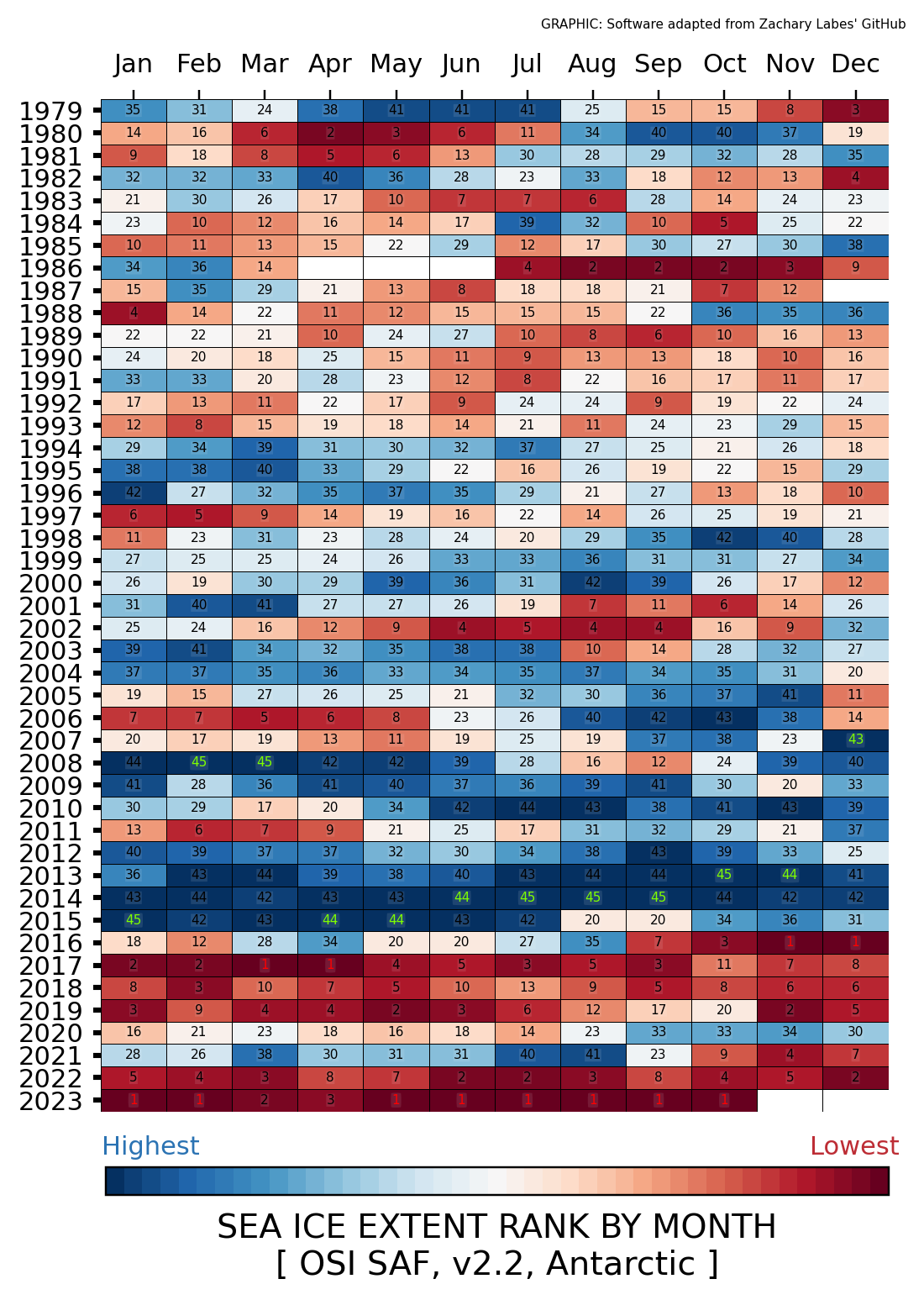
In Antarctica, there has been a sudden, violent and in many ways unexplained lack of sea ice, which normally melts in the summer and re-forms in the winter.

Monthly sea ice extent ranked by month also processed by OSI SAF. 2022 and 2023 are both extremely low.

In August, you could read on Videnskab.dk that the continent had failed to restore so much sea ice compared to normal that it was equivalent to the size of the world’s largest island, Greenland, or about 50 times the area of Denmark.

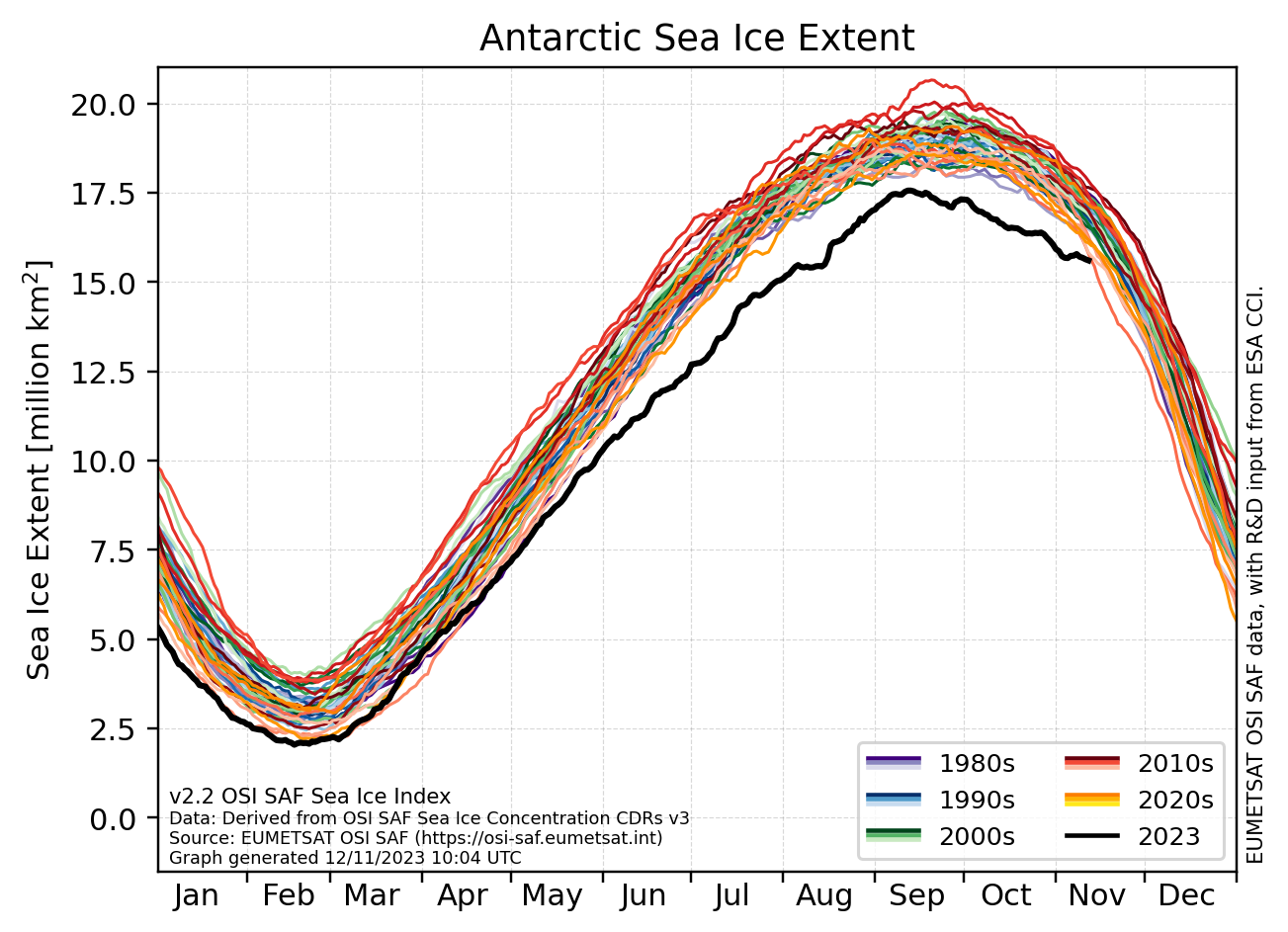
Since then, some of what was lost has been recovered, but when the sea ice peaked in September 2023, 1.75 million square kilometres of sea ice was still missing. This is equivalent to about 40 times the area of Denmark.

Antarctic sea ice extent in 2023, produced by the Eumetsat satelliute processing facility OSI SAF. The plot is updated daily and can be downloaded from: https://osisaf-hl.met.no/v2p2-sea-ice-index along with other data products.

This is by far the lowest amount of sea ice ever measured in Antarctica.

“The melting sea ice in Antarctica is not unexpected in itself, because we have long predicted that it would disappear due to global warming,” Ruth Mottram, senior climate researcher and glaciologist at the Danish Meteorological Institute (DMI) tells Videnskab.dk.

The climate seems to be changing before our eyes.

2023 has seen record high temperatures both on land and in the sea, which you can read more about in the article ‘Is the climate running out of control like in ‘The Day After Tomorrow’?

“But to suddenly have a very, very large disappearance like that is a big surprise. We can’t explain why it happened, and our models can’t recreate it either,” she says, but adds that over time, the models are getting closer to reality.

Disturbances in the Earth’s system are probably connected

Videnskab.dk has in a series asked five leading Danish scientists to assess the state of the climate from their chair – in this article Ruth Mottram.

Ruth Mottram is head of the European research project OCEAN:ICE.

The OCEAN:ICE project
The researchers in OCEAN:ICE, led by Ruth Mottram as principal investigator, will take measurements below the ocean surface. This will provide more knowledge about the temperatures in the ocean around Antarctica.
They will also calculate how fast the ice is melting in Antarctica due to ocean processes and warming in the air. They will also investigate what the lack of sea ice means for the rest of the Antarctic system.
Ruth Mottram cites as examples:
How does it affect ecosystems? For example, many animals feed on the small crustacean krill, whose life is affected by sea ice. Will more waves now reach the Antarctic ice sheet and perhaps lead to more icebergs and more melting? Will glaciers and icebergs become more sensitive to heat? Or, on the contrary, will less sea ice trigger more snow over the continent, which could even stabilise the glaciers?
More specifically, researchers will focus their efforts on seven areas, which you can read more about on the OCEAN:ICE website.

In the project, researchers will, among other things, take measurements under the sea surface in Antarctica to gain more knowledge about how the ocean and ice interact.

Is melting sea ice linked to warm water in the Atlantic?

In the North Atlantic, sea surface temperatures in some places have been as much as five degrees above normal.

To an outsider, it seems obvious that this could have something to do with melting sea ice.

However, according to Ruth Mottram, the two factors are not necessarily directly related. Sea ice in Antarctica melts from below. Therefore, the temperature at the bottom of the sea is far more important than the temperature at the surface.

“But if there’s one thing I’ve learnt over the past 15 years working at DMI, it’s how interconnected the whole world is. So I think we’re seeing some disturbances throughout the Earth system that are unlikely to be completely independent of each other,” she says to Videnskab.dk.

Ocean Professor Katherine Richardson made the same point earlier in the series. You can read about it in the article ‘Professor: The oceans are warming much faster than expected’.

Lack of knowledge and observations

Ruth Mottram emphasises that far more observations from Antarctica are needed before we can say anything definite about the causes of the rapidly shrinking sea ice, but: “It could indicate that the Antarctic sea ice has a critical tipping point like the Arctic, where for a number of years we see a slow decline year by year, and then suddenly it drops to a new stability where it is very low compared to before.””But we don’t know, because there are parts of the system that we don’t understand and that we haven’t observed yet,” explains Ruth Mottram.

Possible reasons why sea ice is disappearing

Ruth Mottram talks a lot with international colleagues about why the sea ice is currently experiencing a significant decline.

She explains that there are different theories, for example that warmer water from below is coming into contact with the sea ice and melting it from below, and that warmer air may be feeding in from above.

In Antarctica, the direction and strength of the wind has a big impact on the state of the ice (click here for a scientist’s timelapse of how Antarctic weather changes rapidly).

Perhaps the sea ice has been hit by “a very unfortunate event”, where it is both being hit by warm water from below and being affected by weaker winds from changing directions, which is holding back the recovery of sea ice.

Again, more research is needed.

Melting ice also contributes to sea level rise, and the Earth is actually designed so that melting in Antarctica hits the northern hemisphere much harder than melting in Greenland. So, bad news for the ice in Antarctica is bad news for Denmark.

Even more bad news is on the horizon.

The natural weather phenomenon El Niño looks set to get really strong over the next few months. A so-called Super-El Niño will likely only make the world’s oceans even warmer.

“We know that the ocean is going to be really, really important in the future in terms of how fast the Antarctic ice is melting and what that will mean for sea level rise,” says Ruth Mottram.
We can’t just wish the world would look different

The climate scientist does not fear huge increases or a violent change in climate overnight, as depicted in the 2004 disaster film ‘The Day After Tomorrow’. She points out that even abrupt shifts in the Earth’s past climate have occurred over decades or centuries, not a few months or years. Still, Ruth Mottram thinks it makes sense to start talking a little more openly about how we tackle severe sea level rise – which on a smaller scale can still be sudden – and large-scale climate change.

The Antarctic ice sheet is the largest on the planet

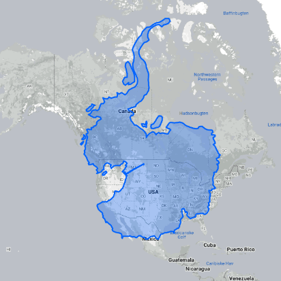
Figure made on http://www.thetruesize.com showing how Antarctica is roughly 1.5 times the size of the USA.

The Antarctic ice sheet contains around 30 million cubic kilometres of ice. This means that around 90 per cent of all fresh water on Earth is frozen in Antarctica.

If all the ice sheet in Antarctica melts, the world’s oceans will rise by around 60 metres. Even if we stay within the framework of the Paris Agreement, we risk that melting Antarctic ice from Antarctica will cause sea levels to rise by 2.5 metres.

Ruth Mottram notes that the more we exceed the limits of the Paris Agreement, the faster sea levels rise – and slower if we act quickly and stay close to the set limits of preferably 1.5 and maximum 2 degrees of temperature rise compared to the 1800s.

“The Earth’s climate system may be shifting towards a new equilibrium, which could result in a different world than we have grown up with,” continues Ruth Mottram.

“It is already affecting us and will do so increasingly in the future. That doesn’t mean it will be a total disaster, but we will probably get to the point where we have to adjust our lifestyles and societies.”

“It won’t necessarily be simple or easy to do so, but we can’t just wish for the world to be different than it is,” says Ruth Mottram.

In another article in Videnskab.dk’s climate series, Professor Jens Hesselbjerg Christensen notes that the world’s finance ministers – including Denmark’s – must pull themselves together and find money to slow climate change by, among other things, putting a cap on greenhouse gas emissions.

“We are in the process of allowing future generations to accept that large areas of land will become uninhabitable because the water level rises too much,” he says.
‘Bipolar’ researcher: Keep an eye on Greenland too

In the short term, Ruth Mottram is interested in finding out what the consequences of El Niño will be and how Antarctica will change over the next few years.

But she also has her sights set on Greenland.

“Because there have been so many weather events elsewhere, it has gone a bit unnoticed that we’ve had a really high melt season in Greenland this year.

“It can give us the opportunity to see very concretely how weather and climate are connected. That’s why the next few years will be really interesting in Greenland,” says Ruth Mottram, who has also conducted research in the Arctic for many years.

The next article in Videnskab.dk’s series on the state of the climate will focus on Greenland.

Translated with DeepL

Oh Vienna…

In the before times I would usually spend this week walking around a world class city humming an old 80’s hit (- don’t ask me why it was so durable in my head, probably something to do with being an impressionable age at a time when access to pop music meant half an hour on a Thursday evening).

Anyway, it is the time for EGU… Sadly I will not be wandering the streets of the ever beautiful (and most livable) capital of Austria this year. I have to get some actual work done, but I’m following the #EGU23 on mastodon and hoping to catch a few highlights on the sides. I do have a poster, which will be capably presented by PolarRES PI Priscilla Mooney and my DMI Colleague Abraham Torres on Thursday.

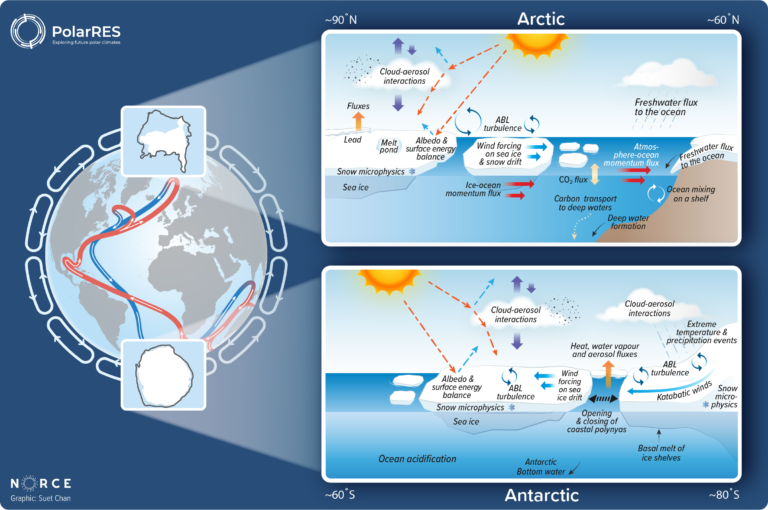
The topic is our PolarRES project – an ambitious Horizon 2020 effort to produce a large ensemble of regional climate simulations over both poles. These are state-of-the-art regional climate models run at unprecedented high spatial resolution and all data will be made open access and free via the CORDEX project.

I will also put it here later – feel free to comment here or ask questions on mastodon or get in touch by email if it sounds exciting.

Mottram, R., Mooney, P., and Torres, J. A. and the PolarRES Consortium: A first look at the new PolarRES ensemble of polar regional climate model storylines to 2100, EGU General Assembly 2023, Vienna, Austria, 24–28 Apr 2023, EGU23-14470, https://doi.org/10.5194/egusphere-egu23-14470, 2023.

Other posters and talks I’ve contributed to from PolarRES are

Kristiina Verro’s talk on HCLIM_Arome results from the Antarctic peninsula:

Verro, K., van de Berg, W. J., Orr, A., Landgren, O., and van Ulft, B.: New non-hydrostatic polar regional climate model HCLIM-AROME: analysis of the föhn event on 27 January 2011 over the Larsen C Ice Shelf, Antarctic Peninsula, EGU General Assembly 2023, Vienna, Austria, 24–28 Apr 2023, EGU23-13864, https://doi.org/10.5194/egusphere-egu23-13864, 2023.

Abraham Torres joined our group last year and is primarily working on PolarRES also. He will show some of our preliminary HCLIM results for both the Arctic and the Antarctic

Torres-Alavez, A., Landgren, O., Boberg, F., Christensen, O. B., Mottram, R., Olesen, M., Van Ulft, B., Verro, K., and Batrak, Y.: Assessing Performance of a new High Resolution polar regional climate model with remote sensing and in-situ observations: HCLIM in the Arctic and Antarctica, EGU General Assembly 2023, Vienna, Austria, 24–28 Apr 2023, EGU23-14090, https://doi.org/10.5194/egusphere-egu23-14090, 2023

Quentin Glaude is a collaborator from Liege in the Horizon 2020 PROTECT project on sea level rise contributions from the cryosphere . Baptiste Vandecrux, a former PhD student with me here and now working at GEUS is also presenting some work based on the same models as Quentin, with a comparison to the PROMICE observation statons on the Greealnd ice sheet. It’s very cool application of machine learning and the results are very interesting.

Glaude, Q., Noel, B., Olesen, M., Boberg, F., van den Broeke, M., Mottram, R., and Fettweis, X.: The Divergent Futures of Greenland Surface Mass Balance Estimates from Different Regional Climate Models, EGU General Assembly 2023, Vienna, Austria, 24–28 Apr 2023, EGU23-7920, https://doi.org/10.5194/egusphere-egu23-7920, 2023

Vandecrux, B., Fausto, R. S., Box, J. E., Covi, F., Hock, R., Rennermalm, A., Heilig, A., Abermann, J., Van As, D., Løkkegaard, A., Fettweis, X., Smeets, P. C. J. P., Kuipers Munneke, P., Van Den Broeke, M., Brils, M., Langen, P. L., Mottram, R., and Ahlstrøm, A. P.: Historical snow and ice temperature compilation documents the recent warming of the Greenland ice sheet, EGU General Assembly 2023, Vienna, Austria, 24–28 Apr 2023, EGU23-9080, https://doi.org/10.5194/egusphere-egu23-9080, 2023.

Nicolaj Hansen (who finished his PhD with me and Sebastian Simonsen at DTU Space last year) has just submitted a beauty of a paper which he will talk about – also partof PROTECT.

 Hansen, N., Sørensen, L. S., Spada, G., Melini, D., Forsberg, R., Mottram, R., and Simonsen, S. B.: ICESat-2 Ice Sheet Mass balance: Going below the surface, EGU General Assembly 2023, Vienna, Austria, 24–28 Apr 2023, EGU23-12349, https://doi.org/10.5194/egusphere-egu23-12349, 2023

Mathias Larsen is a current Phd student with me and is presenting a poster on the CARRA dataset and an application in surface mass balance modelling. This work falls under the danish National center for klima forskning

Larsen, M., H. Mottram, R., and L. Langen, P.: CARRA-driven simulation of Greenland Ice Sheet surface mass balance at 2.5 km resolution, EGU General Assembly 2023, Vienna, Austria, 24–28 Apr 2023, EGU23-5852, https://doi.org/10.5194/egusphere-egu23-5852, 2023

Last year I co-organised a bootcamp for early career researchers on Arctic processes in the CMIP6 models. It was super fun and would not have been possible without the support offered by Anne Fouilloux, Tina Odaka and colleagues from the Pangeo project. Their poster is super interesting and if you’re interested in optimising the use of big climate data, go and check it out!

Fouilloux, A., Marasco, P. L., Odaka, T., Mottram, R., Zieger, P., Schulz, M., Coca-Castro, A., Iaquinta, J., and Eynard Bontemps, G.: Pangeo framework for training: experience with FOSS4G, the CLIVAR bootcamp and the eScience course, EGU General Assembly 2023, Vienna, Austria, 24–28 Apr 2023, EGU23-8756, https://doi.org/10.5194/egusphere-egu23-8756, 2023.

Excitingly, at least 3 of the projects at the bootcamp will also be presented at EGU this year. So, lots to be getting on with, for now, here’s a link to Ultravox’s finest…

Out and about in Leeds..

I’ve been on holiday this last week and I’m combining the trip to the UK with a visit to colleagues and collaborators at the University of Leeds. I’ve also been nabbed while I’m in Leeds to give a wider interest talk at the Royal Meteorological Society Yorkshire branch in Leeds.

I’ll be discussing ice sheets, their contribution to sea level rise and how the future is looking. There may also be some nice photos from our fieldwork in Northern Greenland for those who like dogs, icebergs and snow…

If you’re in Leeds and fancy joining you’re most welcome to register and attend at this link.

In general, I’m trying to reduce my travel this year, last year, with all the rolled over meetings from the COVID times was disruptively busy with work travel, it makes it challenging to actually get the work done. So I think combining work and holidays and rolling up meetings into a block is the way forward.

Although I very much appreciate the opportunity to present online at various meetings, I’m less convinced about hybrid meetings where the purpose is mostly scientific discussions, that is something that works much better either all online or all in person in my opinion, but I think they work well when the aim is to present new and ongoing work (like EGU).

For those who are interested but can’t attend I will see if the talk tomorrow will be recorded and can be uploaded somewhere. Here’s the abstract:

Frozen Threats: Understanding the Role of Ice Sheets in Sea Level Rise

In this talk, we will delve into the world’s ice sheets and explore their importance in the climate system. Ice sheets are the largest stores of freshwater on the planet, their size and location means they influence our climate but their interactions with the atmosphere and ocean are complex. As the world warms, they will inevitable have an impact on sea level. Adapting to sea level rise will be one of our civilisations biggest and longest challenges, so understanding ice sheets is now of critical importance. They are also beautiful and fascinating environments in their own right. In this talk I will discuss some of the scientific challenges, but also show how far we have come in understanding ice sheets and glaciers.

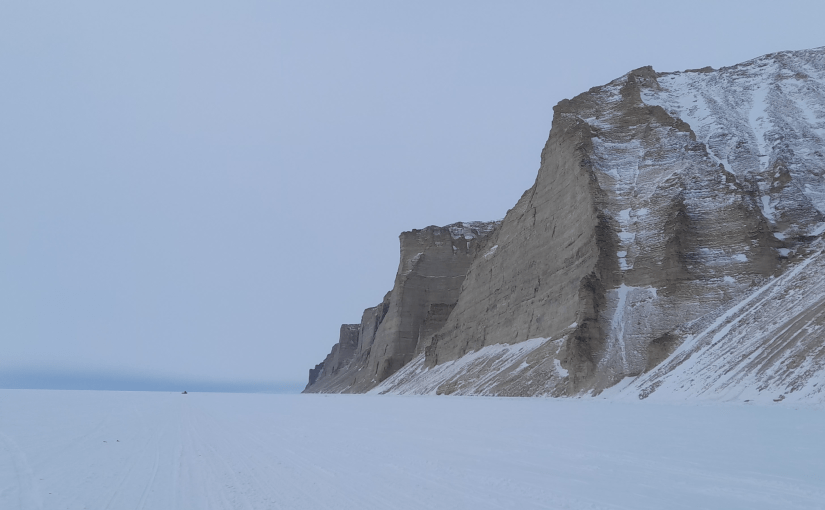
The Inughuit cliffs near Qaanaaq in Northern Greenland rising up above the sea ice. In the far distance a dog-sled is a small black speck.