I’m in Antarctica and yet I have been getting contact from journalists because Greenland is all over the press at the moment for all the wrong reasons. It’s reasonable I think to worry about what the various deranged threats towards Greenland will mean for us all also outside of Greenland. But I also think about (and yes, worry) about the friends I’ve made in Greenland over the years. Let’s hope common sense prevails and we can step back from the brink, and concentrate on the really long term problems that we are still rapidly storing up for ourselves.
Greenland is also on my mind, not just because of geopolitics, but also because the Copernicus Climate service has just put out their annual global climate highlights* for 2025 report with some disturbing results from Antarctica.
A few months ago we had a paper published called the Greenlandification of Antarctica, in which we argue that the changes in the Antarctic cryosphere increasingly resemble those we have previously observed in Greenland and the Arctic. To see the future of Antarctica, look at Greenland.
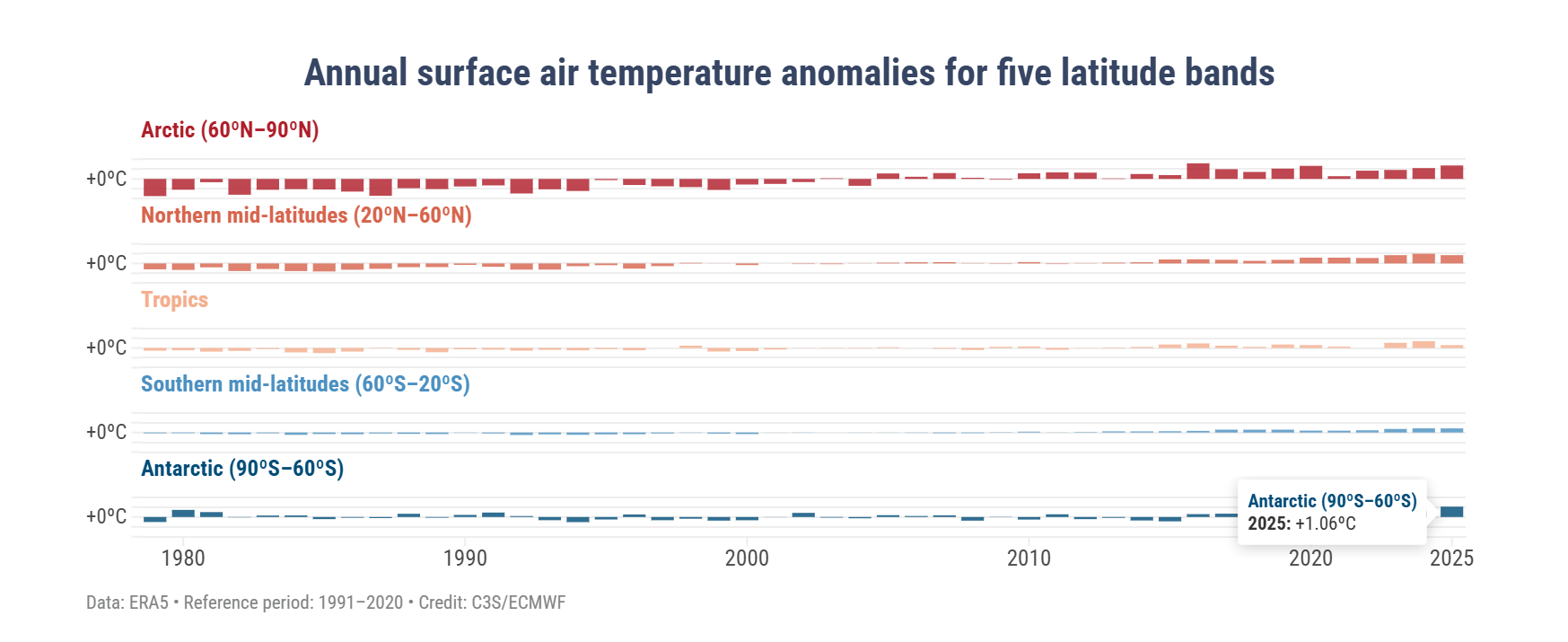
It’s been a busy time preparing for fieldwork and I didn’t manage to write anything here about it at the time, but this few eye-opening figure rather supports some of our arguments.
In this graphic, the 2025 temperature over the Antarctic region was 1.06°C higher than the average between 1991 and 2020 (a temperature anomaly). This is actually higher than any other region except the Arctic, where the temperature anomaly was reported to be 1.37°C above the 30 year average (bear in mind also that between 1991 and 2020, the temperature was also much increasing, so we’re not comparing with a pre-industrial climate here). Polar amplification was predicted long ago and as those first experiments found, it also is seen more in the Arctic than the Antarctic – but these results are a first hint of the amplification that is perhaps appearing now and may come to stay in the Antarctic.
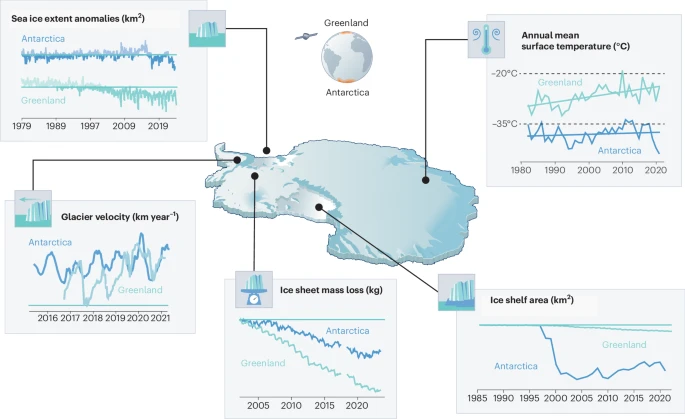
In our paper we show the figure below (many thanks to illustrator Jagoba Malumbres-Olarta for the fine work), which shows five different cryosphere properties that are changing: 1) shrinking sea ice, 2) glacier velocities that show a seasonal cycle (mostly detected on the peninsula so far, though there are indications that Totten glacier for example has some kind of seasonal cycle, possibly modulated by sea ice), 3) total ice sheet mass loss, 4) ice shelf area and 5) annual mean surface temperature. In virtually all, the changes look very similar between Greenland and Antarctica, but with the crucial difference that the speed of changes is so far faster and more advanced in Greenland.
From Mottram et al., 2025: The Greenlandification of Antarctica. Original caption: a, Commonalities include decline in sea ice extent from 1980 to 20232, with notable step-like changes in both poles. b, Seasonal glacier velocities are shown for two representative marine terminating glaciers, Kangilernata Sermia in Greenland13 and Hotine Glacier on the AP9, both now displaying similar seasonal dynamics. c, Both ice sheets show an accelerating total mass loss measured by GRACE satellites8. d, Multi-sensor records of ice shelf area loss in Antarctica11 show a steeper decline than Greenland7 as Arctic ice shelves were largely lost in the pre-satellite era. e, Satellite records of annual mean ice sheet surface (skin) temperature for 1982 to 2021 from radiation data in the CLARA-A2.1 record processed by OSISAF2 over both ice sheets. Earth observation data allows us to generalize over the vast size and spatially varying trends of the ice sheets, where there is generally poor coverage of in situ data. Individual weather stations indicate warming trends in air temperatures over both ice sheets of ~0.61 °C per decade at the South Pole and ~1.7 °C per decade at Greenland coastal stations. Illustration by Jagoba Malumbres-Olarte
The latter surface temperature plot is not the same as the Copernicus 2m air temperature which is based on the ERA5 reanalysis (so a blending of computer model with observations from satellites, weather stations, balloons, ships, planes etc). In our paper we wanted to focus on the contribution that satellite data has brought as we simply have so few direct in situ observations, so we used skin or surface temperature which is measured from satellites. It’s a somewhat theoretical construct, imagine a very thin surface (hence skin) layer, where incoming and outgoing energy are summed up to give a temperature. This is calculated over both ice sheets and sea surface by our colleagues in the satellite group at DMI and this is the dataset we used here. Their results which stretch back to the 1980s show a slow upward trend in Antarctica and a steeper change in Greenland, the record stopped in 2021 in our paper but it actually shows an upward increase since and that’s also borne out by the Copernicus results. In climate and weather models we in fact first calculate the skin temperature and then back interpolate to 2m temperature, so the two are very closely related.
To check that the satellite skin temperature record was accurate, I also looked at some of the longer in situ records, the South pole station for example has a long record and shows a small increasing trend over the last 30 years or so (which also may be attributable to natural causes, it is hard to pick out the global warming trend). Analysis of the record also shows that it is largely due to decreasing cold extremes rather than necessarily higher warm extremes. Again, a pattern we also observe in the Arctic.
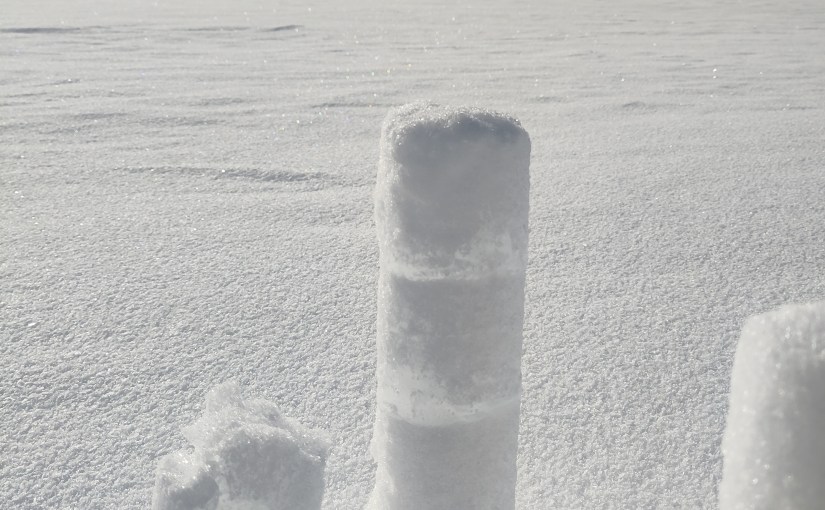
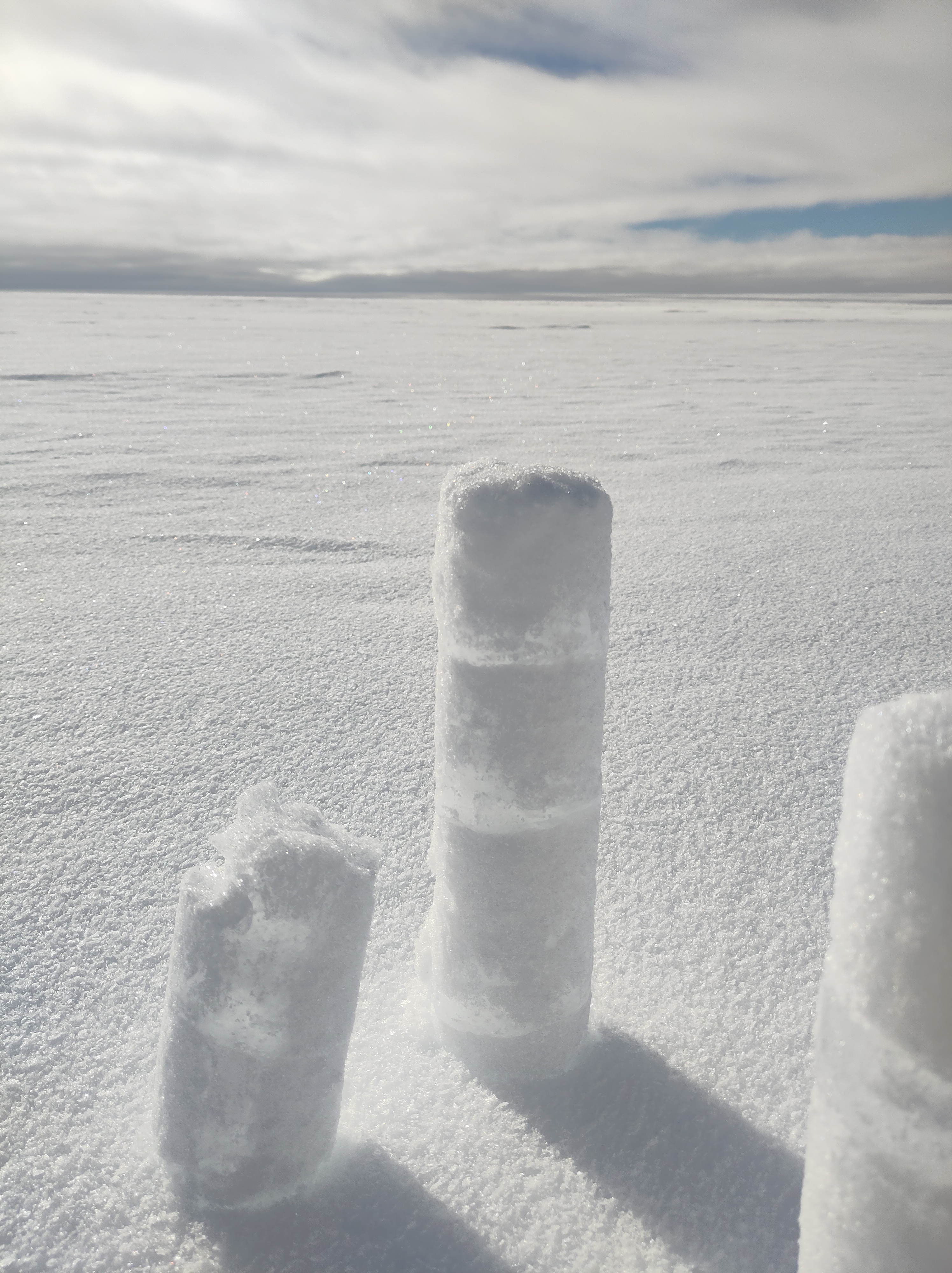
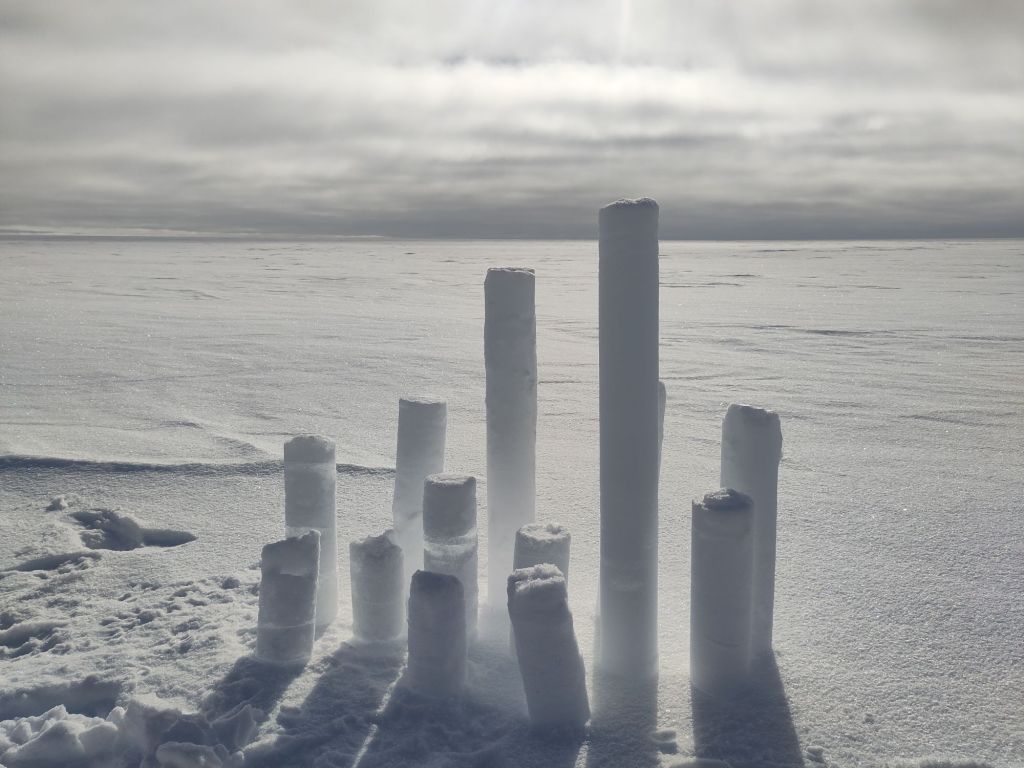
Shallow snow cores drilled near Wasa, the clear layers are refrozen surface melt that has percolated into the snow below the surface. I was genuinely not expecting to see these, and it’s not always captured in the satellite record either, so we clearly have work to do to explain some of these findings.
The analogy is not exact. As a continent, Antarctica is much further south than Greenland is to the north and it is much more insulated from warming by the circumpolar ocean than the Greenland ice sheet, sticking out in the middle of the Atlantic is. In a very real sense then, geography is destiny. Surface melt, which is also not nearly as common here in Antarctica mostly refreezes in the snowpack, whereas in the lower parts of Greenland it generally runs off and contributes directly to sea level rise. That has not yet become a major process in Antarctica, it’s still colder here and there is less surface melt for now, although from our own observations in the field, much more than I’d expected. Surface melt is definitely something we need to keep an eye on and some of our observations show how tricky that is, especially given disagreements between satellite sensors on this point .
But these are all details, the point is that Antarctica is also part of the global climate system and the same processes we’ve been observing for more than three decades in Greenland are now also starting to become apparent here too.
In one other respect Antarctica is becoming more similar to Greenland – it is becoming more contested. The Treaty that has governed Antarctica is vulnerable and subject to the same weakening of the global order that is now playing out in the North.
Let’s hope that geopolitics can settle down soon so that we can start to tackle the more serious and longer term crises coming down the line.
*I’m not sure “highlights” is quite the right word either – maybe “lowlights” would be better, but then it also starts to sound like a report on hairstyles…
LISA is alive! Kind of. We had a really good field test of the system in this, our first week in Antarctica (though thank goodness for satellite wifi connection** to the rest of the world so LISA’s genius creator Helle Kjær could assist in troubleshooting). It was a bit of a struggle and I would say we came out partial winners, with a much deeper understanding of how the box is actually put together and more importantly some really interesting data (yay!) that Clement is busy processing already – I’m very excited to see how it turns out as it will help to direct our following field sorties.
This is the first field deployment of LISA in Antarctica, and even if she didn’t give up all the secrets of the snow, it’s still an achievement worth celebrating that we got half of it, and an interesting half too.
We chose a coring site around 60km from Wasa, so it was a long slow snow-scooter tour up Plogbreen (the plough glacier – named after our neighbouring nunatak Plogen, the plough) and on to the flat plateau of Ritscher Flya at about 1000m elevation.
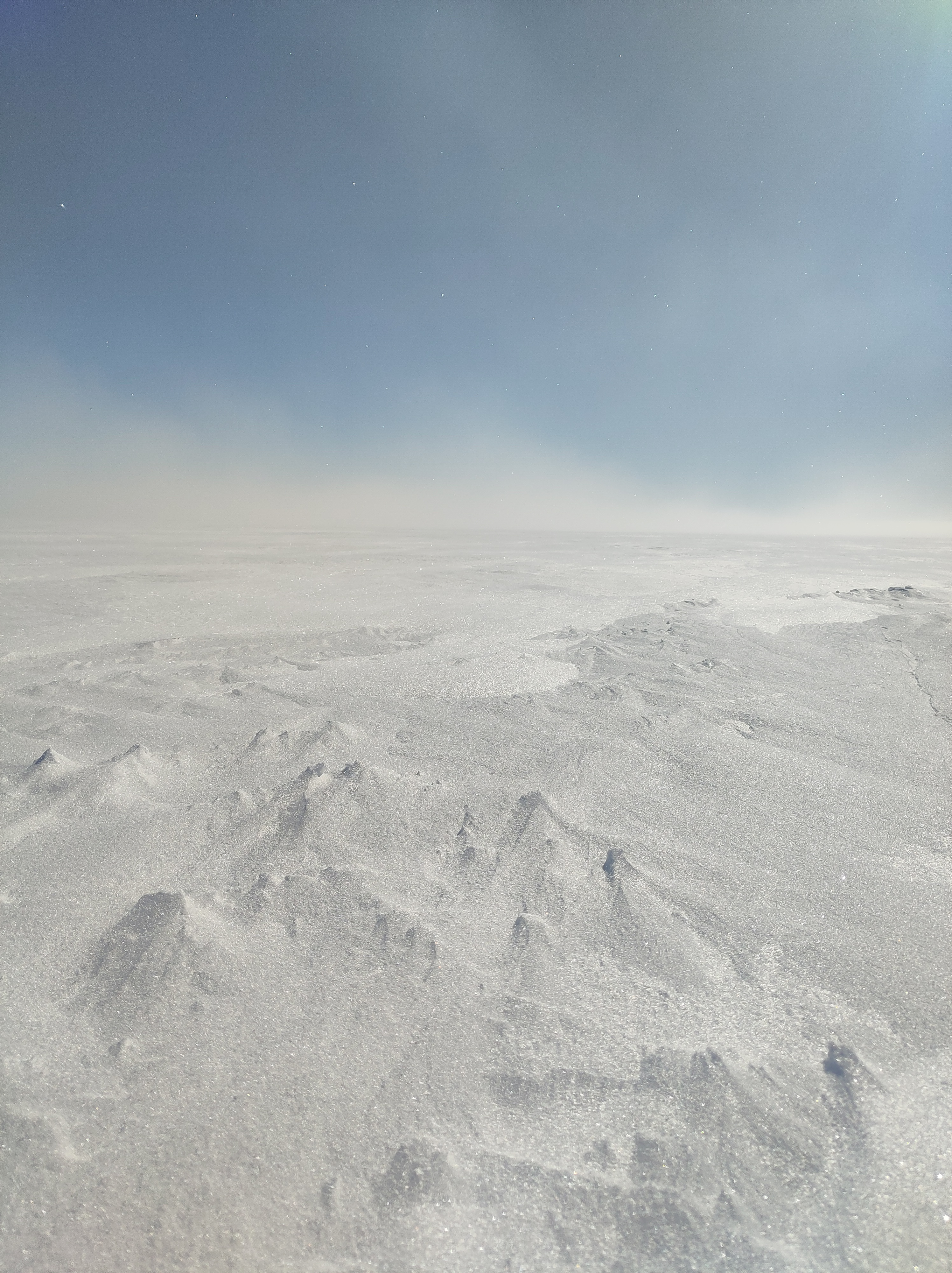
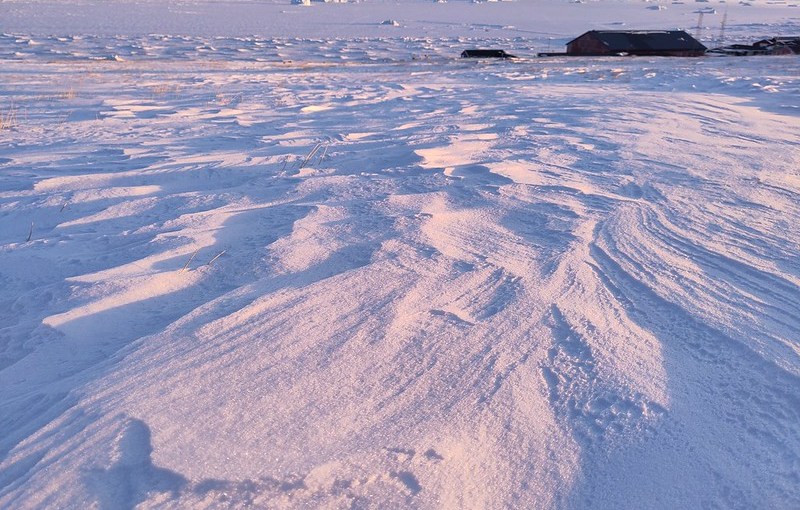
Wind sculpts snow into ridges called sastrugi. We had quite a bit of fresh snow at this site while we were there. Sometimes it’s hard to work out where the snow surface actually is.
It was a pretty wind and snowy site, in a katabatic wind zone (thankfully not too strong on this trip), which was intentional, as one of the aims of our study is the effects of strong winds on snow accumulation. As preparing to leave took most of the day (especially doing the chemistry mixes for LISA), we headed up in the afternoon and then stayed out overnight in these fantastic little cabins on skis.
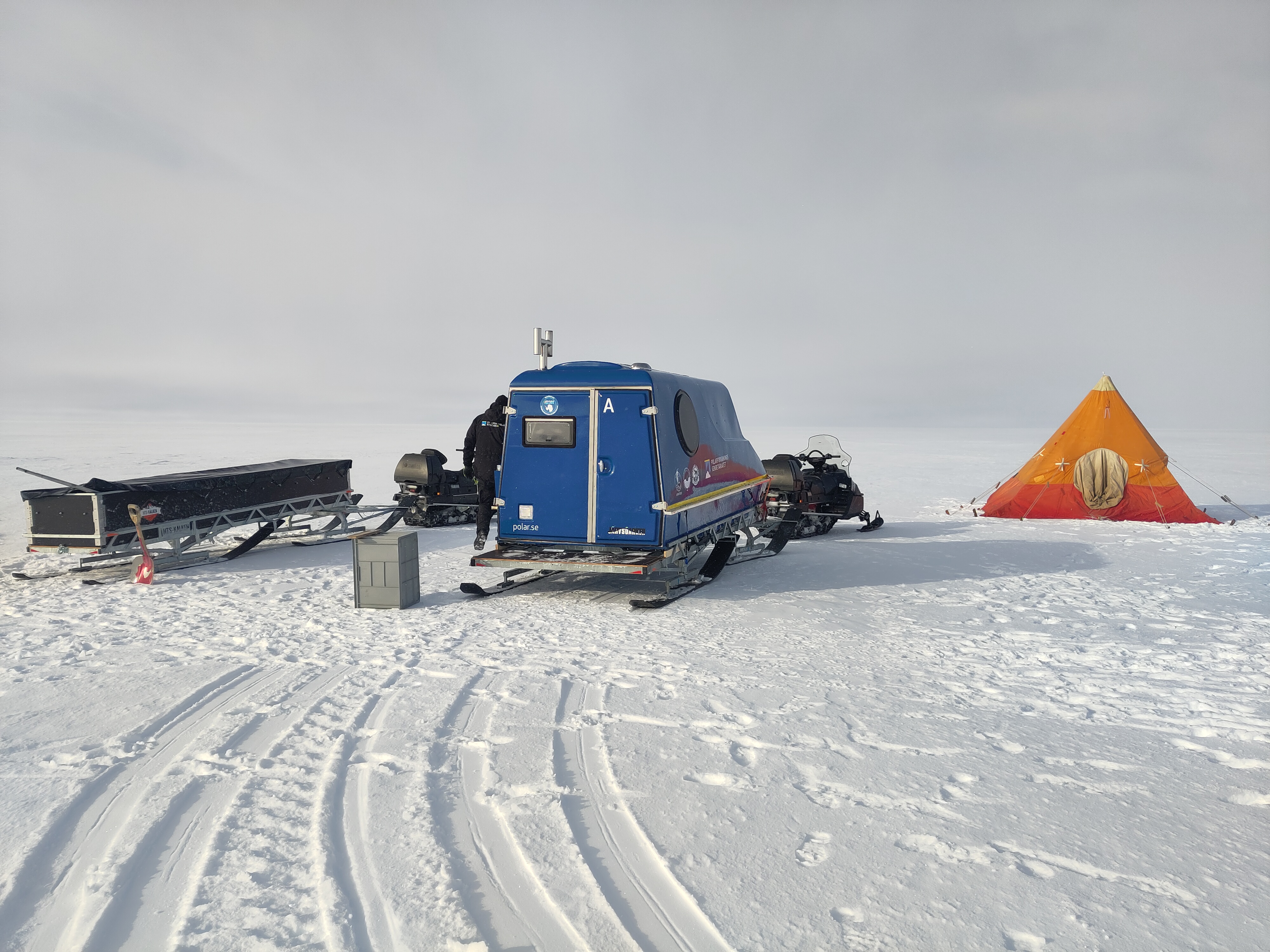
Our field camp: sledge full of equipment, the blue cabin on a sledge (an ark) is one of our living quarters and the pyramid shaped, orange Scott tent is our bathroom.
The Polar Research institute in Sweden calls them arks and they are really a very nice solution to the problem of cold and wind and trying to work in quite extreme conditions. Pulled by a snow-scooter and with a stove inside for melting snow and heating, they’re really very cosy to sleep in and it makes a big difference to be able to warm up when for example you’ve been sitting in a snow pit at -15C with a hefty wind chill on top and are covered in spin drift snow (as me how I know).
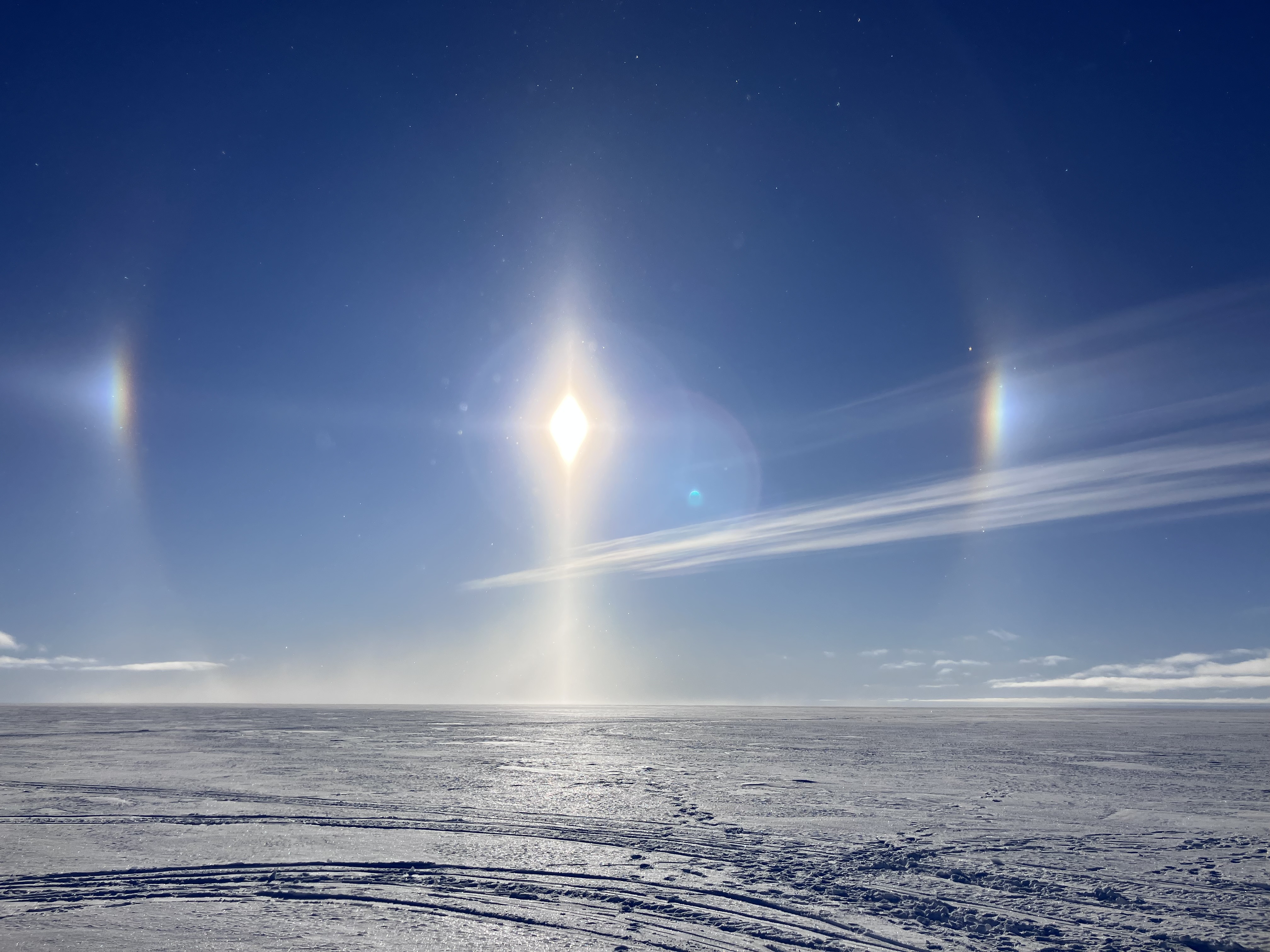
We were greeted by this beautiful halo around the sun upon waking, with sun dogs on either side, caused by the ice crystals in the sky. In fact we nick-named the site diamond dust because of the clear sky precipitation on the first morning.
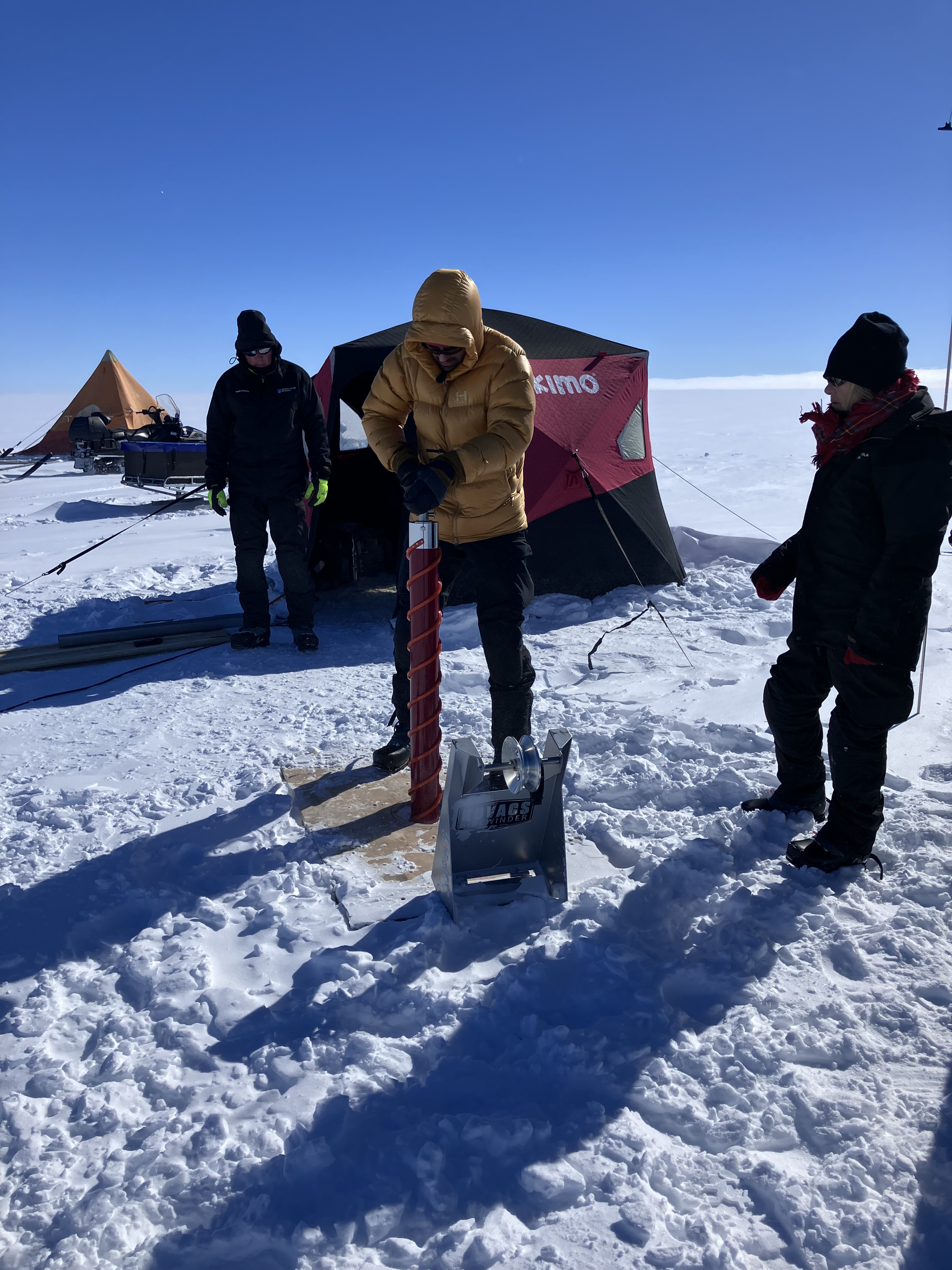
We soon got into a good rhythm with Henrik driving the coring, Clement logging and Ninis and myself assisting with the cores.
Starting the first core, (l to r the rest of the field team, Henrik, Clement and Ninis)
And then it was time to get LISA going and a very long and slightly frustrating day followed. Thankfully, by bedtime and having reconstructed quite a lot of the inner tubing of the box, we got LISA ready for work the next day.
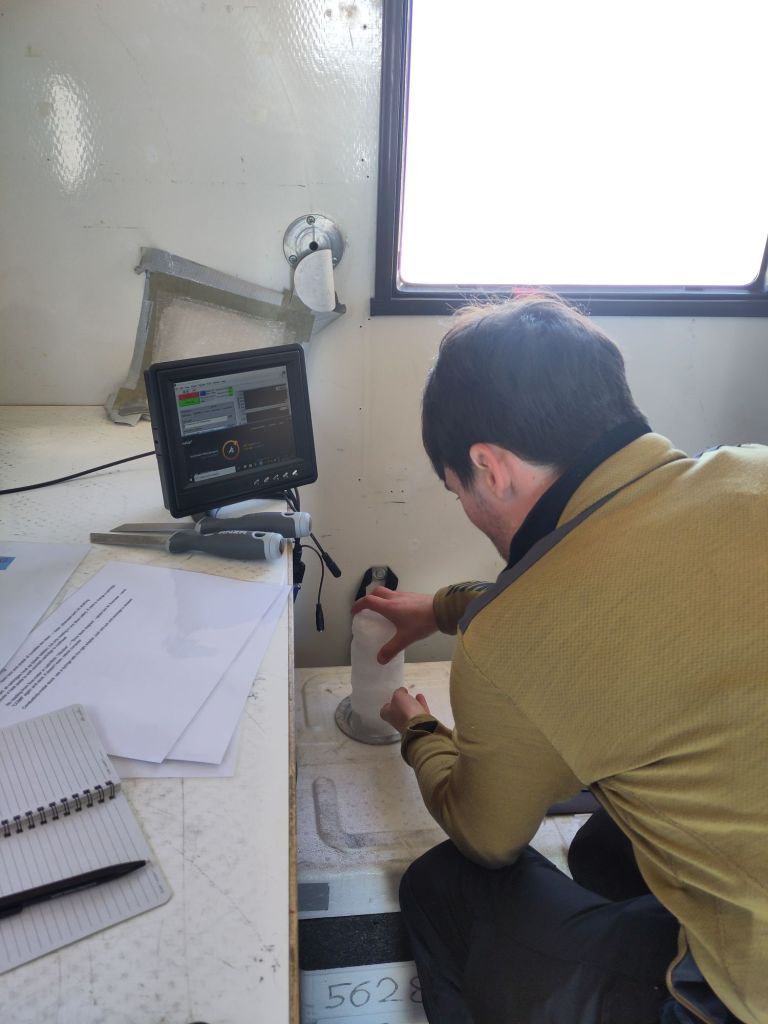
The LISA box with melting ice core on top and computer recording the data as it appears. The pop-up fishing tent was essential for working at this site in the cold winds. Without wind chill it was around -10C outside, preventing ice crystals from forming in the chemistry lines and reagents is also a concern, but the arks also simplify things.
I dug a snow pit – always one of my favourite activities, it’s good to get your hands in the snow and really feel what is going on, and we identified some really intriguing layers. Lots more work to be done there to work out what is going on.
As added entertainment, Ninis was interviewed live from the top of the ice sheet by Swedish TV live from the fieldcamp (check out God Morgon Sverige on TV4, 23rd December if you’re interested). However, after 2 nights out it was time to pack up and head back, 3 cores worth of data richer, for a shower, laundry and a Christmas Eve day off.
On Christmas eve daytime it was my turn with a brief 2 minutes to explain our project on Danish TV2 news (at 12.15 CET in case you have an account and would like to see me looking wind swept). Juleaften, Christmas Eve, is the big day of celebration in the Nordic countries, so we took an almost day off, doing some washing, cleaning the living modules and enjoying plenty of good food courtesy of the Swedish chef Raymond who prepared a Christmas dinner feast later, perfect after a long Christmas hike over the nunatak.
Field Photos
Given the current state of the US administration I think it’s worth thinking about what services we use, to become less dependent on US tech and social media companies. Therefore, I’m sharing photos over on pixelfed while we’re out here, in case you want to see more field photos, though sharing is a bit intermittent as it depends on the internet link and due to the expense of the data, we’re trying not to use too much.
I am also posting over on blue sky, though there is much that makes me uneasy about that platform, so I will keep posting on the fediscience server on mastodon too (and indeed the quality of interaction is often better there strangely, given I feel that the platform is smaller than blue sky).
*The Swedish research station Wasa is located on a nunatak in Antarctica called Basen (it’s pronounced Baasen, like the sound a sheep makes in english)
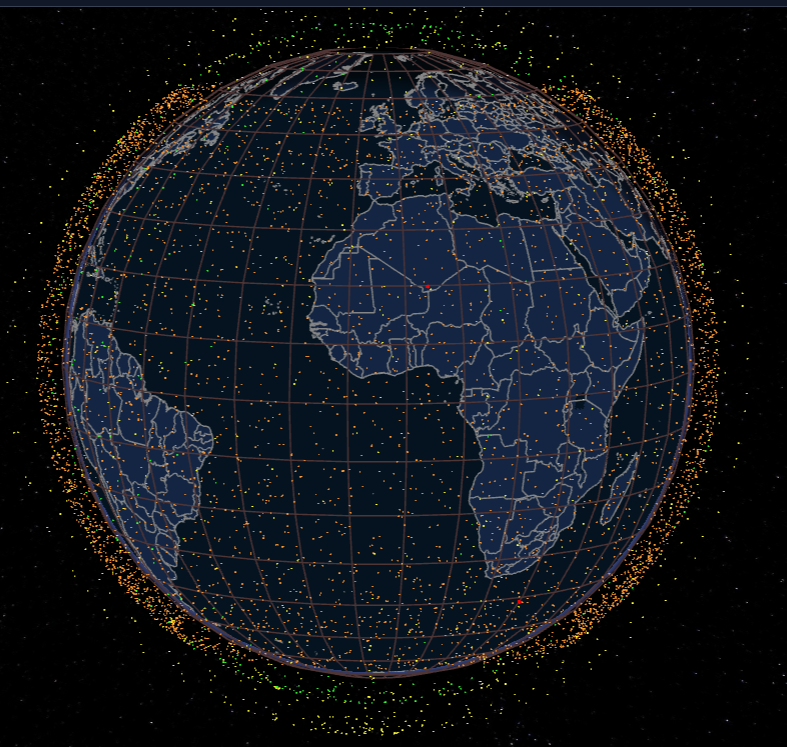
**Yes we are on starlink. It’s incredibly impressive performance wise, but I’d rather not be supporting the nazi man-child, the sooner Eutel Oneweb makes an alternative for users like us, the better, though preferably without this polluting a footprint in low earth orbit. In fact if any EUTEL folks are reading this, I’d be delighted to test out a lightweight system for polar field scientists for you 🙂
Screenshot from satellitemap.space showing the position of the tens of thousands of starlink satellites currently orbiting earth. Check out their visualiser to see other satellites!
It’s been a good start to the field season, incredible competent logistics, great field equipment, super helpful colleagues and incredible food by the station cook. For the first time ever I suspect I’ll be putting on weight in the field. But everything also takes a lot longer in Antarctica so little in the way of actual scientific results to report yet. Nevertheless we’ve some tantalising hints of some interesting processes and we’ve been settling in to the expedition frame of mind.
We had a very good flight from Oslo, a small delay in Prague notwithstanding, very friendly cabin crew and 3 seats each to lie across meant a relatively good sleep and a decent amount of work finalised on route.
Clouds over Namibia’s Etosha National Park. We basically crossed a third of the world to get here. A carbon debt I’ll be paying for years…
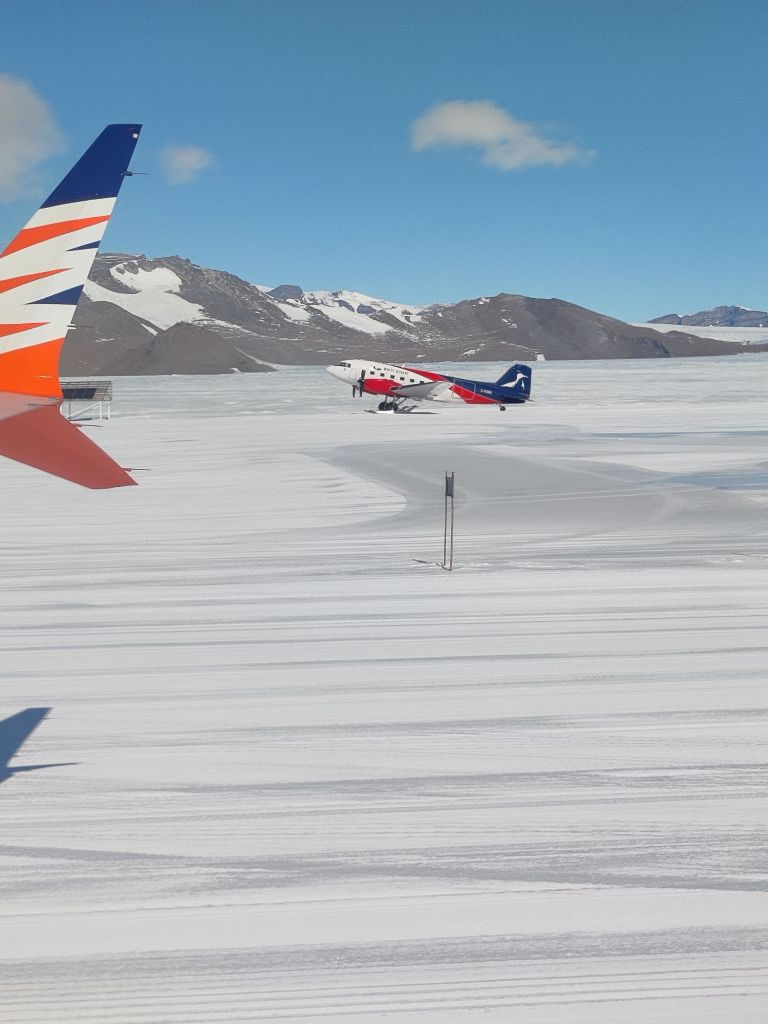
Similarly, in Cape Town, mostly spent in a hotel room finishing off reports, except for dinner and an occasional walk. And then a very smooth and easy 5 hour flight first to Troll, to be met by welcoming Norwegian colleagues and a vintage Basler (a DC3 airframe dating back to 1944, but with new engines – I’ve seen it in Greenland before – it still works!), that took us more or less directly to Wasa, where our Swedish colleagues met us on the glacier runway. And what a welcome! Everyone has been extremely helpful and very friendly.
The “vintage” Basler, an unpressurized aircraft. Very fun to fly in and beautiful views..
Operating in Antarctica is a bit like working in Greenland and also not at all like Greenland. In both places you have to be pretty flexible, self reliant and able to work in difficult conditions and across broad teams. It’s just much more extreme in terms of isolation, logistics, costs and everything else here in Antarctica.
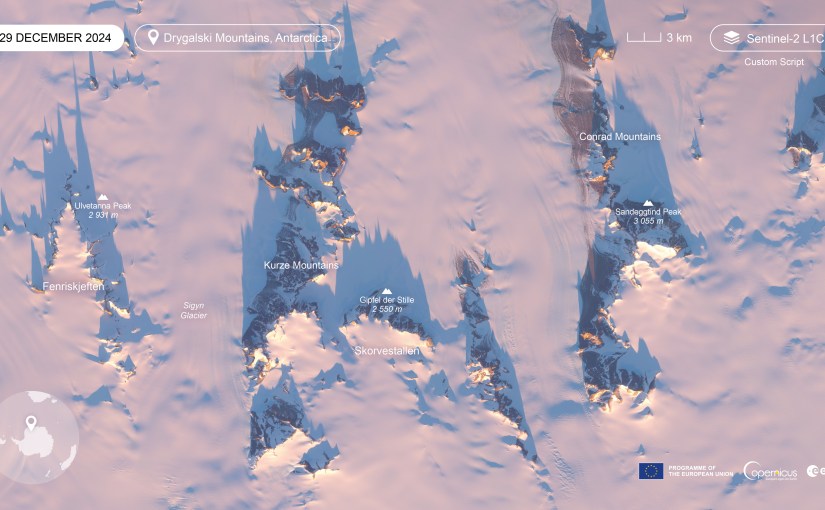
The nunataks of Dronning Maud Land: it’s a big and very beautiful place
We are extremely fortunate to be so well- supported by such a great crew and it is important to me that we repay that investment with some excellent science results.
So far though, we’ve been laying the groundwork, getting our safety training done, testing some new coring equipment, unpacking and testing the LISA box and learning how to use the arks (a kind of plastic shell on skis that we will use for camping in while out of the station) and preparing for what I believe is sometimes called “deep field” (perhaps a touch melodramatic for what is basically camping).
Safety training: testing a snow anchor for crevasse rescue purposes
We’ve also tested some new drilling equipment, finding some very interesting firn features in the process, including several thick ice lenses in a region we didn’t expect.
Stacked firn cores on the glacier.
There have been a few anxious moments around our old friend LISA. She is a complex machine with many pieces that can go wrong but finally at 9.30 this evening Clément managed to get her working. In a tiny “lab” but one with a great view. A huge relief all round (and hopefully field operation will be more straightforward now we’ve had some practice).
Tomorrow will be mostly packing up and preparation for a few days away, so Christmas Eve will likely find us camping out on a glacier somewhere working away. Weather permitting of course. So far we’ve been pretty lucky with that and we need to make the most of it while it lasts.
So that was a quick field update, it’s been pretty busy and a bit weird to think I’ve only been here 3 days so far. I’ve already slipped into field mode and slightly lost track of time.
Tomorrow I’m taking the first stage of the journey to Antarctica, ironically enough though, I’m heading south by first heading north, to Oslo, where the Norwegian Polar Institute have organised an almost direct flight from Oslo to Troll station with a short stopover in Cape Town.
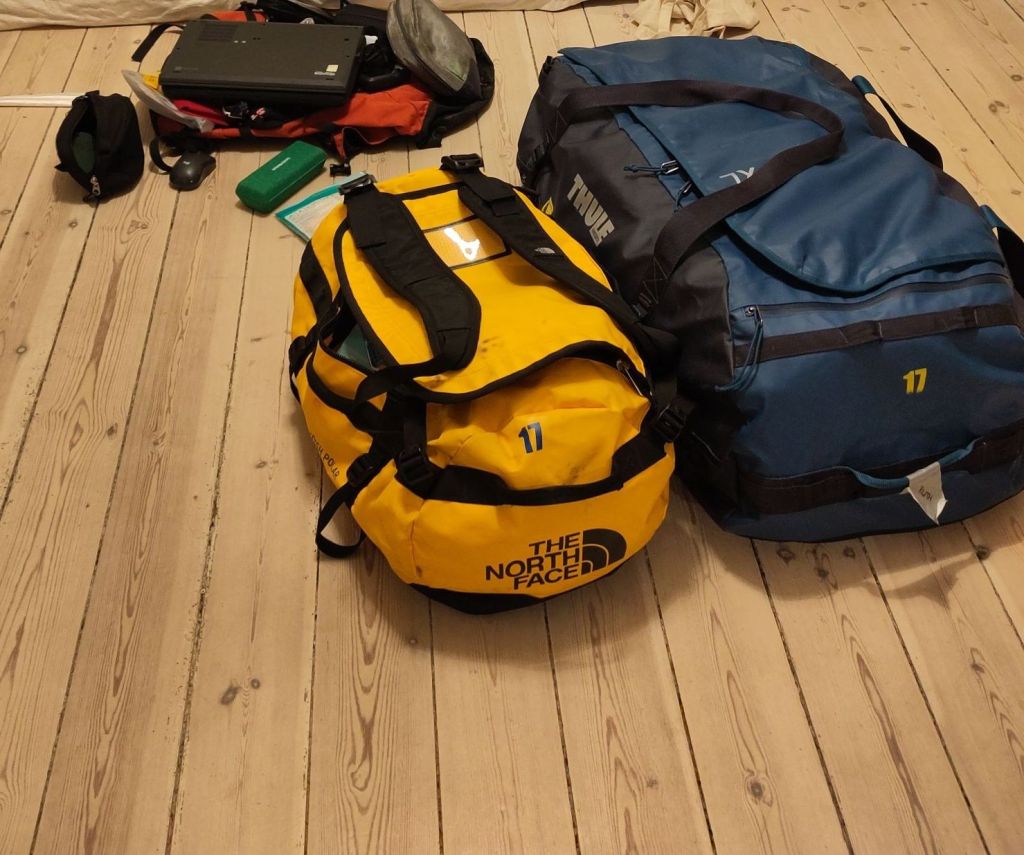
Bags almost packed and ready to go…
I’m super excited and also suffering a little trepidation. It will be my first field visit to Antarctica, even though I’ve worked in Greenland for many years, the differences will, I imagine be pretty huge…
We also have a very ambitious work plan with pretty novel and experimental equipment. It’s going to be interesting to see how much of what we have planned actually works. Small points of failure can destroy a field season. Though in our case, I’m pretty confident we’ll bring something back, even if it is not as much as I hope. And I’m always a little over-ambitious, but surprisingly often it pays off.
The opportunity to participate in iQ2300 first came up almost 3 years ago, so it’s been on the cards for a while and fieldwork has been on my mind all year. It will be nice to finally get going, even if I don’t necessarily feel ready in spite of the long run-up.
I never really feel ready for fieldwork, but at some point you just have to get on with it, like the penguins nervously clustering on the edge of the iceberg, wondering if there is a leopard seal in the water. Eventually someone jumps (or is pushed), and then they all go in and usually, the water is lovely. Although in our case, I doubt I will even get to see any penguins, the Wasa station, my home for the next 6 weeks or so is rather a long way for the sea. In the meantime the first groups are already out, opening the station ready for our arrival next week, deploying weather stations, running ice penetrating radar and checking out the equipment we’ll need to use. The signal groups we have are no longer just coordination but field updates direct from Antarctica – a miracle of telecommunications that we don’t even think about anymore!
The Autumn has also been far too hectic with my eternal inability to say no to interesting opportunities challenging everyone around me and especially myself. Will I ever learn? I remain extremely grateful for the team at DMI and at home for keeping things ticking over.
However, it has also felt like a sequence of tasks to tick off while the grand départ gets closer, annual meeting, tick, Hackathon, tick, panel meeting, tick and then eventually, annual report, tick, expense claims, tick, Christmas presents, yep, and finally tomorrow may actually come. Hence though, the notable lack of updates on here, I have had to find some slack somewhere on these informal little pieces that I’m unsure anyone reads have definitely been a casualty.
I’m not sure much is going to change the next couple of months either. But I will try to post at least occasionally, work schedule, weather and internet access permitting.
But first it’s time for a little Christmas hygge with my incredible family and my lovely husband who have never asked me not to go..
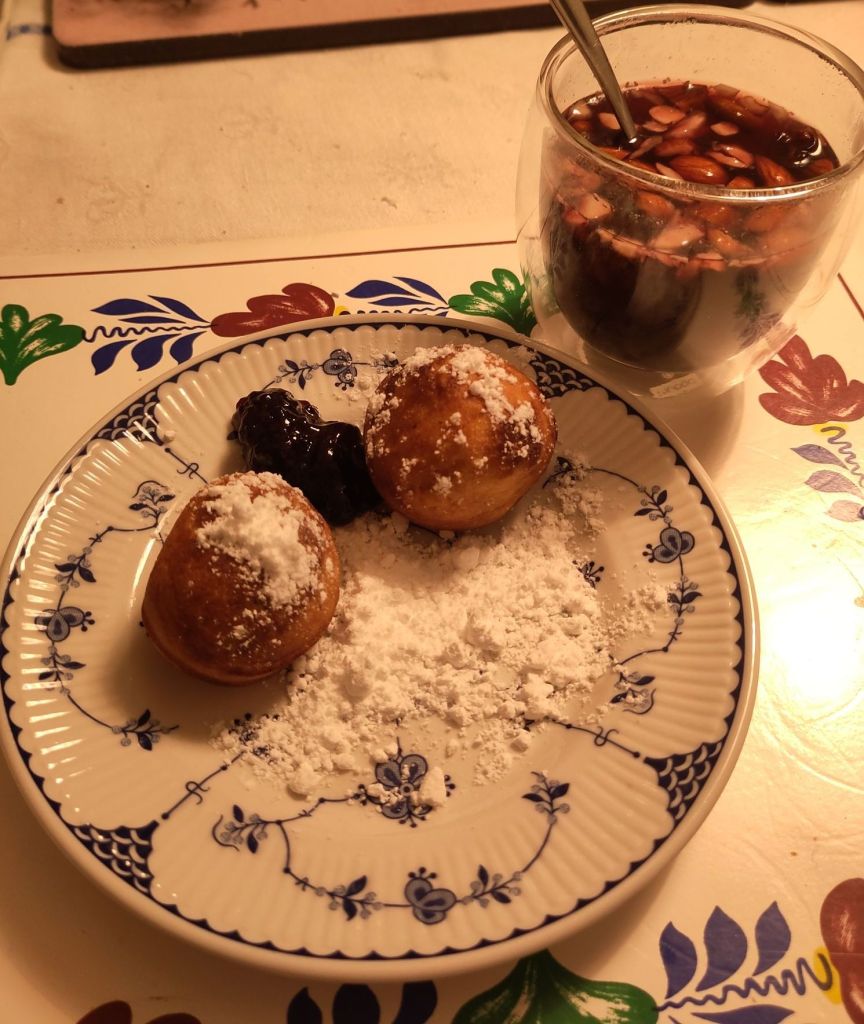
Danish æbleskiver and gløgg by candle light, perfect for a dark December evening, bring on the 24 hour daylight…
As ever I’m grateful to the Swedish Polar Secretariat for giving me and the team the opportunity to participate in this field season, as well as the Novo Nordisk Fund whose PRECISE challenge grant has also helped us to pay some of the other costs.
LISA: the Lightweight In Situ Analysis box is one of a kind; built by our friends at PICE in the Niels Bohr Institute. Later this year we’re taking LISA to Antarctica for the first time ever, to analyse shallow snow and firn cores directly in the field.
This is part of our contribution to the EPIC iQ2300 – a project led by Prof. Arjen Stroeven in Stockholm and organised by the Swedish Polar Research Secretariat.
iQ2300 is a huge project, and we are just a small part of it: the aim is to understand Dronning Maud Land’s evolution from the Holocene and out to 2300. Expect to hear a lot more about this effort in coming months…
Map of Antarctica, I lifted from polar.se : LISA will be visiting the Swedish Wasa station in DML – the top bit on this map – with us
Now back to our humble friend.
We hope LISA will help us understand how much snow falls in Dronning Maud Land, how much it varies from year to year and what is the influence of sea ice and far field atmospheric processes on the rate of snowfall. Snowfall is exceptionally difficult to measure and one of our biggest uncertainties in working out Antarctic mass budget and the response of Antarctica to a changing climate (spoiler alert: we might have a paper coming out about this shortly)…
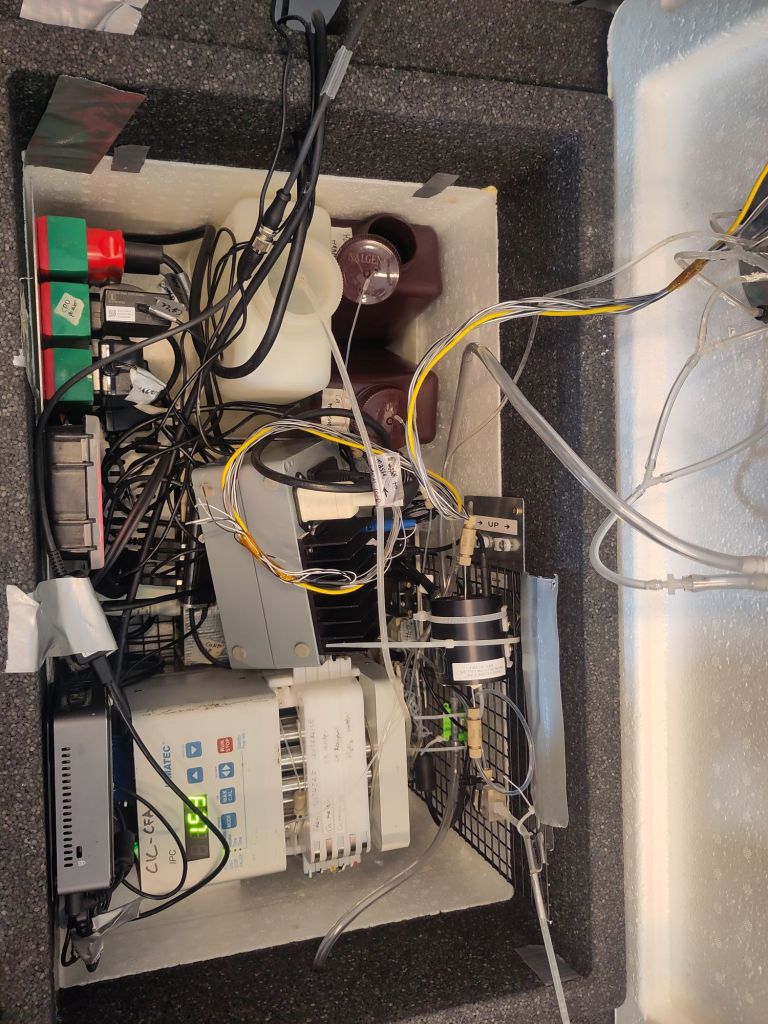
Meet LISA: a view inside the Magic Box..
Although LISA has been used in Greenland before, this is quite an experimental deployment, which means potentially really a lot of valuable scientific results. We would ultimately liek to build an Antarctic specific box, but that will have to wait to see if the results of this deployment are as good as we hope. (And some funding – if you are a billionaire with a spare couple of hundred thousand Euros, we’re always interested in talking).
The box itself is conceptually simple but in practice a little complex with a multiplicity of tubes, connectors and spare parts. This means it’s easy to fix if it breaks down, but also we need to understand how it works first.
There’s a lot to remember and a lot to check but we’re reasonably hopeful we’ll get good results. The aim is to understand both the interannual variability on decadal timescales and the spatial gradients in snowfall accumulation. It’s a huge task, so it’s probably fortunate that we have 6 weeks or so (depending on the weather always!) to try and get it deployed at anumber of different sites which will hopefully allow us to do this.
It’s a big change to my normal fieldwork activities, but also a logical extension of them. And highly complementary to the climate and SMB modelling we are developing.
Nonetheless, ithere’s a lot of new stuff and I have in the past weeks learnt a great deal about transporting very small amounts of mildly hazardous chemicals on airlines, how to deal with customs and pack fragile instruments in large boxes.
Much more to come on this project, so stay tuned…
Clement getting stuck into using the software that measures different properties in the cores.
I very rarely have time to write a proper field diary, our time in the field is usually extremely hectic and filled with 12-18 hour working days that blend seamlessly together. I suspect this week is also going to be busy, but Nature has offered an olive branch in the shape of an early break-up of the sea ice, so I’m taking a moment to write a few things down. Updates will be posted at the top so scroll down to read the first day.
And finally…
I’m writing this on the metro home, I’ll spare you the flight delays, the packing up dramas, the last minute, “just one more snow pit”…
Melville Bugt from the air
It was a good tour. Enormous amount of work done, perhaps more importantly, it has also been foundational work, on both data and field site management, it will be much easier for colleagues to help us maintain this and to build up a long term data set of all the observations (and more that I haven’t written about here) in future. That should reduce costs and field time in the future but also give others the opportunity to visit and do their own research up here.
The traditional hunters gloves turn out to be by far the best thing to work in when programming outside. You can put your hands in and out very fast and they are super warm.
I think streamlining the storage of data is extremely important. There is far too much data in the world on hard drives and in field notebooks, doing no good to anyone. This system will be much easier for other colleagues to use what we have collected and we will be able to publish them outside of DMI soon too. I remain committed to FAIR publishing, but I often feel the barriers are practical rather than psychological.
I’ve also introduced my new(ish) colleague Abraham to the Arctic. Given he grew up in a place without snow it has been a delight to watch him discover the processes and problems that I’ve been working on the last 20 years and that we’ve been discussing together the last 18 months. I believe it’s extremely important for climate modellers to understand and see the system they’re trying to model. This trip has definitely confirmed me in that. This was not just a field campaign but also a pedagogical field trip in some ways too. We have also had the opportunity to brainstorm a lot of new research ideas along the way, there is rarely such time in the office, so plenty more to work on in coming years..
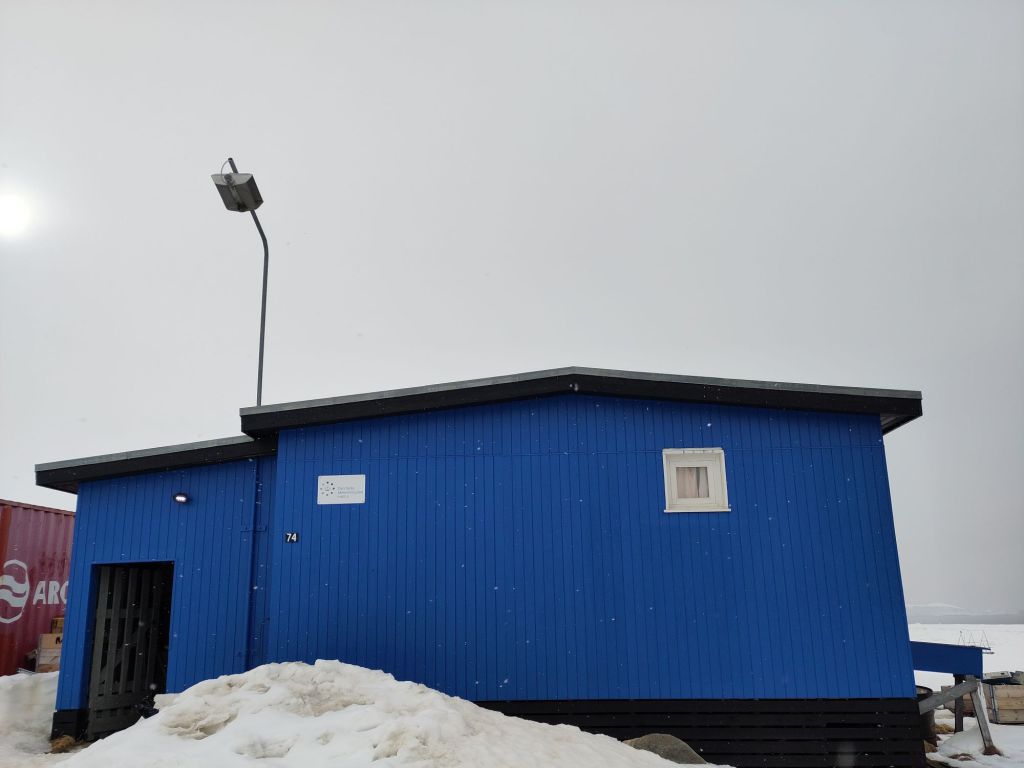
The DMI geophysical facility, newly painted!
As ever massive thanks to many colleagues, especially Aksel our DMI station manager without whom this work would be close to impossible given he is both interpreter and collaborator on the practical observations; Qillaq Danielsen for taking us out on to the sea ice with his sled. Steffen for running an extremely valuable long-term programme, Andrea for helpful and practical discussions and of course Abraham for making it a very good week. Glad we got to do this.
I should also say a large thankyou to my husband for keeping the home front running smoothly along whilst I am travelling. None of this would work otherwise.
Tak for denne gang Qaanaaq!
Day 6: Last day
It’s amazing how fast the tine goes, our last full day in the field (we’d originally planned for 9 days, but that was partly because last year we planned a week and it got cut to 3 days due to flight weather problems, I learned and left a safety margin this year). Nonetheless, a busy day. As we’re really interested in lots of different processes that combine in what we call the Arctic Earth System our focus for today was twofold, looking at the atmosphere and the subsurface, both of which are partly other scientists projects, but giving data we really want to use with our climate model, both for evaluation and development.
Aksel and Abraham giving the site a few last tweaks
The main aim was to finalise the snow site ready for observations over the next year. We finally reinstalled the remaining FC4 and new logger, this has been ticking over and being tested in our station kitchen for the last couple of days. I’m rather pleased with myself in managing to get these 2 talking to each other, I was envisaging a bigger struggle, but the Campbell Scientific software is very easy to use with good user guides.
The installation was the last element for the snow site and after Aksel and Abraham’s sterling work in building our new logger station, it was trivially easy.
Et voilá! We have a fully functional snow site…
The experience with the new Campbell system proved invaluable in the next task, downloading a whole bunch of data from colleagues’ weather stations for shipping back to Denmark. Normally, we would have been a bigger crew to handle work on the sea ice as well as at the station, but as the sea ice broke up so early (see Day 1), our local hunter friends had taken them down and brought them in to Qaanaaq for us. They needed a bit of repacking, data downloads and checks and we set up a skin temperature calibration station for the satellite group, which I think will also be quite interesting for us in polar regional climate modelling to use. This we left overnight for longest possible calibration.
As we have many collaborations we also spent an hour trying to collect some data from the subsurface permafrost sensors installed by our colleagues at the University of Copenhagen. Unfortunately, it appears they need rather more maintenance than we can provide, so that will need a full team. I am extremely keen to see the data though, ten years + of permafrost and temperature measurements is a seldom dataset and will be super interesting to use in the further development of our surface scheme. Qaanaaq is somewhat vulnerable to permafrost disturbance as it is built on sediments, so monitoring this in a warming climate is pretty important.
A long day, but made even longer by the excitement of narwhals in the bay! We headed out to the ice edge at 11pm, (the polar day plays havoc with your body clock), where quite a few hunters had gathered and were busy slicing up a freshly caught narwhal, eagerly filmed by at least one of the several film crews and photographers there appear to be in the town right now. We have noticed increasing numbers of film crews visiting this part of the world. It can be surprisingly busy.
Greenland does have a strictly regulated quota on narwhals, it’s an important part of the culture, but it is a bit brutal to watch if you’re not used to seeing animals sliced up. Personally, I think everyone should see where the meat they eat comes from. It would make us all more honest about agriculture. But I digress, I was actually more excited to see live ones out in the bay. We’re immensely fortunate to see them, this is only the 2nd time in 5 years I have seen live narwhal here, and it’s only really because the ice has shrunk so early allowing them in. I have immense respect for the hunters who go out in flimsy lightweight kayaks to harpoon them. That must take some courage.
It’s such a peaceful scene, hard to imagine the life and death struggle implied here.
UPDATE: And as an aside, our ace colleagues and collaborators at the Greenland Institute of Natural Resources have a wonderful series of videos exploring all kinds of research in Greenland, including this brilliant one featuring Malene Simon Hegelund and my DMI colleague Steffen Olsen, together with Qillaq Danielsen who we were also out with this year, which really gives a flavour of fieldwork in Qaanaaq and just how important our collaborations with the local community and Greenlandic scientists are.
Day 5: Glacier Day!
As an unrepentant glaciologist, I always look forward to glacier day, when we get up onto the land ice. In this case it’s only a tiny outlet glacier from a rather small local ice cap (well I say small, in the Alps it’d be considered quite large, but by Greenland standards it’s small but well studied). It’s easily accessible and the point about today was to take surface snow measurements and density profiles, so accessible is good.
The deep soft snow that has been a bit of a bane everywhere this year was also a problem. It was very heavy going, there isn’t really a path, just very loose rocks in a (at this time of year dry) riverbed, which is bad enough in summer but when covered in 30cm of snow was quite heavy going. Nonetheless we made a decent pace and got quite high up. By the time we came down again, the outwash river was starting to show signs of life again. It was a cold day, between -3 and -5C but the blazing sunshine alone is enough to start to generate melt and we saw plenty of signs of radiation driven melt going on under the surface snow crust, especially where there were dust layers to accelerate the process.
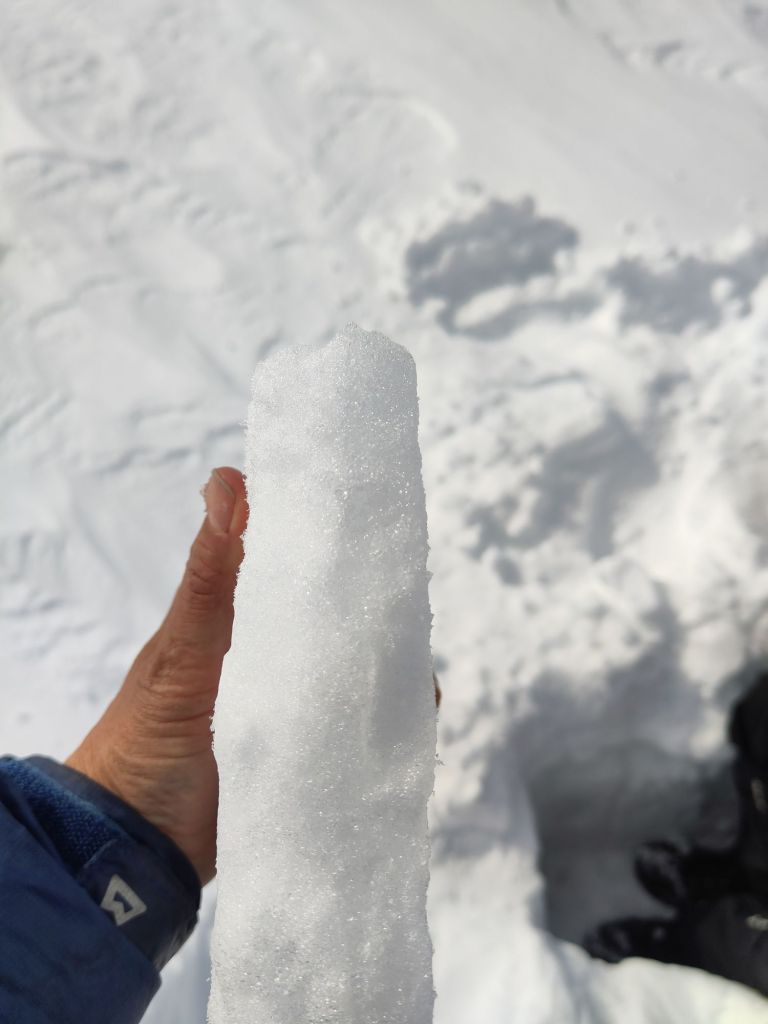
The snow pits proved indeed how cold the snow has been, typically around -10C at the bottom of the pits, but in one we also found signs of refrozen melt water, perhaps from the brief March warm period?
Ice layers in the snow, surprisingly difficult to photograph, you’re going to have to trust us on this one!
We did a transect down with our borrowed infrasnow, made several density profiles and had quite an efficient time. The idea is to repeat this transect at different times of the year so we can see how the snow properties change. In particular, I’m interested in surface albedo (how much incoming light is reflected by a surface). The reflectivity of the snow and ice surface is extremely important for the energy budget, which in turn controls how fast the snow (and ice) melt as well as being important for satellite data retrievals of surface temperature.
The Infrasnow is a very neat device that measures density and specific surface area. It’s not quite the same thing as albedo but it will help us to develop our albedo scheme in the model as it is based on grain size. Unfortunately it does not work on glacier ice, which is some places we also saw peeking out the top where wind has scoured the surface snow away. The movement of snow by wind is the subject of our final full day in the field.
We continued the observations off the glacier all the way to the road so we have a nice base transect that can be repeated to assess how conditions change through the year.
Although we only hiked 10km, it was quite tough, so next year we’ll bring snow shoes…
Tomorrow is our final full day. Lots more to do.
Day 4
Day 4 was pretty typical of the highs and lows of fieldwork. We finished (or I should say my colleagues finished) a new mounting for the snow site logger box so hopefully the icing problem will be reduced, we (re-)installed all the instruments except for the new loggers and generally tidied up. It’s looking pretty nice now. This was a high.
Part way through the reinstallation at the snow site
Then, I struggled and failed for about 4 hours to try and get the snow drift sensors to talk to the new logger. That was frustrating low. low. However, a walk around on the fast ice in the bay to try and take a new sea ice core was some valuable breathing space – a little bit of rewiring later and the first numbers started ticking in as planned…. Hurray! That was a high!
It’s immensely satisfying solving these kind of problems. And it was the first time I’ve programmed one of these loggers – new skills are also always rewarding to learn, even if the process is frustrating. I’ve learnt a lot about SDI-12 interfaces and how the instruments actually work too. I need to remember to give myself more deep work time back in the office too. It’s much more personally rewarding and advances the science much more than endless emails and meetings.
While the attempt to get an ice core was interesting, ultimately we failed due to very broken and uneven ice that made access to the part of the sea ice we wanted to get to with our kit too difficult – that was a low. I am simply counting the attempt as my evening walk, in which case maybe it counts as a high? I’ve often thought of Caspar David Friedrich’s famous Arctic painting The Sea of Ice in the coastal part of the fast ice. It’s spectacularly fractured and churned up, though FReidrich’s ice blocks are a little too angular – the real sea ice flakes are a bit more rounded.
Where the fast ice meets the land…
We also did lots of preparation for day 5’s trip to the local glacier, planned a final UAV structure-from-motion mapping campaign on land and got software working to download data on permafrost from sub-surface loggers for colleagues at the University of Copenhagen – that will all however have to wait until tomorrow, our last full day in the field. Today, we have a date with a tiny local glacier.
Day 3
I’d originally assigned only one day in the fieldwork plan for the snow site work, but given we missed our prep day to go directly into the field, we have missed a few crucial steps, so we have been busy today trying to catch up, but mostly in the workshop here at the DMI geophysical facility in Qaanaaq with a couple of visits out to the snow site.
I realised I haven’t introduced the snow site.
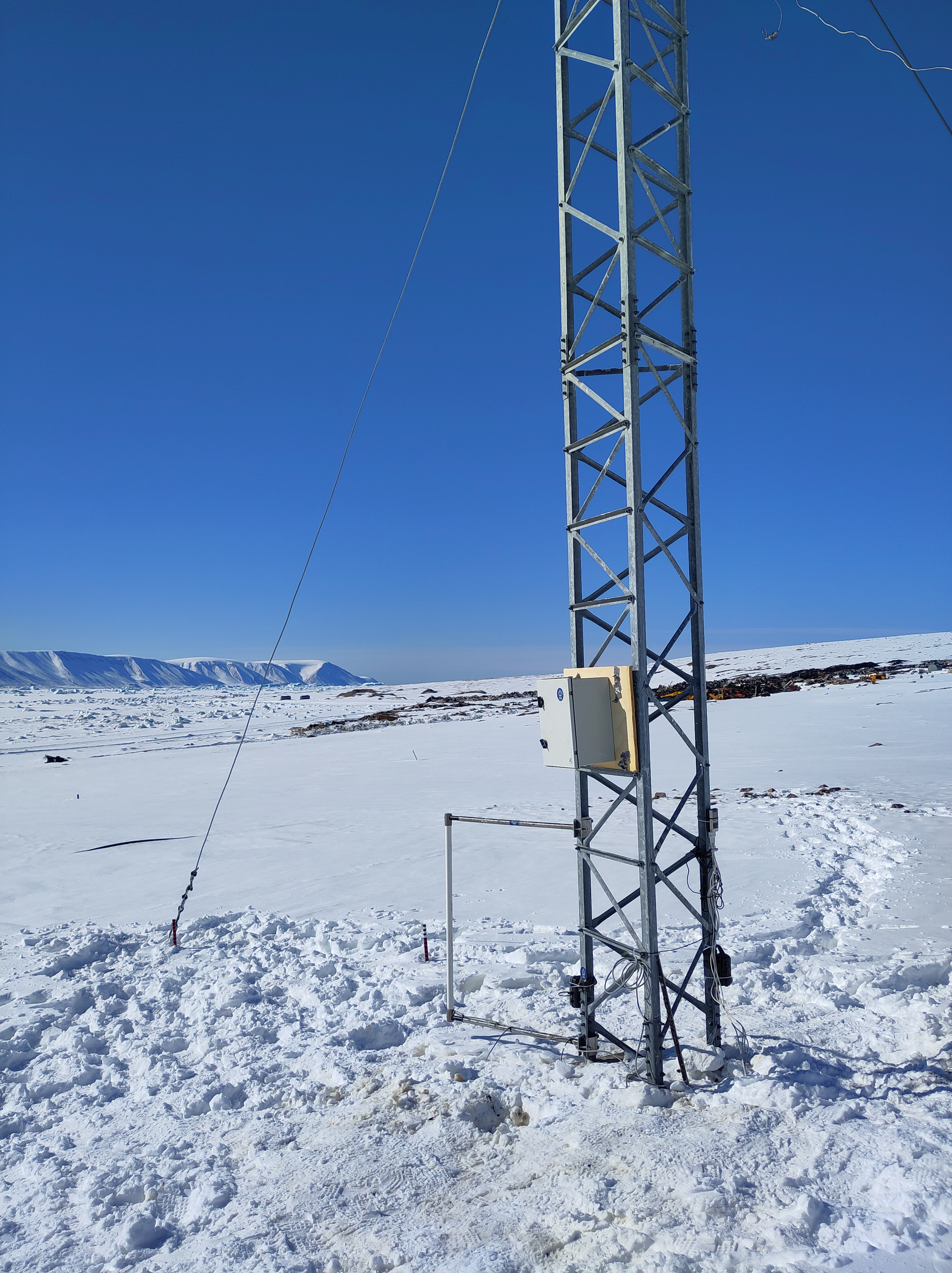
View over towards the south west from the old ionospheric research station on the edge of Qaanaaq. Our snow site in the foreground. It has a great view, if you ignore the town dump at the coast!
It is a small area on the edge of the village (unfortunately near the town dump, but otherwise perfect) where we are conducting a long-term (hopefully) series of observations – we’re currently only at the end of the first year so there are a few teething troubles to sort out. We’re installing a new logger for our snow drift sensors, adding a new snow cam and downloading data from the current one. We also have a standardised set of measurements of snow properties (density, temperature, reflectivity) that we carry out whenever time and opportunity permits, that we will hopefully use to better understand how the snowpack evolves through time. The land based side is a kind of complement to a longer set of observations I have from throughout the region – all point measurements made at rather random times and locations, so the constant monitoring site will hopefully help us to understand the wider context in space and time of those point data. In fact I have a student workign on digitising that data now, so I hope to soon make available the whoel dataset for research purposes.
Snow is incredibly important in the Arctic: it forms an insulating layer over sea ice that prevents futher formation in the winter, but also helps to stop or delay surface melt in the spring and summer. On land, the insulating properties of snow also help to preserve vegetation, insects and mammals through the winter, with specific vegetation assemblages being very much determined by the local snow patterns. And that’s without even discussing the importance of snow to glaciers and ice sheets.
Do you want to do a snow pit? (I asked) Yes! said my colleague. It’s always good to get the modellers to understand just how hard observations can be.
However, it turns out to be difficult to measure when it falls, difficult to work out how much blows around, challenging to model when it melts and when it refreezes and generally a larger than we’d hope uncertainty in weather and climate models. Much of the work developing parameterisations that describe snow properties has been done at lower latitudes too. High Arctic snow is certainly different in many respects to more southerly locations and that needs to be accounted for.
Hence the establishment of our snow programme. Which sounds rather big and impressive, but we’re hoping to set it up sufficiently smoothly this year that it will almost run itself with minimal input from us and assistance from colleagues. Let’s see, there are still some teething troubles to sort out.
The sea ice has now cleared out of a huge part of the bay in front of Qaanaaq and the hunters have been busy taking boats out from the edge of the ice so there are clearly narwhals expected soon. Although, we’ve spent most of the last two days indoors, I keep looking outside, hoping to see some of the marine mammals that visit here. There are already masses of sea birds arriving. Yesterday managed to spot a rather handsome snow goose couple on my evening walk at 11pm.
On my evening walk today I went to the very eastern edge of the town to get a look at the sea ice in the fjord – it’s quite clearly retreating rapidly now; much of the area we travelled over on Friday has gone.
View down Inglefield Fjord with the sea ice breaking up in the distance
Day 2
After Day 1’s rather hectic and busy time, Day 2 was assigned post-processing status. We had a slightly later than the 6am start yesterday, and put some serious effort into assessing our results from the previous day. That means downloading data, clearing up wet kit to dry it off properly, repacking stuff we don’t need further. Then there is the computer work, doing some initial processing, backing up files, writing field notes and doing some measurements (of salinity) on the sea ice cores we collected.
Conductivity/salinity measurements of a melted sea ice core in the workshop, fieldwork is very diverse. And fun.
We also made time to visit our snow site to download data from the instruments there. Unfortunately, it was clear that we need to somewhat reorganise the site, the logger box was completely snowed in, and I was a bit sceptical there would be any data at all. So we collected in some of the instruments for testing and further data downloads in the workshop instead of trying it out in the field. In fact, fieldwork means a lot of tidying up and computer work! I used the opportunity to reorganise and standardise the way we archive all our data, including the UAV images as well as the meteorology instruments, which will also hopefully mean we have an easier time to find and use it in the future.
It wasn’t all laptop work though, we did a few snow pits and some further testing of the Infrasnow system we have borrowed. I’m actually quite impressed with it – very straightforward to use and very consistent data produced.
It’s also always fun to check our snowcam – this takes a photo of a stake every 3 hours to monitor the depth of the snow pack, and quite often we get beautiful views and some cheeky ravens hopping past too – I live in hope for an Arctic fox, or even a bear.
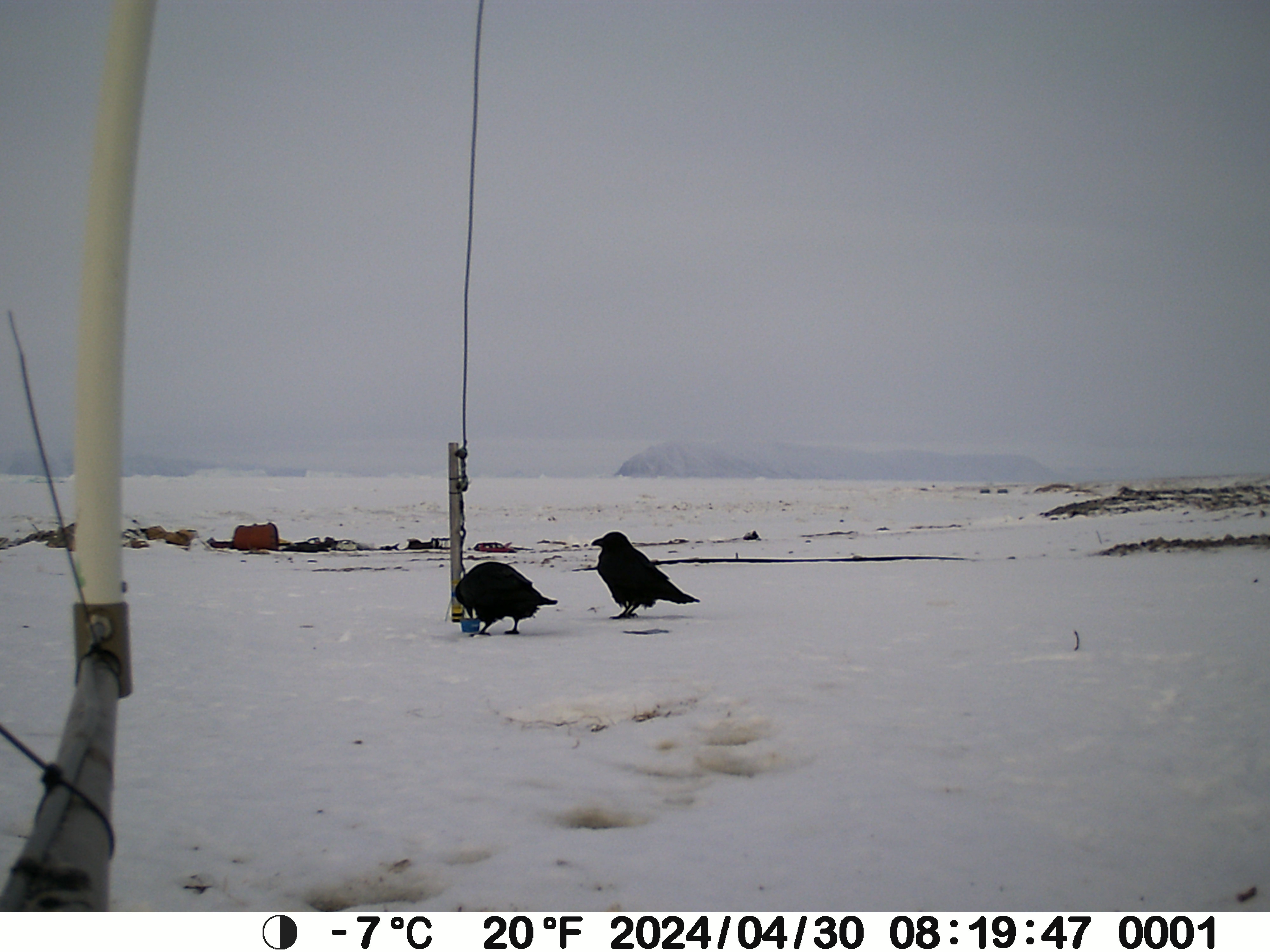
Two ravens in the snow, exploring some leftovers apparently.
On the subject of bears, I had heard there were rumours of one near the snow site, but sure enough there were the footprints – rather small and filled in with snow but quite distinctive and heading up towards the ice cap. We shall be extra careful when we go up on to the glacier later this week.
Day 1
We had originally planned terrestrial, glacier and sea ice work, primarily focused on snow processes. The sea ice part though was altered and expanded when the rapid break up in April and again this month was observed. Normally, we’d have a preparation day between arrival and going into the field, but the threat of winds and high temperatures meant we decided not to risk it and we went out straight away on the first full day. Our instincts to just go yesterday turned out to be correct, we had perfect weather and with the help of Qillaq, one of the local hunters we still made it out on to the sea ice. So all is not lost. I woke up this morning to see a wide blue sea just off the last pieces of fast ice on Qaanaaq, so I’m very happy with that decision. Sentinel-2 captured this yesterday while we were out in fact.
It probably looks more dangerous than it is. We were working on the stable fast ice to the east of the big flake, that stretches right into the fjord. The local topography make it very stable and our measurements yesterday confirmed it’s pretty typical for the time of year in thickness, though there was a surprising amount of snow on top, which can actually help to protect the ice from melt at this time of year.
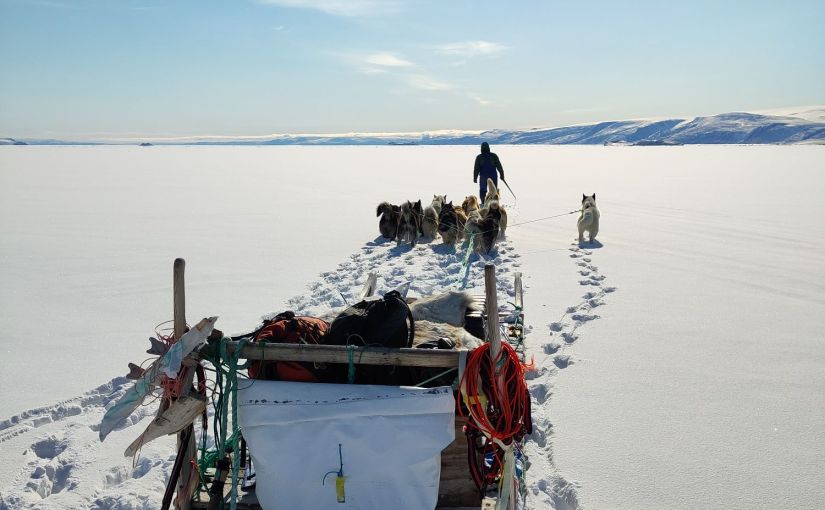
Getting around the coast was surprisingly straightforward, the fast ice has a very stable platform, though some large churned up part of the ice with cracks made for some slightly bumpy manoeuvres to get on and off the stable parts.
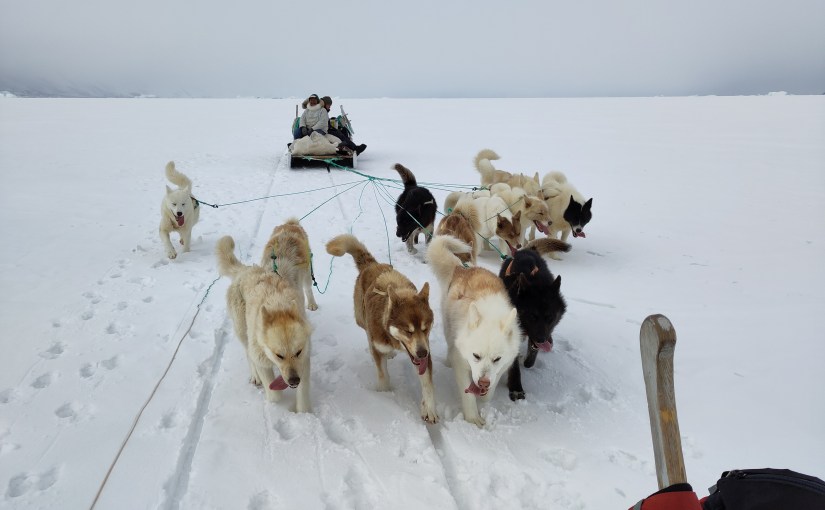
Manoeuvring the sled through the coastal zone
The dogs were I think happy when it was over. But in fact it was much more straightforward than I’d feared. The large crack we noticed earlier in the week that opened into a wide lead further extended while we were out, see below, and I woke up this morning to a wide open lagoon. It’s an extraordinarily beautiful place to work and I feel so privileged, especially on days like today when the weather is also being extra nice.
Happy dogs on the way home. Note the large area of open water behind that opened up while we were out.
Work wise it was a successful day, we managed 2 stations, where we did very extensive work. I’d have liked a third but the deep snow made it very heavy and slow going to travel on and in spite of the early start we basically ran out of time and had to return home.
Qillaq and Abraham taking a manual measurement of snow depth and ice thickness next to target for the UAV calibration flights.
We flew the UAV for surface properties, did a lot of snow pits and snow surface properties work, drilled some ice cores (which I will be working on this morning) and even got our loaned EM31 working to do automated ice thickness mapping. We will hopefully start to look at the data later on today to make sure it makes sense before we leave on Thursday.
Our first sea ice core of the season
The reduction in ice means we can actually concentrate on the terrestrial part of the work plan for the rest of the week. And there’s a lot to do!
Last year I set up a semi-permanent snow site to monitor conditions on land through the year. It is going to get a bit of an upgrade this week with some new instruments and of course we need to get the rest of the data downloaded and processed from here too.
I’m writing this from a hotel room in Ilulissat, rather than Qaanaaq where I had intended to be arriving shortly, because our plane has been cancelled due to bad weather (at time of writing the airport was measuring gusts of 14 m/s, so I’m actually quite glad it was cancelled).
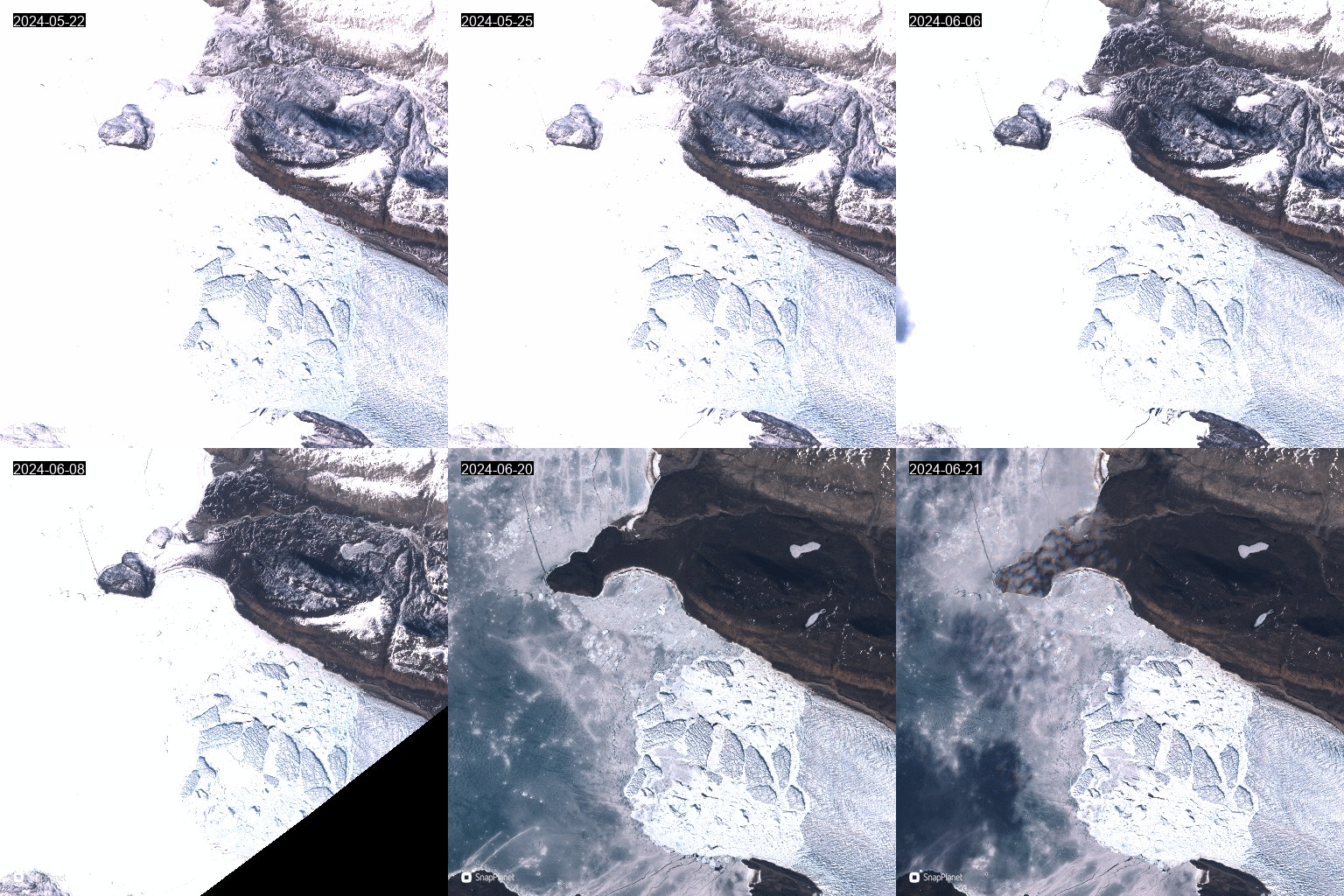
Weather and flight cancellations are an eternal hazard when doing fieldwork in Greenland, but in this case it also means an impact on our planned fieldwork, because the sea ice is falling apart. And rather earlier than usual (though we have not yet done a systematic review to prove this). In fact, part of the reason for coming here in May (instead of my usual March trip) was to investigate an interesting event that happened earlier this spring. In the animation of satellite pictures below you can see the sea ice rather dramatically falling apart in mid-April and then again at the end of April.
The March to May sea ice season from Sentinel 2 in NW Greenland
To understand what is happening and why it’s unusual, first a bit of background. As I have written before, my DMI colleagues have been working up in NW Greenland for about 15 years on a programme of ocean measurements in the fjord (see map below). I joined about 5 years ago, working in the melange zone of the glaciers at the head of Inglefield Bredning (PSA: a paper we recently submitted about this programme will hopefully be online soon). We use the sea ice as highway and stable platform for observations, so it’s pretty important for us and came to the conclusion it wa squite important for some parts of the glaciers too. The local community, with whom we work closely use it also for travelling, hunting and fishing from. It’s extremely important for them.
The region of North West Greenland we’re talking about
Normally there’s pretty thick (~1m) sea ice covering the whole of Inglefield Bredning (Gulf of Inglefield, also known as Kangerlussuaq, but not that one) out to the islands of Qeqertarsuaq and Kiatak. You can seen an example of what this looks like normally in the satellite animation from 2020, which happens to be when my first trip out on to the sea ice in Qaanaaq took place at the end of May and beginning of June. We were actually very lucky, we had great weather, got very close to the ice edge and watched narwhals swimming out in the North Water polynya. (Yes, sometimes I wonder how I managed to get this job too). The animation below is Sentinel-2 images as cloud free as I could find them from that first field season. As you can see, the sea ice already in March was much much more extensive than this year at the same time. And perhaps that is part of the answer.
It’s probably worth pointing out at this stage that although there were some pretty warm (unusually so) spikes in March and April, the sea ice breakup in April was probably largely driven by ocean swell, and perhaps some winds which were strong, though not excessively so as far as we can see in the observations. The latest break-up seems to be driven also by high winds.
Back to our current field season. We had in fact planned a brief trip up here already – I am currently setting up a project looking at snow processes with the team and we had planned to install and test some new instruments and protocol that we hope to use in Antarctica later this year (more on all of that later hopefully). However, as the soon to be published preprint shows, I and the team have developed pretty extensive sea ice interests recently, so this unusual behaviour rather piqued our curiosity.
We have a lot of questions:
Why did it happen this year? Is it really the earliest in the satellite record? What makes the ice vulnerable? Composition, thickness, temperature? Is the ocean driving it or the atmosphere or both (it’s usually both), and what makes this year so unusual? Further down the line, can we model it and use those simulations to understand if this is a single aberration or likely to be more common in the future? And what impact will the earlier breakups have on the ecosystem, the adjacent glaciers and the local community?
Or fieldtrip thus appeared an excellent opportunity to grab some real data on all of these points. Our colleague Henriette Skourup at DTU-Space was kind enough to lend us one of her instruments, which we shipped up last minute to allow us to do an add-on. It is all currently sitting there waiting for us.
Unfortunately the sea ice is not waiting for us, if the photos from my colleague in Qaanaaq, Aksel are anything to go by.
A large and widening crack in the sea ice in front of Qaanaaq. The small objects on the sea ice (fishing gear?) suggest we were not the only ones surprised). Credit: Aksel Ascanius, DMI
The high winds which grounded our plane have also been busy on the sea ice, which is falling apart in the bay with surprising speed as far as I can see. We are still waiting for today’s optical imagery but the quick look from radar based Sentinel-1 suggests cracks widening rapidly as the photo above confirms.
Temperature observations from Qaanaaq airport
With a bit of luck we will get to Qaanaaq on Thursday (immaqa) to see if our sea ice research plan can go ahead. At this stage I rather doubt it. But it will very much depend on the next few hours. The wind speeds are quite high still but the temperature which was well above freezing has now dropped down to just below.
Wind observations from Qaanaaq airport
We are fortunate that we work with local hunters on the sea ice who are immensely experienced. The first rule is always safety first. We do have *a lot* of other work to do and rather fewer days to do it all in, so either way we’ll be busy. Ffor now, it’s keep checking in with the weather, the satellite images and our friends in Qaanaaq and use the time in Ilulissat wisely – in our case, it’s time to write some papers. And one of them is all about sea ice.
To be continued…
All satellite imagery on this page is from the European Space Agency Sentinel-2 mission, processed on the Copernicus EO Browser – a FREE!! and easy to use entry point to use ESA data. Weather observations are from Qaanaaq airport, operated by Mittarfeqarfiit A/S – Grønlands Lufthavne (Greenland Airports) and processed by DMI. It’s actually pretty nice how much high quality data we have access to these days…
Over on Blue sky I found a link to this piece by Daniel Nettle – a reflection on life as a researcher, the race for the glittering prizes of high profile publications and how to “succeed” in academia, where succeed has the simple metric of ‘in ten years.. to have remained alive, and ideally continued doing some research.’
Ten years ago in Greenland, I did not imagine I’d still be doing this job-
I found myself very much nodding along with the sentiments of the piece, the conceit that
“Our seduction was by the primary research process: the idea that you could find a question; hit on your own approach; perform and manufacture the work; and finally, see it there in print, with your name attached, a thread woven in to the tapestry of human knowledge. A thread of memory.”
that also motivates me and apparently others in the research world. I still think that idea of building something bigger, no matter how tiny the contribution, the sum total of knowledge is a motivating factor. As Daniel writes, it’s a seduction, but it is also one that resonates and lasts, even through those years when the grind gets you down…
This part also made me laugh in recognition about what makes people persevere in research:
“If she [a student interviewing professors about success in academia] knew how narrowly I have hung on, I thought, she might have chosen someone else for her assignment.”
It’s not always easy keeping going, much of our work requires intrinsic motivation and it too often dissolves into something self-destructive. Famously, science and research in general is prone to mental health problems and I rather liked the characterisation here:
“Periodic demoralization and depression are not rare amongst researchers. It’s not not caring any more, or not being able to be bothered, as depression is often and erroneously characterized. It is caring so much, being so bothered, that one cannot advance on any front. One drowns in one’s own disorganized and gradually souring passion. This feeling is probably near-ubiquitous too.”
But persevere we do and persevere we must and where I thought this piece gets really interesting is where he points to the techniques and lessons that lead us to surviving the academic environment. As the essay is rather long, and a pdf, I thought I would summarise his main lessons here. The first one is I think the most important and while he calls it every day has to count for something (where every day means every *working* day, time off is still essential). I prefer to summarise it as just one thing.
Lesson 1. Every day has to count for something
“I try to start each working day with a period of uninterrupted work. Work, for me, is: collecting data, analysing data, writing code, drafting a paper, writing ideas in a notebook, or just thinking. Things that do not qualify as work are: background reading, literature searches, answering correspondence, marking students’ assignments, peer-reviewing a paper, sorting out my website, correcting proofs, filling in forms, tidying datasheets, having meetings, and so on.”
This goes back to paying yourself first. I’m not always very good at doing it, but I also try to do something meaningful and deep work like each day. Part of the reason I have found the last few months quite hard at work is a surfeit of meetings, workshops and travels, which have been in general quite destructive and distracting from the main work of the day, which could probably be summed up as, learn how the icy bits of the world work. My #AcWriMo efforts as well as #30dayMapChallenge in November were in effect just the kick start I needed to get back into the real scientific work of research, because as Daniel Nettle so eloquently put it:
Daily deep work keeps the black dog away, for there is nothing worse for mood than the sense that one is not progressing. And it can spiral in a bad way: the more you feel you are not progressing, the worse you feel; the worse you feel the more your hours become non-deep junk; and the more exhausted you are by non-deep junk hours, the less you progress.
Not all black dogs are bad.
Lesson 2. Cultivate modest expectations
This was a curiously freeing part to read and I absolutely agree with it. Too often what John Kennedy calls Natureorscience papers are seen as the gold standard. And yet as Daniel Nettle eloquently points out:
the glittering prizes we academics strive for are positional goods kept deliberately scarce by bureaucratic or commercial interests, and allocated in ways whose relationship to long-term value is probably quite weak. For example, Nature is a for-profit enterprise that rejects nearly everything in order to defend its exclusive market position. If we all send everything there, the rejection rate goes up. If we all increase the quality of our science, it still nearly all gets rejected, by the very design of the institution. The idea that all good papers can be in Nature or Science is as ludicrous as the idea that all Olympic athletes can get gold medals, but without the strong link between actual ability and finishing position that obtains in the Olympics.
It’s absolutely true that a natureorscience paper on the CV is seen as a big thing, the ultimate to strive far. And it is. Getting through the review process is in itself an achievement. But it’s also worth bearing in mind that many natureorscience landmark studies don’t stand the test of time. They rarely shift paradigms, though they can focus attention on new subjects, and sometimes that’s a new and important field. And sometimes it’s a distraction. I can think of several notable examples published since I started working in glaciology (but no, I’m not going to call them out here). The text in these journals is often far too compressed to get important details in, I recall an old mentor suggesting that the natureorscience paper is the advert, the starter that reels you in. The good stuff, the actual filler that makes you look at the world anew with its insights, new methodologies and the rest, is very often in a very different journal. So go for natureorscience if you get the opportunity, and if you have the results, but aiming for there from the start is not necessarily the right way to position your research career. Though as this post is now veering dangerously towards giving advice rather than simply expressing my usual slightly scrambled thoughts, take this one with a dollop of Atlantic brine..
For what it’s worth though, I do believe this:
Great art often begins on the fringe. Similarly, valuable future paradigms and innovative ideas start life in obscure places. Journal editors cannot yet see their potential, and the authors themselves are tentatively feeling their way into something new. So by focussing on capturing the established indicators of prestige, you distort the process away from answering the question that interests you in an authentic way, and into a kind of grubby strategizing. Or so I tell myself, admittedly through clenched teeth at times.
Lesson 3. Publish steadily
Is back to just one thing in a way.
the mistake a lot of people make is focussing too much on getting the big shot, the single career-establishing paper in a top journal, and therefore not quietly building up a solid, progressive portfolio of sound work.
Doing the work is the best advice I can give and the advice I would give myself back in the early days of what has become (almost by accident) a research career. Now, I would hesitate to say publish something every year. I know scientists who insist on one first author paper a year, and some who strive for 3. Both seem arbitrary and potentially dangerous in terms of motivation, particularly for a young ECR just making their first steps and unsure of how to do it. Nevertheless it’s certainly true that, regardless of publish or perish, just the feeling of making forward progress, however incremental, is so important. Keep the momentum going. It’s part of what makes the traditional british PhD ending with a big book so hard, there’s no feedback on the way. Just an hour a day (or even an hour a week in busy times) is enough to keep me moving forward, and it’s often enough to produce a decent paper, eventually. And don’t worry, science is highly collaborative, I wouldn’t be able to do it without all my colleagues to remind me on, nudge me to get on with something and keep the wheels turning. I love you all for it too…
So if you are worrying about staying the game, rather than planning your next Science publication, I would ask yourself where your 1-2 solid papers each year are going to come from. Just as you should not go a single day without proper work, you should not go a single year without publishing anything, as one year rapidly becomes three.
Lesson 4: Get your hands dirty
This is why I do field work. But it’s also why I’ve embraced the opportunity to learn more about deep learning and AI/ML methods. Learning new stuff is exciting, it keeps you fresh and helps make new connections. It’s when disciplines cross-connect that the exciting stuff happens and the sparks fly in the brain.
“Keeping your hands dirty also means learning how to do new things. And this is a good thing: the skills I picked up in graduate school could not possibly have sustained me this long. Learning new skills has always paid dividends of one kind or another; and stepping back from doing primary research myself has always been the point at which things have started to go less well.”
I have written one too many white paper style articles recently, it’s time to go back to the field, and back to the code to see if we can make things better by integrating the data and the models.
Learning to fly a drone and to process the data is something I’ve been working on the last few years. I have a really exciting dataset now but little time to work on it. Ifyou’re looking for an interesting MSC thesis project get in touch!
A note of caution though, it’s always easier to start something new than finish an old project. The best colleagues will help you stay on track and make sure you finish what you started!
I’m going to add one more point, which isn’t expressly mentioned in the original piece that started this ramble:
Lesson 5: Cultivate outside interests.
Far too many of us put families, friends, sports, hobbies and anything else that doesn’t taste of work to one side, in pursuit of the all-consuming. It’s not only not healthy, it’s also limiting. The brain needs time off to churn away by itself. You can’t force that unconscious process. Better to take a long walk to admire the flowers than try to twist your brain in knots when you hit a wall. A good night’s sleep is an amazingly effective part of the research process too.
So there we have it, some thoughts on being a (mid-career) scientist and how I have managed to stay in the game. YMMV as the Americans say.
Finally, all that I have said relies on having a supportive employer and good colleagues. The sometimes horrifying stories (take for example this one) of people being pushed out by bullying colleagues, or structural discrimination is a whole other story. And not one I’m going to take on here, but I would point out that without organisation, labour inevitably gets crushed by capital, so organise, join a union, find out what your rights are and make sure that you have a supportive hinterland to help you get through the bad times.
And everyday, do just one thing to help you advance.
This is the first in a two-parter. At this time of year, posts making bold statements about what happened last year and what we plan to do this year start to become prominent. The last few years I have spent a few hours in the first week of January reviewing what worked, what was fun and what was cool, what was awful and what definitely was a waste of time. I’m not honestly sure that any of this is of interest to anyone except me, so read on, but you have been warned..
2024: Themes of this year: Greenland, Machine Learning, people, and big data…
Working with scientists from the Greenland natural resources institute and local hunters on the sea ice.
The final trip was in October for a workshop with scientists in Greenland about climate change impacts in Greenland, the subpolar gyre and AMOC for the UN Ocean decade. It was a memorable meeting for the sheer range and quality of science presented as well as for being stranded in Nuuk by a broken aeroplane in quite ridiculously beautiful weather (I mostly stayed in my hotel room to write the aforementioned paper, sadly. In 2025 I will work on my priorities) .
Apart from fieldwork I have really tried hard on publications this year. I have (like many scientists I suspect), far more data sitting around on hard drives than I have published. It’s a waste and it’s also fun to work on actual data instead of endless emails. This is something I intend to continue focusing on the next few years as well. There is gold in them thar computers…
We had a couple of writing retreats were very successful. These I plan to continue also and the PRECISE project grant is happily flexible enough to do this. I probably achieve as much in terms of data processing and paper writing in 3 focused days as I would in 3 months in the office. It paid off too. I managed to co-author 8 papers published this year (including my first 1st-author paper in ages – a workshop report, but nevertheless it counts.). Some of these are still preprints, so will change, and there are a couple more that have been submitted but are not yet available as preprints. I will submit two more papers in the next 3 weeks as well (1 first author), so January 2025 is going to be the 13th month of 2024 in my mind.
Bootcamps have been a theme the last 3 years, I organised the first in 2022 and so far there have been 4 publications from that first effort. There was another this year in June, ( I have attended them in 2023 and 2024 but was not organising) where we really got going on a project for ESA that I have had my eye on for a while – I hope the publication from that will be ready in the Spring this coming year.
Machine Learning: This was the year I really got machine learning. I’ve been following a graduate course online, and learning from my colleagues and students about implementations. I understand a lot more about the architecture and how to in practice apply neural networks and other techniques like random forests now. This is not before time, as we intend to implement these to contribute to CMIP7 and the next IPCC report. We still have a lot of work to do, but the foundation is laid. And it’s been fun to learn something that, if not exactly new, is a new application of something. In fact the biggest barrier has really been learning new terminology. We have also been fortunate that Eumetsat and the ECMWF have been very helpful in providing us with ML-optimised computer resources to test much of these new models out on. We’re actually running out of resources a bit though, so it’s time to start investigating Lumi, Leonardo and the new Danish centre Gefion to see what we can get out of these.
People: This year our research group has grown with another 2 PhD students, and at the end of the year we also employed a new post-doc. I think it’s large enough now. I’m very aware that if I don’t do my job properly, then not only the research but the people will suffer, so developing people management skills is really important. In any case it’s extremely stimulating to work with such talented young people and I’m really excited to see where the science will take us, given the skills in the team. I hope I have been good enough at managing such a large and young team, but I have my doubts. A focus for 2025 for sure.
Data: This has been the year of big data, not necessarily just for ML purposes but also in the PolarRES project the production and management of an enormous set of future climate projections at very high resolution. More on this anon. Suffice to say, it has taken a lot of my time and mental energy and it’s probably not the most exciting thing to talk about, but we now have 800 Tb of climate simulation data to dig into. I suspect that rewards of this will be coming for years. There has also been a lot of digging into satellite datasets and the bringing together of the two has been very rewarding already. It’s a rich seam, to continue the metaphor, that will be producing scientific gold for many years.
Projects: we have gone in the final year of two projects, PROTECT and PolarRES, both of which will finally end in 2025. We also arrived at the half way point of OCEAN:ICE. So rather than being a year of starts, it has been a year where we have started to prepare for endings – actually this is a fun part of many projects where a lot of the grunt work is out the way and we can start to see what we have actually found out. It can also be a slog of confusing data, writing and editing papers and dealing with h co-author comments. I’ve definitely been in that process this year, hopefully with some of the outputs to come next year…
Proposals: I started 2024 writing a proposal. Colleagues were in 3 different consortia for the same call, alas ours didn’t get funded, but 2 of the others did and will start this year. That is a good result for DMI and our group. I wrote another proposal in the Autumn and contributed to a 4th and finally at the end of the year I heard that both will *likely* be funded (but are currently embargoed and in negotiation, so no more will be said now). It sometimes feels that spending so much time and energy on proposal writing is putting the cart before the horse, but in fact I find proposal writing something akin to brainstorming. It’s essential of course to ensure we can continue to do the science we want, but it can also help us to clarify our ideas and make sure we’re not on the wrong track. It’s also a good way to keep track of what the funders are actually wanting to know and to help us focus on policy relevance.
There was also an incredible number of meetings, reports, milestones and deliverables, but you probably don’t want to hear about that…
Also missing from this summary is personal life, and, well that is not for sharing publically, but suffice to say, I learnt about raising teenagers, I also had some very good times with friends and family, to all of whom I immensely grateful for being a part of my voyages around the sun.
Anyway, reading all that back, I’m not surprised I ended the year exhausted! I am not planning on quite such a slog in future. I should probably pace myself a bit more this year, the plans for which will be the subject of next week’s post.
Way back in the mists of time, that is, early April, I and colleagues deployed some instruments on the sea ice in front of a number of glaciers in Northern Greenland, which I wrote a little bit about here.
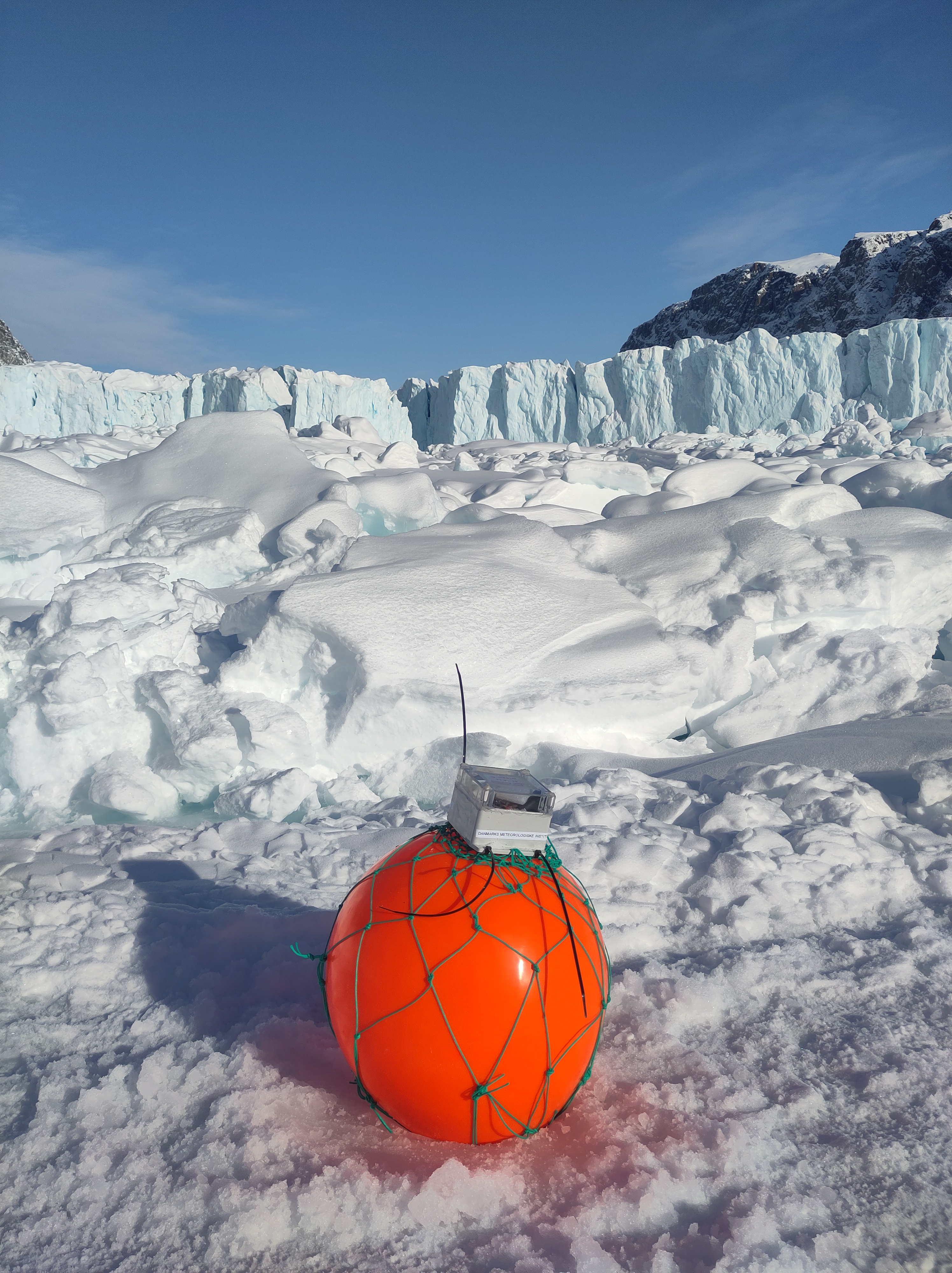
Trusted global GPS tracker buoy
Open met buoy
Since then I’ve mostly been letting them get on with reporting their data back and occasionally checking on the satellite imagery to see how it’s looking in their surroundings.
It was about -30C and very cold when I left them out, so it’s sometimes quite hard to visualise just how much things will change over only a few months and to remember that at some point, they’ll need collecting
After a fairly melty start (yes, that is actually a technical term) to July, particularly in the northern part of the ice sheet (which you can see on the polarportal, see also below right) it’s time to start anticipating their collection.
We have a lot of advantages when it comes to coordinating this kind of project now, compared to the bad old days when imagery and communication were both scarce and expensive
For starters, there is Sentinel Hub’s EO browser, a course in which should be a requirement for every earth science adjacent subject in my opinion. EO Browser produces superb pre-processed imagery for free, such as this one, from the European Space Agency’s Sentinel-2 satellite yesterday
As you can see, the sea ice is still there but fracturing and patches of open water (in blue green) are now becoming visible.
Sentinel 2 satellite image processed on EO browser showing sea ice and ice bergs in front of Tracy and Farquhar glaciers.
If you’re out and about and only have your phone, there is also the excellent snapplanet.io app on your smartphone, with which you can create instagram ready snapshots of the planet or even animated gifs, with high resolution imagery a link away…
Now that’s what I call a fun social media* application…
Animated gif of satellite images showing the front of Heilprin glacier with icebergs and landfast sea ice.
Anyway, back to the break up. Every year, the sea ice forms in the fjord from October/November onwards, by December it’s often thick enough to travel on and then from April it starts to thin and melt and by late June large cracks are starting to form, allowing the surface meltwater to drain through. For a look at what happens if you get a large amount of melt from, say, a foehn wind, before the cracks start to open up, see this iconic photo taken by my colleague Steffen Olsen in 2019.
An extremely rare event, that nevertheless went viral
The other advantage we have working in this fjord is our collaboration with the local hunters and fishers. In winter they use dog sleds for hunting and accessing fishing sites, and to take us and our equipment out on to the ice. In summer, they are primarily using boats for fishing, hunting narwhal and, hopefully, collecting our equipment! Our brilliant DMI colleague Aksel who lives and works in the local settlement is also a huge help in assisting with communication and generally being able to get hold of things and people when asked.
Winter travel
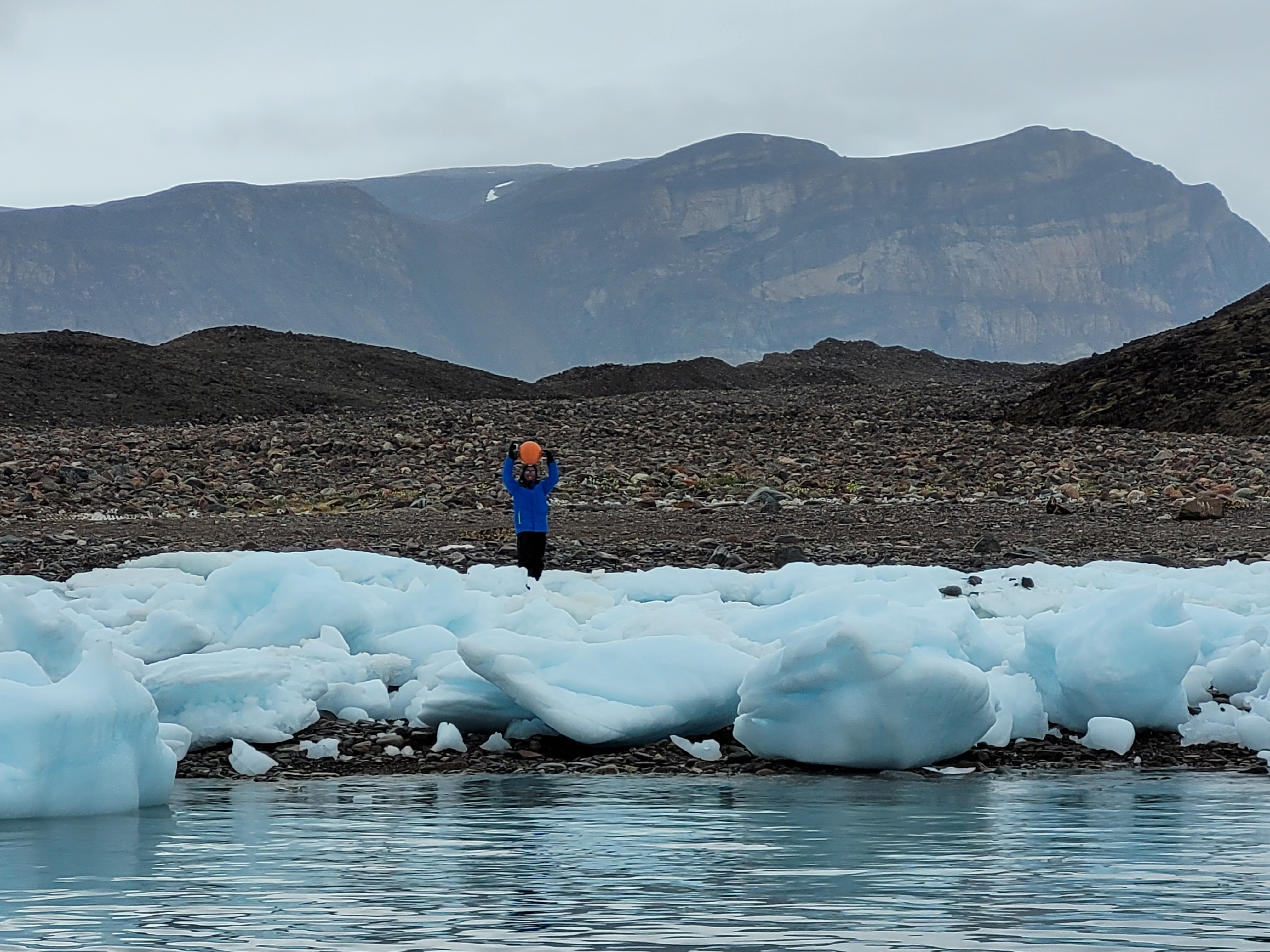
We offer a reward for each buoy that is found and brought back to our base in Qaanaaq, so many of them in fact make their own way home. But we also work with our friends on a kind of remote treasure hunt, challenge Anneka style, with someone at home watching their positions come in via the satellite transmissions and sending updated information via sms to an iridium phone to the hunters on the boat…
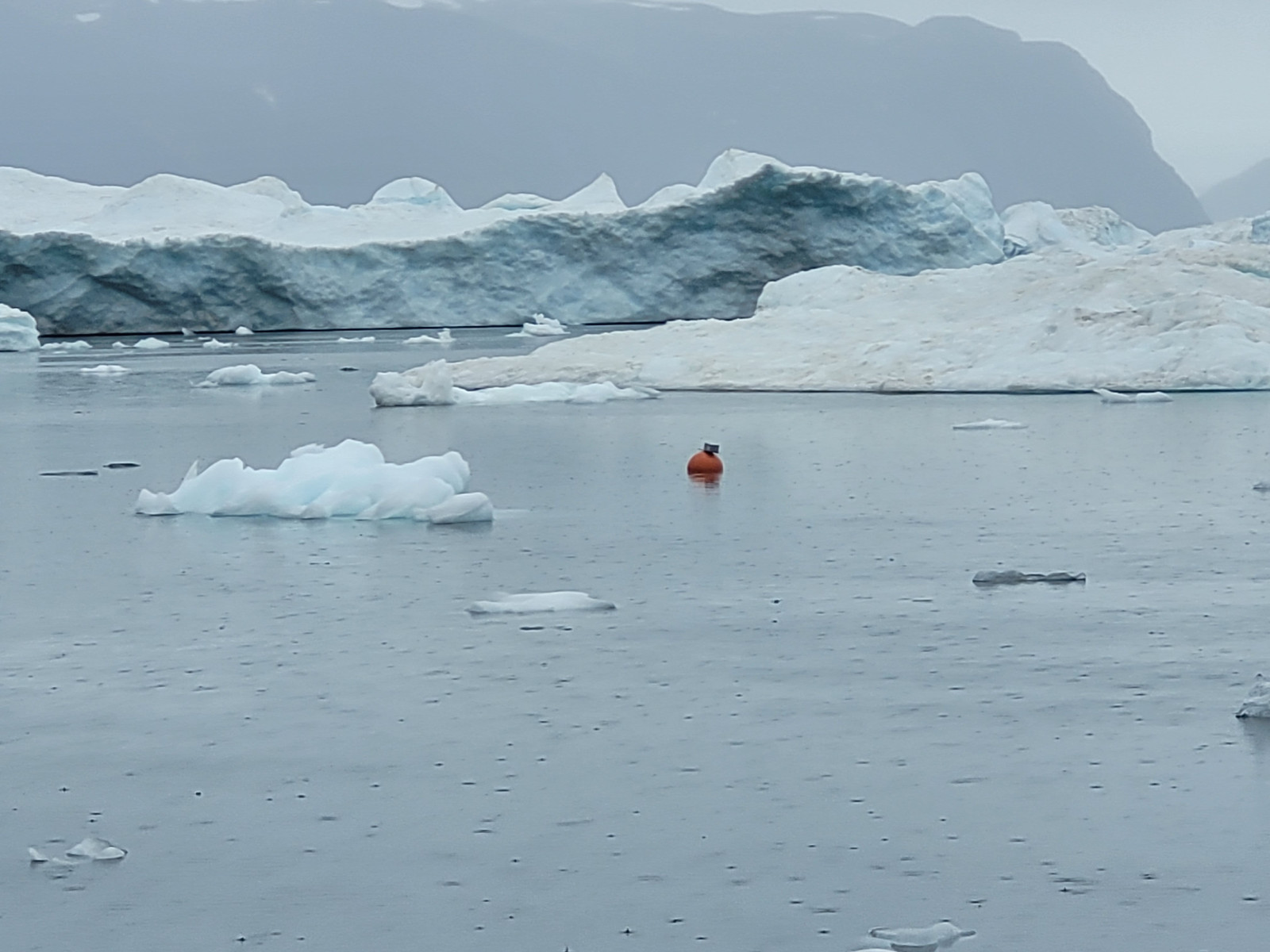
I’m told it’s tremendous fun, with sharp eyes required, as even a bright orange plastic globe can be challenging to spot.
A floating trusted buoy in 2022.
I’ve never participated in this treasure hunt myself sadly, on land we generally see something like a spaghetti of arrows and spots via the Trusted global web api:
GPS positions from a trusted buoy.
We then have to try and superimpose these movements on the latest satellite images to work out if the buoy is floating or not, and then check to see if there is sufficient open water for a collection. Naturally working with local knowledge for this part is also absolutely vital.
One of our buoys is found…
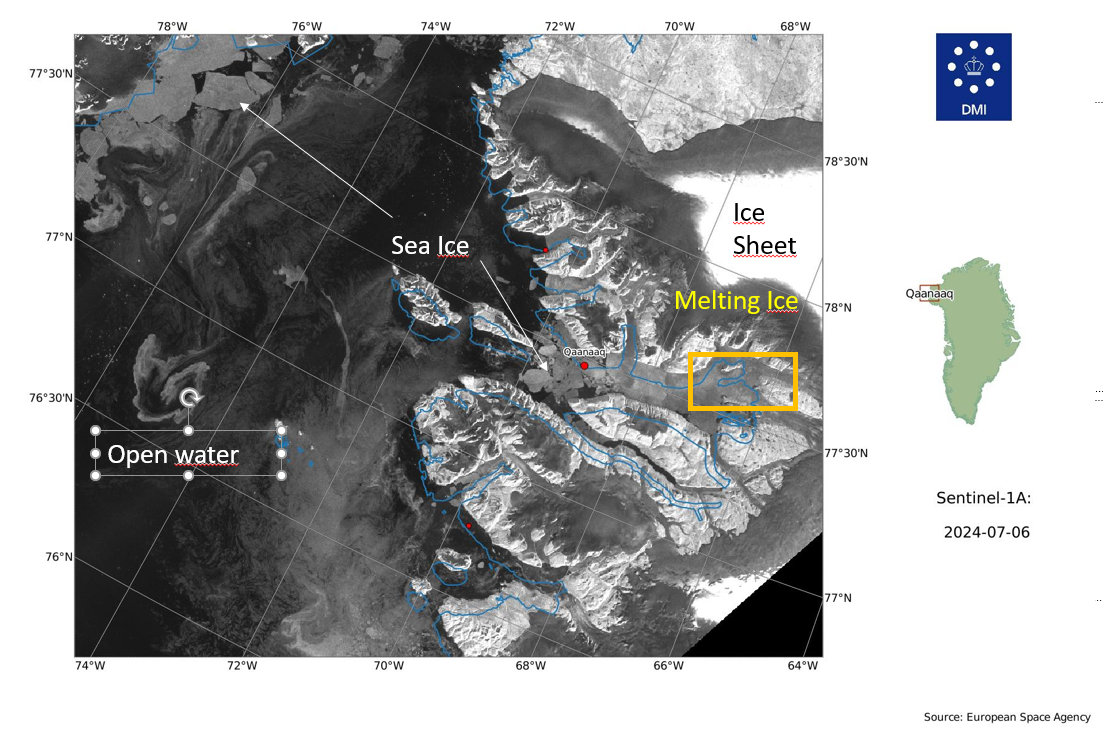
The latest satellite images look like the ice has already broken up into large flakes close to Qaanaaq. I’ve annotated the Sentinel-1 image below as it is from a radar satellite that can see through clouds and the images can be a bit confusing if you’re not used to looking at them.
The scale of the massive melt on the ice sheet from the last few days is clearly visible in the dark grey rim on the glaciers. The open sea water is black and the sea ice shows up as geometric greys. This one is downloaded from the automatic archive my colleagues at DMI maintain around the whole coast of Greenland. It can be a handy quick check too.
Annotated satellite image of Kangerlussuaq/Inglefield Bredning (Gulf of Inglefield) fjord. The orange box shows where our study glaciers are located.
So, although the ice is starting to break up it’s at the tricky stage where it’s far from navigable by dog sled and certainly too difficult for boats, so it’s not quite the time to send out hunting parties for GNSS buoys.
It also means that when I go on holiday next week, I will not be quite leaving all this behind. I and my colleague in this project will be monitoring the movements of the buoys and the satellite pictures, as well as relying on our friends in the local community to let us know how the ice is looking and if they can get out to rescue our brave little sensors.
In the mean time I have plenty of data to start analysing and writing up. As ever massive thanks to the people of Qaanaaq and my cool colleagues for putting up with me and our GPS buoys. We hope to submit our first paper pretty soon..
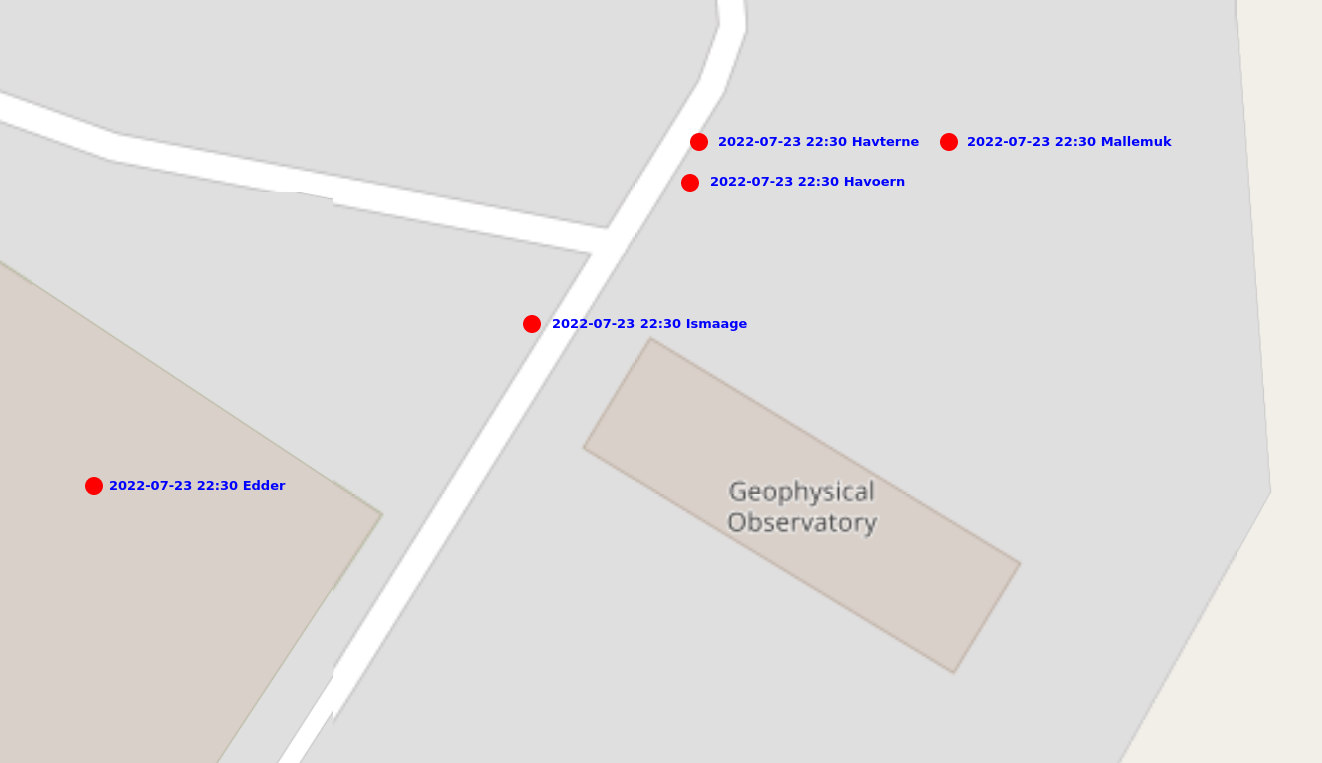
Hopefully I’ll soon be able to look at a map like this one to see where they are (note that the precision on these buoy positions isn’t great, probabaly because they were thenbeing stored in a metal container).
*Yes, I’m probably a nerd. I’m a lot of fun** at parties too though.
























 Sterna Paradisaea